
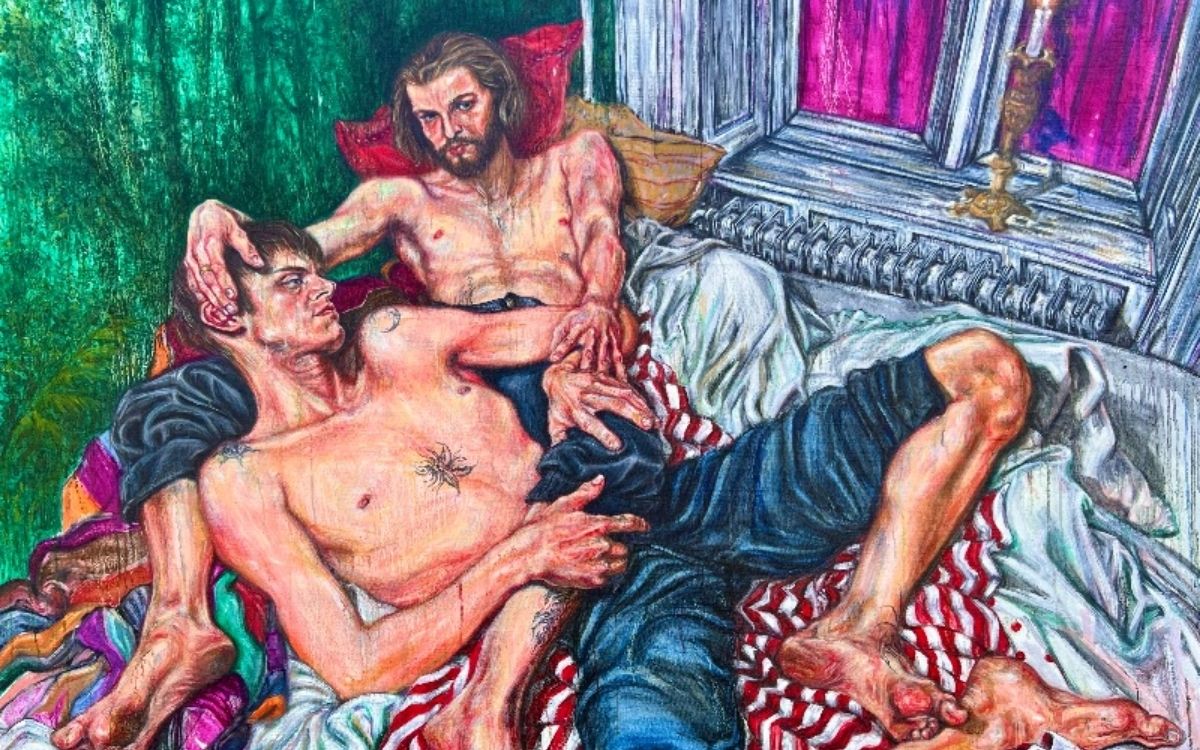
What unusual or unexpected sources of inspiration have deeply influenced your work?
For the past ten years, I have been part of a small group of artists, with whom I facilitate an annual artist-residency outside of Berlin, Germany.We do an open call and subsequently invite approximately hundred creatives, to come develop new works during a two-week residency in- and around an old abandoned sanatorium from the late 1800s. It was last inhabited by the Soviets, functioning as a military hospital up until the reunification of Germany. Since then, the buildings have been kept mostly void of human interference, with the exception of a sole caretaker and his dog. The buildings, spread across a large area surrounded by forest, are in various stages of beautiful decay. Despite the structures appearing to be somewhat intact from the outside, with even some windows still left in their frames, neither the walls nor the ceilings inside, should be taken for granted to remain where they are. The infinite layers of cracked paint on the walls disintegrate by the slightest touch and everything is covered in a layer of pulverized powder mixed with bat-excrement and debris of unknown origin. I move around differently there. Expecting the place to meet the usual standards of safety, will get you hurt. Year by year, the surrounding forest intrudes onto the buildings, diffusing the borders between the indoors and the outside.
The only way to get lights to the many make-shift studios scattered around inside the buildings, is through an endless grid of heavyweight cables. A few years ago, an outdoor shower was established; but the massive lake nearby provides a fine substitute, at least for a while. We’ve set up one tap outside, which is connected to running water: It is drinkable, but it smells odd and has a slight brown tint to it. You get used to it after a while. Peeing is done wherever, the rest is taken care of in a composting toilet that has been build out of upcycled wood, creating a heat inside which feels almost tangible. This is to say, the place is devout of the usual comforts which most of us have always been accustomed to. Nothing in this small-scale world-building comes easy and for things to run somewhat smoothly, everyone must partake in the many and varied communal tasks. I continue to marvel at the things we accomplish, when everyone works together. Each year is different, depending on the participants and how they insert themselves and their specific set of skills into this social experiment. Each year, I try to test new materials and approaches. Some of the experiments I have begun there, have evolved into consistent pillars in my practice.I have found again and again, that the build-in limitations, constraints and the creative solutions required, when working in a place such as this, continue to expand the possibilities of art-making. Many participants create cross-disciplinary projects, pieces or performances together, unlocking new ways of working and seeing. I find myself grabbling with the limitations of words, when trying to convey the weird magic of this creative playground for adults.It is no longer possible to separate this place from who I have become: I’ve inhaled the buildings through the ever-present dust and have left blood, sweat and endless tears of exhaustion and happiness in return. The marks that these annual experiences of wonderful madness have left on me - and so many others -, are neither tangible nor existing in any measurable physical form. Nevertheless, they remain as a strong weave of invisible tentacles, connecting people who are otherwise far apart. I hope that our shared experiences, will continue to find fertile soil for dreams of how it could be.
Have you ever felt drawn toward a conventional career path? What made you take the "creative leap" despite the risks?
Around the age of twenty, I signed a working-contract with a small and quite suburban gallery not far from my hometown in Denmark. I was only just starting out; painting was still very new to me and I had absolutely no idea what I was doing. I just knew, that I loved the way painting made me feel; like coming home somehow. I never frequented art galleries or museums growing up, and no one in my family were artists or had the slightest connection to the artworld or anything in its orbit. The gallerist would direct me to paint in ways, which he believed to be the most commercially viable. Being both young, unexperienced and somewhat perplexed by the whole thing, it was sometimes hard to stand my ground. He did though, manage to sell a fair bit of my works early on. The fact that some people were willing to pay money for my paintings, was pretty wild to me.I was thrown into this sphere without any language surrounding art and with no idea of which rules applied here, if any.Money though, was a metric of value I was familiar with. Although misguided, these early sales provided me with a sort of reassurance that I too, had the right to pick up a brush, let alone display the finished pieces. The income from the sales, also made it possible for me to spend more time in the studio, than I otherwise would have. I slowly found my own legs over the years and I am grateful for the calm, working creatively still gives me. I look back at my first gallery-experience with mixed feelings, knowing that I would not repeat this kind of work-dynamic again, but I do appreciate the experience as a step towards where I am today. The workings of the artworld continue to confuse me; how and where I fit into the whole thing - if at all. In some aspects, I am still Bambi on Ice and that is quite alright. I am proud though, of how I’ve managed to structure my life, so to make it possible to maintain and develop my practice; with all the hustle and grind this entails. I still feel an intense gratification when working creatively and I am also acutely aware that I wouldn’t function very well, if I stopped processing the experience of being alive this way.
Do you think art should have a political or ideological agenda?
In order to avoid complete mental paralysis, the mind works within an interpretative framework of subconscious categorization. More so than ever, we are constantly faced with a sheer overload of information. No need to even move around in the social world, it’s all right there, oozing through screens at all times, serving never ceasing stimulation. No wonder we need some kind of mental guardrails, albeit these somewhat necessesary means to create a sense of order, bear the potential for distortion. Especially seeing as the discourse of ‘them and us’, is so readily available. Delivered to us at length by politicians, platforms or folks and companies in pursuit of power; this terminology has served as a powerful means to create coalition from fear.
Art holds a space for curiosity, nuance and in-depth examination of the multitude of human experience. It has the potential for challenging leading narratives of power and dissecting concepts presented as indisputable truths. It can shine a light on distorted ideas of difference and distance and the hypocricy within institutions of power, who benefit from certain notions of inevitable hierachies.That being said, I believe the notion of should, is best kept out of the equation, in relation to art.I don’t subscribe to the definition of ‘the political’ as something existing solely within a context of government or legislative measures and the 1960’s feminist phrase ‘the personal (private) is political’, still sums up pretty neatly, how societal power dynamics impact all spheres of life. I personally find, that any rigid conveyance of ideology or political agenda, can easily come across as moralistic, which tends to shut down any further curiosity quite effectively. I’m generally drawn towards expressions that beckons questions over statements; dealing with the undefined and in-betweens. Where the absurdities of human existence, hiding in plain sight within the perceived normality of reality, can be turned inside out and upside down, so that new realms of meaning can be imagined and tested.
Artificial Intelligence is increasingly infiltrating creative fields. Do you see artificial intelligence as a threat, a tool, or a collaborator in the art world?
Acknowledging that this question relates specifically to the infiltration by AI into creative fields, I must admit that my worry in this regard, is superceeded by my general anxieties when it comes to AI. I am by no means not rejecting the vast potential of AI; I just don’t think, that we’re in any way prepared for the implications of a rushed and all-encompassing implementation of this new technology. Looking at the introductuon of social-media as a sort of precursor to AI, it is evident that this has had vast political- and social implications, which we are only just starting to grabble with on a societal level, let alone institutional. No meaningful legislative guard-rails have been implemented.Now - years later - the few haphazard attempts to remedy this, appear as nothing more than blowing air on a haemorrhage and hoping for the best. The unchecked expansion of tech-conglomorates such as META, as well as the large tech-companies now in the forefront of AI-development, has continued to metastasised into far-reaching, perverted tentacles. The subsequent infiltration of our political institutions by these companies, their damaging effect to our media-landscape at large and their ownership of our collective data, gives me no reason to trust the proces. Especially seeing as the men running these conglomorates, seem to predominantly be megalomaniacs with a tendency to mythologize whiteness and wet dreams of world domination. Put nicely. Our political institutions are molded in a society, where money wields power, and mainstream media-platforms are struggling to survive - or have already given in to submission. Within the confines of such fundamentally skewed systems, it may be that any attempts to resist the distorted dreams of a few man-babies with big bank, are rendered futile from get-go. The lack of political action as well as serious lack of reporting on the topic, might be a consequence hereof. It does seem as though these institutions of supposed power, are increasingly inhabited by players, who are not simply outmaneuvred by money, but unapolagitically bend the knee to the nearest billionare tech-bro, with promises of a mutually exploitative relationship. There are many grassroot-organizations and independent media-outlets, which have long sounded the alarm. I do hope we all stop to listen in time.
How has your artistic style transformed over the years? Are there specific influences, experiments, or moments that marked a turning point?
I was in my late twenties, before I began my studies at the Academy of Fine Arts in Vienna. It took me many years to feel like, I was someone who belonged in an art academy in the first place. The facilities at the school were like nothing I’d ever seen before! I attended an array of practical workshops and theoretical lectures, which informed many aspects of my own practice. Being around so many students from all over the world, seeing their work evolve over the years, showed me the vast possibilities of expression. I quit painting entirely for the first few years of my studies and let myself be Bambi on Ice full time, trying out different materials and modes of working. I did return to the medium of painting, but the process of experimentation made me realize just how beneficial it was for me, to change between materials in general.
There’s much to say about established institutions of art and the kind of cultural heritage they might still entail; who are accepted as students and who will never feel like they could belong in such a place - or even learn that schools such as these exist as an option for them in the first place. I am though, immensely appreciative of my time studying in Vienna. The Danish government provides four years of funding for people studying abroad; a privilege I wish was granted to everyone. This funding plus a relatively low-interest student loan and steady gigs doing life nude modelling at pretty much every school, bar and venue in Vienna providing drawing classes, was enough to make ends meet. It gave me time and mental space to create work, without having to relate it to a commercial context; whether through gallery sales or commissioned works.
Are there any upcoming projects or dreams that you’re particularly excited about?
Last year I took part in a writing-workshop, something I had thought of doing for some time. I wasn’t really sure where to begin, seeing that I did not have any actual writing experience, besides the occasional private scribbles. During the course of six months, each participant had to write and read aloud two texts in front of the other students, followed by a critique-session led by the writers who facilitated the course. The feedback was enlightening and reminded me of how valuable it can be, to show and talk to others about work still in progress.Something I really ought to be better at in my general art practice. I do find it quite anxiety inducing to write something with the intention to show it to other people. Words printed on paper seem so definitive, so set in stone. Writing somehow requires more preciseness, than how I am use to working, where the right amount of chaos and coincidence, is sometimes a big part of what makes a piece interesting. As I got an intro into this new way of processing thoughts and spitting them out again, I found that new connections and ideas appeared. If nothing else, that is something to enjoy. I still got the itch for writing, more so than ever, but other great projects have since taken up both my time and headspace. Writing requires focus and continuity and I haven’t been able to create a lasting structure to facilitate this as of yet. I am therefore currently applying for a spot at a residency in the Fall, in order to finally begin a dream-project of mine, entailing both illustrative work and text.
What artistic “superpower” would you choose to have, and how would it shape your work?
I sometimes fantasize about having more time: 24 hours, during which I would be the sole person awake. I would spend this time working in my studio, unbothered and focused, so that I could give it all to the world around me in the following 24 hours. And then repeat. I wouldn’t want a superpower that would help my process by obtaining or enhancing any specific skills, cause process is everything to me, even when it’s slow. But I would really, really love to double up on time!
Tine Nedbo does not offer conclusions. The interview ends, as the work tends to, in a state of forward motion: a residency application in progress, a dream project not yet begun, writing still finding its structure. There is no pretense here of having arrived anywhere. The artworld continues to confuse. The process remains everything, even when it is slow. What persists, across all of it, is the sense that creating is not a choice so much as a method of survival, a way of processing the experience of being alive that nothing else quite replaces. The invisible tentacles of shared experience, as Nedbo puts it, connect people across distance. The work is one more strand in that weave.