
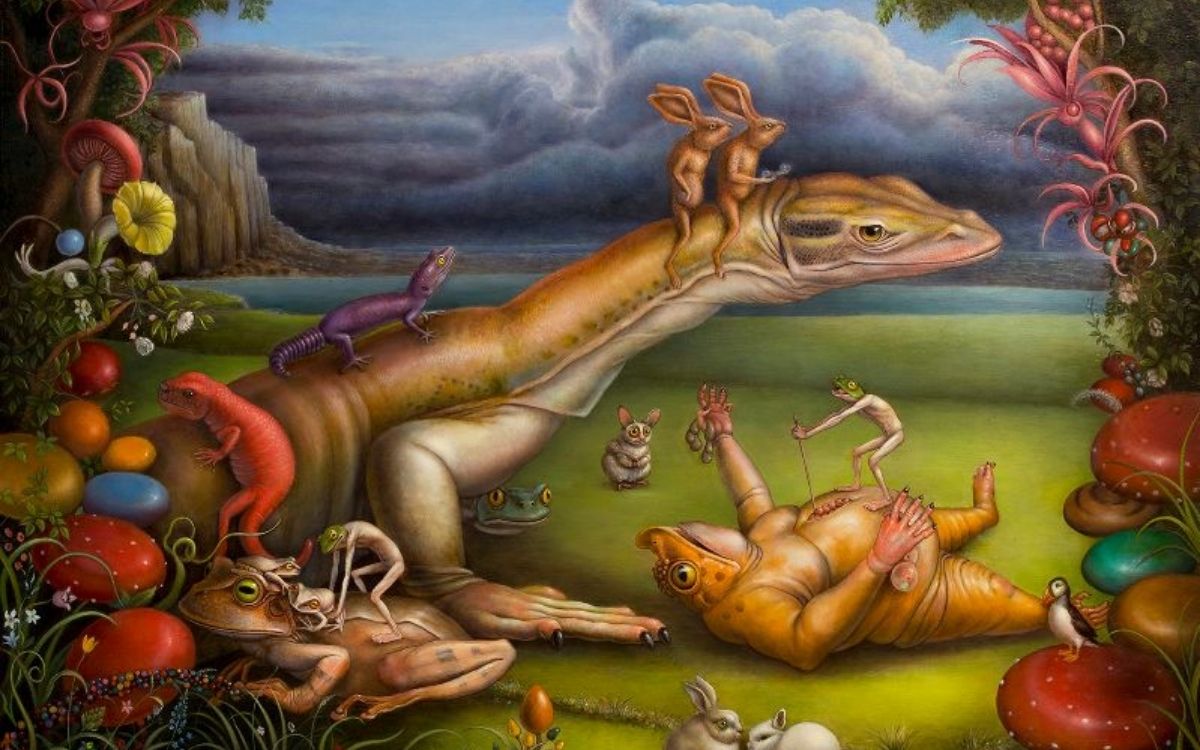
Jean Pierre Arboleda paints from memory and from grief, two forces that are rarely separate. Raised in Quito, Ecuador, among the staggering biodiversity of the Amazon, the Galápagos, and the Sierra highlands, Arboleda absorbed the natural world long before knowing what to do with it. It took formal training at the School of Visual Arts and the New York Academy of Art, years of disciplined study in the methods of the Old Masters, and a return to landscapes slowly being unmade by human presence, to understand that what was stored in childhood had become a life's work. Today, the paintings Arboleda produces are more than technically rigorous portraits of non-human life. They are arguments. They are elegies. They insist that the creatures depicted deserve the same gravity and care that centuries of art history reserved almost exclusively for the human figure. What follows is a conversation about how that vision was formed, sustained, and continually deepened.
How has your upbringing or cultural heritage shaped the themes and techniques you explore in your art today?
Growing up in Quito, Ecuador, I was born into one of the most biodiverse regions on the planet. This environment acted as a living library for my young mind; the sheer variety of species I encountered became permanently etched into my subconscious. My education extended far beyond the classroom as I traveled frequently with my school and family, traversing the diverse landscapes of my home country. We explored the humid Amazon jungle, the volcanic wonders of the Galápagos Islands, the sun-drenched coast, and the high-altitude air of the Sierra mountains.
In these places, I witnessed a spectrum of life that felt almost surreal. I remember the mesmerizing shimmer of blue Morpho butterflies, their wings flashing like mirrors in the canopy. I saw the power of anacondas, the playfulness of pocket monkeys, and an endless array of amphibians—from massive frogs to "glass frogs" so delicate their internal systems were visible through their skin. At the time, I was simply absorbing these sights, but they were forming a deep reservoir of imagery that would eventually define my professional career.
It wasn't until I pursued my Master of Fine Arts at the New York Academy of Art that these memories truly surfaced. As I began to master high-level classical techniques, these creatures started to emerge in my drawings almost instinctively. My professors played a pivotal role during this transition; they encouraged me to look inward and explore the subjects I was truly passionate about, rather than following passing trends. They helped me realize that my upbringing in Ecuador was my greatest artistic asset.
However, as I matured, my work took on a more urgent tone. Returning to the places I loved as a child, I began to see the devastating impact of pollution and climate change. Environments that once felt infinite were now visibly in danger. This realization transformed my art from a simple celebration of nature into a deeper exploration of our human footprint.
Today, my work serves as a reflection on the fragile beauty of the natural world. By utilizing rigorous "Old Master" techniques—such as layering glazes and prioritizing technical precision—I aim to honor non-human subjects with the same historical reverence traditionally reserved for the "great" human figures of the past. While my foundation remains rooted in my Ecuadorian heritage, my curiosity has expanded to include species from every corner of the globe. Recently, I have begun to incorporate the human species into my dialogue, bridging the gap between us and the animal kingdom.
I seek to link contemporary environmental narratives with the wisdom of ancient cultures, exploring how civilizations once viewed animals as sacred spirits or emissaries. By weaving together symbolism, mythology, and anthropomorphic forms, I create stories centered on regeneration. My art is a bridge between a contemporary call for conservation and a soulful exploration of the complex relationship between human evolution and the survival of our planet.
Can art be truly therapeutic? Have you experienced its healing power personally?
I am a firm believer that art possesses a profound therapeutic power, acting not just as a creative outlet but as a vital anchor for the human psyche. Throughout my life and career, I have found that art has a unique ability to provide sanctuary during times of immense personal struggle. As we age, we inevitably confront the complexities of the human condition—the loss of loved ones, the weight of global anxieties, and the personal "ups and downs" that test our resilience. In my experience, art has been the force that saved me from losing control, offering a way to process pain that words often cannot reach.
When I sit before a canvas, my studio immediately becomes my "safe place." There is a physical and mental shift that occurs the moment I pick up a brush. The world outside becomes quiet, and the internal noise of anxiety or grief begins to fade. I feel a sense of profound calm as I enter a "flow state," where the focus on the task at hand is so absolute that everything else disappears. For me, this state is not just about productivity; it is about survival. It allows me to navigate difficult chapters of my life with a sense of grace and purpose.
I experienced this healing power most acutely during my divorce. It was a period of significant transition and emotional weight. Because I am a full-time artist, my daily life is quite solitary; I typically paint seven days a week. In such a quiet environment, it would be easy to succumb to loneliness or rumination, but my pets bring constant life and energy to the space. Ultimately, my art became the bridge that led me through that time. I found that I could go for weeks seeing very few people, yet I never felt truly alone because I was in constant dialogue with my work.
Each morning, I wake up with a singular obsession: to bring the painting on my easel to light. This obsession is not a source of stress, but rather a source of immense peace. The technical demands of my work—the meticulous rendering of fur, the careful layering of glazes, and the study of anatomical precision—require a level of concentration that leaves no room for despair. I often find myself so lost in time that the day passes in what feels like minutes. This drive provides a rhythm to my life; the transition from waking up to standing at the canvas is seamless, and the desire to continue the work the next day gives me a reason to move forward.
The healing power of art lies in its ability to transform internal struggle into external beauty. By focusing on the lives of other species and the intricate details of the natural world, I am reminded of the larger cycle of life and the resilience of nature. This shift in perspective is incredibly grounding. Art has taught me that even in moments of isolation or pain, there is a way to create light from the shadows. It is more than a profession; it is the sanctuary that keeps me balanced, focused, and deeply connected to my own sense of peace.
How do you challenge yourself to continue growing as an artist while remaining a true voice?
For me, growth is an infinite search; I believe that an artist who stops being a student has stopped growing. I keep myself in a state of constant research, fueled by a rigorous study of history and science. At least twice a year, I visit the Metropolitan Museum of Art to study the European Old Masters. Standing before their work is a humbling experience—I study how they breathed life into inanimate pigment, and I strive to translate that complexity into my own sanctuary of species.
I am my own harshest critic. I often feel as though I am still far behind where I want to be; in fact, I feel I would need three lifetimes to truly reach the level of technical perfection I envision. This realization is my primary driver; it is the 'fuel' that keeps me in the studio painting seven days a week. Recently, I have pushed this challenge even further by finishing small areas of my compositions using a magnifying glass. It is physically and mentally exhausting, but necessary to achieve the visual 'richness' my voice demands.
Maintaining a 'true voice' in an industry driven by trends requires a radical, uncompromising honesty. To have a true voice, you must listen to your own thoughts rather than the noise of the outside world. I stay true to myself by researching the rare species and ecological themes I am genuinely passionate about, refusing to compromise on detail. Every brushstroke I make today is building a technical bridge toward a future 'masterwork'—a vision much larger than myself. When a work is created with that level of sincerity and technical dedication, it transcends decoration; it gains a soul. Protecting that connection between the artist and the viewer is my primary goal as I continue to evolve.
If you had the chance to sit down with any creative mind from history, who would it be and what would you ask?
If I were granted the impossible opportunity to step back in time and sit with the greatest creative minds in history, my journey would lead me directly to the studios of Peter Paul Rubens, Michelangelo, and Leonardo da Vinci. To me, these three individuals represent the absolute pinnacle of human expression, technical mastery, and intellectual curiosity. To speak with them—or to simply observe the atmosphere of their workspaces—would be an experience beyond anything I can imagine.
My first stop would undoubtedly be the studio of Peter Paul Rubens. In my eyes, Rubens is the ultimate master of oil painting, specifically in his ability to render the vitality of human flesh. His compositions are often described as "out of the ordinary" because of their incredible scale, complexity, and sense of movement. I would ask him to let me stand in a corner of his studio just to watch him work—to see how he transitions from a small, energetic oil sketch to a massive, breathing masterpiece. I am fascinated by his "Rubensian" anatomy and how he manages to imbue his figures with such a sense of weight and motion. Furthermore, as someone who manages my own artistic practice, I would ask him about the logistics of his studio. I would like to know how he supervised his assistants, how he maintained such a high level of quality across hundreds of works, and how he balanced his role as a diplomat with his life as a creator. To see his process of building a painting from the first layer of underpainting to the final, glowing glazes would be a masterclass unlike any other.
Next, I would seek out Michelangelo. While I am primarily a painter, Michelangelo’s understanding of form and terribilità—that sense of awe-inspiring power—is something I strive to capture in my own depictions of animals. I would want to watch him sculpt, to see how he could look at a raw block of marble and claim to see the figure trapped inside. I would ask him about the psychological weight of his process. How does one maintain the stamina to paint the Sistine Chapel or carve the David? I would like to discuss the relationship between the spirit and the material, and how he used his profound knowledge of anatomy to express the deepest of human emotions. For Michelangelo, art was a struggle, and I would want to understand how he navigated the tension between his vision and the physical limits of his medium.
Finally, I would like to spend time with Leonardo da Vinci. Leonardo represents the "Scientist-Artist" in its purest form. I would ask him to show me his sketchbooks—those legendary codices filled with observations of water, birds, anatomy, and machines. I would like to hear him explain how his scientific inquiries into the way the eye perceives light and shadow informed his invention of sfumato. In my own work, I spend a great deal of time researching species and biological details, so I feel a deep connection to Leonardo’s belief that art is a tool for understanding the laws of nature. Watching him work on a painting like the Virgin of the Rocks would reveal so much about how to balance scientific accuracy with poetic beauty.
To sit with these three geniuses would be to touch the very soul of art history. I would want to understand not only how they made their art, but how they felt about the act of creation itself—to truly see the world through their eyes. I want to feel the raw obsession and the inspirations that drove their work, while witnessing firsthand how the world of art in their time differs from my own. Simply knowing how they thought and how they perceived the world would be a gift that would change my art forever.
Do academic institutions still play a vital role in shaping artists today, or has self-taught creativity disrupted this tradition?
I believe that everyone is different. For some, being self-taught allows them to reach a unique level of mastery; the same can be said for those who choose academic institutions. Ultimately, it is a personal choice that depends on the artist, where they are in their journey, and the type of art they wish to create.
For me, the decision to be taught within an academic institution was where my personal choice led. My foundation began at the School of Visual Arts (SVA), where I pursued a BFA in Illustration. The program provided perfect training; I was immersed in classes focused on the core mechanics of image-making—anatomy, composition, traditional oil painting techniques, and sculpture. These are subjects that require a level of rigor that is difficult to maintain without a mentor's guidance.
One of the most transformative aspects of my time at SVA was the leadership of Thomas Woodruff, who was then the chairman of the Illustration department. Because he is a respected artist, he was able to bridge the gap between the classroom and the professional world. Our junior year thesis show was held at P.P.O.W., a prestigious space in the heart of the New York art scene. This was a surreal experience that gave us an immediate, firsthand look at the contemporary art scene—an opportunity that self-taught artists rarely encounter so early in their careers.
Deciding to continue my education at the New York Academy of Art for my Master’s degree was perhaps another crucial decision in my life. The Academy is unique because it is entirely dedicated to the study of the human figure and traditional techniques, yet it exists within the pulse of New York City’s modern art world. The training I received there allowed me to dive much deeper into the "Old Master" methods I now use daily, such as underpainting and complex glazing. However, the true value of the institution was the access to legendary creative minds. We had workshops and critiques with world-class artists like Jenny Saville, Eric Fischl, and Will Cotton.
Sitting across from an artist of Jenny Saville's caliber and receiving a direct critique of my work was a window into a higher level of thinking. These interactions taught me how to take the ancient techniques of the Academy and adapt them to my own unique vision. It showed me how to use the "language" of the Old Masters to speak about contemporary issues, such as environmental preservation and the beauty of endangered species.
Name five pivotal lessons you've learned that shaped your artistic journey.
The journey of a professional painter is rarely a straight line; it is a path paved with both technical challenges and personal growth. Over the years, I have identified five pivotal lessons that have not only shaped my career but have allowed me to sustain a life dedicated entirely to my craft.
Resilience in the Face of Rejection: The first and perhaps most important lesson is to never give up and, more importantly, to never let rejection define your worth. The art world is notoriously subjective. I have learned that a "no" from a gallery or a grant committee is not necessarily a reflection of the quality of my work, but rather a matter of timing or fit. By developing a thick skin, I have been able to keep my focus on the canvas. Staying true to your vision despite external criticism is the only way to eventually find the audience and the institutions that truly resonate with your voice.
The Necessity of Professional Organization: There is a common myth that artists must be chaotic or disorganized to be creative. I have learned that the opposite is true. Especially when preparing for solo exhibitions, being organized is truly important to reach your deadline. Calculating exactly how many weeks a painting will take and how many pieces I can realistically produce in a year. Without this level of organization, the quality of the work suffers under the pressure of deadlines. Being organized provides the structure that actually allows my creativity to feel free.
The Power of Absolute Focus: For a long time, I balanced my art with a five-day-a-week job. The transition to being a self-employed, full-time artist was a life-changing revelation. I learned that when your focus is split, your paintings often feel rushed or conceptually thin. Now that I am dedicated 100% to my studio, I have the mental "breathing room" to explore my ideas deeply before the brush even touches the panel. This undivided attention allows me to reach a level of detail and psychological depth that was simply impossible to achieve when I was working for someone else.
Physical and Mental Maintenance: Painting at a high level of technical precision is a physically demanding act. I have learned that my work is a direct reflection of my physical state. If I am tired or unhealthy, the work does not flow. I have made it a priority to eat well, exercise, and ensure I get enough sleep. When my body and mind are healthy, I can stand at the easel for ten hours a day and maintain the steady hand required for my work. Taking care of myself is not a luxury; it is a fundamental part of my artistic process. A healthy body creates the endurance needed for a long-term career.
Perpetual Curiosity as a Creative Engine: Finally, I have learned that an artist must remain a perpetual student. I constantly challenge myself to learn something new, whether it is a technical refinement within a specific medium or a new piece of information about the natural world. I spend a significant amount of time reading articles and books, observing nature, and analyzing the historical impact humans have had on other species. This curiosity is what prevents my work from becoming stagnant. By constantly feeding my mind with new data about our planet and our society, I ensure that I always have a fresh reservoir of ideas to draw from.
These five lessons—resilience, organization, focus, health, and curiosity—form the foundation of my practice. They are the invisible tools that allow me to produce the highly detailed, meaningful work that I am passionate about today.
Describe a piece you've created that has held the most emotional weight for you. What makes it significant?
There is a painting I am currently working on that holds immense emotional weight for me. At 48 x 72 inches, it is the largest canvas I have ever tackled. Because my work is characterized by high levels of detail and intricacy, a piece of this scale has been a significant challenge; however, the process has given me the confidence to move toward even larger works in the future. Although I initially thought it was finished, the piece continues to 'call me back.' I have realized that this world is still evolving, requiring more intricate flora and additional creatures to feel fully realized.
What makes this painting significant is the obsessive level of detail; many of the characters are smaller than my thumb, requiring a magnifying glass to render their final features. This process has become a form of devotion. The composition is deeply inspired by the lush, encyclopedic nature of Jan Brueghel’s The Garden of Eden with the Fall of Man, as well as the atmospheric, melancholic beauty of Gusztáv Keleti’s The Exile’s Park. To me, this painting isn't just an image; it is a living sanctuary that I am still discovering.
The narrative tells the story of an arrival—the birth of a new species in a world I’ve spent two years building. The scene depicts a diverse gathering of creatures coming together to welcome this new life as it emerges from the water, a moment of magnitude emphasized by four large eggs resting near the shore. This emergence draws upon ancient archetypes of primordial birth, echoing the 'Cosmic Egg' and the sacred waters found in many ancient mythologies. The work is dense with symbolism; for instance, a surreal, dragon-like form is woven into the foliage of the trees, acting as a hidden guardian of the forest. I meticulously considered the placement of each creature to ensure a harmonious composition, echoing the disciplined spatial logic and balance utilized by the Old Masters.
On a personal level, this piece carries immense weight because I have placed myself directly into the narrative. I am depicted alongside a 'frogman,' and together we are bearing a ceremonial litter for a Queen of the Lagomorphs. I drew inspiration from historical royal carriages where subjects would carry their sovereign; here, we are honoring my rabbit, Muñeca, who has been my companion for 11 years and who always sits beside me while I paint.
This world is a dense ecosystem populated by a giant sloth, an ancient, massive turtle, bushbabies, and mushroom creatures. The level of refinement is so high that the work must be experienced in person; a camera simply cannot capture the micro-details that define these characters. For me, this painting represents a threshold—a doorway into a new, even more ambitious era of my work. I have not titled it yet; I am letting the painting rest for now so I can return to it with fresh eyes. I believe that once I see what final touches are needed, the title will reveal itself naturally.
Jean Pierre Arboleda's studio is a solitary place, kept alive by the work on the easel, the presence of a rabbit named Muñeca, and a conviction that the act of looking carefully at other living things is among the most serious things a person can do. The paintings that emerge from it are slow, demanding, and populated by creatures most of the world never stops to see. That is the point. Every glazed layer, every figure rendered smaller than a thumb and then brought into focus through a magnifying glass, is an act of witness. In a time when the natural world grows quieter and further away, Arboleda keeps painting as if the work itself might hold something in place.