
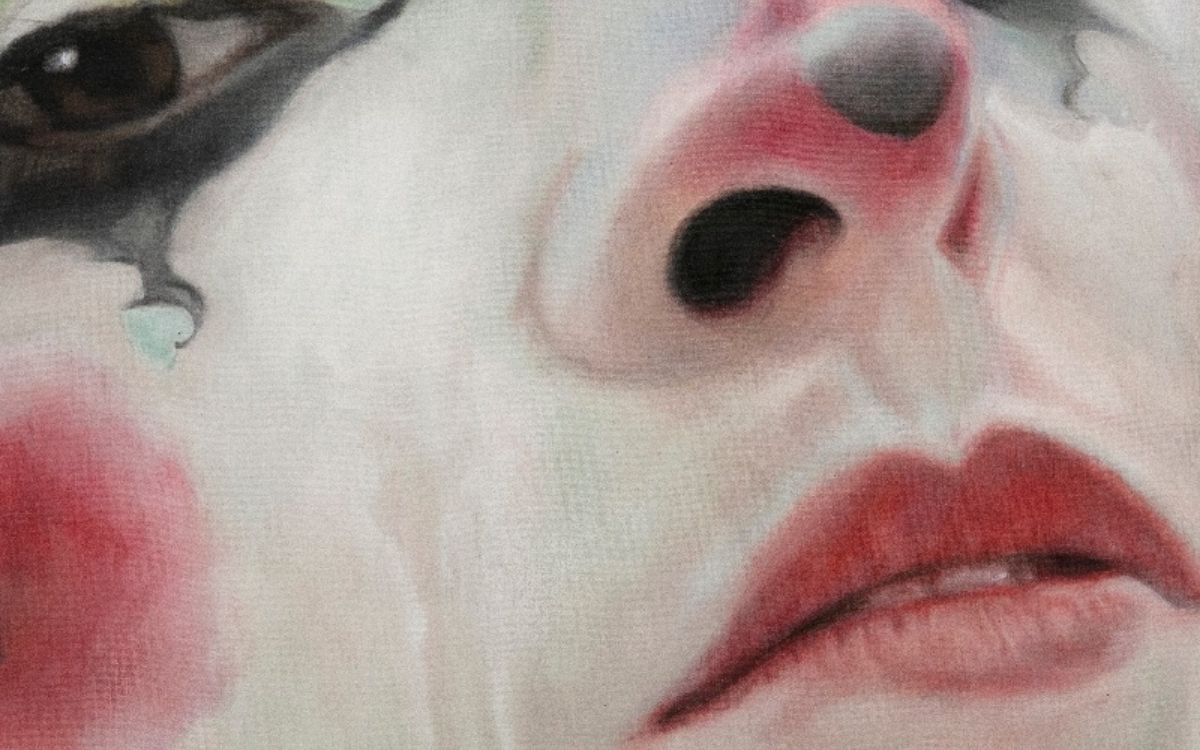
Caroline Ivins came to painting through curiosity and stayed through discipline. Largely self-taught, working in layers across many sessions, Ivins builds images sourced from daily life: clips recorded on a phone, photographs of friends, old magazines, frames from vintage films. The practice is grounded and physical, shaped as much by craft as by intuition, and driven by a genuine love of the process itself. Somewhere between compulsion and calm, between synchronicity and brushstroke, the work keeps finding its footing. This is a conversation about learning in public, trusting your own lens, and why showing up for the work is sometimes the whole point.
How do you reconcile the tension between raw, innate creativity and the discipline required to master your craft?
Improving my craft has been the main motivation for dedicating to a painting practice in recent years. Visual inspiration itself often emerges organically as I navigate the mundane, and in a day and age where media inundation is commonplace, my ongoing search for emotional resonance by way of image curation feels a bit like an automatic process running in the background of my consciousness regardless of my intent.
Of course I am influenced by my time spent online, but the images that I source and composite to paint mostly come from clips I record in my day to day life, from photographs of friends, vintage magazines, and projections of old films. The real driver behind the practice, however, is the desire to expand my technical ability in the process of executing a particular image.
Aside from the oil painting basics I learned in high school art class (thank you Ms. Carter and Mr. Murray) I am self-taught, so allowing myself this space and time to learn and improve, especially over the last year or two, has both been a conscious choice and an exercise in self-trust. I’ve tried not to overthink the images that I’ve been drawn to paint and instead keep faith that in spending enough time with them, I’m able to bring them to life while increasing my technical knowledge. I love working in layers, and appreciate the delayed gratification of finishing a painting over many sessions. I learn something new about the medium with every single piece. Being able to draw and paint accurately from sight has been so important in developing my skills, so I didn’t start using a projector for my underpaintings until very very recently. I know some fine artists will still consider projection “cheating,” but it really saves a lot of time. As my skills have improved, I’ve shifted my priorities towards spending more time and thought on the image compilation and execution of the layers themselves rather than sweating whether my proportions are in check for the underpainting, especially as I’m now starting to work on larger canvases.
Dedicating myself to a physical craft has changed my life for the better. Working with physical matter in this controlled, disciplined, but ultimately expressive way has brought me a greater sense of peace. I’ve definitely got some compulsive and perfectionistic tendencies. If I don’t carve out time for those little monsters to play, they inevitably turn against me in some less consciously integrated way. Ultimately painting is a pretty random way to spend one’s time, and I do it because I enjoy the process. It gives me some mental relief and helps me feel more at ease in my body.
Does spirituality or a connection to something larger than yourself influence your creative process?
Absolutely. I believe a huge part of being human is experiencing the illusion of separateness through our limited consciousness while actually existing in a state of perpetual energetic enmeshment with everything around us. As an artist I understand that nothing I create is actually coming from me, it’s just a summation of energy and experience filtering through the lens that I’ve been told to call “Caroline.”
I am also so deeply inspired and influenced by my friends, many of whom are artists, generally creative beings, or exceptional taste makers. Whether the intellectual concepts, media, physical environments, and sensory experiences that influence me arrive by way of direct recommendation from a real person, accidental discovery, or an eerily tailored algorithm, I believe there’s magic in it. I’m big on synchronicity. As humans we just can’t create in a vacuum. We are all tapped into something larger than ourselves. Participating in collective consciousness through symbols, pop or subculture, sociopolitics, the physical earth we all stand upon—whatever—makes for good art. Resonance is everything.
Although I’ve become less and less interested in outwardly discussing it, I’ve also been practicing astrology and tarot for the better part of the last decade. The archetypal designations of those systems, whether used as a divinatory tool, an anchor in time, or for self reflection, is something that informs my art practice whether I consciously intend it to or not. It’s a big part of how I make sense of my own experience of reality. When you learn to read astrology charts with enough precision and start tracking world events, learning techniques like progression and zodiacal releasing, and considering transits to synastry and composite charts, it does start to change your brain and the way you think about time, space, and energy (for better or worse). It’s not a hill I’ll die on–I don’t know that I’m attached to any way of thinking or being enough to vehemently insist upon its validity. But as a visual artist, astrology in particular resonates with me because it all comes down to geometry–to harmony and dissonance. It’s kind of fun to ponder the possibility that perhaps the vibe is feeling absolutely wack for you because a couple of malefics are transiting an angle or making harsh aspect to your chart ruler or something. Good shapes and bad shapes, right? It’s a fun perspective rooted in millenia of human observation that helps me consider the energetic potential of a moment and how best to proceed.
What are five things you do to overcome creative blocks or feelings of discouragement?
Putting my headphones on full blast and dancing around the studio like a fool. I don’t have an ounce of musical talent in my body, but I do have synesthesia so working with sound intentionally has a visceral impact on my other senses. I listen to many genres for every mood–sometimes I am quite serious or even pretentious in my selections and other times I have a real sense of humor about what I’m listening to. I'll even throw on pure tones and binaural frequencies or straight up noise. Sound puts me in a flow state big time.
I let myself wander. I love aimless strolls–a smoke break, a side quest. If I’m really not in a headspace where I can trust myself to lock in appropriately, I don’t force it. Seeing the sunset or an interesting piece of trash on the street or having a bizarre interaction with a stranger is often the palette cleanser I need to get out of my own head.
I get a little treat. A pastry, or some takeout to eat while I sit on the floor of my studio. How lucky am I? Maybe I really need to whisper nice things into a glass of water and chug it. It’s easy to forget to take physical inventory. If I’m feeling insane or super anxious there is a good chance I am just dehydrated and hungry. We are actually kind of simple creatures.
Rest and recharge. I start to experience dysmorphia somewhere between hours 6-10 working on the same piece in a single session. At that point I need to go to sleep or hang out with friends. When I return to it, it’s never as bad as I thought it was, but it’s also really not a big deal either way. I’m quite literally pushing pigment around a surface for fun. My last studio was in SOMA in San Francisco so it was easy for me to work for hours at a time and then meet friends in the Mission or head to dance events or art openings or live music. Ultimately I love being alone–I find great peace in working independently, but too much isolation can become toxic so quickly if I’m not engaging with community. The people I come into contact with inspire me and expand my worldview endlessly.
This is a tough one but sometimes I do just have to brute-force myself through mental resistance. More than half the battle is overcoming dread around “doing the work” or whatever limiting beliefs are keeping me stuck or procrastinating. At a certain point I just have to tell myself that if I don’t believe in myself no one will, and that it’s up to me to decide that my work is good and valuable and worth doing. Self-image goes such a long way. It really can be that simple, which is both beautiful and maddening.
In a world flooded with imagery, what responsibility do artists have to stand out and say something authentic?
Authenticity is maybe the only responsibility I see as mandatory for an artist. In the face of accelerationism, there’s really no reinventing the wheel, so just do what you do in the most “you” way possible. We’re at this supersaturation point in terms of visual and auditory input/output and it’s kind of pointless to strive to create something so wholly unique or make a brand new statement with your work. Frankly, try too hard to do so and you’re likely to nerf yourself by making something so obviously contrived. The limited individual vantage point that makes us so very human, so beholden to our own silly little identities and sometimes meaningless little lives, is also exactly what we can lean on in finding an authentic voice while drawing on the stimulus surrounding us. Our blind spots hold our gifts, or at the very least make us ourselves. An artist has to honor that “lens” we’ve learned to call our own, even if everything filtering through it can never fully belong to us. You have to be true to your own sensibilities through and through. There’s an earnestness in that, even for super satirical work. Again, I think that’s where the resonance happens. People want to connect with something innate to the human experience, filtered through a lens that feels simultaneously unique and familiar. I think the only way to get there is through practicing repetitively and authentically.
How important is it for viewers to understand the intended message of your work? Does ambiguity add value, or do you seek clarity in your expression?
Honestly, I find any need for clarity when it comes to art-making to be a bit asinine. Experiencing art is subjective by nature. I don’t think it’s any of my business how the viewer interprets what I’ve put before them if I’ve done my own part in executing the vision to the best of my ability. I want to contribute to the cosmic soup. For certain pieces I guess it makes sense to provide some amount of context, and I do title my work carefully. I definitely appreciate intellectually driven work, but ultimately ambiguity is what allows for greater resonance on a personal level. I know what the piece meant to me when I made it, but it’s much more interesting to allow greater meaning to unfold through the lens of the viewer, compounded by their own knowledge, memories, and preferences–especially for a medium like painting. Who am I to tell you why and how my painting should resonate with you? If it resonates at all, I see it as evidence for the miraculous interconnectedness that pervades humanity in spite of our limited vantage points. I love the mystery in it all.
Do you believe the ‘mad artist’ stereotype still holds weight, or is creativity more grounded than we think?
Yes and no. Even the more intellectually motivated/less outwardly emotional artists I personally know are all a bit neurotic in their own way. But in general artists are among the more disciplined and competent people I know. I think to be a practicing artist you have to be quite rooted in daily life–to have this space and routine and set of materials or parameters you return to day after day. You have to have a way to make money and feed yourself and pay rent and also make time for this bizarre obsession that keeps you sane and gives you purpose. There’s a recognition of the passage of time, and how one chooses to spend their time again and again. In that sense, an art practice is quite grounded and earthly. But yeah, you have to be a little bit bonkers to be so obsessed with your craft or to find the level of inspiration needed in order to carry out a dedicated practice. I think it is true that most artists are at the very least highly sensitive people in order to be moved to the point of creation, but it also takes a marked steadiness to navigate from an emotionally charged or dreamy headspace and build something tangible for another to experience. It’s probably true that some artists out there are egomaniacs, but you could say the same about plenty of business people, or architects, or doctors or lawyers, or software developers, or restaurant owners. I think artists get a bad rap on that front because of the amount of personal expression directly associated with the work.
Can art be truly therapeutic? Have you experienced its healing power personally, or seen it impact others?
Art is wholly therapeutic for me. I have often joked that I got my first studio space in SOMA instead of paying for a therapist. Because I spend so many hours on one piece, I see the execution as an opportunity for transmutation: pain into beauty, worthlessness into value. I’d be lying if I said I wasn’t often ruminating over my strifes and beefs as I paint. It’s not all fun and games and dancing around the studio like a fool. Every now and then I stand there and actually cry my eyes out in front of the painting, brush still in hand. It’s a safe space that I’ve created for myself. I can let my deranged obsessive compulsive thoughts and tendencies work themselves out through the repeated brush strokes and glaze layers, and I can let the ugly emotions and hurt feelings come up in the studio without the humiliation or consequences of being directly vulnerable with another person. I let myself feel it because I’m also fairly preoccupied with whatever ridiculous detail I’m attempting to get “exactly right” (whatever that means), so I’m unlikely to keep sniffling or carrying on for very long. In a best case scenario it’s like, “oh wow, I was really carrying around all that rage and sadness and I felt it and looked it straight in its face and did so in the process of creating something beautiful, and the product of those thousands of tiny brush strokes is now hanging in a gallery and has sold for actual money.” (To be clear, the therapeutic benefit is infinitely more about the process than it is about any monetary compensation, and I will continue to paint regardless, but starting to sell work as an emerging artist is a pretty amazing feeling.)
Committing to an art practice was healing in and of itself for me because I started showing up for my authentic self the way I always wanted to, which in turn helped me be seen by others the way I hoped to be seen. Keeping that sort of promise to myself helped me build real self esteem, and I found myself making so many new friends just by feeling more like myself in the world. But in general, even if you have no intention of taking art seriously, giving yourself the time to work with your hands and colors and shapes can do tremendous good for the brain and soul. Especially in this era of incessant stimulation and media consumption, it’s a restorative act to create anything, even if you show it to no one. Finding a way to externalize anything you have rattling around in your head or heart is a worthwhile exercise, as is letting yourself aimlessly play around with shapes or words or sounds without any real plan or purpose. We don’t do that enough these days.
How do you envision the evolution of your work in the coming years?
I’m still very much at the beginning of my journey as a working artist. I’ve dabbled in bursts on and off since finishing high school, but it’s only been the last couple years that I’ve consistently dedicated such a large part of my life to creating for myself. I’m fairly new to exhibiting work—I actually had my first solo in November 2025 at Good Mother’s San Francisco location and this year I am proud to have contributed some pieces to a group show at Pt. 2 Gallery which is an incredible space in the East Bay.
I think technical development will continue to remain important to me, but I’m not interested in locking myself into a particular style for the rest of my career. It’s not that I necessarily am working towards mastering photorealism, but I do want full control over my renderings while maintaining an ethereal, painterly quality. I want my lens to remain authentic and the images I’m painting to feel like “me,” but the way I choose to paint will probably continue to vary depending on what I’m aiming to execute. I don’t have a long term plan for how my subject matter will develop—following my intuition and the natural spark of inspiration is how my favorite pieces take shape. But I’m certain it will all change. Scale alone is something I’m happy to have more space to experiment with. I’m taking my first go at some really big pieces. I’ve got an eight foot wide one in the works at the moment that I’m really excited about, though I’m continuing to work on some small panels as well.
I also work with video collage a bit currently—I sometimes paint stills directly from these motion compilations—so I am interested in moving towards a more fully integrated interdisciplinary practice as I’m able to dedicate more and more time to it. I’ve shown some digital work at a Superchief Gallery pop-up in 2024, and a video collage at a DIY show called “Chain Mail” at the Rayko Photo Center last spring which was a lot of fun. But, as long as I have the physical ability, I imagine working with my hands and tangible materials will continue to be the main draw for me as a release in this increasingly digital world.
Communicating some profound meaning to my audience really isn’t the main goal for me, but I do pay attention to the greater geopolitical landscape and social and environmental issues—I care about the world, and I so want to believe humanity can evolve for the better. In an ideal trajectory, my practice also evolves so I’m able to contribute more directly to improving the lives of others, whether at the individual or organizational level. I have another piece in the works that I’m looking forward to sharing this summer as part of a fundraising effort for a friend in need. I guess that’s my own version of mutual aid. I hope to find more concrete ways of giving back as my career develops.