
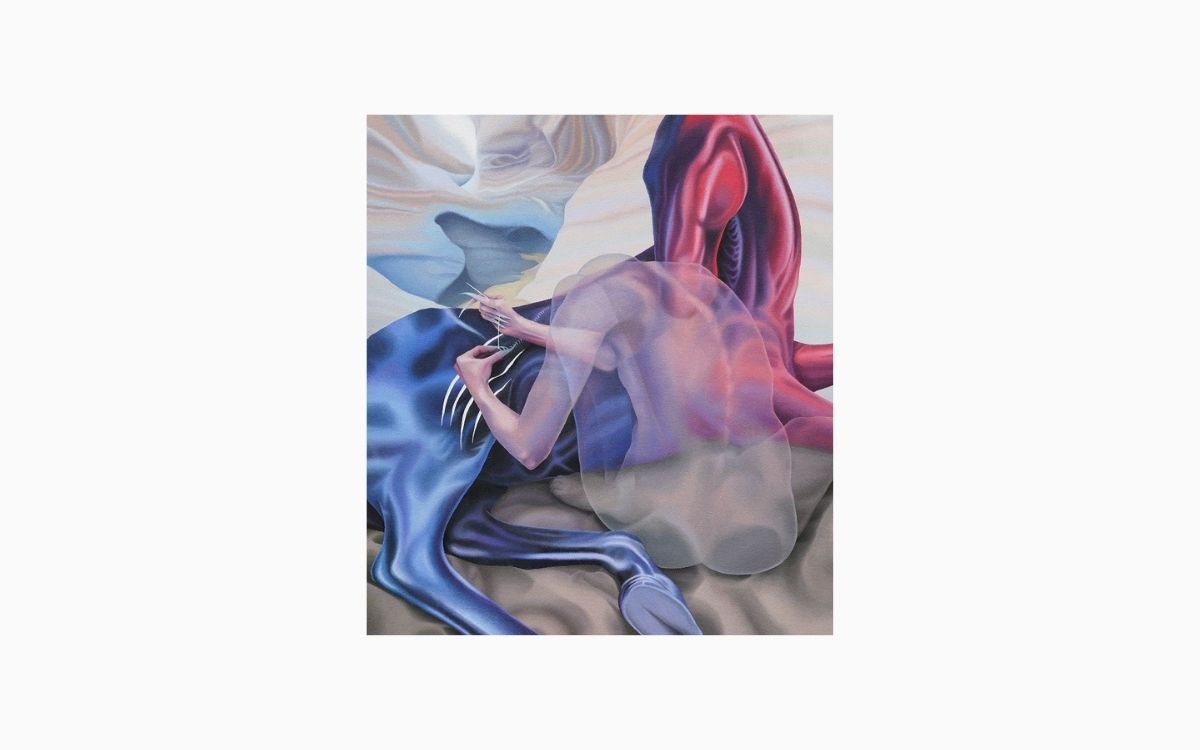
Beáta Hechtová grew up in motion. A childhood spent in theatres, forests, and borrowed cities, following a mime father across countries, left a lasting mark: a practice built around wandering, searching, and the tension between rootlessness and belonging. Today, working from Vienna, Hechtová paints post-apocalyptic worlds populated by figures mid-transformation, caught between what was and what might come next. The work is speculative but personal, strange but grounded in real questions about survival, identity, and what it means to start again. This is a conversation about movement, myth-making, and building an entire fictional universe to process the one we actually live in.
How has your upbringing or cultural heritage shaped the themes and techniques you explore in your art today?
I come originally from the Czech Republic, where I was growing up with my father, who was an actor, specifically a mime, so during my childhood we were moving around a lot. We lived in Finland for several years, then in different cities in the Czech Republic. I spent a lot of time in theatres, exploring around, admiring the puppets, costumes, masks, the dancers, acrobats, and clowns. I remember it as an exciting adventure. This need for movement, exploration, and an endless search for stories stayed with me until today and became an important inspiration and driving force for my practice.
Another influence comes from my cultural context. Part of Czech culture is let’s say “tramping” phenomenon. During the Soviet era, when the borders were closed and people couldn’t leave the country without special permission, the only option was to explore nature within those limits. People spent time hiking, camping, and wandering through forests and mountains. This is the environment in which my parents’ generation grew up, and it still lingers in the culture today, having an impact on my work as well.
I kept on moving around myself and living in different places like Spain, the USA, Peru, and now I am based in Vienna, Austria. Over time, as I was developing the storyline of my work, I realized that the main underlying theme is a personal search for home and a need for belonging.
I am often portraying this melancholic feeling of rediscovering oneself and taking the time to reflect and define. For me, this becomes an intimate process of negotiating between movement and stillness, between an ongoing search and a need to root.
Can you pinpoint a single moment in your life when you realized art was not just a passion but your purpose?
During my studies at a high school in Pilsen, I took part in a year-long exchange program in the USA. I found myself in a small village called Jackman in Maine, surrounded by forests and lakes. It was a very interesting, yet somewhat contradictory experience. It was actually there that my interest in art began to take shape. The level of education there was different, so in some subjects I had to rely mostly on self-study. I chose to take three hours of art classes a day, thinking I would somehow catch up with my other studies, but in the end I spent most of the time simply drawing, painting, and experimenting, and it was great.
I started drawing nudes, which became an issue in the conservative, Christian environment. The school administration did not want other students to see them, so I was moved to a different room and they refused to exhibit my work, considering it inappropriate.
Until then, I had always imagined the US as the “West,” advertised as open and progressive, and suddenly I was experiencing something quite different. I began drawing caricatures of the local system. These drawings circulated among students and led to discussions with the authorities and a kind of negotiations. For me, this was a very interesting moment. After that experience, I decided that art was something I wanted to pursue.
What unusual or unexpected sources of inspiration have deeply influenced your work?
During my studies at the University of Applied Arts in Vienna, I spent two years in Peru, first in Lima and later traveling through the Amazon rainforest. Together with a friend, we got a canoe and paddled on the Río Napo from Ecuador to Peru, and then continued along the Amazon River toward Colombia. We stayed in different villages, where I taught kids drawing and painting.
This journey played an important role in the development of my work. During that time, I was searching for an ultimate connection with the environment, wanting to be close to its source, lost in the wilderness.
At the same time, I was dealing with questions around cultural appropriation and my own position within it, with a growing awareness that I maybe shouldn’t access what I was looking for there.
After this experience, my focus turned more inward. I began to think that this “something” I was searching for could be found within, which led me to develop my post-apocalyptic worlds, where people, after the collapse of everything we know, get another chance to reconnect.
Does spirituality or a connection to something larger than yourself influence your
creative process?
In the paintings there are often figures wandering through landscapes, performing obscure rituals, seemingly in pursuit of meaning. As if in an absurd search for the origins of life or the future of humanity, a kind of existential survivalism. They are looking for updated versions of belief systems.
As the narratives within the works developed, I understood that this is also my own way of approaching these connections. In an overwhelming society, it is easy to slip into a kind of unavoidable pessimism, and building this world helps me to process and organize my thoughts. I see it as a dialogue and a form of personal research into these fundamental questions.
How does your art engage with or comment on pressing contemporary issues—social, political, or environmental?
My work reflects on possible future scenarios shaped by the current ecological and social crisis. I create post-apocalyptic landscapes where human figures, transformed by evolution, try to adapt to a new world and rethink their values.
Through these speculative environments, I explore questions of belonging, identity, and the need for community and cooperation. The figures are searching for meaning, while learning to exist in a more balanced relationship with their surroundings.
Rather than offering direct answers, I use these narratives to question the idea of progress and to reflect on how we might navigate the uncertainty of the present.
Do you engage with new technologies and AI in your work, and if so, in what ways?
I do refer to new technologies and AI in my work, but more in a conceptual way. Technology becomes part of the narrative within my fictional universe and evolves into another physical entity.
For example, when I observe VR spaces and art created within them, they often evoke an otherworldly experience, almost resembling a kind of religious visual language. There is a sense of shared global imagery, with floating monumental landscapes, unknown light sources, and deep, almost existential sound environments.
These aspects also appear in my paintings. I use smooth, almost digital transitions between colours in the background. I often paint a transparent, liquid-like substance that takes on different shapes and remains undefined. I see it as a potential new ideology, or perhaps as a kind of digital entity, a new form of life that emerges from data and begins to exist on its own, almost like a digital spirit.
How do you envision the evolution of your work in the coming years?
As I continue to develop my work as an ongoing storyline, it will keep moving and shifting. I depict creatures caught in mid metamorphosis, in a state of potential evolution. They begin to grow claws and thorns on different parts of their bodies, adapting to a rougher environment. Later in the series, they become transparent. This could suggest the next stage of evolution, or perhaps that they did not make it and are moving through some form of afterlife.
This process will continue to evolve within a melancholic uncertainty. Perhaps these figures will eventually dissolve and vanish, leaving the landscapes empty, or maybe only fragments of them will remain.
I would also like to continue developing sculptures to expand the environment and place the paintings into more installational settings. As an upcoming experiment, I am planning to write short, abstract stories to complement this fictional world.
The figures in Hechtová's paintings are always searching. They wander through uncertain landscapes, perform half-understood rituals, and adapt slowly to conditions that keep changing. It is hard not to read the artist's own story into them: a life of crossing borders, of looking for connection in remote places, of turning inward after realizing the answers were never going to be found elsewhere. The world Hechtová is building has no clear ending yet. The figures might dissolve, or fragments might remain. That unresolved quality is not a weakness in the work. It is what keeps it honest.