
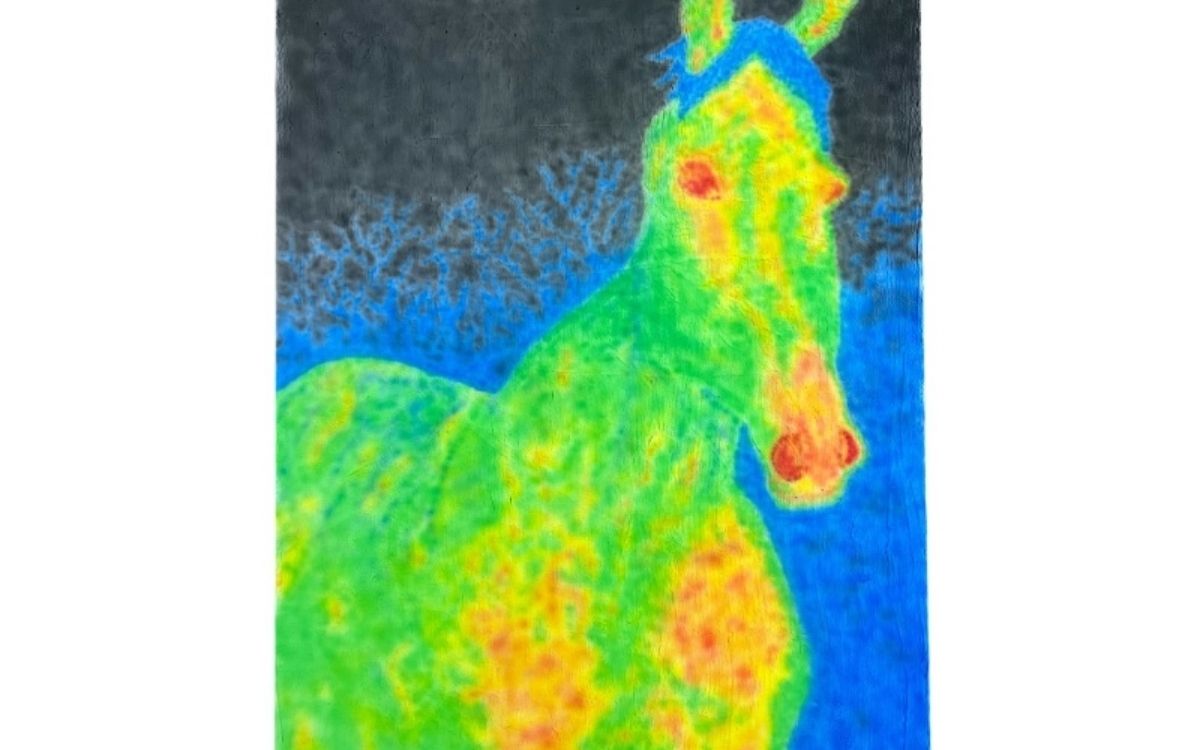
Antoine Traineau started making art to hold emotions that had no other outlet, things too complex or too raw to put into words. The practice that grew from that need is slow, material, and deeply intuitive, shaped by religious imagery, the resistance of different surfaces, and a persistent interest in what sits just beneath the visible. This is a conversation about transformation, uncertainty, and why some things can only be worked through by making them.
Why do you personally turn to art, rather than another form of expression?
Art came into my life at a time when I felt overwhelmed by emotions I couldn’t name. There was something inside me that didn’t fit into language fragile or too intense to be spoken. Creating became a way to hold those feelings without needing to explain them. It gave me a space where I could exist with them, rather than fight against them.
What draws me to art is that it allows me to stay close to what I don’t fully understand. I don’t approach it as a way to find answers, but as a way to remain present with questions, doubts, and contradictions. When I work, I’m not trying to control what comes out. I’m trying to listen to something quieter, more instinctive — something that doesn’t pass through words.
There’s also something very physical about it. The materials, the repetition of gestures, the time spent on a surface — all of that creates a kind of rhythm, almost like a ritual. It helps me slow down and reconnect with something more essential. Through that process, what felt abstract or overwhelming begins to take shape, little by little.
Art, for me, is not about expression in a traditional sense. It’s more about transformation. It allows me to move through emotions, to shift them, to give them another form.
It’s not something I chose consciously — it’s something I needed, and still need, in order to feel grounded.
What unusual or unexpected sources of inspiration have deeply influenced your work?
Religion has influenced my work in a quiet but persistent way, even though I’ve always felt distant from it. I didn’t grow up with a strong connection to faith, yet I’ve always been drawn to its imagery, its rituals, and the intensity of belief. There’s something deeply moving in the idea of devotion — the way people surrender themselves to something invisible, something they cannot fully prove or understand.
What fascinates me is not religion as a system, but as an emotional and symbolic language. The objects, the gestures, the repetition, the presence of silence — all of it creates a space that feels both intimate and collective. In a way, it’s similar to what I experience in my own practice. There is a need to believe in something, even if that “something” remains undefined.
At the same time, I’m very aware of the contradictions that come with it. Religion can be a source of comfort, love, and guidance, but it can also create division, fear, or control. That duality resonates deeply with me. I’m interested in that tension — in the space where something can be both protective and oppressive at once.
In my work, I don’t try to represent religion directly. It appears more as a trace, a feeling, a structure beneath the surface. It’s present in the symbols, in the repetition, in the way forms are held or restrained. It becomes a way to question what we believe in, what we hold onto, and why.
How do you challenge yourself to continually grow as an artist while remaining true to your voice?
Growing as an artist, for me, is less about changing direction and more about going deeper into the same questions. I don’t feel the need to reinvent myself completely, but rather to explore my practice from different angles, using new materials and new approaches to reach something more precise, more honest.
Materials play a central role in that process. Each one brings its own resistance, its own limitations, and its own possibilities. Working with them forces me to adapt, to let go of certain habits, and to accept that I can’t fully control the outcome. It keeps the process alive, unstable in a good way.
At the same time, I try to stay connected to what feels essential in my work — a certain atmosphere, a tension between softness and constraint, between presence and disappearance. Even when the forms evolve, that underlying feeling remains. It’s like a thread that I keep following, even when I don’t fully see where it leads.
There is always a balance to find between intuition and intention. I need both. Intuition allows things to emerge naturally, without forcing them. Intention helps me shape and refine what appears. Growing, in that sense, is about learning how to move between the two without losing myself in either.
How do you feel social media is shaping the way art is created, consumed, and valued today?
Social media has changed the way we encounter art in a very direct way. It has made it more accessible, more immediate, and in some ways more democratic. As an artist, it allows me to share my work without waiting for validation from institutions, and to reach people I would never have met otherwise.
But this accessibility also comes with a certain tension. Images move very fast, and attention is often brief. There is a risk that artworks are reduced to what can be understood in a few seconds, or to what visually stands out the most. It can create a kind of pressure to produce constantly, or to adapt to what performs well.
Personally, I try to keep a distance from that. I use social media as a tool, but I don’t want it to define the way I create. My work needs time, silence, and sometimes slowness — things that don’t always align with the logic of platforms.
At the same time, I think it’s important to accept that this is part of our reality. It’s not something to reject completely, but something to navigate carefully, without losing the depth and intention behind the work.
Can art be truly therapeutic? Have you experienced its healing power personally, or seen it impact others?
I don’t know if I would define art as therapy in a strict sense, but I do believe it has a deeply transformative power. In some of the most difficult moments of my life, creating allowed me to hold on to something — a sense of direction, or simply a reason to keep going.
It doesn’t erase pain, and it doesn’t necessarily make things easier. Sometimes, it even brings you closer to what hurts. But it creates a space where those emotions can exist differently. They are no longer just internal; they become something you can look at, work with, and slowly reshape.
There is also something very grounding in the act itself. The repetition of gestures, the contact with materials, the time spent focusing on something tangible — it creates a kind of calm, even when what you are dealing with is not calm at all.
I’ve also seen how people react to artworks, how they project their own experiences onto them. In that sense, the process doesn’t stop with the artist. The work can resonate with others in unexpected ways, and maybe offer them, even briefly, a space to feel understood or less alone.
Do academic institutions still play a vital role in shaping artists today, or has self-taught creativity disrupted this tradition?
I’ve always felt closer to a self-taught approach. There is something important for me in discovering things on my own, in making mistakes, in building a language that isn’t shaped by predefined rules. It allows a certain freedom, a way of trusting intuition without constantly questioning its legitimacy.
That being said, I don’t think academic institutions have lost their relevance. They can offer a space for dialogue, for critical thinking, and for encountering different perspectives. Being surrounded by other artists, having feedback, being challenged — all of that can be very valuable.
The issue, for me, is when these structures become too rigid. When there is only one way of doing things, or one type of course that is considered valid, it can limit rather than support creativity.
I think the most interesting position today is somewhere in between. Taking what is useful from academic environments, while keeping the freedom to step outside of them. It’s about building your own path, rather than fitting into one that already exists.
Is art created for the artist, the audience, or somewhere in between?
For me, a work always begins in something very personal. There is an emotion, a tension, or a question that feels urgent and needs to be expressed. At that stage, I’m not thinking about how it will be received. It’s a very inward process, almost private.
But once the work is finished, something shifts. It no longer belongs entirely to me. It becomes something that can be seen, interpreted, even transformed by others. Each person brings their own experience, their own sensitivity, and the work takes on meanings that I didn’t necessarily intend.
I find that transition important. It allows the work to exist beyond me, to have its own life. At the same time, I don’t try to control how it is understood. I’m more interested in creating a space where different interpretations can coexist.
So I would say it exists somewhere in between. It starts from something deeply personal, but it opens itself to others. And maybe that’s where it becomes most alive.
Do you think the boundaries of what can be called “art” are being stretched too far, or is this evolution necessary?
I don’t think art can really be confined within fixed boundaries. Every time we try to define it too precisely, something escapes. And maybe that’s what makes it alive — the fact that it constantly moves, shifts, and redefines itself.
What might feel excessive or difficult to understand at first often becomes, over time, something we accept or even expect. That process can be uncomfortable, but it’s also necessary. It pushes us to question our perceptions, our habits, and the way we look at things.
Personally, I’m not looking for clear definitions in art. I’m more interested in what it makes me feel, even when that feeling is uncertain or ambiguous. I think there is value in not fully understanding, in staying open to something that resists immediate interpretation.
So for me, this evolution is not a problem — it’s essential. It keeps art from becoming static, and allows new forms, new voices, and new sensitivities to emerge.
Throughout this conversation, one thing comes through clearly: Traineau is not trying to deliver a message or arrive at conclusions. The work begins somewhere personal and then opens up, taking on meanings that belong as much to the viewer as to the artist. That openness is not accidental. It is where the work becomes most itself, and where it finds room to last.