
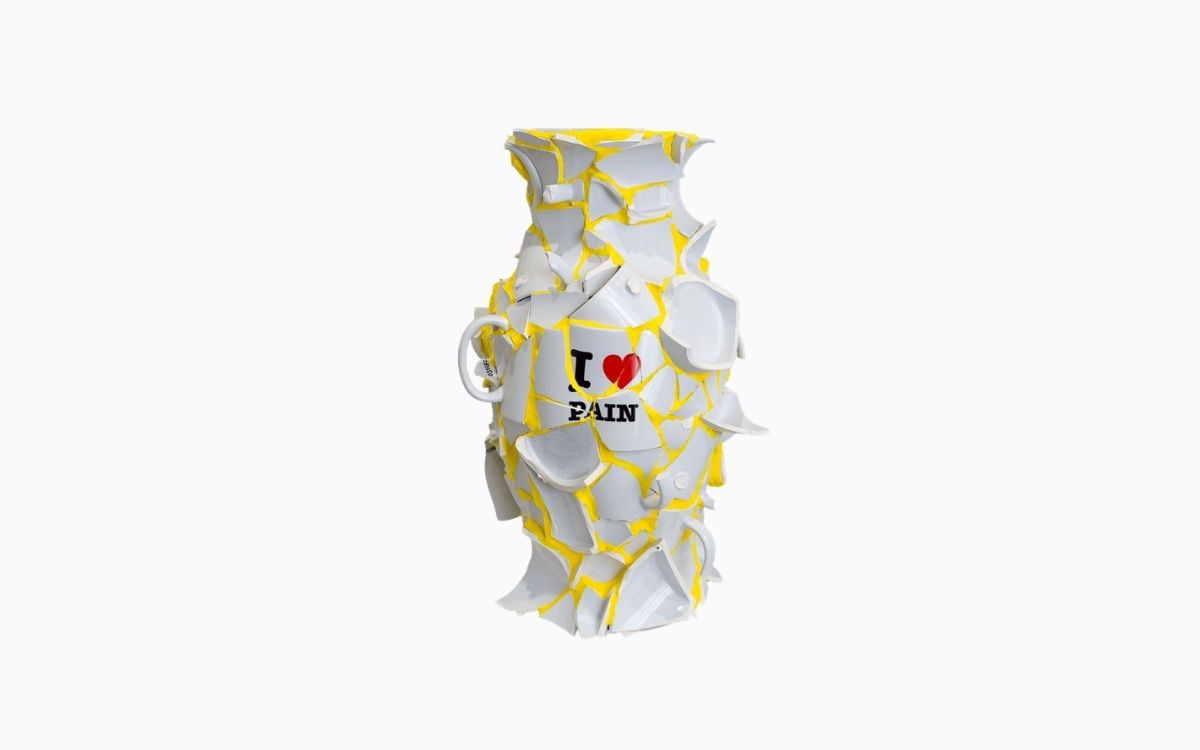
Lyu Chirkova grew up between two worlds: open meadows on one side, an abandoned tannery on the other. That early tension between nature and decay, between imagination and harsh reality, never quite left. Today, working across visual art, fashion, directing, and design, Chirkova builds practice from the materials of memory: plasticine, found objects, childhood artifacts, and the emotional residue of a life lived across multiple countries and cultures. The work is tactile, honest, and quietly transformative, turning inner darkness into vivid form and the ordinary into something that holds unexpected emotional weight. This is a conversation about roots, migration, creative survival, and the courage to remain truthful in the work.
How has your upbringing or cultural heritage shaped the themes and techniques you explore in your art today?
I was born in a small provincial town in Russia called Mozhga, in the Udmurt Republic. The population is around forty thousand people. It is a place where nature and remnants of industry coexist in a strange and sometimes harsh way. On one side of where I grew up there were open meadows and forests; on the other side stood an abandoned tannery factory. Around us were mostly wooden barracks and modest apartment buildings where very different lives unfolded — some families were warm and supportive, while others struggled with poverty, instability, and conflict. I grew up in a large family with four children, and I was the third. Despite the environment around us, my mother managed to create a childhood that still felt imaginative and alive. She often made handmade decorations for holidays and created small theatrical settings for us. We would perform little plays, sing songs, and recite poems together. Looking back, I realize this was my first experience of staging, storytelling, and constructing worlds — something that still exists in my artistic practice today. As a child, I didn’t think the environment around me was unusual. I believed that everyone lived like this. I watched how people tried to live and survive, how very different realities existed side by side. Only later did I begin to understand how much these early observations shaped my sensitivity to human environments, emotional atmospheres, and the everyday objects that surround people’s lives. Nature also played an important role in my childhood. Our town felt almost like a village. We spent most of our time outside — building small shelters from found materials, swimming in ponds, exploring the abandoned factory, and wandering through fields and forests. Sometimes we even explored places like local junkyards, which for a child’s imagination felt like strange landscapes full of hidden treasures. These experiences formed a kind of emotional and visual archive that still influences my work today. Another important layer of memory comes from the architecture of the post-Soviet environment. The landscape was filled with Khrushchyovka apartment blocks, old playgrounds with rusted swings, heating pipelines running across open spaces, and the remains of Soviet infrastructure slowly decaying. Even when I was a child, many of these objects already looked fragile and outdated. That aesthetic of fading structures — somewhere between nostalgia and collapse — left a deep impression on me. At the same time, I spent a lot of my childhood immersed in imagination. I played with toys for a long time, probably until I was around eleven, and drawing was always a central part of my life. One object that has accompanied me for most of my life is a toy called Mickey Mouse, which I received for my fifth birthday. Today I am thirty-three, and this toy still travels with me from city to city and from country to country. Over time it has become a small personal artifact of memory — a physical object that quietly connects the many places I have lived. These early experiences naturally evolved into the materials and language I use in my art today. Plasticine, for example, has become one of the central materials in my practice. It carries associations with childhood, play, and tactile memory, but in my work it also becomes a material of transformation — something that reshapes objects, blurs borders, and questions fixed structures. I often combine plasticine with everyday objects or toy-like forms, allowing them to move between innocence and tension. Migration has also become an important part of my story. I have lived in several countries and continue to search for myself through different cultural environments. Each place has given me a new perspective on who I am as an artist. Interestingly, since early childhood I remember having a dream of living in London, although I still don’t know exactly where that idea came from — perhaps from a film or a book. Today I live here, and it feels like an important point in my journey where many experiences from different places have finally begun to connect. Living across different countries has made me see the world less through borders and more through people and shared experiences. It has given me a sense of freedom and confidence in my practice. Interestingly, while I lived in Russia my work was rarely recognized there, but it began to receive attention in Western contexts — particularly in Europe and the United States. Because of that, I never fully felt that I belonged to one fixed cultural space. In many ways my work continues to explore the idea of searching for home. Through objects, materials like plasticine, and fragments of memory, I try to create emotional landscapes where childhood, migration, and imagination can coexist.
Can you pinpoint a single moment when you realized art was not just a passion but your purpose?
In many ways, I feel that art has always been part of my life. My mother is an artist, and from a very early age I was surrounded by creativity. I began attending a Sunday school for children at the age of two — not a religious one, but a place focused on creative development. Later I studied at an art school and continued building my artistic education from there. Because of this environment, art was never something separate from my life; it was simply the natural way I understood the world. Thanks to my mother, our home was always filled with a creative atmosphere. Making things, drawing, inventing stories, building little worlds — all of this felt completely normal to me as a child. I never really imagined myself becoming anything other than an artist. It wasn’t a decision that appeared suddenly; it was more like something that had always existed within me. However, there was a moment when I consciously recognized this path. I was fifteen years old and had to decide where I would continue my studies. For the first time, I had to make a real life decision about my future. What surprised me was that I didn’t even consider any alternative. There was never a moment of doubt about choosing another profession. The only direction I could imagine for myself was going to an art college in Kazan. That was the moment when I clearly understood: I am an artist. Not because it was a career choice, but because I simply could not imagine my life outside of art. I didn’t want anything else, and I couldn’t see myself doing anything else. At fifteen I moved away from home and began living on my own, starting a deeper journey into my artistic practice and into understanding myself through it. In this sense, I often say that I have been in art since birth. It is not a hobby or even a profession for me — it is simply my way of existing in the world. Creating is not something I decide to do; it is something I cannot not do. At the same time, my path has not always been easy. I have lived with chronic depression since I was a teenager. There have been many moments when I felt lost, burned out, and unsure about where I was going. There were periods when I completely devalued myself and questioned not only my artistic path but the meaning of life itself. Those were very difficult and dark moments. During one of those periods, something unexpected happened. In my life appeared A$AP Rocky, who showed genuine interest in my work and helped me see that what I was creating had value. That moment was incredibly important for me. Sometimes a single gesture of recognition can shift your entire perception of yourself. In many ways, that experience helped me regain confidence in my art and in my path. I am deeply grateful for that moment, because sometimes when you are completely lost, even a small confirmation that your voice matters can change everything. In a way, it reminded me again why I create — not because it is easy, but because it is an essential part of who I am.
If you could communicate just one core message through your entire body of work, what would it be?
If had to define one core message in my work, it would probably be about honesty — the courage to be yourself and to face your inner world without pretending. However, when people look at my work, I am not trying to impose a single meaning on them. For me it is much more important that a viewer finds something of themselves in it, or simply feels something genuine. Art, in my opinion, should not dictate interpretation. It should open a space where different emotions and personal reflections can exist. For me personally, art is a form of reflection and a way to process life. It is how I deal with both joy and difficulty. My practice is deeply connected to my emotional states and my inner experiences. In many ways it is a tool that helps me understand myself and survive complex moments in life. One of the central themes in my work is the darkness that exists inside me. Instead of hiding it, I try to transform it through the act of creation. The darker and heavier my internal state becomes, the brighter and more intense my work often appears. There is a kind of paradox in that transformation — pain turning into color, tension turning into form, and chaos becoming something visible and tangible. I think this transformation is an important part of my artistic language. Through objects, materials, and playful visual forms, I explore feelings that are not always easy to articulate directly. Plasticine, toys, and everyday objects allow me to approach complex emotional territories through a language that may initially appear simple or even childlike. Childhood is also a significant element in my work. I often think about children as the most honest and emotionally open human beings. Children express feelings without boundaries, without social filters, and without fear of vulnerability. That purity of emotional expression resonates deeply with me. In many ways, I try to return to that state in my work — a place where emotions can exist freely, without being controlled or hidden. Through my practice I explore ideas of freedom, limitlessness, and also trauma. These themes often coexist. Freedom does not exist without vulnerability, and transformation rarely happens without confronting something painful. If there is one message that runs through everything I create, it would simply be this: to be yourself and to remain honest with your own feelings. Art, for me, is a space where that honesty can exist without compromise.
Can you take us through the evolution of an artwork, from the first spark of inspiration to the finished piece?
For me, the beginning of an artwork is rarely a clearly defined idea. Most of the time it grows directly from my life — from lived experiences, emotions, memories, and sometimes from more difficult or traumatic states. My work is closely connected to what I am going through internally. Because of that, the starting point of a piece can be something very simple: a feeling, a thought that stays with me, or an emotional state that I need to process. Sometimes inspiration also comes from an object I unexpectedly encounter. It can be something very ordinary — a toy, a household item, or a found object that suddenly triggers a memory or emotional association. When that happens, the object becomes a starting point, and the work begins to develop around it almost naturally. Plasticine plays a very important role in this process. For me it is not only a material but also a kind of therapeutic tool. Working with it helps me calm anxiety and reduce stress. The tactile experience of shaping plasticine is deeply connected to the body and to fine motor movement, which also helps the brain slow down and reorganize thoughts. Because of that, the act of working with the material becomes part of the emotional process behind the artwork. Many people imagine that artists first develop a concept and then execute it. In my case, it often happens in the opposite way. I rarely start with a fully formed idea. Instead, the work grows out of the process itself. It is a continuation of my life rather than a separate project. Creating becomes a way of expressing and understanding what I am experiencing at a particular moment. Because of this, my process is quite intuitive. I allow the work to evolve through interaction with materials and objects. Plasticine allows forms to remain flexible and unstable — it can reshape surfaces, blur boundaries, and transform everyday objects into something unfamiliar or emotionally charged. I am interested in that moment when something ordinary begins to shift and reveal another layer of meaning. In a sense, the artwork becomes a space where emotions can take physical form. What begins as an internal feeling slowly turns into something visible and tangible. When it comes to finishing a work, I don’t think there is ever a completely final moment. A piece could always continue evolving if I allowed it to. Materials could change, layers could be added, or forms could be reshaped endlessly. However, there is one internal signal that tells me it is time to move forward. The most important question for me is whether the process has helped me emotionally. If, through creating the work, I feel that something inside me has shifted or become lighter, then I know that the piece has reached its moment of completion. In that sense, finishing a work is less about the object itself and more about a change within me.
How do you feel social media is shaping the way art is created, consumed, and valued today?
In my opinion, social media has a very dual nature for artists. On one hand, it is an incredibly powerful tool. It allows artists to show their work to the world, connect with people across countries, and discover new ideas and inspiration. Platforms like Instagram have created a kind of global network where artists, curators, collectors, and audiences can meet each other without traditional barriers. For many artists, social media has become one of the main ways to build visibility and find opportunities. It allows you to present your work directly, without waiting for institutions or galleries to notice you first. In that sense, it has made the art world more open and accessible. At the same time, social media can also create certain psychological challenges. The system of likes, comments, and shares can easily influence how artists perceive the value of their work. It becomes very easy to start comparing yourself to others constantly, which can create unnecessary pressure and insecurity. I think this is especially true for creative people, because artists are often very sensitive and emotionally open individuals. Many of us also have strong egos — which is not necessarily a negative thing, since a certain level of ego is often connected to creative drive. But when that ego becomes too dependent on external validation, social media can amplify insecurity rather than confidence. For this reason, I believe it is important for artists to maintain a healthy relationship with these platforms. Social media should be a tool, not a measure of self-worth. It can help you share your work, find connections, and build community, but it should not define the value of what you create. Personally, I try to see social media as just one layer of the artistic ecosystem. Real artistic development still happens in the studio, in the process of thinking, experimenting, and living through experiences that eventually shape the work. In that sense, social media can be useful, but it cannot replace the deeper and slower processes that are essential to art.
Artificial Intelligence is increasingly entering creative fields. Do you see it as a threat, a tool, or a collaborator?
For me, AI is an incredibly powerful and almost limitless source of inspiration. I see it primarily as a tool — and a very strong one — especially for people working in creative industries. Artificial intelligence has the ability to accelerate many stages of the creative process. It allows artists to quickly generate visual ideas, create sketches, and explore different directions for a project. Instead of imagining something abstractly, you can immediately see a visual interpretation of your idea. This ability to test concepts quickly can open many new possibilities. Because I work across several creative fields — including directing, photography, design, fashion, and visual art — AI helps me move faster between ideas and projects. It allows me to experiment more freely and visualize concepts that might otherwise take much longer to develop. In that sense, it expands the creative process rather than replacing it. I also think AI can push artists to look at their ideas from a different perspective. Sometimes it produces unexpected results that can inspire new directions or challenge the way you initially imagined something. That kind of dialogue between the artist and the technology can become a very interesting part of the creative process. At the same time, I don’t believe AI can replace the role of an artist. It can generate images, music, films, or visual compositions, but art requires something deeper — a sense of human experience, emotion, and consciousness. Art is not only about producing images; it is about expressing a lived perspective and an inner world. At the current stage of AI development, I see it more as a creative assistant or collaborator rather than a replacement. It is a tool that can support artists, help them experiment, and accelerate certain processes, but the core vision still comes from the human mind. For me personally, AI is a positive and exciting development. It expands the possibilities of creativity and allows artists to explore ideas in ways that were not possible before.
How do you envision the evolution of your work in the coming years?
I have always had very big ambitions and a strong curiosity about different creative directions. In the coming years I would love to expand my practice into larger installations and spatial works that allow viewers to physically enter the worlds I create. I am also interested in developing objects that exist somewhere between art and design. Creating design pieces, toys, and collectible objects feels like a natural continuation of my practice, because I have always been drawn to the emotional power that everyday objects can carry. These kinds of forms allow art to become part of daily life rather than existing only inside galleries. At the same time, I continue to develop my clothing brand and my small production studio. For me these projects are not separate from my artistic practice but rather extensions of it. Fashion, film, objects, and installations all become different languages through which I can express ideas and emotions. In the future I would like to present my work internationally and exhibit in different parts of the world. I truly believe that there are no impossible goals if you continue moving forward and remain honest with yourself. Failures are simply experiences that help you grow, while successes are moments that you can build upon and multiply. Because of this mindset, I try not to limit myself to one medium. Earlier in my life I was often told that I should choose a single direction and focus only on that. But that approach never felt natural to me. I feel most alive when I can work across multiple disciplines. In a way, it feels like living several creative lives at the same time. Cinema is another field that deeply interests me. As someone who works with visual storytelling and directing, I would love to create my own film when the right moment arrives. Film offers a powerful way to combine narrative, visual language, and emotional atmosphere. I am also increasingly interested in working with social themes. Art has the ability to reflect the world we live in, and I feel that exploring social realities through artistic language could become an important part of my future projects. Above all, I simply want to continue creating what genuinely interests and excites me. I love what I do, and the most important thing for me is to keep moving, experimenting, and growing through art.
What are five important lessons that have shaped your artistic journey?
Over the years, my artistic journey has taught me several important lessons that continue to shape the way I approach my work and my life as an artist. The first and perhaps most important lesson is to remain honest with yourself. Art loses its meaning the moment it becomes an attempt to please others or follow trends. Authenticity is what allows work to carry real emotional weight. The second lesson is not to be afraid of mistakes. Failure is an inevitable part of any creative process. Every mistake contains information and experience that eventually helps you grow and refine your artistic voice. Another important realization has been to avoid constant comparison with others. The art world can easily create an environment where comparison becomes endless, especially today with social media. But every artist has their own path, rhythm, and story. Comparing yourself too much can distract from developing your own language. A fourth lesson is the importance of continuing to work even in moments of doubt. Doubt is something most artists experience, and sometimes it can feel overwhelming. However, continuing the process — even slowly — is often the only way to move through those periods. Finally, I have learned that art requires time. Developing a meaningful artistic practice cannot be rushed. It grows through patience, persistence, and the accumulation of experiences over many years. These lessons continue to guide me as I move forward in my practice and explore new directions in my work.