
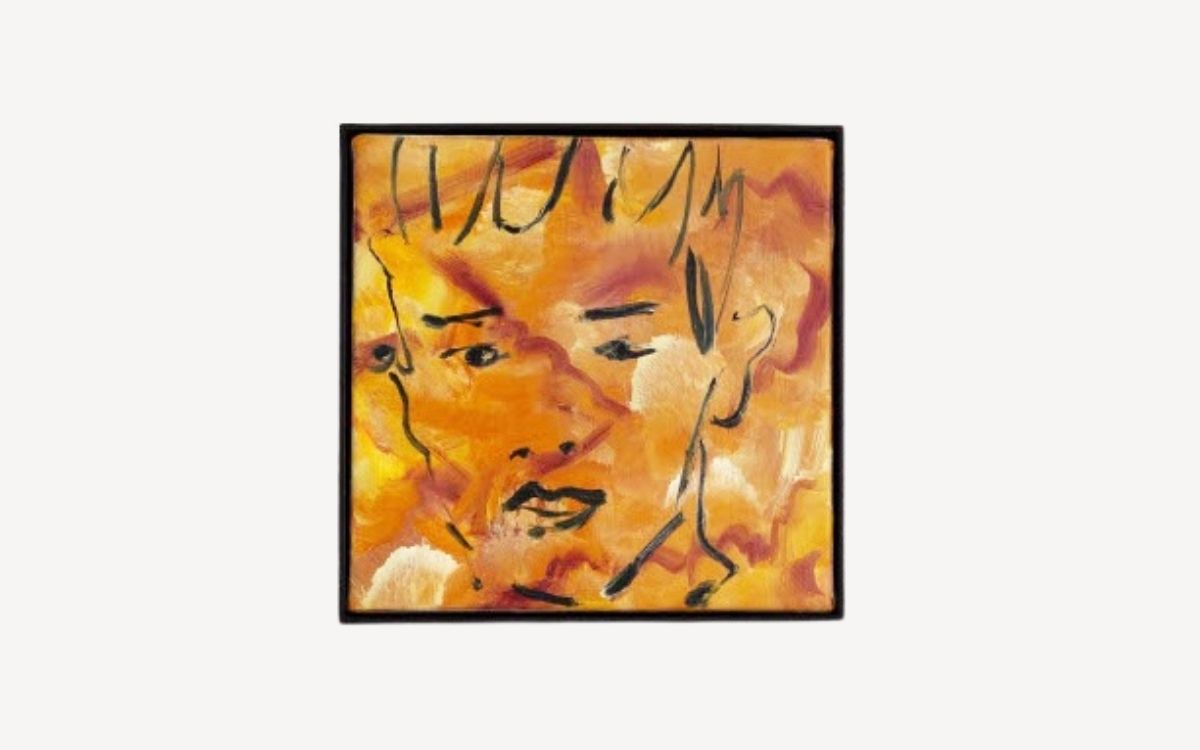
Ross Head paints figures encountered in passing, caught in everyday media, saved from a scroll, or drawn from archival sources near Liverpool Street, and brings them through hundreds of drawings before they ever reach the canvas. That long process of looking, returning, and redrawing is not preparation for the painting so much as it is the thinking itself. Working with a restricted palette and gestural marks that build a surface before the figure enters it, the work sits deliberately between recognition and uncertainty, between longing and form. What results is painting that does not explain itself but asks to be felt, open, shifting, and emotionally charged enough to mean different things to different people depending on what they bring to it.
How important is it for viewers to understand the intended message of your work? Does ambiguity add value, or do you seek clarity in your expression?
For my work, it is not essential that viewers understand a fixed or intended message. I try to make my work as open as possible. That’s the beauty of painting as a process; it is always asking questions of me as the artist as well as of the viewer. I am interested in paint as a material, and there are themes that run through my work, but I am not trying to tell people what to think.
Ambiguity is important in that sense, as it allows the work to remain open and shifting, with different readings emerging depending on who is looking and what they bring to it. I am more interested in emotional connection than clarity. If there is a message at all, it is a desire to feel something, rather than to explain something. I think of the work as sitting between recognition and uncertainty, where meaning is felt rather than resolved.
Can you take us through the evolution of an artwork, from that first spark of inspiration to the finished piece?
I paint figures encountered through everyday media, where looking becomes entangled with desire and recognition. An image might catch my eye whilst travelling or on social media, and I’ll photograph or save it to return to later in the studio. Visits to archives such as the Bishopsgate Institute near Liverpool Street also offer a rich source of material.
I then edit and select which images to focus on. I am drawn to images that carry a certain intensity or charge, something that can spark the beginning of a painting. I then spend time with the image, often drawing it repeatedly at home. Drawing is the foundation of my process, the point where thinking and feeling begin to shift something from the page towards the possibility of the canvas. I build up hundreds of drawings, which I then return to in the studio as starting points for paintings. It is not a straightforward path from paper to canvas, but a process of revisiting, shifting and building over time.
It is on the canvas where I use gestures and paint to translate sensation into form, treating it as a space where thinking and making converge to express feelings connected to longing and connection. It is not a direct translation. The canvas begins as something separate, and I build it up through layers of gestural marks that form the surface before the figure enters the painted space.
How has your artistic style transformed over the years? Are there specific influences, experiments, or moments that marked a turning point?
I did what many people did during the pandemic, and I took a step back and really reflected on what matters to me at that point in my life. It was a period of reflection that led me to make the decision to fully commit to painting. I was fortunate to get a place at Turps Art School in Elephant and Castle, followed soon after by studying an MA in Painting at the Slade School of Art. It was at the Slade that I really found my voice. I threw myself into the work, rigorously breaking down and rebuilding my practice. My earlier paintings, which focused on bodies merging and melting into one another, became more stripped back, with line and colour taking on a more central role.
During my first year at the Slade, I took part in a colour workshop that explored hue, value, and saturation. It was a turning point for me. I realised that a restricted palette could create a much more powerful and focused experience for the viewer. After that, I moved away from using multiple competing colours on the surface and instead began working with a single colour to carry the meaning and feeling of the work.
How do you challenge yourself to continually grow as an artist while remaining true to your voice?
It comes down to staying open and curious and through a love of painting. I usually don’t have a fixed idea of how a piece will evolve, and that sense of discovery is what keeps the work exciting. I trust my intuition to lead the way and don’t lock myself into a single vision. My paintings often move beyond fixed time and place, opening into imagined or alternative realities where intimate moments accumulate within the surface; with earlier decisions remaining visible and blurred beneath the final image.
How do you think art should be valued, emotionally, socially, or monetarily? Is there ever an objective measure?
Art doesn’t really submit to a single way of being valued. Often, it begins with an emotional response. A work either does something to you, or it doesn’t. It might make you feel seen, unsettled, nostalgic, curious, or even completely at a loss. That reaction is personal and not always easy to articulate, but it’s often the most immediate and honest form of value.
At the same time, art exists within a broader social context. It can reflect the moment it was made in, challenge prevailing ideas, or shape how people understand themselves and one another. Sometimes a work only reveals its significance later, as the culture around it shifts or catches up. In that sense, its value isn’t fixed. It changes depending on who is looking, and when.
How do you approach criticism, whether from peers, critics, or audiences?
For me, it depends on both the context and who the criticism is coming from. I consider their experience, perspective, and how much I value their opinion. Conversations with my peers tend to be the most productive space for growth and development. Through these exchanges, I’m often prompted to question what I want from the work, while also gaining insight into what others see in it and how they respond to it. I try to stay honest and open to feedback, but I also filter it through what feels right for the work. Ultimately, I see my work as a conversation. Hearing what people see and feel is an important part of my process, so I value that exchange alongside my own perspective.
Are there any upcoming projects or dreams that you’re particularly excited about?
I’m currently developing a new body of work for my first exhibition in China this summer, which feels especially exciting. The pieces are moving toward a sense of calm and serenity which is something I feel increasingly drawn to. In a world that often feels chaotic, busy, and saturated with images, that quietness feels not just appealing, but necessary.
Recently, I’ve also been exploring elongated canvas formats to introduce a more architectural sensibility into my paintings. Tall, flexing figures begin to echo classical pillars, while reclining bodies suggest entablatures or resting pediments to create a kind of layered spatial language that draws from interior architecture. This new work continues that exploration, using these spatial strategies to cultivate a more nuanced sense of intimacy and aesthetic pleasure.
Ross Head is an artist whose practice deepened through commitment rather than sudden discovery, the pandemic as a moment of reflection, the Slade as a place where the voice finally found its shape, the colour workshop that revealed how much power a restricted palette could hold. Now, with a first exhibition in China ahead and new elongated canvases in which figures begin to echo classical architecture, the work is moving toward a quietness that feels, as described here, not just appealing but necessary. In a world saturated with images, that deliberate stillness is its own form of resistance, and its own form of clarity.