
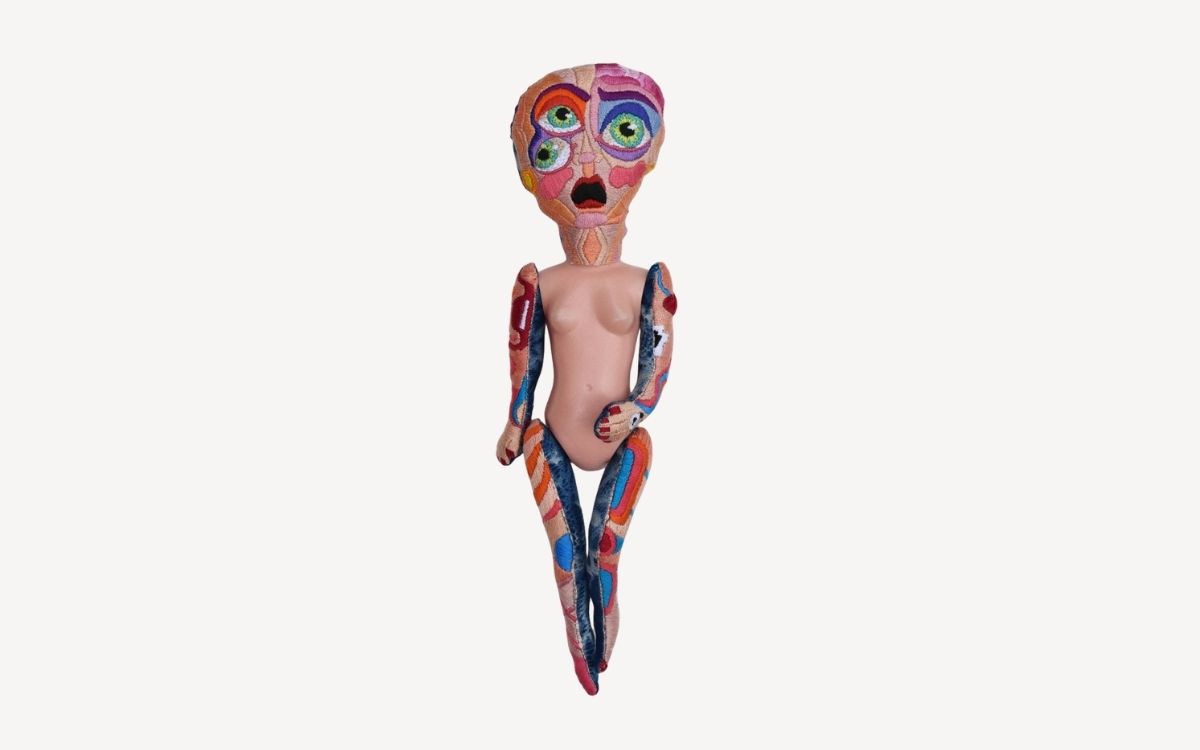
Melanie Thoren stitches identity into existence, slowly, by hand, one thread at a time. Working in embroidery as a deliberate act of resistance against the instant and the generated, this is a practice rooted in the belief that physical making carries a presence that cannot be replicated or scraped. Identifying as a feminist surrealist, and working primarily with dolls, figurines, and textile forms that explore the feminine while remaining open enough for anyone to find themselves within, Melanie Thoren makes work that functions as a mirror: some viewers find it playful, others find it disturbing, and both responses are equally welcome. The interpretation, shaped by a viewer's own life and values, is where the work truly lives.
Art is often chosen as a medium for its freedom. Why do you personally turn to art, rather than another form of expression?
I think I personally turned to art because I feel that it transcends language. Often, I find that I don’t have the words to express my emotions, but I can do so physically and visually. I know a lot of modern art includes words and phrases, particularly in textile art, but it is for this reason that I don’t use words or phrases in my artworks, though they will always have a name put to them.
What do you think is the most meaningful role an artist plays in society today?
I think that the most meaningful role an artist plays in society is to hold up a mirror to a viewer. I don’t mean this literally of course, but it is often very interesting to see the responses that different people have to the same stimulus. For example, some people find my work playful, while others find it disturbing (as I have been told in my exhibitions), but it is all the same material at its core, so the interpretation is the key thing that is shaped by the viewers life experiences and values. I think art should be reflective of an idea or an allusion to something found deep within humanity.
Have you ever struggled with the ethics of your art, such as who it represents or who it impacts?
Yes absolutely, I consider myself a feminist surrealist artist, but I am aware that not everyone identifies with feminism or have different ideas about what feminism is. To me, feminism is equity for female or non-binary identifying people, but not necessarily restricted to feminine or traditional gender norms. I am aware that part of my audience are LGBTQIA+ identifying people, and so I am usually careful to say ‘feminine’ or ‘female identifying’ when it comes to submitting dolls and figurines to exhibit- just because I see them as feminine it doesn’t mean that everyone else has to! It has been very interesting to see that a lot of Trans identifying people vibe with my work, I think because I explore identity.
I am also aware that my perspective of feminist work comes from a very white and privileged background, and has very little exploration of the concerns of women of colour, which since reading the book “Hood Feminism: Notes from the movement that White Women forgot” by Mikki Kendall, I have been acutely aware of but not sure how to incorporate into my work. I guess I try to make my figures a little more ambiguous so that anyone could identify with them if they wished.
If you could communicate just one core message through your entire body of work, what would it be?
I think I would say ‘explore yourself’ would be my message. Rather than ‘be yourself’, which suggests finality of identity, I would encourage everyone to constantly question who they are and what they are constantly becoming.
Do you believe the ‘mad artist’ stereotype still holds weight, or is creativity more grounded than we think?
I have met all sorts of artists, from those who are quirky to those who thinks the sun shines out of their backsides; I’ve found personally that I love a ‘mad artist’, those who seem to have no limits on how they express themselves. I think these people are the bravest people of all, and that it does come from a particular kind of grounding; where they have been so deep within themselves there is no other option than to express themselves in the way that they do. I am very interested to see what kind of artist I will become (if I don’t already classify as the ‘mad artist’!)
Artificial Intelligence is increasingly infiltrating creative fields. Do you see artificial intelligence as a threat, a tool, or a collaborator in the art world?
One of the reasons I initially transitioned to embroidery was because of A.I. I was convinced that if I made physical works out of thread, it couldn’t possibly be copied by a computer. As A.I and companies have grown though, I realise the threat isn’t A.I, but the people who create and dictate it, who can feed it artists work without any credit to them. I think A.I can be a great tool for learning and expression, especially where someone feels they don’t have the skills to express themselves in the way that they would like, but it shouldn’t come at the expense of artistic integrity.
Name five pivotal lessons you’ve learned that shaped your artistic journey.
Art should be done first of all for yourself- if other people happen to resonate with it, that is a bonus.
Not everything you do has to be perfect, just think of it as a stepping stone towards better pieces and explorations in future.
Don’t ignore art history, I can guarantee someone somewhere has had a similar idea that you can explore (but of course, don’t plagiarise! Make it your own!)
Some art can just be for yourself; you don’t have to share everything
Any form of making is good making; a little bit each day can make a huge difference
What artistic “superpower” would you choose to have, and how would it shape your work?
The ability to create at superspeed! The only trouble with hand embroidery is that it takes a long time. Many days and months can go into a single piece of work.
What are your long-term aspirations as an artist, both personally and professionally?
I would love to investigate creating larger scale works, could time and budget allow! I would also love to run an independent gallery in rural Victoria (Australia) at some point, which could double as a makers space for local artists. I would love to create a space that is artist run, but also allows artists the time to work at their own crafts simultaneously. This would create a space that has more emphasis on the hand made and the time that it takes to create work, which I think a lot of art viewers might not understand fully.
Melanie Thoren's long-term vision, an artist-run gallery in rural Victoria, doubling as a makers space, built around hand-made work and the time it takes , is a natural extension of everything the practice already stands for. Slow, physical, honest, and genuinely curious about what identity is still becoming. The message offered to anyone who encounters the work is not "be yourself," which implies a fixed destination, but "explore yourself", a continuous, open-ended invitation. That distinction, small but significant, says everything about an artist still in the process of discovering what kind of maker the future holds.