
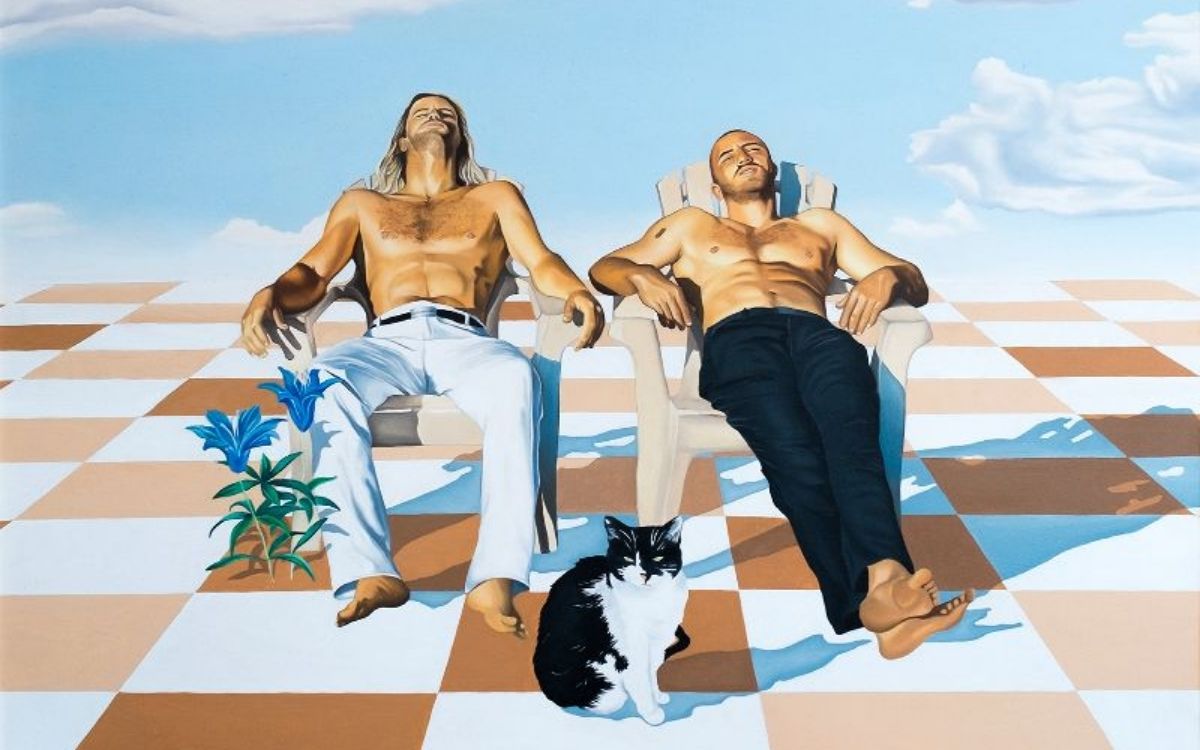
Audrey Bertoia paints with time as a material. Growing up in the French countryside south of Lyon, shaped by Alpine landscapes and an athletic childhood cut short by injury, and carrying a half-buried Italian heritage that surfaced later through old films and Mediterranean color, the confluence of these experiences produced a painter drawn to light, to the body, to the relationship between figures and the natural world. Oil painting arrived as a necessity, not a choice: it filled the space left by movement. That origin has never been forgotten, and it shows in work that takes weeks, sometimes months, to complete, not as a statement but as a genuine commitment to the kind of attention that slow making requires.
How has your upbringing or cultural heritage shaped the themes and techniques you explore in your art today?
I grew up in France, in the countryside south of Lyon. My mother, who is a passionate lover of the mountains, often took us hiking in the Alps when we were children. I didn’t fully realize it at the time, but those mountain landscapes, and the sense of freedom they offer both to the mind and the body, deeply influenced my imagination. I only became aware of this later, when I moved to Brittany to study at the Fine Arts. There were no mountains around me anymore, and it was at that moment that I felt the need to make them reappear in the background of my early paintings, and to question the relationship between humans, nature, and landscape.
I also think that the theme of the body, which is quite present in my work, its feminine representation, its relationship to movement and freedom, also finds its roots in my childhood. I had a very athletic upbringing; I practiced artistic gymnastics from the age of 5 to 17. For me, being “muscular,” agile, all these things often considered as not very feminine, were for me on the contrary my greatest source of freedom and my first form of expression. Then, at the age of 20, I had an accident that left me with lasting injuries. I had to distance myself from all the sports practices that had nourished me until then, and it was at that moment that I immersed myself in oil painting. I believe that without this accident, my commitment to painting would not have been as intense.
The intense colors, the light, the sun, the oranges, the sea, and the Mediterranean atmosphere that frequently appear in my paintings, I believe, come from my Italian grandparents’ origins. A heritage they chose not to pass down, for reasons of integration when they immigrated to France, but one whose presence I have always felt and found intriguing. These buried parts of my origins led me to explore this culture more deeply by myself, and to watch many old Italian films, which I believe have greatly inspired my pictorial universe.
How do you reignite creativity during those inevitable periods of self-doubt or Stagnation?
I have several ways of responding to periods of doubt and stagnation. The first, which I practice most often, is to always make sure I remain in a continuous flow of production. Once a painting or a series is finished, I set it aside, I don’t look at it for a few weeks, and I immediately start the next one. Generally, I have a sort of waiting list of painting sketches to realize, so it is not very difficult to know what I will do next. However, it can happen that it is the colors, the composition, or the atmosphere that do not come, and in that case, I persist until I finally find the sketch and the colors that truly resonate with me. Sometimes this can last an entire week, trying from morning until evening, thinking about it even in my sleep. It is quite obsessive, but I don’t really have another choice: until I have found the composition of my next painting, I feel suspended in my own life, as if I am floating, unable to fully inhabit and enjoy what surrounds me.
Otherwise, my second way of responding is to take a break. I always set aside a period during the year to completely disconnect from my artistic practice. During this time, I reconnect with my sensations and my body, I travel, discover new places, read, and go on long mountain walks. I see this period as a time of inspiration, where I function almost like a sponge: I absorb everything around me, colors, languages, music, landscapes, and then, once I return to the studio, everything I have experienced naturally finds its place in my painting.
How important is it for viewers to understand the intended message of your work? Does ambiguity add value, or do you seek clarity in your expression?
It is important to me to always leave a space for interpretation and appropriation of the work by the viewer. This is one of the reasons why I rarely depict the faces of the people I paint. I prefer each viewer to be able to identify with my paintings, or recognize people they love within them, so that their reading of the work remains their own. Behind each painting I create, I am always driven by a message, an emotion, a story to tell, but it is above all an impulse to create. Even though I feel deeply fulfilled when some people perceive exactly what I intended to convey, I am just as curious to let each person’s interpretation unfold freely.
This is why I do not seek to express certain ideas through clarity or obviousness in my paintings, but rather through subtle symbols and suggestions, like clues that might orient and guide the viewer through an atmosphere or a certain setting, without ever fixing them into a single, definitive reading. I love the idea of seeing painting as a collaboration between what I create and what the viewer projects onto it, through their own lived experience and imagination.
In a world flooded with imagery, what responsibility do artists have to stand out and say something authentic?
Personally, my response to this saturation of images, and especially to instant production, is precisely the long and deliberate time it takes to oil paint. For me, spending several weeks, sometimes one or two months, on a single painting is already a form of commitment. In a world where our attention is constantly being stolen, I have chosen a path that requires a great deal of patience (and is certainly less profitable), but where every detail of the canvas : a drapery, a skin or a flower, is executed with care and precision. The reason I like taking the time to paint and to focus on each detail is that I hope to offer the viewer, when they see the painting in real life, a sense of slowing down or suspended time. As if I were trying to allow my paintings to open access to a form of calm and deep attention, similar to the one I myself experienced while creating them.
Can you take us through the evolution of an artwork, from that first spark of inspiration to the finished piece?
In general, the “spark,” the idea of a painting, emerges in a very natural and instinctive way when I listen to music, walk in nature, or feel deeply connected to my emotions. From there, a kind of “sensation of colors” appears to me, a diffuse yet intense perception of colors and atmospheres. These can carry a texture, a sound, or even a taste. This sensation is always my starting point. It guides me and then pushes me to search in reality for which form and which scene might best give it a body, whether it is a still life, a landscape, bodies, flowers, etc. Then, once this sketch begins to take shape, in order to have a visual reference, I take photographs myself of the elements I need to create the painting: people from my surroundings, flowers, skies, landscapes etc…
How has your artistic style transformed over the years? Are there specific influences, experiments, or moments that marked a turning point?
It has been almost ten years since I started painting. So far, I think I have mostly explored the same direction: that of realistic painting. But a year ago, following a proposal from the brand Lefranc Bourgeois inviting me to develop a series of paintings around the work of Claude Monet, I had a kind of breakthrough and a desire to experiment with a new way of painting and of addressing the relationship between humans and nature.
Until then, I had been composing in a fairly classical way, with subjects posing in front of a background or a landscape. But this invitation to work from Monet’s practice, who, to me, is a painter of perception and of nature, made me want to go beyond a representation that separates humans from nature, and instead try to create a form of fusion between the two.
This is how the series Les Songes came to life. A series of paintings which, at first glance, appear as a diffuse impression, a kind of chromatic vibration, and then, gradually, in a second reading, human forms and fragments of vegetation emerge into one another. Like memories, like dreams appearing and disappearing.
This new way of painting, more diffuse and bordering on abstraction, gives me a great sense of freedom. I feel it is a new path I have taken in my practice, and I very much want to continue exploring it.
How do you approach criticism, whether from peers, critics, or audiences?
When I first started painting in a self-taught way, I was still a student in graphic design at the Beaux-Arts of Rennes. My professors at the time, who were all graphic designers, did not judge my work and did not try to direct my painting in any way because they were not painters. I think this really helped me at the beginning to feel free to create.
The fact that no one told me how to paint technically, or whether what I was doing was good or not, this external neutrality towards my work, was a strong driving force for me. It allowed me to paint from my own feelings, from what deeply moved me, without taking external opinions into account.
Until now, I have always kept this way of working, which allows me to find a balanced place for criticism. I consider that a painting should please me and resonate with me at 70%, and that for the remaining 30%, I remain open to advice from my close circle or from the public, to hear what they perceive, and then select the critiques that feel relevant to help my practice evolve.
In general, I really enjoy asking for the opinion of my closest friends or family who are the least connected to the art world. I find that people who describe themselves as “not educated” in art often have a very pure and accurate way of seeing. A gaze that is based more on their feelings than on knowledge or current trends.
Identify five habits or concerns you are actively trying to let go of in your practice.
Placing too much importance on new trends, social media, and external opinions.
Comparing myself to artists whose careers seem more prestigious. Over time, I have truly come to understand that every artist follows a path that is their own, shaped by the environment in which they evolve, the era, the encounters they make, and the opportunities and uncertainties of life. What matters to me is to do my best with what I have, to focus on creating with authenticity, and to be proud of my path and the effort I have put in, regardless of failures or successes.
Doubting myself and letting negativity take over during periods of stagnation. It took me almost ten years to understand that, during these phases when there are no commissions, upcoming exhibitions, or sales, all I need to do is resist negativity and impose a discipline on myself to keep thinking positively and staying in action. By applying this approach, these quiet periods instead become moments of breathing space for free creation, a pause from stress and deadlines, where I can step back and better consider my compositions and the direction I want to take.
Not experiencing FOMO and, on the contrary, staying focused. The practice of an artist is demanding, and I believe that in order to stay aligned with what we create, it is sometimes necessary to be alone and disciplined, and to be able to say no to external demands and distractions.
Judging my painting the moment I finish it. In general, I don’t know why, but at the very moment I complete a painting, I no longer know what to think of it. Over time, I have learned that I always need a period of distance after its completion in order to receive it, learn to look at it again, and judge it with discernment.
List five moments or achievements in your career that fill you with gratitude.
When, a few months after graduating, I began receiving commissions from the brand JACQUEMUS to create paintings intended to be printed within their clothing collections.
When I discovered the joy of having a studio within shared spaces alongside other artists and creatives.
When I signed with my agent Karine Garnier.
My collaboration and exhibition with Lefranc Bourgeois. This is a brand I have always admired, and through this collaboration I had the honor of being invited to create a fresco in their iconic Charbonnel window’s boutique. During this wonderful week of painting in Paris, and throughout our collaboration, I felt immense support and respect from them, which filled me with gratitude and gave a strong momentum to my creative practice.
My first sale to a major collector and art patron.
Can you imagine ever choosing to stop creating art? What might lead you to such a decision?
I am rarely radical in my answers, but on this subject, it seems impossible for me to imagine my life without painting. It is a space-time that has become my lifelong refuge. It would be like imagining living without light or without colors.
Audrey Bertoia is an artist who has learned to trust the period of suspension between one painting and the next, the obsessive searching for a color and composition that truly resonates, the weeks of mountain walking and absorption before returning to the studio full. The series Les Songes, diffuse, chromatic, human forms emerging from vegetation like memories surfacing from dreams, marks a new direction: toward fusion rather than separation, toward the edge of abstraction, toward a freedom that feels genuinely earned. Imagining life without painting, the answer comes without hesitation. It would be like living without light or without colors. That is not a poetic flourish. It is simply the truth.