
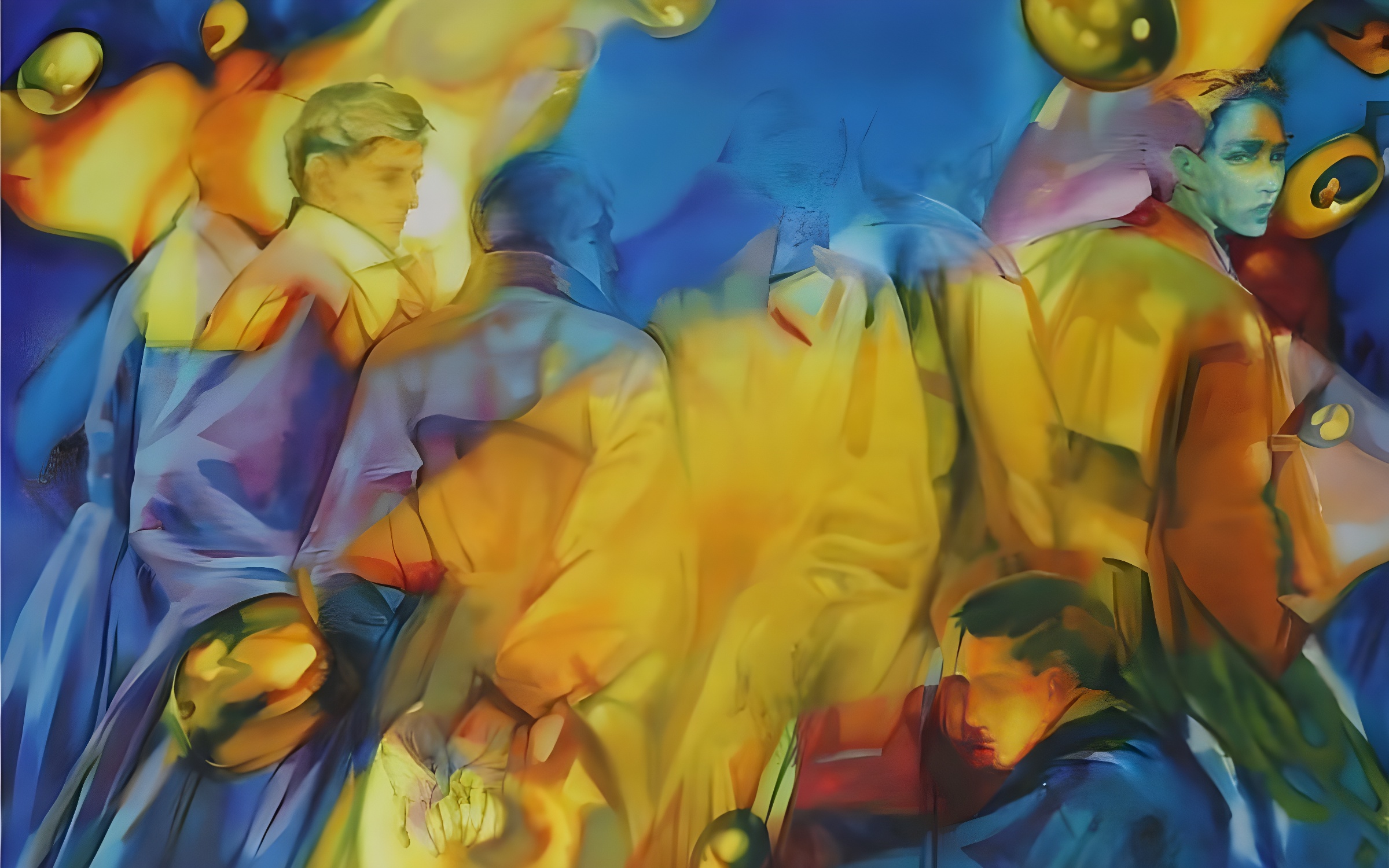
Anna Lugovska paints the crowd, not as spectacle but as condition. Working primarily in oil on canvas and wood, and drawing on a background that spans monumental art, icon painting, murals, and stained glass, the practice that has developed over nearly two decades is one preoccupied with visibility, memory, and the fragile intersections between individual and collective identity. Figures emerge through raindrops and window reflections, ghostly and tender, engaged in what feels like a shared ritual. Faces remain composed, unreadable, social masks, while the hands, given full expressive weight, carry what the face withholds. The result is a body of work that slows down what would otherwise pass unnoticed, searching for silence within movement, and sometimes creating that silence itself.
How important is it for viewers to understand the intended message of your work? Does ambiguity add value, or do you seek clarity in your expression?
Over the past few years, I have been working with quite complex compositions. I have always been drawn to building multilayered images, using different techniques to create dense surfaces full of detail and colour. This approach comes partly from my background in monumental art, where I was interested in making works that could be read differently depending on the distance, more abstract from afar, and more figurative and detailed up close.
Recently, though, my focus has started to shift. I have become more interested in light, space, and depth, and I am intentionally trying to say less within each painting. I am reducing the amount of detail to create more openness, both visually and conceptually. Usually, each work starts with a specific idea or theme, but I don’t want to fix its meaning too much. Through ambiguity and layered compositions, I try to leave space for interpretation, so the viewer can have their own experience with the work.
Can you take us through the evolution of an artwork, from that first spark of inspiration to the finished piece?
I started my practice at the age of ten, and from early on I was exploring different approaches to painting. I spent many years working from life, painting models and working en plein air, responding directly to what I saw and felt in the moment. At that time, this felt more engaging than being in the studio and inventing my own compositions. This changed quite radically after I completed my first Master’s degree in painting in 2019. Since then, I have had very little experience with life painting. My practice has become almost entirely studio-based, where instead of observing the external world, I construct my own. What began as a shift gradually became something much more engaging and meaningful for me.
My background in monumental art, through murals, icon painting, stained glass, and mosaics, has strongly influenced how I work. I rarely begin directly on the final surface. Instead, I spend a lot of time developing sketches, refining compositions and colour relationships in smaller formats before translating them into larger works. Most of the experimentation and decision-making happens at this stage. At the same time, the final painting never fully replicates the sketch, especially because I work with collage elements. The process becomes more intuitive and open-ended, often leading to unexpected results. I do not feel that I fully control the outcome; instead, it becomes a kind of dialogue with the work. In many ways, my role is simply to be present and responsive. That sense of not fully controlling the process is what keeps it alive and continually engaging.
How has your artistic style transformed over the years? Are there specific influences, experiments, or moments that marked a turning point?
Looking back at nearly two decades of my art practice, I can see significant transformations, in my visual language, working methods, themes, and overall approach. I remember discussing with peers the risks of changing one’s style, especially when working with galleries, as it can create certain challenges. While I acknowledge this, I also accept that my work evolves as I do. I began my artistic journey working with watercolour, and after four years I moved into oil painting. My tendency to apply paint in thin layers comes from this early experience, as well as from working on walls and wooden surfaces. There were periods when I used heavier applications of paint, but over time I realised that it is important for me to allow the surface to breathe.
I have always been interested in textures that contrast with more refined, delicate details. Working on wood or paper, I sometimes use sandpaper or even a knife to remove upper layers, revealing what lies beneath and allowing light from the white ground to emerge. The materials I use strongly shape the process. For example, when working on a lewkas ground on wood, linseed oil cannot be used, as it leaves greasy traces.
Without it, the paint dries very quickly, sometimes within 30 minutes, which limits the ability to rework the surface over time, as one might on canvas. While these constraints can feel restrictive, they also encourage experimentation and ultimately lead to new discoveries.
How do you feel social media is shaping the way art is created, consumed, and valued today?
Social media has radically changed the rules of the game in the art world. It has become a powerful tool that offers many opportunities. Galleries, curators, and artists can now connect more easily, no longer depending on geographical location or the need to meet in person. Artists can access open calls for exhibitions, residencies, grants, and competitions much more quickly. In many ways, distance has been reduced to a single click, yet this shift has not solved all the challenges. It is quite difficult, though possible, for emerging artists to build a career without an online presence. I am aware of a few exceptions, artists who have been successful without social media, but in most cases, they are already represented by galleries that manage their visibility for them.
At the same time, many artists point out how difficult it is to compete for attention online, where artworks exist alongside advertisements and AI-generated images, all competing within the same visual space. Because of this, I believe that while digital platforms will remain an important tool, they cannot replace the experience of encountering art in real life. This is reflected in the continued popularity of gallery openings, art fairs, and biennales. The period of intensified digital engagement in 2020–2021, resulting from enforced isolation, further reinforced the desire for direct, physical encounters with artworks.
The same can be said about the financial side. While some artists sell very successfully through social media, many others are not interested in this type of sales at all. This is not because they do not need financial support, but because they recognise that it can remain a niche. They may not want to be seen as “Instagram artists”; instead, they aim to work with galleries and build more established, long-term careers, which, despite the strong influence of digital platforms, still largely develop in real-life context.
Is art created for the artist, the audience, or somewhere in between?
Most artists create because they cannot imagine their lives without the process of making. At the same time, I like to think that an artwork truly begins its life once it leaves the studio. The moment it encounters an audience is when it starts to exist more fully. I remember a conversation between a student and a professor while I was doing my BA, where the student was hesitant to exhibit their work. The professor responded that, as artists, we don’t have the right to hide what we create, that in some way, art is a form of service to others.
There is no simple answer to this question, as every artist understands it differently. Personally, I experience different kinds of relationships with my work. During the process, there is a sense of care that feels almost parental, but afterwards, I try to create some distance. I am always curious to see how the work exists in different contexts, whether in exhibition spaces or in someone’s home. I try to look at it as a viewer would. This distance helps me stay more objective and critical, and ultimately to grow.
I also find it fascinating to encounter my works again after five or ten years. It is a strange feeling, you recognise them as yours and remember the context in which they were made, but at the same time, you can see them with fresh eyes. It becomes a way of understanding how much you have changed, or sometimes realising that the work still resonates despite that change.
In an increasingly globalized world, how can artists preserve authenticity and cultural integrity in their work?
I believe the key is to stay true to yourself and to engage with ideas in your work that do not have an expiration date, something more lasting and profound. I see some artists trying to directly reflect political events. On one hand, this kind of work risks losing its relevance as situations change, much like news that quickly becomes outdated. On the other hand, with time, it can gain significance as a reflection of a particular historical moment.
Thinking about culture, and having experienced different contexts, I have noticed the strong influence of social media. People from very different backgrounds and rich cultural traditions often begin to consume the same music, wear similar clothes, and adopt similar habits. This observation, which struck me in 2017 when I travelled to Asia for the first time, made me reflect on globalization and its irreversible consequences. It led me to develop a project called Generation Link, which I worked on over several years. Using different techniques and materials, I focused on depicting elderly people I encountered in various non-Western countries. For me, they became symbols of one of the last generations preserving the richness of cultural diversity, a world defined by different sounds, smells, and colours.
List five core themes or messages you aim to convey through your art.
My practice explores the fragile intersections between individual and collective memory, examining how historical contexts, cross-cultural encounters, and global influences shape contemporary identity. Working primarily with oil painting on canvas and wood, I investigate time, visibility, and physical presence as shifting and unstable conditions. Through layered compositions and structural metaphors, I reflect on rapid social transformation and the ways perception is continuously reconfigured.
By observing crowds of unknown people, particularly within large, bustling cities, my works address visibility across its multiple dimensions. The viewer is offered a series of visual portals, including views through raindrops, window reflections, and shadows. Both warm and cold palettes, as well as intense, almost blinding light, accompany the emergence of ghostly, tender figures that appear to touch one another sensitively, as if engaged in a shared ritual. At the same time, specific details, most notably the hands, introduce tension into the composition, contrasting with the overall softness of the scene. While faces remain calm and emotionally unreadable ‘social masks’, the hands become the primary site of expression, revealing individuality and vulnerability. Rather than being treated as passive or purely functional, the hands are given a voice, acting as active carriers of memory and unfiltered emotion.
My paintings merge different contexts, creating seemingly fragmented images. Each work becomes a kind of snapshot or fleeting glimpse, a moment briefly held in place. It reflects the constant and rapid changes of the world around us, slowing down what would otherwise pass unnoticed. By pausing the moment, the work attempts to extend its presence, searching for silence within movement, or even creating that silence itself. I draw on both reality and imagination, or even illusion, allowing the image to exist in multiple dimensions. Objects and figures may shift between being concrete forms, memories, or fleeting ideas. My artworks do not aim to represent reality; instead, they question its very existence. Multiple dimensions of space and interpretation coexist, encouraging the viewer to reconsider what they see and how they understand it. I question the confidence with which people judge the world around them based on limited personal experience.
Even when inspired by real-life prototypes, people in my paintings become more than individual characters. They transform into symbols of particular communities, ethnic groups, or, conversely, into anonymous crowds, strangers who maintain emotional distance and resist personal attachment. In some works, the focus on material surface is deliberately softened, reducing the distance between the viewer and the inner world of the painting and inviting a more intuitive, intimate encounter. Through minimal layering, the light of the white ground becomes essential to the luminosity of the work.
What defines Anna Lugovska's practice is a sustained attentiveness to the moment just before it disappears. The sketch that never fully predicts the final painting, the surface sanded back to reveal what lies beneath, the composition that stays open enough for the viewer to enter, these are not technical choices so much as philosophical ones. The work does not aim to represent reality, it questions whether reality, as we confidently perceive it, is as stable as we assume. That question, asked quietly and with great painterly care across every canvas, is one worth sitting with for longer than a passing glance allows.