
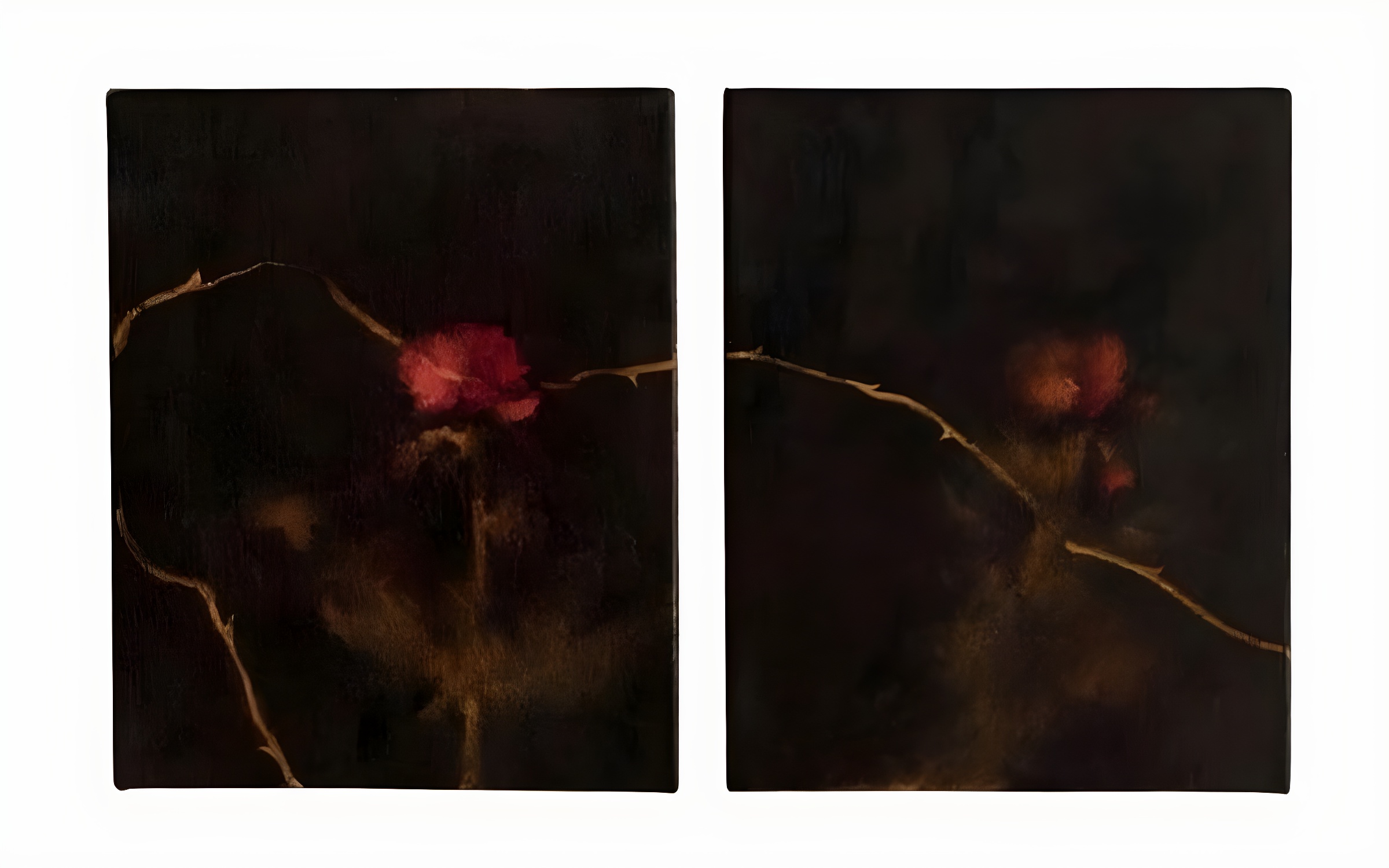
Amanda Nolan paints flowers that are not really flowers. They are figures, stand-ins, little ghosts, memory given form without being made specific. Working within the Heirloom series, now approaching its fiftieth painting after five years, the practice is built on a paradox: a grid laid in pencil at the start, then everything intuitive within it. The structure holds, the painting moves. Flowers from memory rather than observation, edges that overlap without tape, meaning that lives in the imperfection. What drives this work is an interest in what lingers after something has passed, the shapes that experience takes, the way moments leave marks and stay, even when the person who made them is gone.
Can you pinpoint a single moment when you realized art was your purpose?
I think it was always there, kind of humming in the background. It was less about discovering it and more about finally committing to it and getting past the fear of failing at something that felt so tied to who I am. I feel like my early 20s were me avoiding it without really realizing. I was hovering near it by working different creative jobs, but I was miserable. I cried all the time, and I couldn’t explain why. Nothing felt right. I remember hitting a point where I had to ask myself, why does everything feel so wrong if I’m doing something creative? And it hit me, it wasn’t the right kind of creative work. So I needed to commit to painting. Not casually, not on the side, but fully. And that was the moment I stopped ignoring the hum in the background, looked it in eyes, and actually chose it.
Can you take us through the evolution of an artwork from the first spark to the finished piece?
For my Heirloom paintings, the structure is set from the beginning. I start with a grid, laid in pencil, so there’s already a framework in place. But within that framework, everything is intuitive. Usually, the starting point is a feeling or a color scheme. I don’t go in knowing exactly what I’m going to paint. The flowers aren’t based on observation, they come from memory or a feeling, something less defined than that.
Once I start, I don’t move in any logical order. I jump around the canvas, building sections in different areas, and that allows the edges to overlap naturally. I don’t tape anything off because the slight imperfections and layered edges are important. They hold a lot of the life of the painting. A lot of the meaning is in the overlap. As the painting progresses, I start responding to what’s already there. Toward the end, I become more precise, but it’s always in reaction to what’s there, not a predetermined plan. So it’s structured, but it moves like a flow. And that balance is what makes it work for me.
Describe a piece that has held the most emotional weight for you.
Heirloom XVI, which I painted in 2022, is probably the most significant.
It was the first time I used a black-and-white checkerboard pattern and it was inspired by memories of my grandmother’s kitchen floor. She had this black-and-white tile that I remember so clearly from growing up. The black and white sections are filled with mostly pink and red flowers. My grandmother loved red, my daughter loves pink. It felt important to include both. At the time I made the piece, she was very sick. So it all kind of converges, the memory, the place, the timing, and the loss. It’s a very heavy piece, and it holds all of that for me. A few years ago, I had old family videos digitized, and there’s a clip of her doing a house tour, talking about putting that floor in. I had already made the painting before seeing that again, so it felt really meaningful to come across it afterward.
How do you challenge yourself to grow while staying true to your voice?
I think there’s a lot of pressure around the idea of authenticity, and so much outside influence. Even when you’re sitting in your studio alone in silence, you’re not really creating in a vacuum. There’s still this kind of noise, this frequency that comes with everything you’ve seen, absorbed, and been around. Ironically, the way I challenge myself to grow is by not being hard on myself. By not forcing constant change or always pushing for something new just for the sake of it. Sometimes growth, for me, looks like repetition. Allowing myself to stay with something long enough to really understand it, to say what I need to say, or express what I need to express fully before moving on.
If I look at the heirloom paintings, I’m almost done with the fiftieth one. I’ve been working on them for about five years now. From the outside, it might look like I’ve been doing the same thing over and over, but for me there’s been constant change within that. Small experimentations, shifts, discoveries, seeing what works and what doesn’t, and feeling the difference over time. At the same time, I do think it’s important to try new things. But I also find it hard to always share that experimentation. Not everything has to be shown or turned outward. Sometimes it’s just for me, or for different versions of me at different points in time. I’ve always told myself that when I feel a real pull away from the heirloom series, I’ll follow it.
And I have started to feel that lately, which is why I’ve been quietly experimenting with other things I’m not ready to share yet. So I don’t think staying true to your voice is about constantly pushing it to grow, and I don’t think it’s about protecting it from change either. I think it’s more about staying honest in the process, and being gentle with yourself while you move through it.
If you could communicate one core message through your work, what would it be?
I think it comes down to how moments shape us and stay with us, the way experiences leave marks, and how your perspective shifts over time. I’m interested in what lingers, even after something has passed, and the shapes that it takes. A lot of what I paint isn’t literal. It’s more about holding onto a feeling or a memory and trying to give it some kind of form. Not in a direct way, but in a way that still carries the weight of it. I want the work to feel familiar without being specific, so people can find their own experiences in it. And also because specificity doesn’t always stay with the person holding the memory. So it’s less about telling something clearly and more about letting it be felt.
How important is it for viewers to understand the intended message?
For me, ambiguity is a tool. It’s not about hiding meaning, it’s about allowing it to come through in a different way. My flowers are often stand-ins for people or memories, and sometimes I think of them more as figures than anything else. I call them my little ghosts sometimes. There’s always something underneath, even if it’s not immediately clear. I don’t feel the need to explain that directly. The meaning still comes through. People connect with the work in ways that are personal to them, and I think that’s the point. Sometimes saying something outright doesn’t actually communicate the feeling. Letting it exist in layers gives it more space to be understood.
Name five pivotal lessons that have shaped your artistic journey.
Trusting my intuition has been the biggest one. It’s easy to lose that when your work becomes your livelihood, because there’s so much pressure. But it’s also the thing that keeps everything aligned.
Taking risks is part of that. Not everything works, but avoiding risk usually makes the work feel flat.
Drawing from my own memory and experiences gives the work more depth. Even when it’s not obvious, it’s there.
I’ve also learned how meaningful connection can be. I didn’t anticipate the responses I’ve received. Seeing people connect to the work and find their own memories in it has been unexpected and really meaningful, and I’m so grateful for that.
Practically, I’ve found that I need both structure and freedom. Even in my schedule, I have work days, but what I do within them isn’t set in stone. That translates into how I paint. The grid gives me a foundation, but the improvisation is what brings the work to life. That balance shows up in everything I do.
Amanda Nolan stopped ignoring the hum in the background, looked it in the eyes, and chose it, and that decision, made fully rather than cautiously, is what the work reflects. The Heirloom paintings hold grief and love and memory in equal measure, and they do so without declaring any of it directly. The grandmother's kitchen floor, the black-and-white tiles, the red flowers and the pink ones: specificity transformed into something that anyone can find themselves inside. A pull away from the series has recently begun to be felt, and when it becomes strong enough, it will be followed. That honesty about where the work is going, and the willingness to wait until the moment is real, is the same quality that has made everything so far worth staying with.