
Claudia Di Francesco chose art the way one chooses a relationship that cannot be undone, not as a single decisive moment but as a gradual recognition that it had already entered and would not leave. Working across painting and sculpture, and building practice from photographic archives, layered memory, and the reverberations of light on ordinary surfaces, this is an artist for whom transformation is not a phase but a permanent condition. The work begins in overlap: memories colliding with sensations, past images surfacing through present observation, until something emerges that is never fully defined yet already clear in its energetic balance. From there, the painting takes over.
Art is often chosen as a medium for its freedom. Why do you personally turn to art, rather than another form of expression?
It is true that artists are often associated with a sense of freedom, but this is something that could be discussed at length. I likely turned to art because it represents a continuous challenge: a constant questioning, an ongoing transformation that moves alongside everything that shapes daily life, from the way we observe spaces to events, reflections, and experiences.
I chose it because it feels like a lover that becomes love itself; once it enters your life, it is impossible to let it go. And like any deep relationship, it requires time, space, and freedom, but also dedication and structure. Of this, I am certain. I do not believe that art is only about expressive freedom. It is much more than that. It is a complex composition of elements that must be discovered, brought together, and sustained in a precise balance. Then, at a certain point, it asks you to transform again, to seek a new form, and the process begins anew.
How do you challenge yourself to continually grow as an artist while remaining true to your voice?
In my view, listening to oneself and evolving is the foundation of an authentic visual coherence. Whether the work remains similar or becomes entirely divergent, what matters is that it is always in transformation. For me, this is the key to growing as an artist without betraying the truth of one’s voice.
It is not an easy path. There is always a tendency to avoid change, especially when what you are doing is appreciated. Yet that is precisely where I see the beginning of a possible decline. Art involves risk, and that is also why one chooses it. Making art means understanding oneself, but also reaching a point where you may no longer fully recognize what you create, or where you rediscover yourself in unexpected ways. If this tension, this space of uncertainty and transformation, is lost, then the possibility of true evolution is lost as well.
How do you approach criticism, whether from peers, critics, or audiences?
I should say that I am sensitive, but in this field it is necessary to learn not to be. At the same time, I truly value thoughtful criticism, especially when it is well-argued and contextualized. Over time I have received many kinds of feedback, often contradictory: opposing advice, different perspectives, all kinds of opinions. I would go home and reflect on what was said, always trying to process it with clarity. I absorb these observations through my own sensibility, and continue to study before translating them into my work.
There are moments, however, when it is necessary to listen and then set things aside. Not because criticism is not valuable, on the contrary, advice is always precious, but because at certain stages a more internal form of listening is required. In those moments, external voices risk overlapping with one’s own perception, and you can lose direction. What I seek is an authentic direction, something that is true, that can be felt, that vibrates. When I begin to glimpse it, even partially, I develop it through listening, continuous production, and, fundamentally, observation.
Can you walk us through the evolution of an artwork, from the first moment of inspiration to the finished piece?
My work begins with an overlap of memories and sensations. It is a pictorial composition that takes shape from a gaze resting on simple, natural elements, colors, details, and above all the reverberations of light. These stimuli recall other memories, which transform and settle, becoming forms or re-emerging through studies, previous works, and traces of the past. For this reason, I build photographic archives. I go out, take pictures of moments, light, reflections, and landscapes that bring memories to the surface. I also collect images of works that, within my research, have captured mystery and attention: sculptures resembling archaeological fragments, paintings that strike me for their mastery of color and the atmosphere they evoke, elements that in turn open up further memories.
Gradually, an image forms that is never completely defined, yet already clear in its energetic balance. It remains open, but present. When I begin to paint, that image fully takes shape. It changes, transforms, evolves through the process, yet its essence remains intact. I prepare the canvas, lay out the paper, work with vegetable glue; I put on my red headphones, make a coffee, wait for the paper to dry, and begin to reconstruct the image. Colors suggest new directions, the randomness of brushstrokes opens others, the line defines them, and slowly the image emerges. Some works are more difficult to visualize and take longer, as they are built through multiple layers; others appear almost as if by magic. What continues to surprise me is precisely this unpredictability.
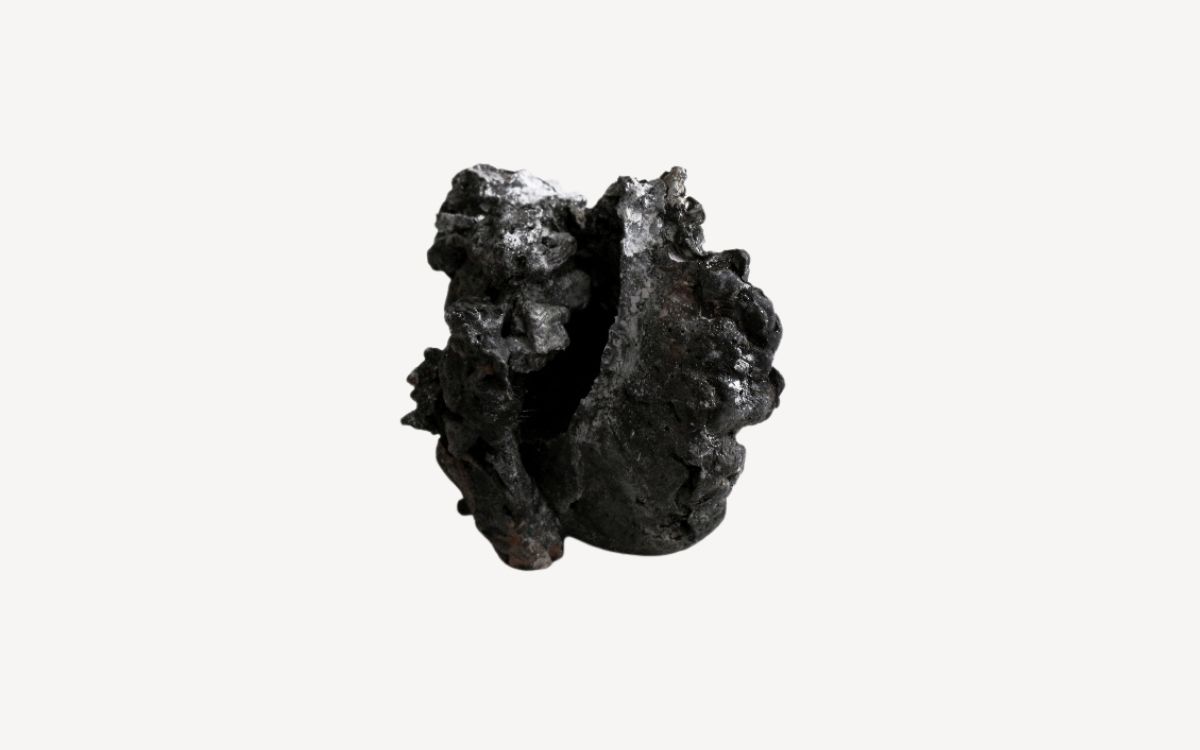
In sculpture, the process is different, almost inverse. Sculpture connects me first to a sense of impulsivity and pure gesture. Only afterward does the compositional phase begin, where fragments are organized through casting, structural planning, and chromatic decisions. Already in the initial modeling in clay, the form begins to suggest memories, either dreamlike or earthly, and from there comes the choice of pigments and materials, in a continuous dialogue between intuition and construction.
How important is it for you that the audience understands the message you intend to convey? Does ambiguity add value, or do you seek clarity in your expression?
For me, creating comes from a deep necessity. It is a form of love that one chooses, and like any relationship, it carries difficulties and possible disappointments. Within this dynamic, the audience becomes a mirror, reflecting back what you are together. It is important to me to create something that originates from a subjective dimension but can be communicated in a collective way. Whether it is a form, a light, or a chromatic layering, what matters is that it can be shared, perceived, and experienced.
Do you think an artist’s passion is something predestined or a conscious choice?
It is both, one cannot exist without the other. Passion may have a deep, almost inevitable root, but it is through conscious choice that it takes shape and develops over time. An artist must cultivate this awareness, moving fluidly between visions and ways of seeing. It is through understanding what one perceives and how one feels it that evolution takes place, giving rise to an authentic and ever-evolving artistic process.
How do you think art should be valued emotionally, socially, or economically? Is there ever an objective measure?
All these dimensions coexist within artistic work, and this is precisely what makes it complex: finding a balance between emotional, social, and economic value without losing oneself. The artist lives through what they see and how they perceive or feel it; society observes and interprets, while the market responds. These elements are interconnected, forming a chain in which each part influences the other. To deny this, in my view, is to avoid acknowledging how the world functions. At the same time, this should never diminish the creative process or the poetic essence of the work, but rather stimulate it. It is within this tension that one of the most complex challenges of making art emerges.
Claudia Di Francesco is an artist who understands that the moment a practice becomes comfortable is precisely the moment it risks beginning to decline. That vigilance, about transformation, about the risk of losing the tension that keeps work alive, runs through everything said in this conversation. The red headphones go on, the coffee is made, the paper dries, and the image begins to reconstruct itself through color and brushstroke and the unpredictability that continues, still, to surprise. What is being built, across painting and sculpture and continuous observation, is something that vibrates, and that, when it is working, can be felt.