
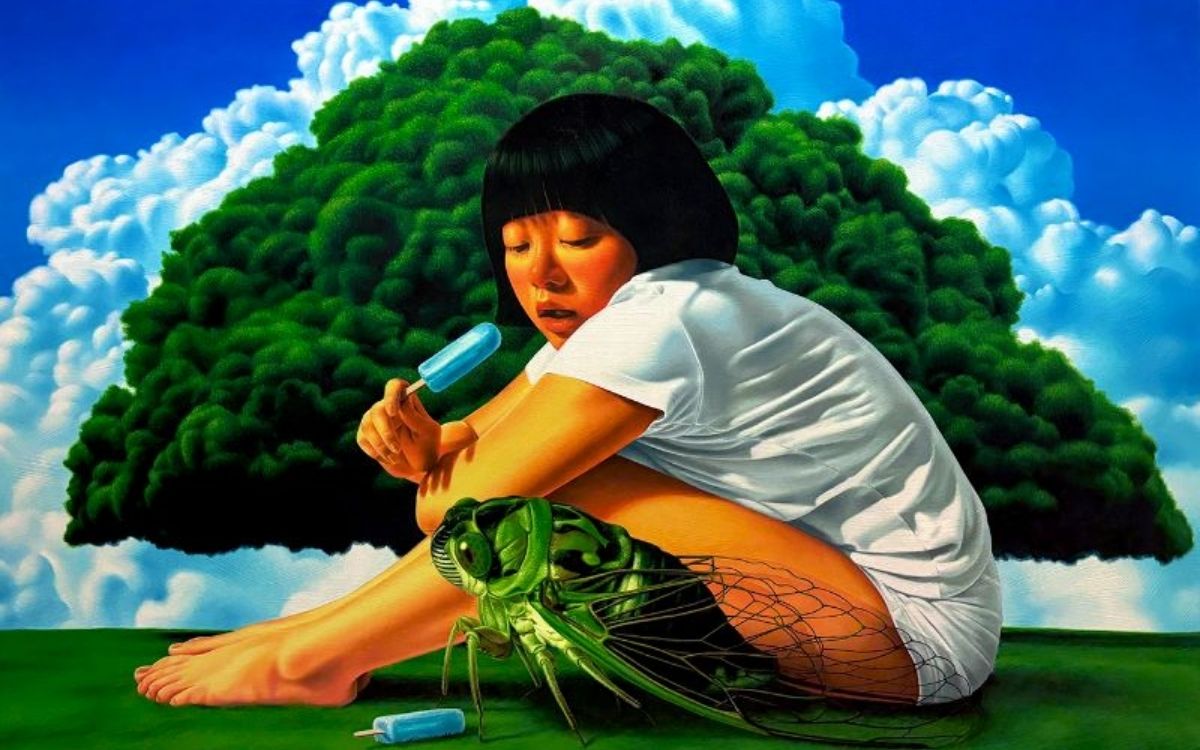
Hayley Chiu grew up in Markham, Ontario, a Canadian suburb with a Chinese heart, where North American surfaces contained something much older and more particular underneath. That experience of in-betweenness, once felt as lack, eventually became the foundation of a practice. The turning point was a snail: the idea that home travels with you, that the middle point of convergence is not a place of loss but of possibility. From that realization grew "Snail's Home," a series of surreal, dream-like paintings drawn from Chinese sayings, Canadian landscapes, childhood memory, and cultural imagery absorbed over a lifetime of moving between two worlds. Always becoming, never towards a fixed destination, just in motion, and safe within that motion.
How has your upbringing/cultural heritage shaped the themes and techniques you explore in your art today?
I’m from Markham, Ontario, a Canadian town that was very Chinese for its time. My parents moved here from Hong Kong in the 90s amidst a wave of Hong Kong and Chinese immigrants. There was always a feeling of in-betweenness here in how it took the appearance of a typical suburban town that you'd see in old American kids' movies, but beneath the surface, everywhere was Chineseness. People, language, food, media, just stuffed into a North American container. Being born and raised in this environment, it was impossible for me not to fall in love with my language and culture, it brought me closer to my family, myself, and a faraway home that felt more symbolic than real. Spending most of my time here and my summers in Hong Kong, I became more aware that the in-betweenness was more than just in my surroundings, but a part of my identity. For a while, I saw it as a lack, that I wasn’t enough of one thing or the other and swinging between leaning into and giving up in attempts to find the answer to “Where and how do I belong?”.
Later on, I found my answer when thinking of snails. They inspire me, the way they take their homes with them wherever they go. Why shouldn’t I be the same? This middle point of convergence that I was afraid of is where I thrive, an abstract place manifested into the physical form of my body. It became the cornerstone in my series that I named “Snail’s Home”, depicting a continuous journey through surreal lands and shifting forms. Always becoming, not towards an end goal, but just in motion. Always willing to be curious with the confidence that I am safe in the protection of my body and home. Each painting, like the title of the series itself, starts from and is named after a Chinese saying that I interpret from my perspective and transform into personal guides. The imagery and colour palettes are drawn from my own life, the memories and experiences in Canadian landscapes as well as cultural imagery absorbed from Chinese media and traditions, coalescing into surreal and dream-like narratives.
How important is it for viewers to understand the intended message of your work? Does ambiguity add value, or do you seek clarity in your expression?
I believe my paintings thrive in ambiguity. Scenes unfold and change, things look familiar, but in ways that seem unnatural. It’s not intentional, but hard to avoid with the layers of personal references that I work from. Chinese sayings translated into English can be hints for those who are already familiar with them, but then there are still my interpretations of them, with imagery from my own memories, that make it pretty difficult to grasp fully without a thorough explanation of each element. It just made the most sense for me to paint “Snail’s Home” this way. Despite all the scattered pieces, I don’t think it prevents people from enjoying the work. Instead it makes them more curious to ask why and insert their own interpretations from their unique combinations of memories and perspectives.
Even though the message may seem buried beneath, the ambience and emotions remain. My work is the kind that, once they leave the studio, I no longer have control over the meanings and values that people ascribe to them. I paint a lot of things from the everyday, none of which are mine, but I give them my own meaning. Why should it be different for the viewer? My paintings are extensions of myself, and I wouldn’t spill my guts to everyone I encounter or force who I think I am onto them. I think it’s more effective and authentic to show than to tell.
Is art created for the artist, the audience, or somewhere in between?
For me, art is most genuine when it’s created for myself. If I don’t care about what I’m making, I can’t really expect others to. Why should I be an artist if there are numerous other ways to get validation from others, without first needing acceptance of myself? That’s not to say the goal should be to make art that only works for the artist, I think we make what we want to see in the world, but we aren’t islands. What we do will find its audience and be the bridge between artist and world. This was one of the things I learned when I created “Snail’s Home”, where my goal was to try making a body of work that was so meaningful to me that I wouldn’t consider whether it mattered to anyone else. I would give physical form to my inner world, and wouldn’t paint anyone but myself in them. If other people didn’t get it, that’s okay, hopefully my painting skills alone were good enough to draw people in. I could even leave the work unexplained as pretty mysteries that put me behind a thin veil of intrigue and distance, the true meaning of the work a secret only for myself.
Perhaps it’s because I thought nobody would care to stay for what’s beneath the surface that I had the impulse to draw from a place so personal. It wasn’t until I showed the paintings for the first time at my grad show that I realized my paintings had already become larger than myself. I didn’t expect it to be important to me that others genuinely connected to my work and to me, more than just pretty things to look at. I felt my story was understood in ways that I didn’t know how else to say. When people see my work and smile, or even cry, I feel fulfilled that I can bring this emotion into the world. For art to be effective, the audience has to feel its depth, and that is the passion, love, and emotion of the artist.
Can you take us through the evolution of an artwork, from the first spark of inspiration to the finished piece?
Fly spotting / 拍烏蠅 was really memorable for me because I only had two weeks to do it, from start to finish - conceptualize, draft, and paint, for a deadline. Normally, I prefer to take my time for inspiration to arrive, and painting alone takes me at least a month for something of that size. I was anxious if I could even do it, but acting more intentionally and focused proved to me that I don’t rely on luck as much as I thought, and I really could if I tried. I first thought of the saying when I watched “The Way of the Dragon” in theatres, where it was dubbed in English, among a mostly non-Chinese audience.
There was a scene of waiters sitting at a table in a quiet restaurant, smacking a fly with a swatter. I understood it was literally acting out “拍烏蠅”, or “smacking flies”, in charade. It describes a business doing so horribly that the workers can only keep themselves busy by smacking the flies. I wondered what other viewers made of this without this piece of context, if they noticed it at all. I felt a familiar connection to this association of boredom and flies, because I also enjoy staring at the flies that land on my window when I’m bored. I like watching their little movements, the details of their anatomy capturing my attention and slowing me down when everything else feels too fast-paced and demanding. It’s like we're so uncomfortable with boredom that we’re quick to fill empty moments with another kind of noise, instead of allowing ourselves to stop. The word “拍” means “to smack” in the original saying, but “拍” can also mean “to photograph”, so I started thinking of a double meaning and play on perspective - when faced with boredom, do we attempt to destroy it, or slow down with it?
Before painting, I always make a digital collage in Photoshop that acts as my reference image. I don’t have access to most of the things I paint for me to take a proper photo, and I enjoy experimenting with colours and compositions here rather than leaving it to be decided on the canvas. I chose a Hong Kong-style café interior, with myself posing as a waiter watching a giant fly zoom by. My hand would hover over both a fly swatter and a camera. After photographing myself, I planned the environment and made sure it felt believable and real (I have a silly fear that someone who actually knows what I depict, in this case a Hong Kong-style café regular, would see my painting and catch the errors). I watched “The Lucky Guy”, a Stephen Chow movie revolving around Hong Kong-style café culture, to get a better grasp of the interior and vibe. Then I built “the set” with cut-out textures and furniture I found on the internet.
The painting stage was the most straightforward part of the painting, which is quite rare. I had to plan strategically for how I’d paint it, so it could be quick but still refined with depth. I considered the order, estimated how many days I’d spend on each part, from furthest to closest, and potential wait times if additional layers were needed. Some might think my painting style isn’t intuitive, even rigid, or wonder why I choose paint as my medium if I don’t let myself “push the paint around”. For me, the most satisfying part of painting is rendering and getting the colours right as I imagine them, taking my time to turn blocks of colours into polished forms. Creating a digital collage first eliminates the distraction of trial and error needed on the canvas (which can be very stressful with wet paint), and also allows me to achieve very unexpected effects and colour combinations. In the end, I finished right on time! I had a blast making this piece, and it gave me a lot of confidence moving forward about what I’m really capable of.
Describe a piece you’ve created that has held the most emotional weight for you. What makes it significant?
A painting I always return to is The moon shines her light onto the earth / 月光光,照地堂. It was one of the first paintings in “Snail’s Home”, and is really special to me because, when it came together, it felt as if forgotten pieces of myself had resurfaced. They clicked together, my past joined with my present. The words are from a Chinese lullaby my mom would sing to me when I was a baby, perhaps the first of many Chinese songs I would grow up hearing. These words were buried in my subconscious after she stopped singing me to sleep, but I grew up connected to Chinese music because of my parents. I hadn’t started listening to it on my own until I became a fan of Faye Wong in my teens, and later in 2021, I chanced upon her new song that would inspire this piece. In “灣”, she sang those words again, and it felt like something from deep within me had jolted awake. I was transported back to my childhood and felt a warmth and wholeness to hear her sing it. Suddenly, I understood that my mother had given me this song when I was a child, and with it, her love and her culture.
As I grew up, I held on tightly to the gifts he had given me, shaping them into my own and discovering these parts of my identity for myself. The words themselves feel like they describe my mom and me; the moon is my mother, and her love, her light, nourishes me as the carrot still buried in the earth. I’m big and healthy and bright, bursting to the surface as my leaves stretch high to meet her. The sky is like a patchwork quilt, but also made of the “rice grids” I grew up using to practice writing Chinese characters as she sat next to me, teaching me how. The sky is made of many different colours, her presence unchanging throughout all the evenings that she has spent with me.
How do you feel social media is shaping the way art is created, consumed, and valued today?
I think one of the most significant ways in which social media has influenced art is how everything has become so much faster. Mainstream social media has become how we primarily experience and share art now, and it exchanges the experience and impact of seeing art in the flesh for the accessibility and visibility of seeing art on the internet. I’ve been posting my work on Instagram since I was 13 and always had an anxious relationship with it, mainly because it felt like my value was being measured by its numbers for everyone else to see. Now that I’m older, and slightly less bothered by it, I can see how it can do good if we don’t let ourselves be dictated by its rules. We get to discover art and communities across the globe, and it’s much easier to be seen by opportunities and galleries. It doesn’t take artists who are just starting out as long to make their mark, and for much less, too. But social media’s pace doesn’t match that of creation. Art is slow, and suddenly there’s a pressure for artists to be content creators on the side. Every step of the process needs to be milked into a new post to maximize engagement. The tools are there, so why not make use of them? It could be beneficial and even act as a source of income that wasn’t an option before.
But for others like myself, it can be tiresome and distracting - it takes me weeks of undivided attention just to create a painting, and I don’t have it in me to consistently film and edit videos. I’m just not a hustler! We have access to so much wonderful art instantly, but that art is only seen for seconds, liked, scrolled to the next, and forgotten. It’s like the biggest achievement is for art to go viral. At a gallery, people can stare at a painting for 10 minutes, walk away, and return to ponder it all over again just because it’s captured them so much. But nobody has the patience to stare at an image on their phone for so long, not when there’s always more to see. How we enjoy, what we enjoy, and how long we spend loving it and then tiring of it. Maybe it’s not only art, just that social media has permeated so much of our lives that it’s hard to discern what came first. Art has always been influenced by the social, it’s just that now it’s moving much faster.
What are your long-term aspirations as an artist, both personally and professionally?
I always feel a little embarrassed to share this, but my relationship with art hasn’t always been as great as it is now, especially during a lull in my late teens. Art had always been a passion and talent of mine, but at a certain point I wondered if I loved it for myself - it felt more and more like I did it because I’m good at it, and people expect me to and like me better as an artist. On my own, I didn’t know what I wanted to do with it or what personal voice I had, and sometimes I wondered how and why I used to love drawing so much as a child. Would I still do it if nobody cared?
During this time, I might’ve hoped that I could achieve some sort of reputation to prove to others and myself that I’m a good artist, because I desperately needed that external validation. Things took a turn for the better in university when I slowly began to rediscover my love for art and painting. It brought me a simple and childlike joy, and I felt a change not only as an artist, but as an individual, too. I learned to be vulnerable with myself and communicate my thoughts and feelings in ways that I’d be too afraid to share otherwise. This growth is what I cherish the most about being an artist, and the realization that what I want to learn isn’t lost in a faraway place, but within me, the world, and painting. Now I only hope that as I continue to paint and grow, I can fall more and more in love with painting and being alive.
What emerges from this conversation is an artist who has learned, slowly and with genuine difficulty, that the most personal work is often the most universal. The paintings kept behind a veil of personal reference, the lullaby, the flies on the window, the rice grids that double as a patchwork sky, turned out to speak to people in ways that surprised even the person who made them. Hayley Chiu paints to fall more in love with painting and with being alive. That is not a small ambition. It is, in fact, exactly the right one, and the work being made in its service is already something worth staying with.