
Robert Roest grew up in a conservative Christian household where every cultural expression was measured against a single standard, and where contemporary art, film, theater, and modern literature were largely absent. That restriction produced not indifference but fascination, a curiosity about all the things that were kept at a distance. When the religion itself eventually failed to hold up under serious scrutiny, something loosened: a practice began to emerge that placed the act of seeing at its center. How we see, how our views shape what we see rather than the other way around, how utterly fallible and incomplete human perception is these became the animating questions of a body of work that has only grown more urgent as the world outside the studio has demanded a response.
How has your upbringing or cultural heritage shaped the themes and techniques you explore in your art today?
I grew up in a very conservative Christian family. My father is a decent draftsman, but I grew up without a lot of (contemporary) cultural heritage. In that community we weren’t allowed to watch films, listen to non-christian music, no theater or dance. Modern literature wasn’t really appreciated. Every cultural or artistic expression was meant for the glory of the Christian god. Old masters were appreciated, but contemporary art not so much. As a curious person I had a fascination for all these cultural expressions. Once I started to try to internalize and embrace this religion from within, rather than going through the motions, I stumbled on many ethical and intellectual problems with Christianity. Initially I tried to find answers within the broad tradition of Christianity, from very conservative to very progressive, but the more I studied it the more I realized that it didn’t make sense to me and that it didn’t appeal to me in so many ways. That process took a few years. Ultimately, I started self-studying modern bible scholarship, studying these texts without the assumptions that believers make. That was very liberating to me, as I realized the biblical texts were not divine but all too human. Soon after studying it I left Christianity behind.
I realize that my work is very much rooted in these experiences. I am very much fascinated by how our senses, especially our eyes, see the same world in so many different ways. How our seeing relates to our views, how our views often shape what we see, or what we think we see, instead of what we see shape our views. I left the religion of my upbringing behind, but later in life, when my paintings asked for it, I recovered and re-appreciated the old masters again that I was brought up with.
Does spirituality or a connection to something larger than yourself influence your creative process?
I think so. I realize I don’t come to my ideas from nothing, or by sheer personal will and creation out of nothing. I feel like ideas are given to you, you get, receive ideas. That initial spark seems lit from the outside, from something larger than yourself. But that larger something can only express itself through that ‘ smaller’ thing that is you. It’s as if ideas are floating around in reality and they want to take on form. It tries to find the path of least resistance; it finds the person who has the right predispositions and skills to give form. This is how it feels. But I don’t think of this in an anthropomorphic or personal way. I don’t think there is some agent larger than myself deliberately picking me out and putting an idea in my mind. In a way that larger something is larger than you, but from the perspective of that something you are perhaps the larger one. Without the artist that something, that idea stays formless, unexpressed and in oblivion. What is ‘larger than’ is a matter of perspective.
How does your art engage with or comment on pressing contemporary issues, social, political, or environmental?
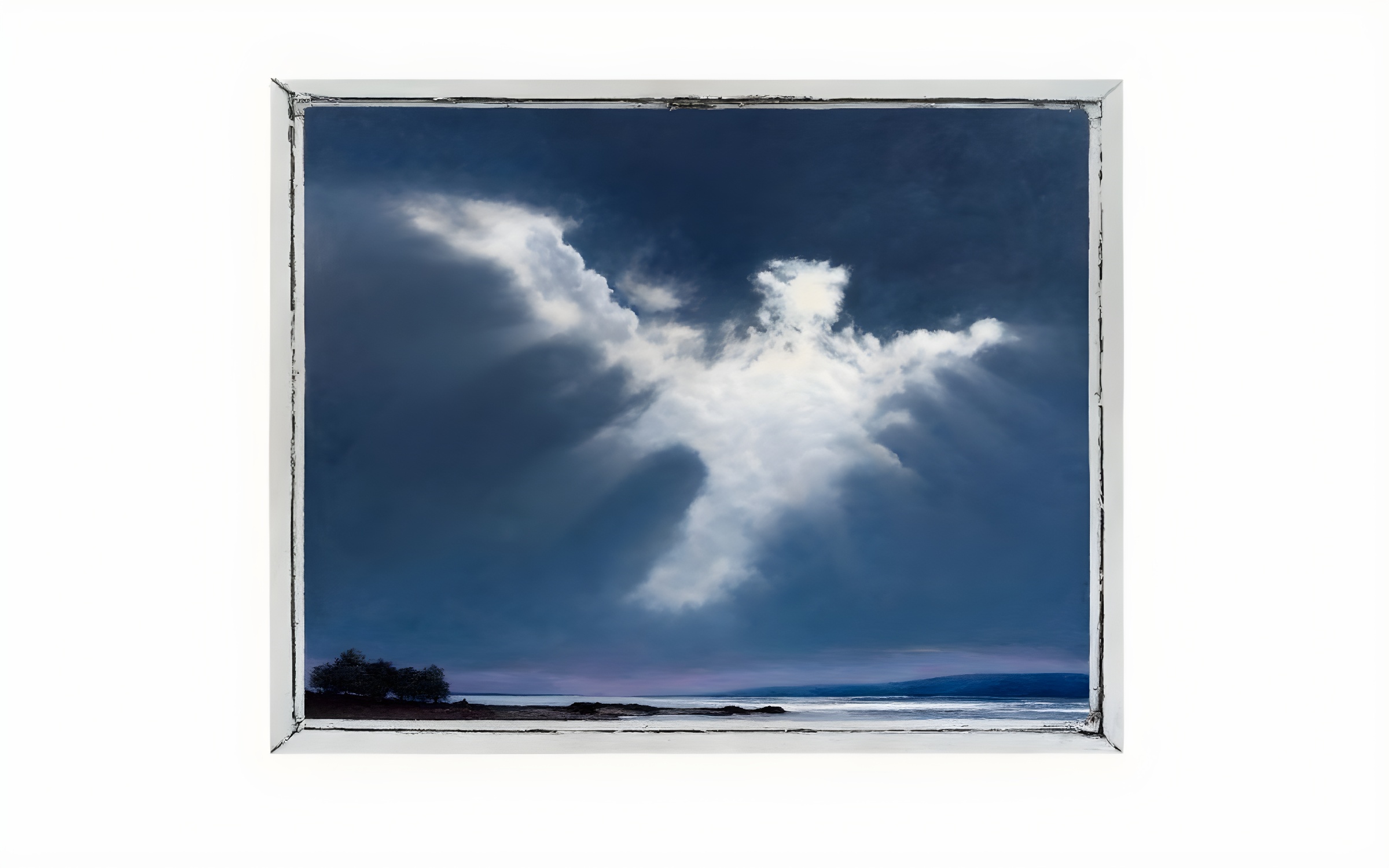
This question became a desire and became more and more urgent for me to engage with seeing what we as humanity are going through the last few years in late stage capitalism. Worlds, natures and peoples and cultures are being destroyed in the name of capitalism and neo-liberalism. When the genocide in Gaza started, I was working on a series of clouds. Most of them don’t refer to a specific time and place in history. But the conventions, the framework of that series allowed me to fit in something of these pressing socio-political (and even environmental, as genocides also release an incredible amount of CO2 emissions) issues. The cloud paintings are made up from a stroke of landscape at the bottom, making up like 10% of the canvas, and a cloud often taking on the form of a figure that resembles and angel or demon. That part takes up 90% of the painting.
The whole view is framed by a trompe l’oeil painted weathered window frame. In two of those paintings I painted a dark menacing, evil, grim looking cloud figure, looming over Gaza-City. One where the city is still standing, but awaiting this evil fate, and the second one where the city is in ruins. I am also working now on a series of Palestinian tunnel paintings. I wanted to paint tunnels for years, but was working on other series, and hadn’t really found a good reason to paint it. After I came across the Palestinian tunnels I could root, ground this idea in a reality that disturbs me as much as it interests me.
What do you think is the most meaningful role an artist plays in society today?
I think it depends on the time you live in and the issues at play. I think art should be free, and we humans should be able to express everything we want, from just sheer beauty and art for art’s sake, till engagements with important issues in society and the world. For me personally I feel like it’s more meaningful now to try to make art that could be a bearing witness to what goes on in the world. It would be wrong to me that when in all of this (capitalist and supremacist) destruction going on, if we as humanity are still around in 50 years looking back at the art at this time and see a self-absorbed art, its-own-tail-chasing-dog art world, producing distracting, harmless, sweet commodities for the wealthy, that would be a shame. I would want to see a bit of art with that tries to reflect these big issues, with the same gravity, care and seriousness as let’s say a Goya or Käthe Kollwitz.
Do you think art should have a political or ideological agenda?
That’s a difficult one. I think it’s important to form an ideology and political view that makes sense and seeks to serve justice and truth. I think though that art should not be constrained. Not constrained at all. Artists should be able to make whatever they want; it should really be free. Although I am a Marxist myself, and approach communist states with quite an open, good faith perspective - like I try to understand why they made the choices they made, also the bad choices - ultimately, I have more loyalty to critical thinking in service of truth and justice than to an ideology. I’m happy to be part of a tradition but have no problem to be a heretical one if I see so fit. In the USSR under Stalin the communist party wanted the arts to be in service of the working class. All the arts must be ‘socialist realism’. And although I can see why art in service of the working class can be very interesting and noble, and I welcome artists that freely choose this perspective, I think this ‘should’ is very dangerous. What happened in the USSR under Stalin is good example of what can happen if we say ‘art should...’ Incredible filmmakers, composers, writers, artists etc. had to flee from the USSR because of that. The Marxist worldview is one about liberation and freedom from the shackles of capitalism and exploitation, but if you constrain the arts with ‘should’ or even ‘must’ it stifles freedom and liberation, sometimes even till death. I deliberately choose an example out of a political ideology, tradition I am sympathetic too, or see myself in the tradition off. Self-criticism is important and I want to highlight that even under a political ideology that’s about liberation of the oppressed it can go terribly wrong if we constrain the arts. We can never demand that art should serve this or that ideology. It needs to be really free indeed... But I could’ve given also countless examples of art under the ‘should’ and ‘must’ boot of the ideology of shackles and oppression: fascism and capitalism.
How important is it for viewers to understand the intended message of your work? Does ambiguity add value, or do you seek clarity in your expression?
It’s quite important to me. I remember that I once was annoyed by the idea that I get really excited about an idea and make a body of work about it, and then the spectators have a complete other interpretation or view of it. I was like, I received this idea, and I want to transport that to the spectator, so the spectator can see what I saw and was so excited about. But of course, I can’t dictate what people see and understand. So, I wrestle with it, although in a playful way also enjoying this tension. If I want to express my ideas clearly, I better use the medium of writing perhaps. Pictures, art are much more prone to ambiguity and can be interpreted in different ways by different people because of their different experiences, views and knowledge.
What also is an issue, I might be clear in my work with respect to the idea I got, let’s say I am, but the spectator doesn’t necessarily have the tools and insights, or experience with the history of art, or knowledge about my work, or maybe because he sees it for the first time without foreknowledge or context, to recognize that clarity. So, I guess I try to seek clarity in my work with respect to the idea, but accept ambiguity with respect to the spectators relation to my work.
Have you ever struggled with the ethics of your art, such as who it represents or who it impacts?
Yes, I have, and I do. Much of my work is about the nature or of seeing. How do we see? What do we see? And how do or views shape what we see, and what we see shape our views? Also, very much about how utterly flawed and terrible, and fallible and incomplete we are at seeing and forming views. We have not evolved to see the truth of things but to adapt to environmental and social challenges, and as it turns out not seeing the truth can enhance that adaptation. These adaptations are made blindly, not with vision and with long-term consequences in mind. But more and more I questioned for whom I make this and who’s enough of a nerd and interested to engage with my work like that. I think much of my work is about these ideas I mentioned, but at the same time I’m very much aware that paintings don’t communicate such ideas very well. Painting is not the best medium to communicate an intellectual or moral idea clearly. It’s in the end much more of an emotional and aesthetic communicator. But I questioned whether I make it just for an in-group of art world colleagues, friends and fans, and for people with too much money who can afford to buy a big painting... Or just myself. And I guess I make it for everyone who’s interested, including the above. I diversified my practice to also have work that can be bought for a price basically anyone can afford. Like 100 dollars for an etching to decrease some of that tension.
Since I’ve been witnessing Gaza being erased by, with the help of the US empire where I live, it felt ethically a bit wrong to me not to make work about these matters. It felt a bit wrong to me in a moral sense to just paint angry dogs, or pastoral clouds. I wished we lived in a society that was just and fair enough so everyone could just make and create whatever it wants, silly, toothless paintings for it’s own sake. But as the state I pay taxes to inflicts so much suffering on the world I feel like I must make paintings about that reality.
So, I am painting the Palestinian tunnels. This is morally sensitive material. And I knew that when I started it. If you are a Palestinian, or sympathetic to the Palestinian struggle for liberation you look at these paintings differently than an Israeli who’s been held hostage in these tunnels. Or when you’re a Zionist. I have experienced some backlash. Not a serious critique of the works, but just simplistic outrage, harassment and even some threats, based on a very crude interpretation of the works.
Some art is challenging, causes moral outrage, presses on wounds, touches a nerve that doesn’t want to be touched, confronts you with something you didn’t want to see, or maybe even slightly traumatizes some people. Some art is seen as controversial. And my tunnel paintings are seen like that by some people. But I don’t think I have a moral duty to appease them, I don’t feel like I must appease my ideological enemies. I don’t have to be very careful with the feelings of supporters of a state that commits the crime of crimes; genocide. I don’t think I should try to make work that is harmless and doesn’t upset or challenge anyone. Although I am not the kind of person who likes to provoke or wants to provoke for it’s own sake or for the thrill of it - I don’t feel that thrill at all, and much rather am I being understood and approached in good faith- sometimes I have an idea that I think is worthwhile making not because it might be provocative to people, or can be misunderstood, but despite that. I like to make work that can be challenging, but I don’t like to cause outrage. I want to have the courage and integrity to make a body of work I think is worthwhile anyway because I owe it to that idea that was given to me. And if that unfortunately results in some backlash, that is what it is.
I’m not the only one though who makes representations of these tunnels. An Israeli artist made a replica tunnel that was shown on a square in Berlin to empathize with Israeli hostages. Pro-Israeli’s wrote their names on this replica tunnel. So it’s not so much the tunnels themselves that caused the harassment, the same tunnels brought pro-Israel people together in Berlin, but the fact that someone who stands with the Palestinians paints them. I’ll paint this replica tunnel also and include it in my project to make it more ambiguous and layered.
I don’t think my work represents a group of people, or some identity. I don’t speak for anyone. I’m not elected by a group of people who wants me to represent them for something. There’s no democratic, social process underpinning my work with input from a specific group that made me a representative. You cannot on your own accord represent a group of people, only a collective can make one a representative, so I only represent myself and make what I receive in my mind and holds to be interesting, not only for myself but also for a larger public. But I do take a stance, which can be noticed in several paintings, and that is a stance with the oppressed against the tyranny, imperialism, racism, fascism, zionism, white supremacism, capitalism and religious fundamentalism of all kinds.
I have a little bit of moral ocd, and I was like, can I as Marxist, anti-capitalist even engage in the artworld which is very much capitalist? Like is it ethically legitimate to spend my time making commodities, who knows culturally interesting commodities, but still commodities, for rich people’s houses? I don’t really have a satisfying solution to it. Life is messy. And to me a satisfying enough justification is that I should try to spend my time doing that thing I have some talent for.
If you could communicate just one core message through your entire body of work, what would it be?
Look! Don’t look away! See! View! Look-back, look-ahead! En-vision! Re-view! Re-vision! Look! Don’t look away! See! View! Look-back, look-ahead! En-vision! Re-view! Don’t look away! And so on, till your last breath.
But I know this is too much to ask, also to ask of myself. It might be ethically the right thing to do, but we cannot biologically, mentally afford to see it all. It’s just too much, and too bad. But maybe we can try to see a little bit more, with a little bit more accuracy and openness.
Robert Roest is an artist wrestling honestly with questions that most practitioners prefer to leave unexamined: who the work is for, whether painting is even the right medium for the ideas it carries, and what it means to make art while a state you pay taxes to commits atrocities. The Palestinian tunnel paintings, the clouds looming over Gaza, the ongoing negotiation between intellectual integrity and the realities of the art market, these are not separate concerns but parts of the same sustained ethical inquiry. The core message, offered with characteristic directness, is also the simplest and the most demanding: look. Don't look away. Keep looking until the last breath. That is both a practice and a position, and Robert Roest holds it without flinching.