
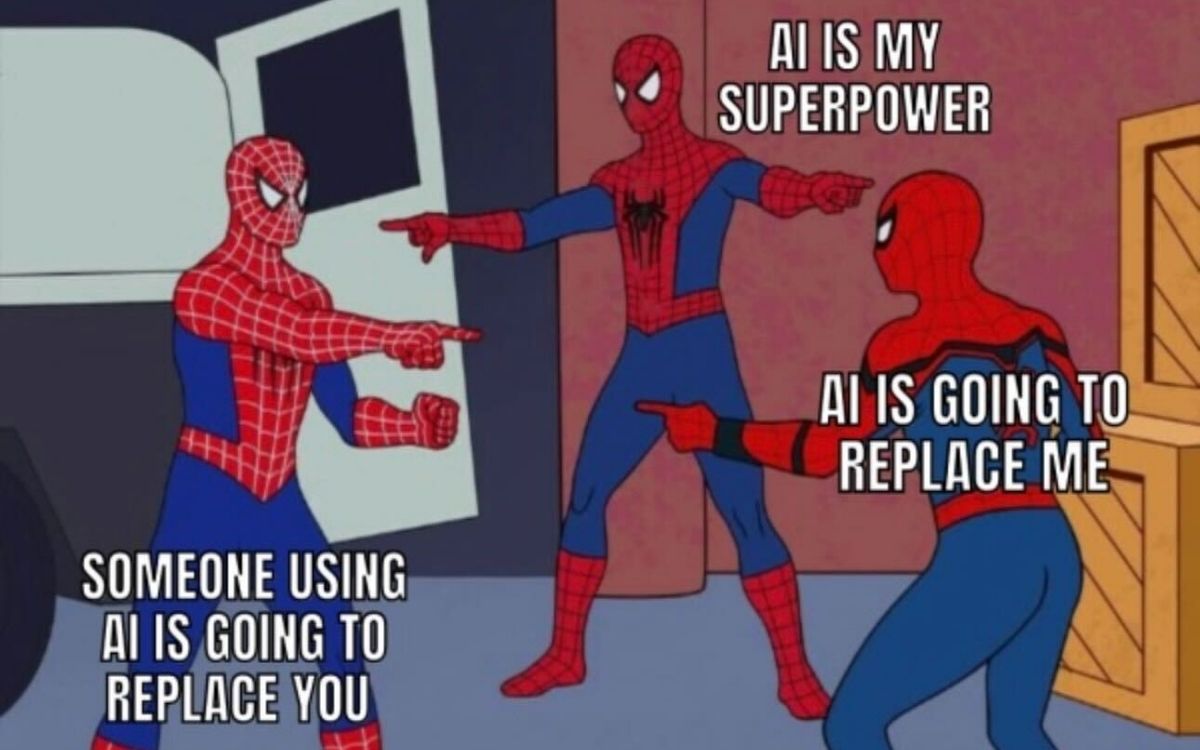
The artist burns out. Takes a break, comes back inspired, opens Instagram. The algorithm buried them while they were gone. AI filled the feed. The audience forgot. They post anyway. Nine likes. One is their mum. One is a bot. They post again tomorrow.
Another artist opens Midjourney. Types a prompt. Something comes back wrong. Extra fingers, collapsed architecture, an erased face. They lean in. Screenshot it. Build a whole practice around the failure. Post it. It is the best thing they have made.
Tell us this doesn't sound familiar.
Is AI a threat, a tool, or a collaborator for artists? Depending on who you ask in this piece, the answer is all three. But most of the artists we spoke to suggest the question is also, at least, an incomplete one. The debate tends to stop at what gets made, what gets lost, and what gets replicated. Underneath sits a question nobody is asking as directly: what making art does to the person doing it, and what we lose if that gets optimised away.
This piece draws ten contemporary artists who have recently elaborated on their view on this topic via their spotlight interviews: Yap Jiaern (Malaysia), Eileen Feng (United States), DAMN TRUE (Russia), Maria Natalie Schmidt (United Kingdom), Julia Ploch (Poland), Despina Charitonidi (Greece), Rebeka Grižon (Slovenia), Hanjironi (South Korea),Valeriia RikiTavi (Russia), and Anton Ian Nielsen (Denmark). They might not agree with each other, but they keep arriving at the same underlying question: not what AI will do to art, but what we will allow it to replace, and what happens to us if we let it.
What the Data Shows
Before we delve into the ten artists, let's zoom out a little. Alongside the Spotlight interview series, Artit runs its own independent global study on how artists worldwide are experiencing the AI shift: economically, creatively, and psychologically. What follows draws on the first 100 responses, from thirty-six countries. Here are our first four findings.
The first is a contradiction, and it is everywhere. 65% of respondents say AI-generated work should not be considered real art. 79% say it lacks the emotional depth of work made by a human. And yet 51% see AI as opening up genuinely exciting new artistic possibilities, and more than half say human-AI collaboration represents a legitimate new art form. These are not contradictions held by different people. They are contradictions held by the same person, often in the same breath. What this suggests is that artists are not simply for or against AI. They are holding a more uncomfortable position: one in which the technology feels like both a diminishment and an opening, depending on the day, the context, and who is asking. The debate tends to flatten this into opposing camps. The data does not support that picture.
The second is a split that artists already see coming 59% expect the art world to divide into distinct AI and non-AI communities. They are not panicking about it, but simply consider it likely. What is striking is that many of the same respondents are unwilling to place themselves firmly on either side of that divide, which may itself be the most honest position available right now. The split they are anticipating is not only aesthetic but also economic, institutional, and reputational. Which galleries will show what. Which clients will pay for what. Which credentials will mean what. These are questions that do not yet have settled answers, and artists know it.
The third is a quiet, practical adaptation that the loudest parts of this debate tend to miss. Of the 58 respondents who have tried AI tools, most are using them for research, exploration, and generating initial ideas, not for final output. This matters because it complicates the binary of artist-versus-AI that dominates public conversation. Most artists engaging with these tools are doing so cautiously, privately, and with significant ambivalence. They are trying to understand something before deciding what to do about it. And almost none are leaving: only 1% say they are considering walking away from the profession because of AI competition. 62% believe the value of human creativity will actually increase as AI becomes more common. 84% believe a premium market for human-made work will endure. The mood is not resignation. It is a wary, eyes-open bet on the irreplaceability of what they do.
The fourth is perhaps the most telling. Artists are not asking for AI to be stopped. They are asking for it to be named. 82% want mandatory labelling of AI-generated art. 54% say AI literacy should be part of future art education. The consensus is not prohibition. It is transparency. This is a meaningful distinction. It suggests that what troubles artists most is not the existence of AI-generated work but its invisibility within systems, competitions, commissions, and feeds, that were built on assumptions of human authorship. The ask is not to turn back the clock. It is to know what you are looking at.
This study is ongoing and open to artists worldwide [→ Participate here]. Below, ten artists from the Artit Spotlight series elaborate on where they stand.
The Cost is Real and Specific
The data captures the collective picture. What follows is what it looks like for specific people, in specific places.
Julia Ploch, the Krakow-based illustrator who has spent eight years documenting rural and religious Poland, watches this unfold at close range. She describes a major Polish illustration competition whose winner, she and others suspected, had used AI-generated work despite an explicit prohibition, and an institution with no mechanism to verify or enforce its own rules.
"Many clients will sacrifice quality and originality for quick and free results. Such situations are happening and will continue to happen more and more."
The institution's failure to enforce its own rules is not incidental. It reflects something broader: the gap between policy and practice in creative industries has never been wider, and AI is moving faster than the frameworks designed to contain it. The loss Płoch describes is not only economic. It is a loss of trust in the systems that are supposed to make fair competition possible.
The counter-argument, that AI creates new kinds of work even as it displaces others, may yet prove true. But it describes an equilibrium that hasn't arrived, while the cost of getting there is being paid right now, by specific people.
Maria Natalie Schmidt, an oil painter who funds her practice alongside other work, names the consent dimension that the economic debate often skips:
"Artists and writers who use digital tools or social media platforms have to withdraw consent they never agreed to in the first place, so that a technology that is a threat to their jobs doesn't loom over their shoulder as they create the thing it is trying to learn and steal from."
The consent argument is structural, not sentimental. It describes a feedback loop in which the artist's own output becomes the raw material for a system that then undercuts them, with no opt-out that does not also reduce their visibility online. It is a bind that copyright law, as it currently stands, has no clean answer to. But the deeper problem is not legal, it is architectural. The internet was built on the assumption that visibility and exposure are always in the artist's interest. AI has quietly reversed that logic: the more an artist shares, the more they contribute to the system competing against them. Participation has become a form of subsidy. And yet withdrawal is not a real option either. To disappear from the feed is to disappear entirely.
Valeriia RikiTavi, an experimental watercolour artist born and based in Moscow, observes the longer consequence with unusual clarity:
"A new equilibrium is emerging: machine-made aesthetics for the masses, human-made for those who can afford the premium. Over time, I suspect anything unmistakably touched by a person, imperfect, idiosyncratic, emotionally resonant, will command much higher value precisely because of its scarcity."
It is a sharp prediction. It is also a troubling one. A premium on the human-made benefits artists who already have markets. It does not help the emerging ones who needed those displaced commercial commissions to survive long enough to develop a practice in the first place. The displacement and the compensation do not fall on the same people.
This is not a new pattern. When photography, for example, industrialised portrait-making in the 19th century, it did not eliminate the portrait painter. Ιt split the market along exactly these lines. The reproducible went to the machine. The singular stayed with the hand. The difference now is speed: that bifurcation took decades. This one took a matter of months to become part of everyday creative workflow.
The Process is the Point
Eileen Feng, whose practice examines the objects we use to construct a sense of self, describes what shifts when making becomes generating:
"It is more like a heat map where each pixel is calculated with precision to give the anticipated result. The greatest threat, in my view, would be that the chaos and serendipity of creation will be rationalised into an algorithm."
For Eileen, an AI image is not a picture of the world. It is the statistical average of how the world has been pictured before: the resolution of a search rather than the record of an encounter.
Yap Jiaern, a multidisciplinary artist working with graphic design and illustration, puts it simply:
"AI can draw a perfect seascape. But its action is not driven by the shock of seeing waves crash against the rocks, or the cold saltwater on their face. If Vincent van Gogh did not live the life he lived, his work would not carry the same force."
The argument is not about technical capability. AI can produce a seascape that is, by most visual measures, convincing. What it cannot produce is the reason the seascape was made, the specific encounter with a specific body of water at a specific moment in a life. Not all artists experience that gap as a loss.
For DAMN TRUE, a Russian artist whose entire practice is built around AI as a medium, the machine becomes useful precisely at the moment it runs out of competence:
"The most interesting moments arise when the neural network fails: it draws extra fingers, confuses architecture, erases a face. That's not a bug. It's a moment of revelation. That's when you can catch something you would've never created on your own."
What DAMN TRUE is describing is closer to a methodology than a workaround. The failure is not tolerated. It is sought. This places them in a tradition of artists who have used the resistance of a medium as generative rather than obstructive: the sculptor who lets the stone determine the form, the jazz musician who builds on the missed note. The difference is that the resistance here is algorithmic rather than physical. The medium pushes back in ways that cannot be fully predicted, and for some, that is precisely where the work begins.
Hanjironi, a Korean painter whose layered canvases accumulate digital noise, borrowed memory, and emotional residue, finds the technology interesting, but mostly in its earlier, less polished form:
"I found the early phase of AI image generation more compelling than its current state. Images from around 2022, when the technology was still unstable, often appeared absurd or humorous. They revealed AI's failure to accurately imitate reality, and it was precisely this failure that made them interesting to me. They exposed cracks rather than concealing them."
There is something precise in that observation: The technology became less interesting as it became more competent, which suggests that what held attention was not the image but the gap between intention and result. That gap is where meaning tends to live. As AI closes it, some artists are moving deliberately to keep it open. It has happened before: every time a technology automated the surface of an art form, a counter-movement emerged that went looking for what the automation could not reach. Consider the Abstract Expressionists. By the 1940s, photographic realism had become so technically achievable that painting could no longer win on those terms, so it changed the terms. What emerged instead was a doubling down on what the camera could not capture: gesture, process, the mark as evidence of a body moving through time under particular emotional conditions.
Despina Charitonidi, a Greek sculptor who works with raw materials salvaged from urban and underwater construction sites, sees AI as neither threat nor enemy. What matters is what the artist brings to it:
"If the language of the artist is strong, then technology is a medium like clay, or marble, or even a choreographed body."
What Charitonidi is arguing is that AI is not categorically different from any other material the artist has ever had to learn to work with. In her view, the question is not about the medium, but about whether the person holding it has something to say. But that language does not arrive fully formed. It is built through repetition, resistance, and time.
Rebeka Grižon, a Slovenian painter whose practice is rooted in psychology and the subconscious, asks what happens when that process is skipped entirely:
"Creation requires time, frustration, repetition, doubt. It requires sitting with yourself. Through that process, we learn about ourselves and about others. If we remove the human struggle and replace it with instant output, what happens to that inner development?"
Grižon takes the discussion to a different level entirely. The question is about what making does to the maker, and whether that transformation has value independent of anything it produces. There is an old argument in craft traditions that difficulty is not an obstacle to mastery but its mechanism: that the years of repetition, failure and revision do not merely produce skill but produce a particular kind of attention, a way of seeing that cannot be acquired any other way. Every technology that has entered the studio has automated a task within that process. This one is proposing to automate the process itself. That is not an incremental change. It is a different proposition about what art is for.
Anton Ian Nielsen, a Danish painter and author, arrives at an inversion,asking what the flood of generated content might give back to it, arguing that scarcity of meaning, not scarcity of images, is what has always determined where value lands.
The debate will continue. The tools will improve. The legal frameworks will catch up, or they will not. What will not change is the question the artists in this piece keep returning to, from different practices and different positions: not what AI produces, but what making something costs the person who makes it, and whether that cost is part of what gives the result its value.
The cost shows up differently depending on where you stand. What the positions in this article share is a refusal to evaluate AI only at the level of output. The image is the endpoint of a process, and the process, including who undergoes it, under what conditions and at what expense, is what the debate keeps skipping over.
Featured artists: Yap Jiaern, Eileen Feng, DAMN TRUE, Maria Natalie Schmidt, Julia Ploch, Despina Charitonidi, Rebeka Grižon, Hanjironi,Valeriia RikiTavi, Anton Ian Nielsen
All quotes drawn from individual Artit Spotlight interviews. Read each artist's full interview at artit.net/spotlight.