
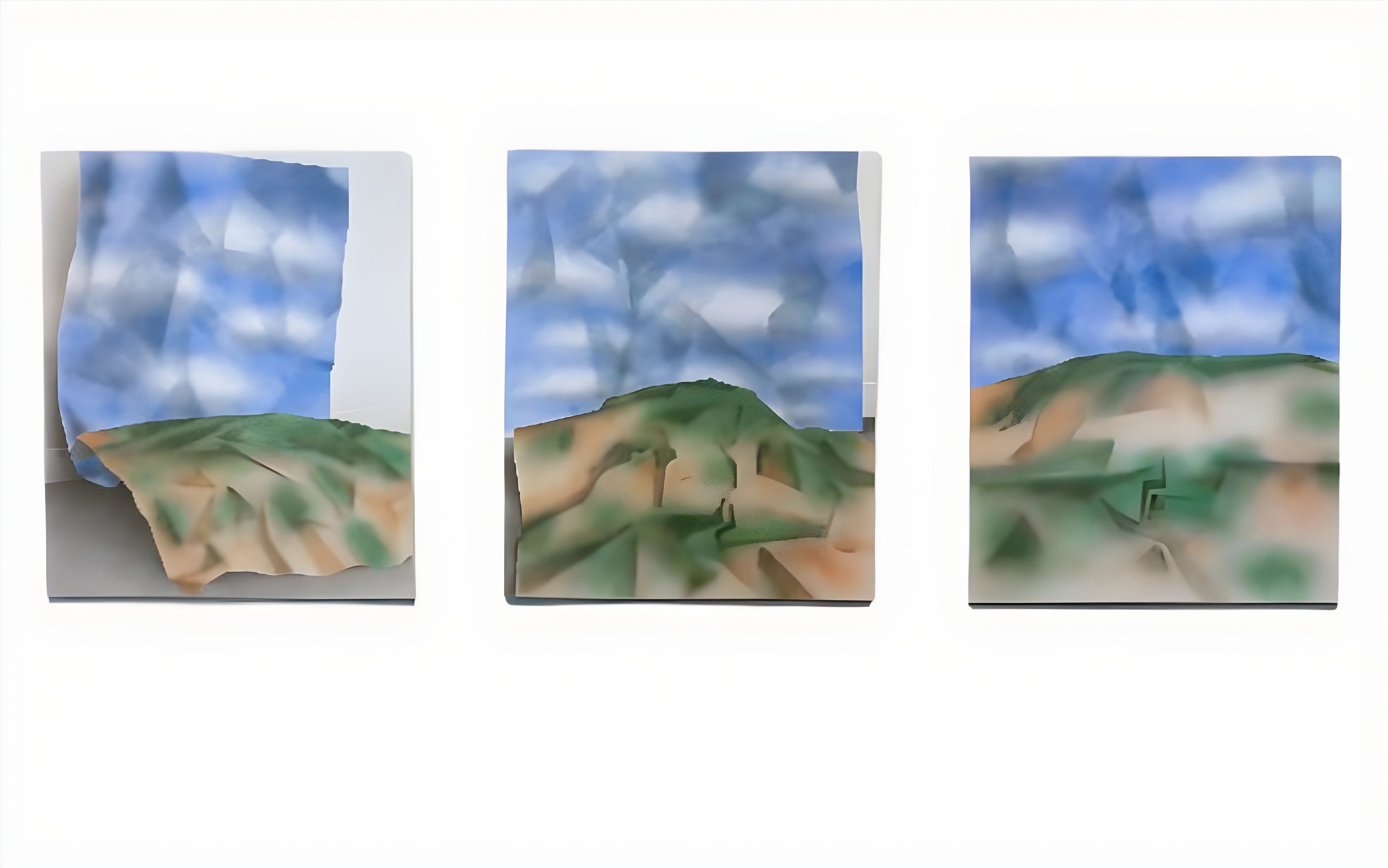
Elena Rotenberg works in the space between a place and its image. Born in Russia, raised in Israel, and never entirely at home in either, the experience of being present without belonging became, over time, the conceptual core of a practice built around simulation, mediation, and the gap between reality and its representation. Tourist sites photographed as proof of presence, Google Street View as a form of visit, computer game environments rendered in acrylic and airbrush: these are the territories Elena Rotenberg inhabits, using a medium, airbrush, that carries paint through air, leaving a mark while keeping the body that made it at a distance. The technique and the thinking arrived separately, but they were always pointing toward the same place.
How has your upbringing or cultural heritage shaped the themes and techniques you explore in your art today?
I was born in Russia and moved to Israel as a child, so I grew up between two cultures without feeling completely at home in either. I don't think I consciously mine that experience for material, but it probably explains something about my consistent interest in the gap between a place and how it's represented, between being somewhere and the image of being there. Tourist sites, Google Street View, computer game environments: these are all ways of "being" somewhere without really being there. That tension between presence and its simulation has been central to my work for years, and I think it starts from something pretty personal, never quite being a native anywhere.
The technique came later, but it fits the same logic. Airbrush has no direct contact between hand and surface. The paint is carried by air. The mark is there, but the body that made it is absent. When I first picked it up, about eight years ago, I wasn't thinking about any of that, I just got hooked on what it could do. But looking back, the fact that it produces inherently blurred, mediated images makes sense for someone who's always been interested in the space between a thing and its representation.
Growing up in a household where art wasn't a realistic career option also shaped me, though more in terms of how I came to the field than what I make. I didn't grow up around contemporary art. The first time I really encountered it I was a teenager at a youth program and we visited the Herzliya Museum, where there was a piece by El Anatsui, an enormous tapestry made entirely of metal bottle caps. I'd never seen anything like it. I felt like I understood something about art that I hadn't before, how an object could move you from the physical to something else entirely. That moment stayed with me. It was the first time I thought art could be something I might actually do.
How do you reignite creativity during those inevitable periods of self-doubt or stagnation?
Honestly, the most useful thing I've found is to stop trying to make art and do something else with my hands. During a really difficult period a few years ago, I sewed clothes for my daughter, I started felting, recently I've been knitting. These aren't side project, they're the thing that keeps me functional when I can't get near the studio. There's something about making that doesn't carry the weight of "is this good enough" or "what does this say about me as an artist." You're just doing. What I've learned is that the desire to be seen, to be validated, to show work, can drain creative energy faster than almost anything else. For a long time I was running on that, submitting to open calls, thinking about how the work would land.
When I had to stop, during a hospitalization a few years ago, I started making coloring pages for myself. No brief, no audience, no significance. And something loosened. The work I made coming out of that period ended up being some of the most honest I've done. So now when I'm stuck, I try to ask whether I'm blocked creatively or whether I'm exhausted by the machinery around the work ,the applications, the visibility, the constant self-assessment. Those are different problems. If it's the second one, the answer is usually to make something small and private and not tell anyone about it for a while. I also visit museums. Not to research, just to be near original works. There's something about standing in front of a painting that was made by a specific person in a specific moment that resets something for me. It reminds me why the work matters, separate from how it performs.
Can you take us through the evolution of an artwork, from that first spark of inspiration to the finished piece?
It usually starts with something I keep returning to, an image or a situation that keeps coming back. With the parents series, it was the selfie photos my parents sent me from their trips to Europe. They'd send these pictures from in front of famous sites, and something about them kept nagging at me. Eventually I figured out what it was: these photos are simultaneously documentation of a real visit and a simulation of it. The site exists as backdrop. The proof of presence is the image. That seemed worth spending time on. From there I do a lot of sketching, usually in dry pastel, sometimes in Photoshop. The pastel sketches are fast and physical, and they help me figure out composition and atmosphere. Photoshop lets me simulate the airbrush effect before I commit to the canvas, which matters because airbrush is hard to reverse. I work through maybe ten or fifteen versions before I feel like I know what I'm trying to make.
Planning the actual airbrush process takes a while. I work in layers, you build up the image gradually, lightest to darkest, and you have to think ahead about where you'll need stencils to get a clean edge and where you want the natural bleed of the spray. In the tourist series, the stencils were very important, they created those hard, cut-out edges that make the figures look like they've been dropped into the scene, like a screenshot from a computer game. That quality was deliberate. The aesthetic of simulation. The painting itself is slow. I'm building up thin layers of acrylic over days or weeks. The image often develops in ways I didn't plan, the paint finds its own logic and the final piece is usually not identical to the sketch. That's fine. If I wanted to reproduce the sketch exactly I could do it digitally.
What I'm looking for is the moment when the painting starts making decisions on its own. When it's done, it's usually because it's achieved a particular tension between the sharp and the blurred, between presence and distance, that I can't improve on without ruining something.
What unusual or unexpected sources of inspiration have deeply influenced your work?
Computer games, genuinely. And not in a theoretical way, I'm talking about the specific visual logic of 3D rendering, how game environments define volume through texture and light, how they produce spaces that feel simultaneously detailed and fake. The technique I use with stencils, especially in the landscape series, is a direct attempt to replicate that aesthetic: sharp, crude borders around objects, but within each object the surface is blurred. Objects that look cut-out. It's very specific, and it came from spending time looking at game environments and thinking about why they feel the way they do. Google Street View is another one. The idea that you can "visit" a place through a photographed simulation, be present without being there keeps coming back in my work. Those images have their own very particular quality: they're photographically accurate but somehow wrong, the light is flat, the perspective is slightly off, things that should feel real feel uncanny. I find that extremely interesting as a visual problem.
And then there's Renoir, which I know sounds like a conventional answer but isn't. Renoir is generally dismissed as kitsch, too decorative, too pretty, not serious. But his biography is fascinating in relation to his work. He started as a porcelain painter in a factory, and when machines replaced him he tried to paint faster to keep up with the production line. The result is this characteristic blurriness, not a stylistic choice exactly, but something that developed from economic pressure and speed. I find that origin story very clarifying for my own interest in blur as a formal element that carries meaning beyond aesthetics.
Do you believe the 'mad artist' stereotype still holds weight, or is creativity more grounded than we think?
I think it's a harmful myth and also a convenient one. Convenient for the art world, which has historically been happy to romanticize instability as long as it produces interesting work. Convenient for institutions that don't want to examine the structural conditions, financial precarity, lack of support systems, the particular pressures on women artists who are also mothers, that make the field genuinely difficult.
I've dealt with mental health issues, seriously enough to be hospitalized. And what I can say from that experience is that it didn't make me a better artist. It interrupted my work for a long time. The creativity didn't come from the breakdown, it came from building something back. The coloring book I made during recovery, which eventually became an exhibited artist's book, happened because I was getting better, not because I was unwell.
What I do think is real is that making art requires a certain tolerance for uncertainty, for not knowing whether what you're doing is working, for sitting with something unresolved for weeks or months. That's a mental state that takes practice and sometimes looks chaotic from the outside. But that's a skill, not a pathology. I'd rather talk about it as a skill, one that can be developed and maintained, than keep feeding the idea that you have to suffer to make something true.
Can art be truly therapeutic? Have you experienced its healing power personally, or seen it impact others?
Yes, but I want to be careful about how I say this, because the therapeutic frame can flatten what's actually happening. During my hospitalization, coloring was offered as a calming activity, mandalas, generic printed sheets. I found them terrible. Visually uninteresting, printed on thin paper, no pleasure in the actual act of coloring them. So I started making my own. First versions of Moomin characters, then things drawn from art history. When I was allowed to leave the ward, I kept making them. Eventually I had enough for a book, which I printed at the press downstairs from my studio and sold directly to people who wanted them.
What the making did for me wasn't provide an explanation or a resolution. It gave me something to do with my hands that had its own internal logic, a problem to solve that wasn't the problem I was trying to escape. And it reconnected me to other people. I started thinking about who else might want these pages, who else was in a situation where they needed something simple and absorbing and pleasurable. That outward movement from making for myself to making for others, was part of the recovery. The paintings in the Weeping series worked differently. Those weren't therapeutic in the sense of being soothing. I was painting portraits of friends crying, imagining their faces in tears, building up these images slowly over hours. What it did was make me feel less alone in something I couldn't talk about directly. I wasn't the only one with reasons to cry. That's a simple thing, but it mattered.
So yes, I think art can do real work in that direction. Not as a substitute for treatment, not as a cure, but as a way of staying connected to making something when everything else feels impossible.
Artificial Intelligence is increasingly infiltrating creative fields. Do you see artificial intelligence as a threat, a tool, or a collaborator in the art world?
It's an interesting question for me specifically because AI-averaged imagery has actually been subject matter in my work, I made a series based on the idea of aggregated, composite images, faces or landscapes that are statistically average, no longer belonging to any specific person or place. That's its own kind of representation problem, and it connects to everything I've been thinking about regarding the gap between the image and the thing.
As for whether it's a threat: I think it's genuinely disruptive for certain kinds of image-making work, illustration, commercial art, anything where the deliverable is a competent image produced efficiently. Those fields are going to change significantly. For painting as a practice, the slow accumulation of physical layers, the decisions made in the room with the canvas, the fact that the object itself carries traces of time and process, I think it's less of a threat and more of a clarifying pressure. It forces a question about what painting is actually for, which is a useful question to have to answer.
What I find most interesting about AI in relation to my own concerns is how it makes visible something that was always true: images are already simulations, already constructions, already one step removed from the thing they represent. AI images just make that explicit in a way that's harder to ignore. In that sense it's not entirely new territory for me, it's the same territory, with a different kind of example. I don't think of it as a collaborator in my practice, at least not now. But I don't think the interesting response is resistance either. The interesting response is to keep asking what painting can do that this can't.
If you could step back into any artistic era, which would it be and why?
The transition between the late Middle Ages and the early Renaissance, roughly the fourteenth and fifteenth centuries. Not the high Renaissance, which is where most people's imagination goes, but the moment just before it fully arrives. What interests me about that period is that it sits exactly on the seam between two different ways of making images. Medieval painting was symbolic, figures were sized according to their spiritual importance, space was flattened, gold backgrounds removed the scene from any specific time or place. Early Renaissance painting started pulling in the other direction, toward perspective, toward individuated faces, toward specific locations and natural light. But for a few decades those two logics coexisted in the same pictures. You get images that are simultaneously abstract and specific, symbolic and observed, outside of time and rooted in a particular moment.
That tension is something I keep returning to in my own work. The blurred figure that could be anyone or a specific person. The landscape that reads as generic but is based on a real place. The porcelain animal that is both mass-produced object and unique painting. I'm working in a similar seam between the digital and the handmade, between simulation and presence, between the sign and the thing itself. There's also the iconography. When I became a mother, I found myself looking at Madonna and Child paintings completely differently. The concern, the weight of being responsible for a small person, the particular grief of a parent watching a child suffer, these images have been carrying that content for seven hundred years because it's genuinely universal content. The Pietà is about a mother holding her dead child. That doesn't require historical context to land. It's immediate. I find it very useful to work with images that have that kind of accumulated weight, images that have been handling the same human material for centuries and haven't worn out.
And practically, the techniques of that period are the foundation of everything I care about in painting. Sfumato, the gradual transition between tones, the building up of transparent glazes, the relationship between light and volume. These are the technical problems I'm still working on, in a completely different medium and context. Going back to that moment would feel less like a visit to the past and more like going to the source.
What comes through most clearly in this conversation is an artist who has learned, through genuine difficulty, to distinguish between creative exhaustion and creative blockage and to treat each differently. The coloring pages made during hospitalization, the knitting that keeps the hands busy when the studio feels impossible, the paintings that emerged from recovery rather than from breakdown: these are not incidental details but the actual structure of a sustained practice. Elena Rotenberg is an artist who keeps asking what painting can do that nothing else can, and who finds in that question, still open, still worth answering, enough reason to keep going.