
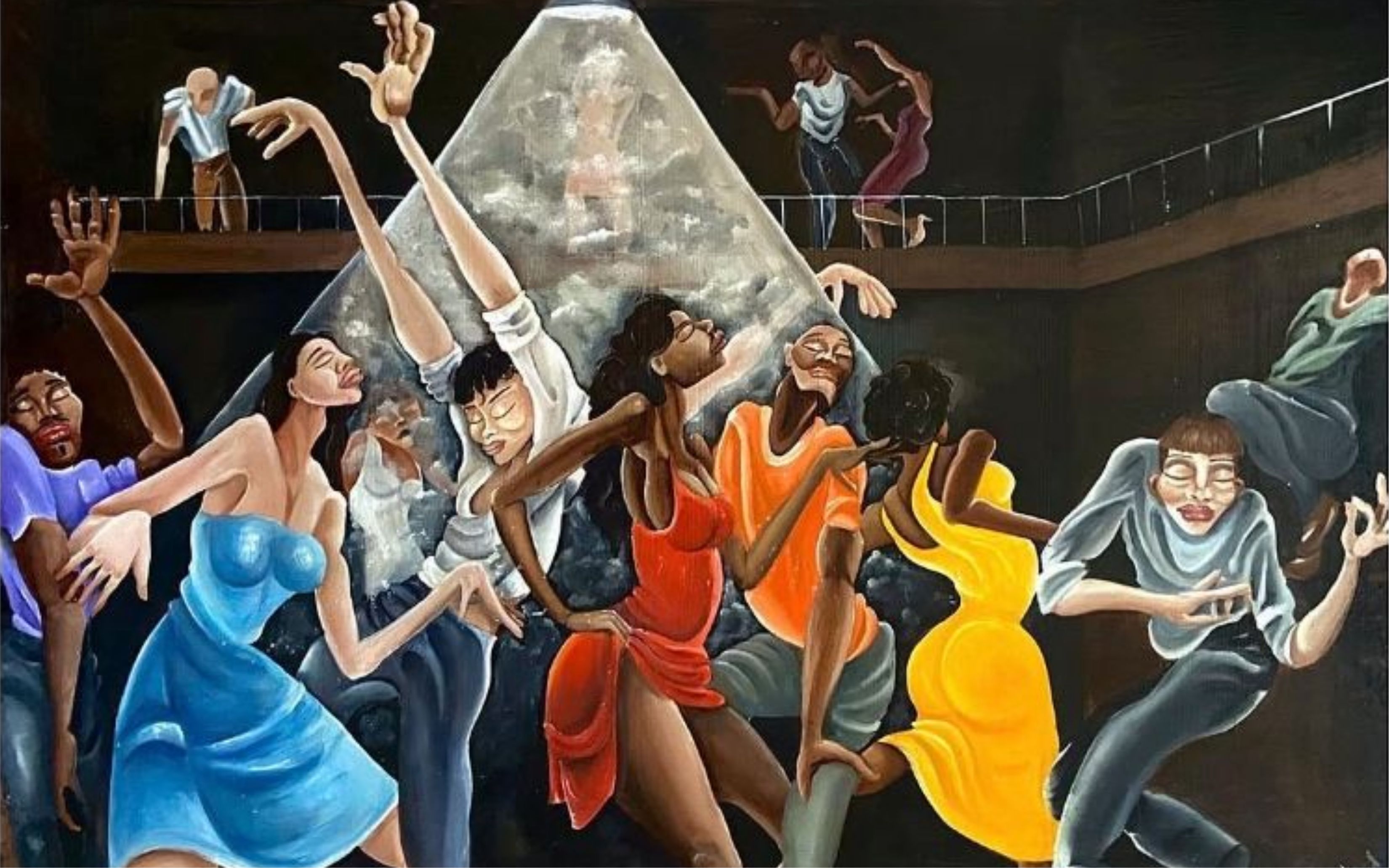
Sergio Laguna arrived at art not through a clear vocation but through a series of quiet redirections, from crafts and theatre to art history, from a planned move to Madrid to study fashion to an unexpected acceptance into Fine Arts, a door that opened sideways and turned out to be the right one. Working primarily in oil painting but expanding into sculpture, performance, video, poetry, and sound, this is a practice that refuses to be contained by a single medium because no single medium is ever enough. The work emerges from emotional rupture, from heartbreak and loss that push inward and, in doing so, open something creative. Slow, layered, and deeply personal, it operates from the conviction that creation cannot be forced, only listened for.
How has your upbringing or cultural heritage shaped the themes and techniques you explore in your art today?
I find it difficult to draw a clear line between my upbringing or heritage and the way I approach art, because, on the surface, art was never presented to me as a real path. I didn’t grow up surrounded by artists, nor with the idea that this could be a possibility for me. And yet, there were subtle traces: my mother creating with her hands, my father gently engaging with music…quiet gestures, almost invisible, but filled with a sensitivity that, over time, I’ve come to recognize as something that also lived within me. For a long time, my relationship with creativity felt light, almost superficial, something closer to play than to purpose. Crafts, theatre, ballroom dancing, painting classes…forms of expression that never quite reached something deeper inside me.
Still, there was always a quiet restlessness, a sense that there was something more I couldn’t yet name. I have always felt, in some way, like I belonged more to my own soul than to any specific place. There has been a nomadic feeling within me, never fully rooted, never entirely anchored. Yet at the same time, strangely held by something greater, something I couldn’t explain but could always feel. It wasn’t until high school, through art history, that something shifted. It felt less like discovering something new, and more like remembering something I had always known. I began to understand that art is not merely a form of expression, but a language of the soul, a way of leaving a trace of who we are and how we feel within a specific moment of existence.
Through oil painting, my most used medium, I found a way to truly express that. It was through it that I learned how to build faces, how to give form to emotion, and how to approach something as intimate as human presence. Its texture, density, slow, almost bodily quality feel deeply familiar to me. There is a texture in the material that reminds me of makeup, something that sits on the skin, that transforms without fully hiding that reveals through layering. In that sense, oil paint feels like the closest medium to human skin, to touch, to presence.
At the same time, I have come to understand that no single medium is ever enough. There are emotions and internal states that cannot be fully contained within painting alone. Because of this, I have allowed myself to expand beyond it, to open my practice to other forms such as sculpture, poetry, performance, video, and sound. This openness has led me to explore stone carving, video art, music (despite not having a conventionally “beautiful” voice), I allow myself to exist within that space as a way of finding myself through sewing, drag, and other forms of embodiment. These practices are not separate from my work, but extensions of the same need: to translate what I feel into something tangible, something lived.
Art gave that feeling a direction. It gave me a sense of purpose, not only to create, but to take care of myself, to slow down, and to understand what lives within me. It became a space where I could exist without needing to belong anywhere else. Since then, I no longer see art as something I chose, but something that moves through me. As if, rather than learning it, I am remembering it. A way of inhabiting the world, and of translating the invisible into something that can be felt.
Can you pinpoint a single moment in your life when you realized art was not just a passion but your purpose?
I don’t think there was ever a single, definitive moment where everything suddenly “clicked” and I understood art as my purpose. It wasn’t a shift that happened all at once, but rather a gradual realization, maybe an understanding of why I was drawn to create in the first place. At some point, I began to see that my relationship with art was not only about expression, but about survival. I have always felt that my mind moves quickly, almost restlessly, like a racehorse that doesn’t know how to slow down. Thoughts overlapping, conversations happening internally, a constant state of movement.
But when I place my hands into the act of making, something changes. The noise begins to reorganize itself. It’s as if an internal mechanism starts to align, and everything that felt scattered begins to take form. Creating becomes a way of thinking, of processing, of understanding. If I had to trace it back to a more tangible moment, it would be connected to one of my first deep heartbreaks, back in summer 2021. That experience opened something in me. It was painful, but also incredibly clarifying. It was during that time that I experienced what I can only describe as a kind of “eureka” moment, one that later became the foundation for my final degree project.
Since then, I have come to understand that many of the most significant ideas in my work have emerged from emotional rupture. I often feel that inspiration arrives alongside loss -ironic, right?- that the same space that holds pain also holds creation. Heartbreak, in particular, has pushed me inward, forcing a kind of introspection that I might not have reached otherwise. In a way, I feel a sense of gratitude toward the loves I have experienced, because they have shaped not only my emotional landscape but also my creative one. They have led me toward some of the most honest and transformative ideas in my practice.
Art, then, became more than something I enjoyed. It became a way of holding myself together. A space where I could translate confusion into form, and pain into something that could be understood, even if only partially. A place where something broken could become something meaningful.
How do you reconcile the tension between raw, innate creativity and the discipline required to master your craft?
I’m not sure that, in my case, this tension is truly real. If anything, my practice leans much more toward innate creativity than toward discipline. I believe discipline has a place, especially in the early stages of an artistic journey. It helps you understand your craft, build technical awareness, and develop a certain level of control. But once that foundation is there, I don’t see discipline as something that should dominate the process. From that point on, it is instinct, curiosity, and sensitivity that continue to shape and refine the work.
To me, art holds something deeply connected to childhood, a sense of play, openness, and intuitive exploration. If you lose that, if you become too rigid or overly structured, something essential begins to fade. The process can shift from something alive and healing into something imposed, almost mechanical. When creation becomes an obligation, when it is driven primarily by productivity, output, or the need to sell, it can begin to erode the artist from within. What once felt like a space of freedom and discovery can turn into pressure, and that shift, for me, is deeply uncomfortable. I don’t see artistic creation as the same thing as production. I believe artists are moved to create out of necessity, not out of demand. There is a difference between making something because you need to understand, express, or process something, and making something because it is expected of you.
For me, these two approaches don’t fully coexist. My work emerges from a place that cannot be forced, scheduled, or entirely controlled. It requires space, honesty, and a certain degree of unpredictability. And I try to protect that as much as I can. When I first began to build a relationship with my work, I didn’t see this as clearly. Perfectionism and control played a much stronger role in my life and artistic process. Even now, they are still present in my day-to-day, but I’ve come to understand that, more often than not, they lead me further away from what I’m trying to reach. There was a constant search for external validation, and a lingering feeling of incompleteness that made everything feel insufficient. Over time, I realized that these impulses don’t refine the work, they rather restrict it. And in many ways, they can quietly erode the path of an artist if they are not questioned.
Does spirituality or a connection to something larger than yourself influence your creative process?
Much like my relationship with art, my spirituality has not been fixed, it has evolved over time. I wasn’t raised within a particularly religious or spiritual environment. There was no defined belief system guiding me from the beginning. But I think that, at certain moments in life, especially when things become the hardest, we all find ourselves reaching for something beyond what we can immediately understand.As I grew older, I began to explore these questions more consciously. One of the turning points for me was reading Manly Palmer Hall. The Secret Teachings of All Ages Through it, I started to understand that faith is something we all carry, even if we speak it in different languages. For me, that language became the idea of the universe, or a higher force, something that doesn’t necessarily need to be named, but can be felt.
From that point on, I began to trust more in that sense of guidance, even when it wasn’t entirely rational. There was a moment in my life where I had very clear plans: I wanted to move to Madrid and study fashion design. That was the path I thought I was meant to follow. However, when the time came, things unfolded differently. Although my grades were not bad, I was admitted into my sixth option, Fine Arts. The same degree I had also been accepted into in several other cities across Spain. It felt like an unexpected redirection, almost as if something was insisting, quietly but persistently. I chose to listen. Allowing myself to be guided in that way required a certain surrender, a willingness to trust that not everything needs to be controlled or fully understood in advance. I began to feel that when certain patterns repeat, when doors open in unexpected places, they are not random. They are invitations.
My spirituality, in that sense, is not something separate from my creative process. It exists within it. It shapes the way I listen, the way I choose, and the way I allow things to unfold. It has taught me that sometimes the most important decisions are not the ones we plan, but the ones we feel compelled to follow. During one of my therapy sessions, after my first heartbreak, I remember saying that I felt frustrated with myself. During that period of emotional blockage, I had gone almost five months without even picking up a pencil, and it weighed on me. I felt like I was failing, like I wasn’t being faithful to something that, deep down, I knew mattered to me. At the same time, I remember that that very week I had started creating again.
What surprised me most was realizing that, despite having done “nothing” during those months, my technique and my style had evolved. There was something different in the way I was seeing, in how I was building, in what I was allowing to emerge. That’s when my therapist told me something that stayed with me: that art, much like the inner path, evolves alongside us, even when we think nothing is happening. That not all of the process is visible, that there is an internal work that continues silently. From that moment on, I stopped putting pressure on myself for not constantly creating. I understood that my practice doesn’t come from obligation, but from listening. I create when I feel the need, when something calls me to sit with myself, to open a space where those internal conversations can emerge, conversations that, somehow, something or someone helps me channel. It’s difficult to explain this to someone who doesn’t have faith. But those who do, and who are also creative, will understand exactly what I mean.
How do you reignite creativity during those inevitable periods of self-doubt or stagnation?
Acceptance. I keep coming back to that word, because for me it’s the starting point of everything. Accepting that these insecurities exist, that doubt is part of the process, and that there are moments where nothing seems to move. Learning not to judge myself for being in that place has been one of the most important shifts in my practice. I also think it’s important to understand the context we’re living in. It almost makes me cringe to say it, because I know how often it’s repeated, but it’s true: we exist within a society that is deeply consumerist, immediate, and constantly demanding. Everything is expected to happen fast, to be visible, to be productive. And art, in many ways, has been pulled into that dynamic. It has become a product, something to be consumed, evaluated, and circulated quickly.
But that logic doesn’t align with how creation actually works. At least not for me. My processes are slow, sometimes painfully slow. They require time, digestion, silence. And when you use art not just as a profession, but as a form of survival, of understanding yourself and communicating something deeply personal, it becomes even harder to accept that things cannot be rushed. I remember about a year ago I was working on an oil portrait for someone I loved deeply at the time. I had to start it almost three to four months in advance, because I knew that if I didn’t begin in November, it wouldn’t be ready by March. And even then, I felt resistance. I didn’t want to start, not because I didn’t care, but because I was already aware of the time, the energy, and the emotional involvement it would require. For someone like me, openly prone to procrastination, it’s very easy to fall into stillness. To stay in bed, doing nothing, waiting for urgency to arrive and push me into action. But what I’ve come to understand is that this dynamic doesn’t actually help me. The pressure doesn’t activate me in a healthy way; it accumulates, it becomes overwhelming, and eventually it leads to more blockage.
So I’ve had to learn a different way of relating to those moments. Instead of fighting them, I try to sit with them. To understand what’s underneath. Because often, what we call “creative block” is not a lack of ideas, but something else: fear, exhaustion, emotional overload, or even the weight of expectation. Creative processes are complex, especially when your work is deeply tied to your own story, your identity, your emotional world. When you’re not just making objects, but translating parts of yourself, it’s inevitable that there will be moments where things feel too close, too exposed, or too difficult to access. Reigniting creativity, for me, is not about forcing myself back into production. It’s about creating the conditions where something can emerge again. That might mean stepping away, allowing time to pass, feeding myself with other things, music, conversations, experiences, or simply resting without guilt.
And therapy has played a huge role in this. It has helped me understand my patterns, my fears, my tendencies toward control and perfectionism. It has given me tools to navigate those internal landscapes without collapsing into them. So if I had to summarise it, I would say: acceptance, patience, learning without self-judgment, understanding your own rhythms, and allowing yourself to be supported. And, honestly, therapy. Above all, therapy.
What do you think is the most meaningful role an artist plays in society today?
I think one of the most meaningful roles an artist can play today is to remain honest. That might sound simple, but in a world that is constantly shaping, filtering, and packaging everything into something consumable, honesty becomes something quite rare. We are surrounded by noise, by images, by narratives that are often constructed to be easily digested, to be liked, to be shared. And within that, I feel that the artist’s role is not necessarily to produce more, but to reveal something real. To create spaces where complexity, contradiction, vulnerability, and ambiguity can exist without needing to be simplified.
For me, art is not just about aesthetics or production, it’s about translation. Translating what is often invisible, internal, or difficult to articulate into something that can be felt, even if it’s not fully understood. In that sense, I think artists act as a kind of bridge between the inner world and the external one. There is also something about slowing things down. In a society that moves so quickly, where everything is expected to be immediate, art has the potential to interrupt that rhythm. To ask someone to stop, to look, to feel, to stay with something for a little longer than they’re used to. And I think that, in itself, is already quite powerful. At the same time, I don’t think the role of the artist is to provide answers. If anything, it’s the opposite. It’s about opening questions, about creating spaces where people can confront something within themselves. Sometimes that can be uncomfortable, but I think that discomfort is necessary. It means something is being touched.
There’s also a responsibility, in a way, not in a moral or didactic sense, but in terms of care. Care for what you choose to put into the world, for how you represent certain experiences, for how you hold your own voice. Because even if the work comes from something deeply personal, once it exists, it enters a shared space. For me, the artist is someone who listens. Not only to themselves, but to what is happening around them, to what is shifting, to what is not being said. And through that listening, they give form to something that others might recognize, even if they didn’t have the words for it before. So I wouldn’t define the artist as someone who produces objects, but as someone who makes things felt. Someone who creates a space where the invisible can take shape, and where people, even briefly, can encounter something true.
If you could communicate just one core message through your entire body of work, what would it be?
If I had to reduce everything to a single message, I think it would be an invitation: to feel, and to allow oneself to exist fully within that feeling, without needing to immediately understand it or escape from it. I think we are often taught, directly or indirectly, to move away from what is uncomfortable. To silence certain emotions, to make things more digestible, more acceptable. But in doing that, we also distance ourselves from something essential, from our own depth. Through my work, I would want to remind people that there is nothing inherently wrong with feeling deeply. That vulnerability is not something to be corrected, but something to be held. That even in confusion, in pain, in contradiction, there is something meaningful taking place. A lot of what I explore comes from that space, where things are not fully resolved, where identities are still shifting, where emotions don’t have clear names. And instead of trying to fix or define those states, I try to give them form. To allow them to exist as they are.
If there is a message, then, it would be that you don’t need to have everything figured out to be valid. That there is value in the process itself, in the searching, in the not knowing. And also, something very simple, but very human: that everything passes. That no state is permanent, no emotion is final, but leaving trace of it being transited is key. Even the most overwhelming moments eventually soften, shift, or dissolve into something else. And in that sense, in a quiet and perhaps fragile way, everything will be okay. Maybe not immediately, maybe not in the way we expect, but it will move, it will change. And maybe also this: that what feels most personal, most internal, is often not as isolated as we think. That within our own experience, there are threads that connect us to others. So rather than offering answers, my work would simply say: stay with it.
Stay with what you feel. Trust that it will pass. There is something there.
Can you take us through the evolution of an artwork, from that first spark of inspiration to the finished piece?
For me, everything begins with a sensation. It’s rarely a clear or rational idea, it’s more like an emotional state that appears and asks to be explored. Very often, that starting point is music. I listen to something that moves me, and that feeling becomes the impulse to create. Since most of my work comes from imagination, what I truly need is to feel, or to allow myself to feel fully in that moment.
Many of my pieces originate from that space of movement and fluidity. Over time, I’ve come to think of this as a kind of liquid anatomy: a way of understanding the body not as something rigid, but as something constantly shifting, soft, and permeable. Forms emerge through gestures that feel almost choreographed, very fluid, very intuitive. Within that, I tend to focus especially on the face. While the body communicates, I feel that everything ultimately converges in the gaze. The eyes hold something essential, something that cannot be fully controlled or hidden.
Practically, my process often begins by looping the same piece of music over and over again until something clicks. At some point, an image starts to take shape in my mind, usually accompanied by a sense of structure, often something linear or geometric that helps contain that initial fluidity. From there, I usually move into a digital sketch on my iPad. This stage gives me a sense of freedom: I can duplicate the composition, test variations, shift elements, and refine the structure without pressure. There have been moments where I’ve gone directly onto the canvas without any prior sketch, but that tends to feel quite overwhelming for me. The digital phase allows me to build a kind of quiet confidence before entering the physical process.
Once the composition feels resolved enough, I project the image onto the canvas and trace it. This gives me a structural base, a starting point from which I can begin to build. From there, the development becomes more layered and material. I usually begin with a grisaille, establishing a monochromatic underpainting where I focus entirely on values, light and shadow, depth, volume. This stage is essential for me. It’s where I construct the body, where I understand how light moves across the surface, how forms emerge from darkness. It’s almost like sculpting through paint. Through this study of light and shadow, the figure begins to gain presence. There’s something quite intimate about this phase, because it strips everything down to its essence, no color, just structure, contrast, and atmosphere.
After that, I slowly begin to introduce color in layers. Oil paint allows for this kind of gradual building, thin veils, corrections, additions. It’s a slow process, almost bodily, where the surface accumulates time. At this point, I try to let go of too much control and allow the painting itself to guide me. The brush starts to respond to something less calculated, more intuitive. Very often, the final piece diverges from the initial sketch. Forms shift, expressions change, elements appear or disappear. I’ve learned to trust that. To understand that the sketch is not a fixed destination, but a point of departure. My works rarely resolve quickly. Many of them take months. I move in and out of them, letting them rest, returning with a different emotional state, a different clarity. In that sense, the process is not linear, it expands, pauses, transforms. And I think that’s what defines it most: it’s not just about making an image, but about staying in conversation with it. Allowing it to evolve at the same rhythm as whatever is moving within me.
Describe a piece you’ve created that has held the most emotional weight for you. What makes it significant?
At the moment, the piece that holds the most emotional weight for me is the one I’m currently working on, and also the one I’m struggling the most to finish. The idea for it began last September, when I was on holiday in Vejer de la Frontera. I came across a series of tribal masks that stayed with me in a very particular way. There was something in their presence, something symbolic, almost ritualistic, that sparked an image in my mind. From that, I felt inspired to create a piece centered around two figures. That, in itself, was already unusual for me. I tend to work with three figures at the very least, as I feel the triangle holds a kind of inherent strength and balance. But during that time, I was in a relationship. I was in love. And that emotional state naturally shifted the way I was thinking and seeing.
When I returned, I began developing this painting of two people bound to each other, not physically, but emotionally. There is a connection between them, something that ties them together, and yet they look at each other differently. Their gazes don’t align, they seem to exist within the same bond but with different intentions, different inner worlds. At the time, I felt deeply connected to that idea. It came from a place that was very real to me. Now that things have changed. And what I’m finding is that finishing this piece has become incredibly difficult. I move in and out of it, I sit with it, I leave it, I return, but I don’t feel it progressing. I think what makes it so heavy is that it asks me to sit with a version of myself, and with an emotional state, that I’m no longer fully connected to, but that is still very present in a different way, through loss.
Painting it means revisiting something that is still in the process of being understood. And sometimes, that feels too close, too raw. It’s not just a technical difficulty, it’s an emotional one. I’m not only trying to resolve the painting, but also to process what it represents. So in a way, the reason it has become one of the most significant pieces for me is precisely because I haven’t been able to finish it yet. It exists in that in-between space, between what was, what is no longer, and what I’m still trying to make sense of. And maybe that’s also part of it: understanding that some works take longer not because of the complexity of the image, but because of the weight of what they carry.
How do you approach criticism, whether from peers, critics, or audiences?
For me, art has never been about competition, nor about seeking validation through criticism. It’s something I do for myself first and foremost. It comes from a very internal place, something I need in order to understand, process, and exist in a certain way. Because of that, my relationship with criticism is quite particular. I can listen to it, of course. I can recognize when something is constructive, when it comes from a place of care or genuine engagement with the work. But at the same time, I don’t allow it to define the direction of what I do. I think once you start creating primarily to meet expectations, whether from peers, critics, or an audience, you begin to lose something essential. The work becomes shaped by external voices rather than by an internal necessity. And for me, that’s where it stops feeling honest.
I don’t see art as something that needs to be ranked, compared, or measured in that way. It’s not a competition. It’s not about being better or worse. It’s about authenticity, about whether something is real, whether it carries truth, at least for the person creating it. Of course, there have been moments where criticism has affected me. I think that’s inevitable, especially when your work is deeply personal. But over time, I’ve learned to create a certain distance. To understand that not everyone will connect with what I do, and that’s completely fine. In the end, I don’t create to be understood by everyone. I create because I need to. And if something resonates with someone else, then that’s something beautiful, but it’s not the starting point. So I would say I approach criticism with openness, but also with boundaries. I listen, I reflect, but I always return to my own voice. Because that’s the only place my work can truly come from.
What holds this conversation together is a particular quality of honesty about perfectionism and its costs, about procrastination and what lies beneath it, about the unfinished painting of two figures whose gazes don't align, which sits waiting because finishing it means processing what it carries. Sergio Laguna is an artist who creates out of necessity rather than demand, who protects the unpredictability of the process, and who has learned, slowly and with the help of therapy, to distinguish between the pressure that accumulates and the silence that allows something to emerge. The core message, offered quietly at the end, is also the simplest: stay with what you feel. Trust that it will pass. There is something there.