
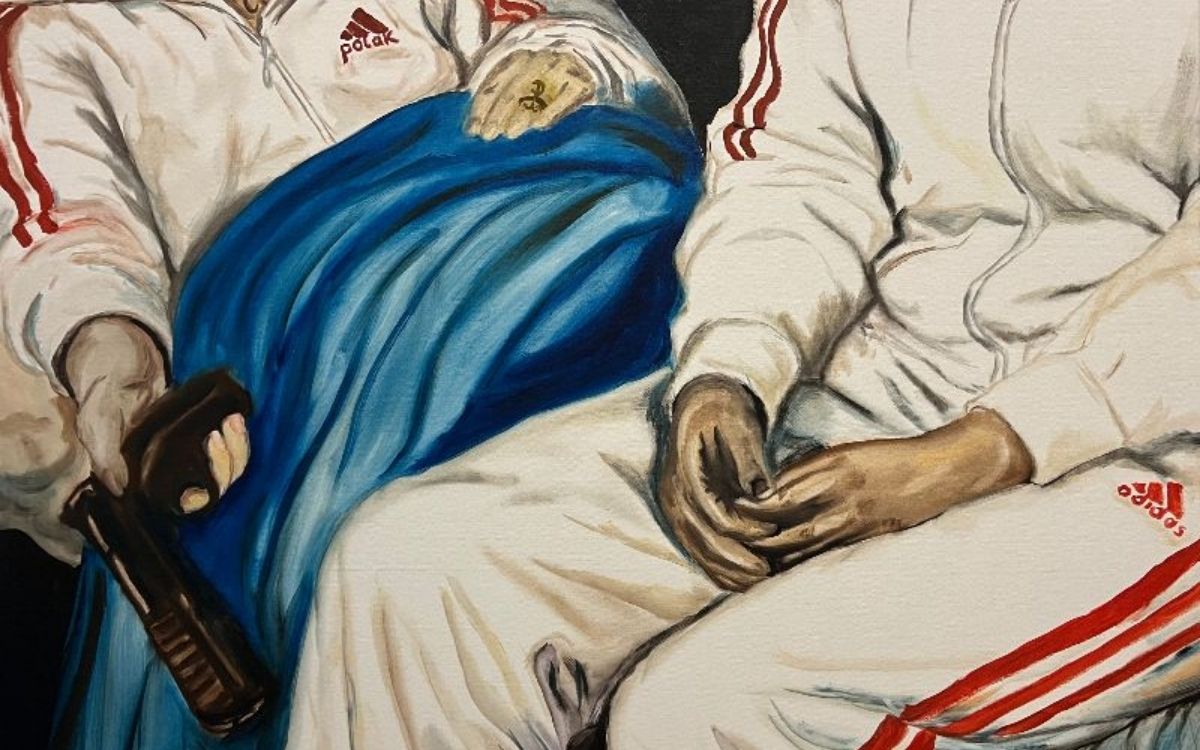
Natalia Sara Skorupa came to art through sociology, not as a departure from that discipline but as its natural extension. Where sociology names and analyses the patterns of society, art makes them visible, tangible, and impossible to look away from. Working primarily in painting, and drawing from the intellectual and political culture of Poland, the practice that has developed is direct, uncomfortable, and deliberately so: a commentary on women's rights, homophobia, and physical violence that refuses to soften its edges. The creative process begins not in the studio but on the tram, in underprivileged neighbourhoods, overhearing strangers, and sometimes at the gym, where an hour of cardio brings the images spontaneously into focus.
Art is often chosen as a medium for its freedom. Why do you personally turn to art, rather than another form of expression?
I'm a sociologist by training. During my university studies, I discovered that sociology in practice is an art. Art is a form of examining society and its responses to psychological patterns and social processes. I began creating to materialize, in a tangible and visual way, the patterns I see in society.
How does your art engage with or comment on pressing contemporary issues, social, political, or environmental?
Most often, to describe a problem, I conduct a social analysis. I usually refer to the intellectual culture of Poles, because as a Pole, I most often address general issues using the environment I'm familiar with. For a change to occur in the law or in people's minds, you have to point the finger at what's wrong. My works are a political commentary on the situation of women in Poland, the lack of abortion, and homophobia ect. I am deep interest of physical violence between two people on the street.
Do you think art should have a political or ideological agenda?
Yes, because art has the privilege of possessing the tools and capital to raise important issues, as this can be achieved through the heavy control of information flowing directly from around the world. If an artist doesn't speak about noble, delicate, and shameful matters, who will encounter such a topic? Due to the norms of society and the graphic repression associated with their use, only the artist has access to the user interface and the ability to ostracize the issue in society.
If an artist becomes silent and disappears, without interpretation and a difference in understanding reality, any change/development is impossible. The artist is not an eliminated species: there may be a solution to society or political involvement to the detriment of the solution.
Do you have any rituals or habits that help you enter a creative state of flow?
I'm most often inspired by overhearing strangers on the street. I often ride the tram through various underprivileged neighborhoods in my city. When I have an idea for a piece about a specific issue but don't know how it should look visually, I go to the gym. Most often, during an hour-long cardio workout, the images come to me spontaneously.
How has your artistic style transformed over the years? Are there specific influences, experiments, or moments that marked a turning point?
I feel like I'm a little different every year. When I started creating, I was interested in post pornography and nudity. It was simple, naive, and obvious: apparently, an artist can break social norms, so I did it with passion. I loved undressing in public. Now I rarely do it because I need a good reason and an answer to the question, "Is nudity necessary in this project?" When I stopped undressing in the street, I started dabbling in painting. That's how I started painting, and I continue to do it to this day.
How do you feel social media is shaping the way art is created, consumed, and valued today?
Social media is a massive censorship that eats away at artists. Many of my posts were banned, and my content was repeatedly deleted. Unfortunately, without social media, a young artist doesn't exist. If you're not heard of, you don't exist. Social media is a snake that eats its own tail. Once, when I was doing a performance, the festival organizers decided not to record and photographically document my work because they said, "What's the point of documentation if we can't post photos of what you did on Facebook?"
How do you respond to debates about the accessibility of art, should it be exclusive, or is it for everyone?
Art's audiences are diverse, just like art itself. The first artistic work to be considered a conceptual art requires education, resources, and intellectual capital. We cannot demand that the content be flattened and the work simplified just so everyone in the world can understand it, because then more educated people who need intellectual play and development will suffer. Art should know its audience. There are works that are difficult to interpret and those that are easy: each will find its audience, and that's fine.
Identify five habits or concerns you are actively trying to let go of in your practice.
I'm afraid I'm creating kitsch, that my work is boring, that I'll disappear from the art world because there are too many artists, that I'll never succeed in the art world, and that my work is being wasted. I'm afraid that one day I won't come up with anything anymore.
If you could become one of your creations for a day, which would it be and why?
I would be a Giant Patriot from my painting "the biggest patriot around" because I would appear as big as Godzilla and that was cool.
What are your long-term aspirations as an artist, both personally and professionally?
I want to create more and better. I want to further develop themes of species feminism, patriotism, nationalism, and the connotations between the human and animal worlds. I want to create more, but I don't have enough money for materials, so I need money to buy great paints and paint.
Natalia Sara Skorupa is an artist who names fears plainly, of making kitsch, of disappearing, of one day running out of ideas, and keeps working anyway. That honesty, the same honesty that drives the political work, is what gives this practice its particular texture. The Giant Patriot, Godzilla-sized and unapologetic, stands as a fitting emblem of a body of work that would rather be too big, too loud, and too present than politely invisible. The ambitions going forward are equally plain: more work, better materials, and the continued development of themes that matter, species feminism, nationalism, the tangled relationship between the human and animal worlds. Direct, as always.