
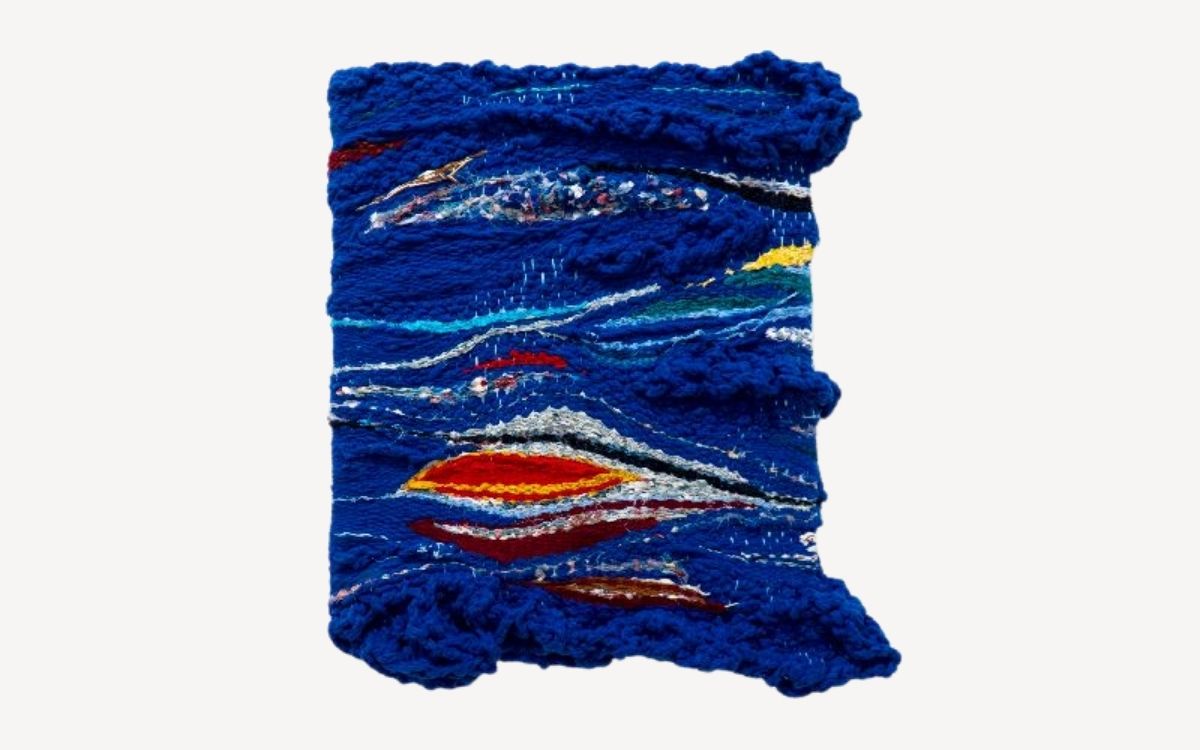
Giselle Lucía Navarro grew up in Cuba during the Special Period, wearing clothes sewn by a grandmother, playing among buttons and paints during blackouts, inventing stories and forms from whatever was available. That early education in scarcity and making, woven through four generations of textile workers, a painter uncle, and the particular resourcefulness that difficult circumstances demand, never left. Poet, visual artist, designer, and restless interdisciplinary thinker, Giselle Lucía Navarro moves between media not out of indecision but out of genuine curiosity about where the boundaries of things lie. At the centre of it all is Sacred Grafts: a living work, built from donated garments and audio testimonies, 450 people long and 20 metres wide, still growing.
How has your upbringing or cultural heritage influenced the themes and techniques you explore in your art today?
I come from a family where textiles have been present for four generations. My great-great-grandfather wove wicker baskets, my great-grandmother was a seamstress, and both my mother and grandmother made dolls and handbags alongside their other professions. I was also born during Cuba’s Special Period, when the crisis meant there was nothing available. Almost all the clothes I wore were made by my grandmother, which gave me the chance to design what I wore. I grew up in the midst of blackouts, playing with buttons and also with paints in my uncle’s studio, he is a painter. My childhood passions were creating stories, images, and forms. After following a path in literature, I graduated in Design and decided to take visual art more seriously, channeling those impulses into a space of my own.
What do you believe is the most significant role an artist plays in today’s society?
I think the artist is the thermometer of their time, and the art they create carries the fever of the moment in which they grow and learn to see their context with different eyes. They learn to situate themselves within that context and to create responses to their own circumstances. But art has the delicacy of suggesting, not imposing. It is a window through which we can look beyond the disasters of our society. In that window, you see where we are headed and have the chance to reflect. Color and form provoke many psychological and emotional sensations, and these are tools art must use to its advantage. The artist is a messenger, a kind of medium. Art and poetry do not change the world, but they can move those who do have the power to change it.
What unusual or unexpected sources of inspiration have profoundly influenced your work?
I am both a poet and a visual artist, but in the past I explored dance and was very close to music and cinema. I am restless in creation, so I enjoy movement, interdisciplinarity, and probing the boundaries of things. For me, reading and philosophy are important sources for understanding the past; music and observation help me remain in the present; and toward the future, I move through experimentation and meditation.
Describe a work you have created that carries the greatest emotional weight for you. What makes it significant?
There is a very important work in my career: Sacred Grafts. This piece marked my debut in the visual arts at the moment when I began to take everything very seriously. I will be working on this piece throughout my life, in parallel with the rest of my work. It is made up of clothing donated by people I have met over the years. Each person donated a garment and left me an audio testimony of what that piece of clothing meant to them. A wedding dress, the shirt a political prisoner wore when leaving prison, the blouse of a deceased mother, work clothes… these are special moments in many people’s lives that I have cut and woven with my own hands to build this great skin, which is why they are sacred. So far, 450 people have donated, and the piece already spans 20 meters in length. It is a work I will show to the public every ten years. In it lies much of what being an artist means to me.
Is art created for the artist, for the public, or somewhere in between?
The artist approaches art seeking answers, seeking to find themselves, and it is in that moment that the primordial artistic act occurs, in that flash of light. Later, the artist needs to share that flash and shows it to the public. There, the energy either spreads or doesn’t, but something always happens in that encounter. And within the audience, something happens too. Perhaps another artist is born, someone smiles, or someone says what they just saw is garbage. The truth is there is always a connection, and it is precisely there where art lives, in the points of energy and encounter between people.
In an increasingly globalized world, how can artists preserve authenticity and cultural integrity in their work?
Authenticity and cultural integrity are sometimes rather abstract matters. In my very personal opinion, we are simply human beings inhabiting a country called Earth. We all share at least one common ancestor. Globalization is already present in our DNA. The rest is about hegemonies and power struggles. I believe what makes art authentic right now is that it has a genuine search, that the artist preserves their innocence, protects their purpose, and keeps it firm, without being overly influenced by trends or market fluctuations.
List five central themes or messages you seek to convey in your art.
I want the person who lives with my work and reads my books
to feel the need to express themselves
to feel inspired
to also complete the work
I am interested in the social, the political, the philosophical
and the energy that things carry
If you had the opportunity to converse with any creative mind in history, who would it be and what would you ask?
I would love to converse with many people. I enjoy talking and observing everything. Among the figures I would like to share time with are Leonardo da Vinci, Artemisia Gentileschi, Gaston Bachelard, Magdalena Abakanowicz, and the group of French Symbolist poets. We would go for a walk or talk in the studio about the mundane things of life. You learn more about a person by the way they eat their food or contemplate the landscape than by the words they might share.
How do you imagine the evolution of your work in the coming years?
The future is always a delicious territory. We have the ability to design it, but sustaining it on our shoulders depends on our cleverness and discipline. My work right now seeks to expand into space, to break its own limits while preserving the delicacy of its intimacy. I am searching to explore new materials and formats. There are books waiting to see the light that will be important in my career. I will be living in Paris in the coming months, which will be a significant point in my work, a change of context and, who knows, perhaps a long-awaited and well-deserved reunion with past lives.
Giselle Lucía Navarro is an artist who understands that the most revealing thing about a person is not what they say but how they eat their food or contemplate a landscape. That same attentiveness runs through the work, the wedding dress, the shirt worn leaving prison, the blouse of a deceased mother, cut and woven together into something that functions less as an artwork than as a collective skin. Paris is ahead, new materials are waiting, books are ready to see the light. The future, as described here, is a delicious territory, one that will be met, as everything has been, with cleverness, discipline, and an innocence worth protecting.