
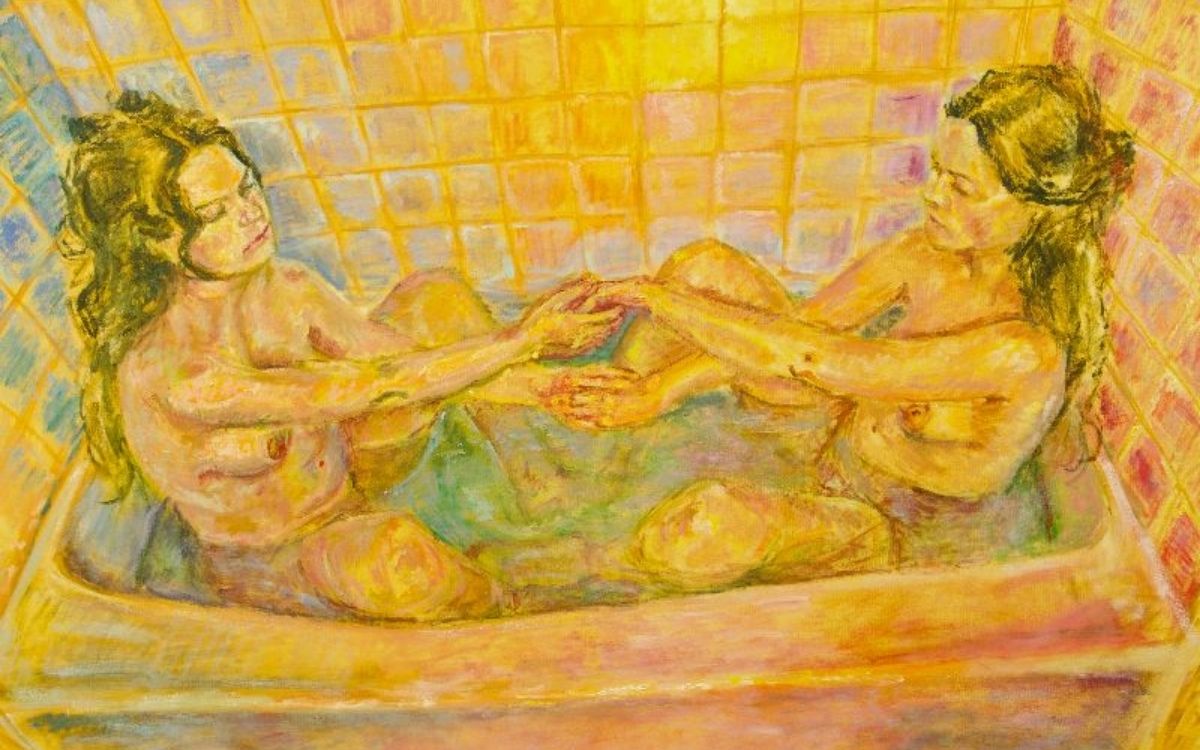
Claire Drummond paints m(otherhood), a term used deliberately to expand beyond the biological and toward anyone who nurtures and sustains life. The foundation of this practice is personal and precise: a mother who was also a painter, who gave up that practice to raise children, whose sacrifice made visible a persistent and largely unchanged injustice. That inheritance of both the subject matter and the painterly instinct itself, shapes everything. After a Master's in Film Studies, an admin job that caused genuine soul-withering, and eventually an MFA, Claire Drummond arrived at the only conclusion that ever made sense: that painting is not optional, and that the work of m(othering) deserves the full weight of serious pictorial attention.
How has your upbringing or cultural heritage shaped the themes and techniques you explore in your art today?
My mom is a painter, and she had to give up her practice to raise myself and my sister. The idea that one cannot be both an artist and a primary caregiver is remarkably persistent and has changed very little in the 30 plus years since my mom had to stop painting. She was also my first painting teacher and actually my only painting teacher, before I began my MFA as I didn’t have formal training before this. Because of this, the relationship between painting and m(otherhood) are the foundation of my practice. M(other) is a term that I use to deliberately include gender diverse individuals who identify as nurturing and sustaining life.
Have you ever felt drawn toward a conventional career path? What made you take the "creative leap" despite the risks?
I thought for a while that I might be a film scholar, though I’m not sure how conventional that is. But I did a Master’s in Film Studies from 2017 to 2019. Even during this time though, all I could think about was painting. But when I graduated from my MA in 2019, I couldn’t find a job in my field and ended up having to take an admin job for a couple of years and I’ve never been so
depressed as I was during that time. Working 9 to 5 gives you very little time to paint, to do the real work. That experience, of trying to hack it as an admin assistant and being so unbelievably miserable, made me realize that I can’t really survive without painting. So the thing that made me take the leap was necessity, really, the fact of my soul withering away when I’m not able to paint.
What do you think is the most meaningful role an artist plays in society today?
Artists play one of the most fundamental roles in society, we reflect the world back to itself, and we envision how the world could be different. We see and build other worlds, better worlds. This is why fascism always targets and censors the arts and artists first: because we see and show the world as it is, and as how it could be, which disrupts and threatens systems of dominance, violent coercion and control. I understand artists as being essential to healthy life and society, and the world today is not okay — it is sick. There is unbelievable suffering in Gaza, in Iran, in Lebanon, in Sudan, in the Congo, everywhere. We need collective action and we need artists to envision another world because the one we are living in now is unbearable.
If you could communicate just one core message through your entire body of work, what would it be?
That the work of m(otherhood) and m(othering) has long been overlooked and devalued by the art world and the world at large, but that this has been a fundamental error. M(othering) is a singularly potent and powerful framework for understanding what it means to be human, and if we dismiss and devalue this subject, we dismiss and devalue our collective interdependence and vulnerability.
How do you measure the impact of your work, by its reception, its personal meaning, or something else?
I measure the impact of the work primarily through emotion, if it makes me feel something when I look at it, then it’s good enough for me. If it makes someone else feel something, that’s great, but I don’t know if you can get too hung up on reception or the way that other people respond to the work, though it’s hard sometimes not to think about those things. Phillip Guston said he painted what he wanted to see, and that’s how I feel too, I make the work primarily for myself because I want to see less idealized, more complex and nuanced depictions of m(otherhood) in painting, so those are the paintings I make.
Do you believe the ‘mad artist’ stereotype still holds weight, or is creativity more grounded than we think?
Making art is actually pretty menial and manual labour, it’s very physically demanding and not that different from being a tradesperson or a caregiver. It’s just that we value one type of work over the other in the public imaginary. It’s all very unglamorous, so the idea of the mad artist has always confused me. Lucy Hunter interviewed a number of artist fathers for L’Officiel a few years ago, and she wrote that “The rigors of an artistic practice, its daily grind and focus and labor, cleave closer to the anti-glamour of spit-up and dirty diapers than to any fantasy of divine creative exceptionalism”. Art is of the body and of life, these things are continuous with one another, and I think the best work comes directly from life and from living.
The idea of the mad artist feels very masculine and makes me think about the age-old idea that “There is no more somber enemy of good art than the pram in the hall”. That’s that horrible quote from British critic Cyril Connolly. It feels like you can’t be a “mad artist” or some god-like genius working away for hours on end in the studio if you’ve got to feed the kids and put them to bed, or if you have an aging parent who needs you. I’m much more interested in understanding what it means to be an artist who is embedded in the daily rhythms of caregiving, of m(othering), of the mess of life.
What are five things you do to overcome creative blocks or feelings of discouragement?
I look at other people’s art and it’s got to be in person as that’s where the charge comes from.
I apply to so many things that when I get another rejection, I barely even remember that I’d applied to that thing, so it hurts less.
It helps me to think about the idea of a creative block or feeling down on myself within the span of geological time and then it just becomes kind of funny. It’s humbling and helps me not to get stuck in those feelings.
I get some new colours and materials that excite me, but this can get really expensive really fast.
I just get to work and I work like an animal. Even if I make a bad painting, it doesn’t really matter. For me, working constantly is the only thing that keeps the energetic space and world that I am trying to create alive. When I stop working, the thoughts and feelings and ideas that fuel the work go quiet, so yeah, I just get to work.
The paintings Claire Drummond makes are ones that did not previously exist in the world, less idealised, more honest, more costly in what they ask the viewer to sit with. The argument running through this practice is quiet but persistent: that m(othering) is not a subject adjacent to serious art but a framework for understanding what it means to be human, and that dismissing it has always been a fundamental error. To paint caregiving with full pictorial attention is also to paint interdependence, vulnerability, and the mess of being alive, which is, in the end, what painting has always been for.