
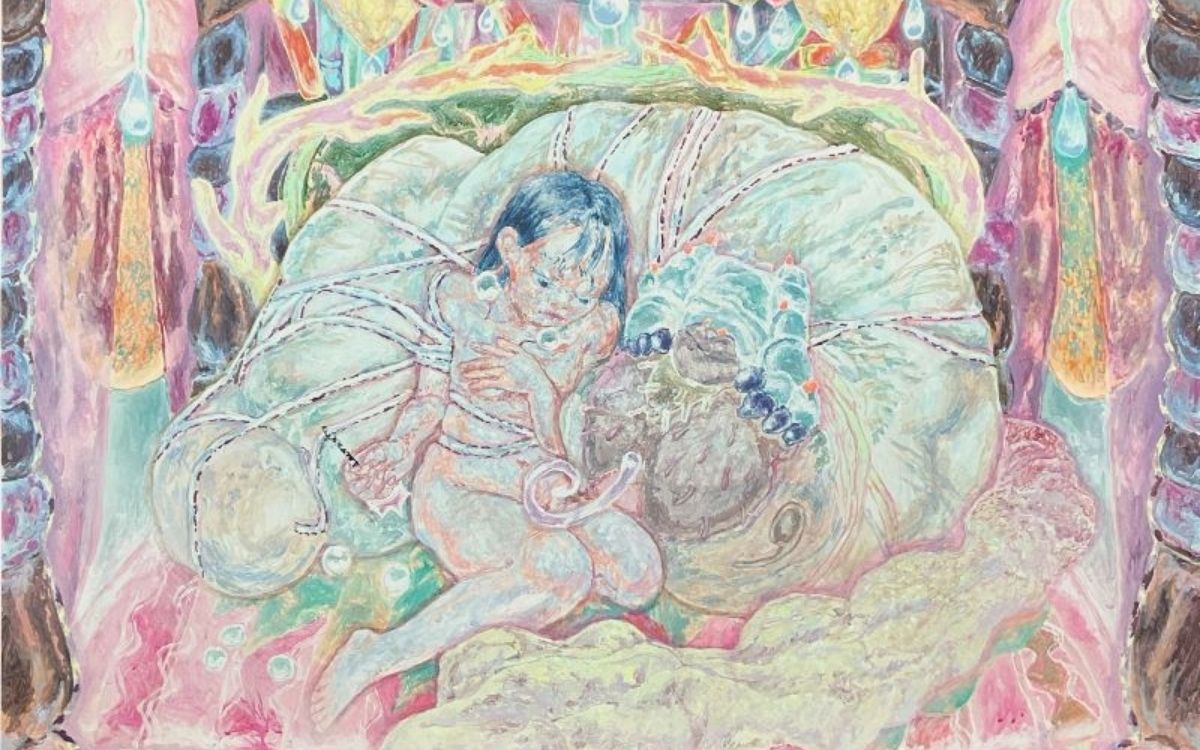
Evelyn Tan paints avatars of the self, not self-portraits in the conventional sense, but sister selves: figures that diverge from lived experience by small but significant degrees, adopting different levels of audacity, fear, naivety, or desire. Born in Canada to Chinese and Taiwanese immigrant parents, and shaped by the quiet but persistent experience of being othered in a suburban landscape, Evelyn Tan has developed a practice rooted in genuine self-inquiry rather than cultural performance. The work does not seek correct answers. It flirts with new possibilities, holds contradictions without resolving them, and finds in that irresolution something more honest than any single conclusion could offer.
Does spirituality or a connection to something larger than yourself influence your creative process?
As a child, I was very interested in the notion of omniscience. In turn, I often desired solutions to ‘adult’ problems. Growing older, I began to question what it means to have a ‘correct’ solution at all, which became an intense need for self exploration. I channeled that energy into drawing ‘sister selves’, which eventually manifested into painting self imposed avatars. Each avatar explores deviations to the events of my life, and adopts slight adjustments to character, whether that be an increased sense of audacity, fear, naiveté, or even sexiness. They contend with each other, and in doing so, create a sort of irony about what is truly ‘correct’. The resulting pieces rarely provide a solid answer, but rather flirt with the idea of something new entirely. They create an understanding of self possibility in a way that simultaneously is beyond me, but not entirely separated from myself either.
How has your upbringing or cultural heritage shaped the themes and techniques you explore in your art today?
My mom is Chinese and my dad is Taiwanese. Both immigrated to Canada, where I was born and raised. Consequently, growing up in a Canadian suburb, I encountered very few East Asian folk and I think that perhaps contributed to a sense of ‘Othering’ that is inherent in my work. That being said, I don’t create with themes of ‘Chinese-ness’ or ‘Taiwanese-ness’ at the forefront, I am proud of my heritage, but I think the lived experiences of growing up Asian Canadian are already embedded and don't need to be explicitly highlighted. This is simply by virtue of my work reflecting my life. While I understand the desire to create ‘identity art’, I’ve found that it sometimes risks diminishing lived experience into something that is more palatable. ‘Identity art’ needed to exist to pave the way for further discourse, however I believe we are at a time to explore that further.
That isn’t to say that it is not a worthwhile venture to highlight cultural excellence-that is still very much something to be celebrated! But I think when creating, my lived experience and memories come first, and culture follows naturally. Reversing that process and filtering my life through a cultural lens tends to dilute my real lived experience and by proxy, my artwork.
Do you believe artists have a responsibility to address climate change or environmental concerns in their work? Why or why not?
It depends on the type of art you are aiming to create. Are you scratching something conceptual, are you taking the role of philosopher, or are you creating for the sake of pure aesthetics? All are valid modes of creation. I do think if you engage in ‘Fine Arts’ spaces which often demand a more critical philosophical lens, there is a level of responsibility there in being very conscious about what you are creating and why. My work often contends with themes of sovereignty, the body, and feelings of naivete and nihilism which can often be paralyzing. That being said, I don’t agree with the notion that art needs to be the central force behind an artists’ activism. Yes, art is inherently political. Creating when it feels futile is inherently a radical act of expression.
However, oftentimes the best activism comes from taking care of your immediate community and preserving the health of those around you, rather than putting all of that energy into the art itself. For me, my art is the balm that is the catharsis for me to heal myself and others, but it is not the primary form of activism. My painting is not going to work a shift at a soup kitchen, and my painting will not be planting trees. However, creating beautiful things may help feed and heal the mental that is required to help my community.
In a world flooded with imagery, what responsibility do artists have to stand out and say something authentic?
Rather than it being a responsibility, I think it is a necessity to consider, especially if you are creating art as a career. I think you shoot yourself in the foot if you don’t. It is so easy to be inundated with imagery and trends, but trends quickly phase out, and many of us are already experiencing a denouement of attention span, me included. I’ve encountered a bit of a ‘chicken or egg’ effect when I had seen my own work being algorithmically fed to me on Pinterest, and wonder if the trends I’m seeing have partially emerged from my own psyche or if I myself am feeding into them.
Perhaps it is both. I’ve made an effort to stay off of Pinterest for that very reason-I’d like my artwork to be predominantly inspired by real life interaction, memories, odd dreams, and the natural world, and believe that is where my richest imagery has originated.
Do you believe the ‘mad artist’ stereotype still holds weight, or is creativity more grounded than we think?
I’ve been having many conversations on ‘oddness’ recently. Many of my friends are also fellow artists, and I find them pretty odd in a delightful way, but definitely not ‘mad’ either. That being said, there’s something to say about truly thriving in a society that feels ill too, and I don’t think you need to be an artist to feel the effects of that. There is a huge fetish behind the notion of a starving or debilitated artist, and while I think there is something beautiful and alchemical about transforming suffering into art or beauty, it should not be celebrated to be ill.
Some artists thrive when their personalities or artist personas are more outwardly eccentric, and that complements their artwork beautifully. I think eccentricity is delightful to witness in artists and perhaps yields more exciting work that is generated from a unique worldview, but I don’t believe in constant turmoil/the debilitation of ‘madness’ for the creative to be a great artist or produce great art. I think eccentricity and depth can exist with health still being at the forefront of an artists’ existence. After all, art and creativity are fertile grounds for preserving and soothing the mind and body.
Artificial Intelligence is increasingly infiltrating creative fields. Do you see artificial intelligence as a threat, a tool, or a collaborator in the art world?
While I’m not a fan of AI in arts spaces, I do also acknowledge that it is a Pandora’s Box that we’ve already opened. Since opening said ‘box’, we as artists must learn how to adapt with it. Because I am most involved in Fine Arts spaces, I am most aware of its impact there. I think a lot of Fine Art is predicated on the desire and culture of human connection.
There was recently an auctioned piece at Sotheby’s created by a robot (Ai-da) that was sold, but I consider that piece valuable as a cultural marker in technological innovation rather than something consistently desirable in the market, because the piece itself inevitably lacks empathy. That being said, it’s good to monitor the climate and be proactive about adjusting accordingly. Technology will continue to evolve, and while I think there must be more regulation with AI, we must protect ourselves as best we can whether that be opting out, not offering consent to training models, and avoiding it where possible.
I also believe it’s important to not let AI help you write (especially if you are writing in your first language). AI is already taking our language (my beloved ‘em dash’ has become a moniker of AI usage), and I think that is something we should all concern ourselves with. Critical thinking is important to exercise, and we should be careful to not let that muscle become passive. I recently found an ‘interview’ of mine online which was a mish mash of AI scraped articles and assumptions about me which contained plenty of false information and false quotations. It is important to look at things online these days with a critical eye.
How important is it for viewers to understand the intended message of your work? Does ambiguity add value, or do you seek clarity in your expression?
Everyone leads a different life and therefore everyone is subject to a different perspective. I am not interested in ensuring that my initial message for my work is the ‘end all be all’ for it. I think it’s beautiful when different perspectives come together to dissect the work through their own lenses. It is certainly a vulnerable experience as a lot of my work features projections of myself, however I think that is part of what it means to show your artwork as an artist and I relinquish that control.
I would never desire for my art to encourage any themes of racism, homophobia, pedophilia, SA, or xenophobia. It is one thing for my art to contend or conjure up these themes, especially as I often make work that is a bit ironic or parodying in nature. It is another to encourage them. As an artist, I take care to ensure my art does not enforce such ideas.
What distinguishes this conversation is a clarity of thinking that matches the clarity of the work about identity art and its limits, about trends and the danger of being algorithmically fed one's own aesthetic back, about eccentricity as something that can coexist with health rather than requiring suffering as its precondition. Evelyn Tan is an artist who has thought carefully about what it means to create authentically in conditions designed to flatten and accelerate. The response has been to stay close to real life, odd dreams, memory, and the natural world, the places where the richest imagery has always originated. That is not a retreat. It is a position.