
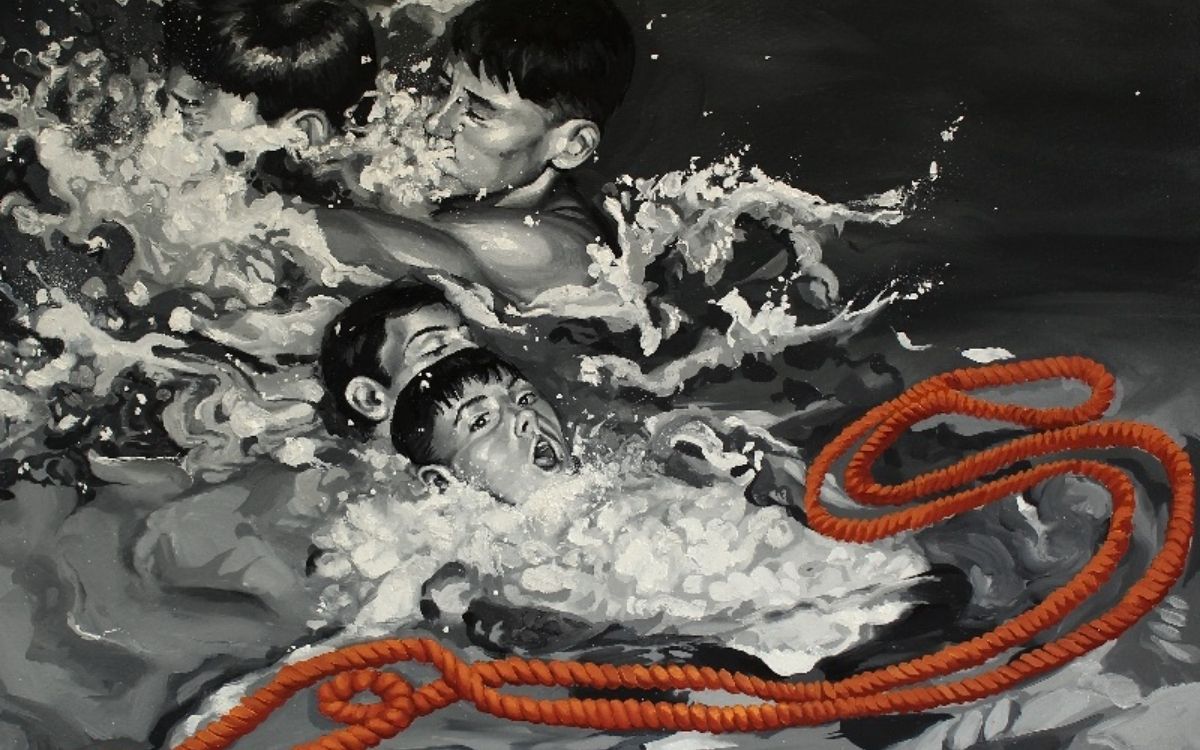
Amelia Tran paints portraits from the inside out. Growing up in a creatively strange and proudly encouraging family, a ceramicist mother who covered hallway walls in paper for drawing, who brought children to galleries and trusted their instincts, something took root early and never needed much convincing. The work that has developed since draws from inherited photographs, family albums, and the faces of people held close: not as documentary material but as a way of decoding feeling, speaking difficult things into existence without having to say them aloud. Precise about process, personal about meaning, and genuinely curious about what a painting can hold, Amelia Tran is an artist only now arriving at the work that was always waiting.
Can you pinpoint a single moment in your life when you realized art was not just a passion but your purpose?
There are a few moments where I think it became apparent to me that this was a life’s purpose kind of thing, and not a hobby. But I will say that it was more so the reactions of other people rather than it feeling like a truth I had not yet uncovered. I grew up in a very creative and proudly strange family. My mom is a ceramicist and has always been creative in whatever endeavours she is pursuing. She never worked in the arts but made sure to always provide access to the arts for my sister and I. Whether that was covering the walls in the hallway in a roll of paper for us to decorate, or bringing us to the national art gallery, she was always encouraging me to make things.
One of the first moments I realized I should pursue this more seriously was in my seventh grade math class. There was a somewhat strict no distractions, including doodling, policy in the classroom. But somehow this did not apply to me. I remember my teacher approaching my desk, I thought to tell me to stop drawing, but instead picked up my math binder and looked at it without speaking for a few minutes. He got down to my level and had a very genuine moment with me where he expressed his appreciation for the drawings I had made on the cover. He then told me that he couldn’t wait to see me succeed in my art, and to be able to point me out and say he was my teacher. This brought me so much pride, and might have been one of the first times I grasped that I could really pursue art as a career.
This was followed by a two year obsession with SFX art and body painting. At 13 I was rushing home after school everyday, heading down to our basement and working on sculpting and moulding facial prosthetics. Not really sure where this came from, I guess I had a bit of an obsession with old horror movies, exposed to me through my dad. That, plus, I think I’ve forever been interested in faces in one way or another. I would then come upstairs for dinner with a bat nose or elf ears. I had a dream to be a movie makeup and practical effect artist. This was replaced when I discovered oil painting.
A final moment that comes up when thinking about this question would be my fourth year of my undergraduate degree. I was coming up on the end of my honours year of my BFA and was facing the final fifth year of my B-Ed. At this point, education had been more of a necessity to fall back on, knowing I could always get a job as a teacher. I had been paying my way through school and after learning the ridiculous tuition fee for my final year I had a choice to make. I could either nearly double my debt and become a public school teacher, or follow my real passion and finish school with one degree. It felt almost stupid at the moment, having completed four years of a degree only to bail out in the last year, but I had to be very honest with myself. Had I only chosen this degree because it was a practical way of keeping art in my life, or was it a passion? The answer was an easy one, and I decided that I would instead work as a nanny and paint until painting took me where I needed to be.
How do you envision the evolution of your work in the coming years?
I feel like I’m at such an exciting time in my career, all I want to do is make. I find myself shying away from certain opportunities until I have a body of work I’m really proud of to show for it. I think for a while this hindered me, and made me feel stagnant. But I’m realizing now that I’m nearing this time, and that the work that I am making right now is the kind of work I have been waiting for. I finally feel like my vision is so much clearer, I understand my thesis, and I understand why I paint. Because of this I feel a sense of freedom instead of hesitance when beginning a piece.
In terms of making, I have a few experiments that will lead to larger works. I have been working with canvasette paper instead of canvas or wood panels. In a recent piece that I am nearly finished, I used many panels of this paper to create one piece. I am interested in the capabilities of this technique once I’m finished. I’m planning on rearranging the panels to create a few different versions of the piece. This modulation of my paintings sparked an interest in cutting my work. I have done a few experiments and it’s led me to a way of pixelating my images. Initially seeing a similar technique online, I used some old photos and sliced 1mm thick pieces from the photo.
Then arranging them with other photos to create completely new images. I feel as though the dismembering of the images has some kind of through line to the meanings I portray in many of my works. I plan on doing this on a larger scale, perhaps ending up with paintings that can be shown differently every time I install them.
Do you believe an artist's passion is something destined or a conscious choice?
This is a question I’ve discussed at length with other creative people in my life. The consensus is, that in most cases, pursuing a life in the arts means giving up comfort. The ‘struggling artist’ trope I feel holds more weight than ever with the cost of living climbing the way it has been. Passion is so separate from the material needs of your body, it feels more like an itch you need to scratch. It’s also never necessarily pleasant.
After finishing a long day at work, many might search for rest and distraction to unwind, but someone with this itch might stay up early into the morning hunched over in the studio just to expel whatever’s been marinating inside them. Sure this is a conscious choice, but sometimes I wonder how much extra time and money I’d have if I did have the subconscious need to make things all the time. Painters historically have been given the title of a ‘tortured soul’ and I feel like the innate need to get this thing out of you and into the open is a big part of that story.
That explanation makes it seem all bad, which it’s not. I think the problem is that when you have a good idea and it works, the feeling is like some kind of high. Subsequently meaning it’s something you then tend to chase, and don’t always find. This makes an artist block absolutely devastating. You have all of this passion and nowhere to put it.
All of this to say, I think passion is something you’re born with and you just have to find where to put it all. I’ve been lucky enough in my life to meet people who have encouraged me to follow this passion without fear. Perhaps without the introduction it would have taken me a lot longer to figure out where it goes.
Can you take us through the evolution of an artwork, from that first spark of inspiration to the finished piece?
I have a large archive of photographs that I keep to pick through. Most of the images I use as reference are old photographs from family photo albums. After a series of deaths from both sides of my family I came to inherit many photographs that I would later use in my work. Normally a photo will catch my eye because of someone’s expression or perhaps there’s something interesting in the composition. Sometimes just looking through these photos is enough to spark an idea that then becomes a finished painting.
However I find this method of working leaves a graveyard of unfinished pieces in its wake. I find when I’m really passionate about an idea its because I’ve come up with it in my head first. It appears similar to a dream you’re trying to remember, like an idea that’s attached to a helium balloon, and you’re outside, and it’s windy. But when I’m able to get it down on paper or in my notes, the work that comes out of it is normally my best. The idea is often for a composition, the full meaning comes later. Once I have the composition solidified in my mind I’ll search for images in my physical collection as well as a folder of digital photos I’ve found online. I often wonder about the ethics of using an image that’s not yours but in the digital landscape today I think it’s almost unavoidable.
Once I have my images I’ll use procreate on my iPad and draw up a more concrete reference. I’ve recently been working on unstretched canvas and thin wood panels. I try to prime these for painting on a day where I’m not feeling particularly creative so when I have the itch to paint I can start immediately. I’ll prime them with at least three layers of gesso, sanding between each layer, leaving me with a completely smooth surface. Finally I’ll use a thin layer of acrylic paint to tone the canvas, recently this has been a muted midtone orange. This helps me make sure my values are correct. Depending on the composition, I will occasionally use a projector to sketch out the drawing onto the canvas. This is very helpful when I have multiple elements in a painting as it helps ensure I have everything in the right place, and the composition that I had taken time to create is translated properly onto the canvas.
After the drawing is done in willow charcoal or a soft graphite I will seal the drawing with one more layer of clear gesso, sanding again afterwards. I’ll then mix my paints, I like trying new colours but have a few favorites I’ll always use up. Quinquadone red and Indian yellow are always used in my paintings. I am a bit of a nerd when it comes to mixing colours, I’ll begin with a few mother colours that I will mix a lot of, then mix the rest of the colours that appear in the painting from those to keep it harmonious. One of my favorite parts of painting portraits is the subtle colour shifts you can find in the skin. One of the greatest joys of life is recognizing how light will reflect on the chin differently based on the colour you’re wearing.
All of these details come after a long awkward period of just putting colour on the canvas until you start to finally see the image. I’ll finish my works with a title that’s normally come to me near the end of the process. Often times a phrase or something that might hint at the meaning behind the piece. However I am also a fan of naming my painting based off of what you see- Woman in a blue dress. For example. My process is always growing and changing, I love to steal tips and tricks from my peers and from interviews I see online and implement them into my own work.
How has your artistic style transformed over the years? Are there specific influences, experiments, or moments that marked a turning point?
From my perspective, my artistic style changes from piece to piece. I’ve had a few of my artist friends describe their practice where they work in three’s, which I think I see for myself as well. It’s almost like seasons, I’ll make three works in the span of a few months that seem to communicate properly. Maybe they have a similar theme or palette. And then I’m onto the next three. That being said for the past two years I’ve been in and out of the worst art block I’ve ever had in my life. I found myself questioning if I was even an artist, or if I was just performing as an artist because it was something I was ‘good’ at. I have come to realize that that was silly, and I am indeed an artist. I was just incredibly burnt out. After the painter in me had an adequate rest, I started to make the best work I had ever made, and a lot of it. I think what brought me out of that catatonic state would be the experimentation I did while experiencing it.
Something that really helped was not taking myself too seriously. One of the tools I used to stretch this muscle was my etch-a-sketch. It was a Christmas present from a loved one, and I found myself unable to put it down. I would use it to warm up my hand eye coordination, looking at an image and trying to draw it with the toy. It would result in very sketchy but legible drawings that were perfectly imperfect. Not much concrete came from these sketches, I appreciated that they were ephemeral, it took all of the pressure out of drawing, having to shake the pad once I was finished. This taught me not to be so careful with my work, a great practice for a perfectionist. I think this loosened up my style, leading to other types of experimentations that I have now completely implemented into my practice.
Has social media democratized art or diluted its value? How do you feel platforms like Instagram influence modern creativity?
This is a question that hits close to home. I've recently been feeling quite lost faced with the task of ‘marketing’ myself as an artist, and the idea of creating a ‘brand’ for myself. I think for many people this feels like the most achievable step. Most of us, especially young people, are now quite familiar with the tools needed to market yourself on social media. For me, I’ve never been quite so sure how to do this in a genuine way. I think the main reason could be that I am not necessarily looking for the most success or engagement on social media, however I think real life success and success online are completely intertwined now.
I have had a few artists my senior share both sides of the coin; that I’m living in the best possible time to be an artist, and that I’m living in the worst. From one point of view, having access to everyone all the time means so many more eyes can see my work. However, filing my work into the umbrella of content then turns it into something to be valued and compared against all other artworks available on social media, which quite frankly feels like all of them, ever. I think my issue comes from the commodification of my work as content. My work often comes from such a deep and personal place that sometimes posting it on social media can feel like a breach of my own privacy. Maybe it’s then about finding balance, posting some and keeping others for viewing in a gallery or on your website, which somehow feels more private.
Part of me feels hopeful though, I think we are coming up on a time where people are beginning to feel exhausted by online culture, and starting to find a lot more joy in engaging with analog media. This could be said about many different art forms but I definitely think this will be especially relevant for visual artists.
Are there any upcoming projects or dreams that you’re particularly excited about?
While completing my BFA at Queen’s University in Kingston I had the unique opportunity to work towards a second degree, a B-Ed at the same time. This was something I enjoyed but did not entirely complete. Mostly because school is far too expensive but also because I realized public school teaching was not something I wanted to pursue. This being said I have always, but especially because of this education, worked with kids. Whether it's facepainting at a birthday party, private art lessons or nannying, I've always loved participating in a child's creative development. Recently, with the growing number of young families I’m now close with, I’ve realized that I might have a unique opportunity to foster that creativity in a more concrete way.
I’ve recently thought about finding a way to create my own studio where I can teach a variety of courses to children, as well as anyone in my community looking to learn. I have a very specialized background in childcare, teaching and art making in a variety of mediums. I also have access to many qualified people, who would be interested in teaching other mediums I might not be so familiar with. I dream this space would be a safe haven to weird crazy ideas, where I could help strengthen the imagination kids are lacking today.
A part of the ethos of this space would be helping to target creative kids who may be effected by the current online landscape of short form content and AI. I’ve met many kids who have been negatively affected by this easy access to dopamine, and in turn, are less interested in activities that take too much time and do not provide immediate satisfaction. I’m no expert in this but I do know its something parents and childcare providers alike are noticing in their kids. I would love to create a space that encourages and empowers young artists to learn practical creative skills without tech.
This is a project I know I’ll actualize at some point, but for now I’m excited about continuing my body of work. A closer dream of mine would be having my first solo show. I’ve been living in Montreal for two years now and am hopefully getting closer to actualizing that dream soon.
Do you feel a personal connection to your subject matter is essential? How has this connection shaped your work?
I think a qualification for something to be a successful artwork is personal connection. If someone does not have a deep connection to the subject matter of their work it becomes obvious. I think without it your work can become soulless and ingenuine. I feel like it might be important to classify what a ‘personal connection’ means in this context, as well as it’s just as important to consider the subject matter. A deep interest in something resulting in a work that resembles research could absolutely be considered a personal connection. But creating a piece telling someone else’s story, even if coming from a place of care can end up being ingenuine.
My work is based on the connections I have with people in my life, and how a closer look at those relationships can help me have a better understanding of myself. These works come out of a need to decode my own feelings. Acting like a sort of meditation or journaling, my portraits help me speak personal messages into existence without even having to say a word. I used to even think of my work as something passive aggressive, as I’ve always been the type to apologize and move on rather than address any kind of root problem. So making paintings about topics I have a hard time speaking out loud, originally felt like a little bit of a cop out. I think now, looking back, I see this as a strength. I spend hours and hours making these paintings and looking at these faces. I find so much empathy in painting someone’s eyes, making the issues I’m thinking of easier to work through in my mind.
I’ve even had moments during my painting process where I’ve remembered repressed painful memories, things that have completely exited my conscious mind only to be called up again because of the subject I’m painting. This turns the work into something painfully personal, even if it was not my intention to do so. Personal connection is essential in creating some of my best work.
How important is it for viewers to understand the intended message of your work? Does ambiguity add value, or do you seek clarity in your expression?
I love this question, it’s something I discuss with my peers often. I am reminded of my feelings about this when chatting with friends who aren’t artists. I think talking about my work can be beneficial, but not normally to the meaning behind the piece. I’d prefer, in regular conversation, for people to interpret the work themselves, and then after doing some thinking and reflecting come to me with any questions. I’d rather answer questions regarding my process. I love discussing the technical side of my paintings as it’s something I can obsess over, and enjoy the opportunity to rant about it to interested ears. However when it comes to the subject matter and meanings behind the work I feel a little shy. It could be because of how personal my paintings often are, but I think another part is just that the meaning for me is, and should be, different than the meaning for you.
I think ambiguity in someone’s work is a sign of a good artist. I don’t like when I have all of the answers, I’d rather figure it out myself and then read whatever the artist has provided to get to the bottom of it. It’s like a puzzle. I think because that’s how I enjoy engaging with work, that's how I’d like people to engage with my own work. I also think I enjoy hearing people describe my own work more than I enjoy explaining it. I miss so much participating in critiques in art school. I would sit my painting in front of a crowd of my peers and only get to explain myself after everyone else has interpreted the work. That way I discover things I wouldn’t have seen otherwise, and the perception of my work isn’t affected by over explanation.
What makes this conversation stay with you is the honesty running through it about the two years of burnout that made the artist question whether art was real or just performance, about the etch-a-sketch that loosened everything up again, about the modular canvases being cut and rearranged into new configurations. Amelia Tran is an artist in the middle of a genuine breakthrough, aware enough to name it and grounded enough not to rush it. The first solo show is approaching. The dream of a studio space for children is forming. And the paintings being made right now are, by every account, the best ones yet. The itch, as described here, has finally found somewhere worthy to go.