
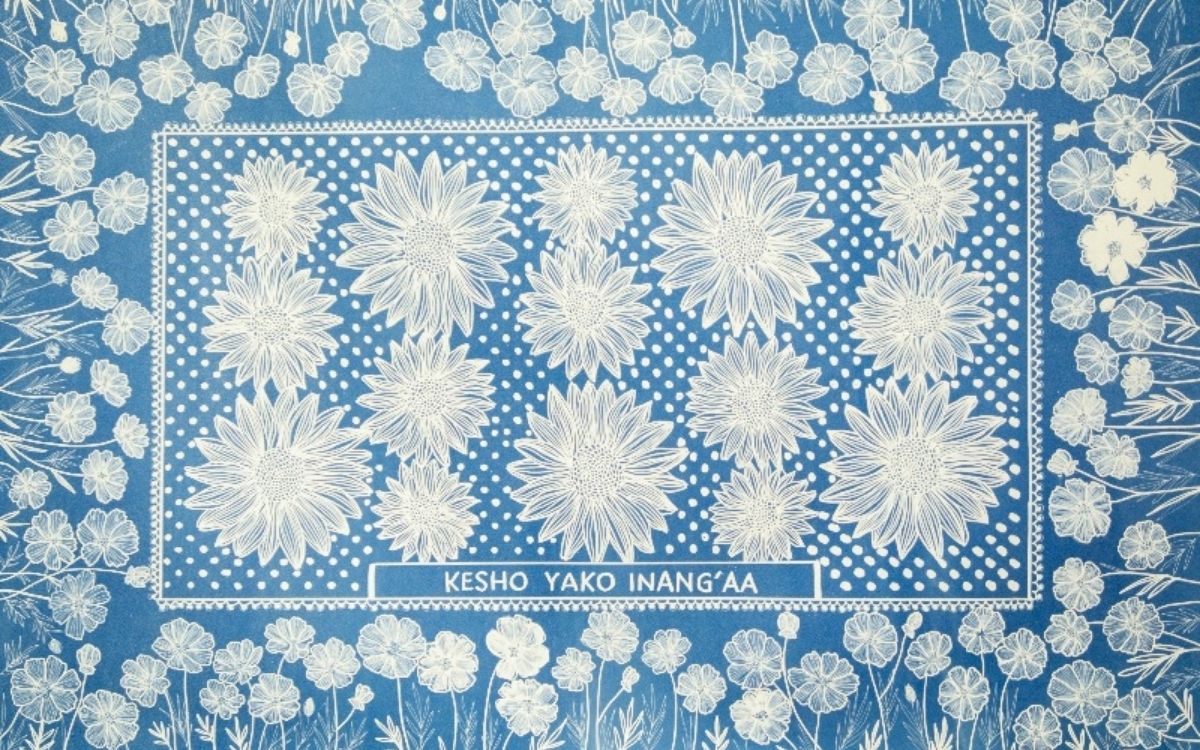
Elizabeth Deng came to art through a richly layered inheritance, a Nigerian father, an African American mother, a childhood visual world shaped equally by Yoruba ibeji sculptures, Romare Bearden collages, and Picasso's Guernica. That confluence of African, African American, and European imagery never resolved into a single aesthetic but instead became a way of seeing: layered, pattern-conscious, attentive to textile traditions, and deeply rooted in Blackness and Pan-Africanism as both identity and visual language. A human rights lawyer by profession, a maker since childhood, and now working primarily in cyanotype and mixed media collage, Elizabeth Deng brings to the work an entire life lived across disciplines, continents, and forms of care.
How has your upbringing or cultural heritage shaped the themes and techniques you explore in your art today?
My father was Nigerian and my mother is African American. I grew up in a home that valued art deeply, especially African art and Black art, though European artists were part of my visual world too. My childhood visual memory is marked by Yoruba ibeji sculptures, Twin Seven-Seven textiles, Romare Bearden collages, Picasso’s Guernica, and Gauguin’s paintings of Tahitian women. Those images still swirl together in my imagination and continue to shape how I see.
In University, I immersed myself in African history, politics, literature, language, and art, and I have spent my adult life living in different parts of Africa. I am drawn to African pattern and textile traditions, which recur throughout my work, particularly Yoruba adire, the kanga/leso of the East African coast, and wax print motifs. I also find myself returning to African American quilting traditions and to the collage work of Romare Bearden. Blackness and Pan-Africanism run deeply through my story, my identity and my visual language.
My upbringing also shaped me in a practical way. As a child, my mother encouraged my experiments with every kind of making, sewing, crochet, basket weaving, cake decorating. My early life as a multidisciplinary maker still influences me now, especially as I move further into mixed-media work. Lately, for example, I have been using a sewing machine in my collage work.
I first discovered cyanotype as a high school student in a black-and-white photography class, and I loved it immediately, though I only returned to it as an adult. What draws me to it now is the scope it gives for multi-disciplinary experimentation and the blue, commonly called “Prussian” blue, though I think of it as indigo. It reminds me of West African batik and indigo traditions and makes cyanotype feel like a medium that aligns naturally with my visual language.
Does spirituality or a connection to something larger than yourself influence your creative process?
Towards the end of 2024, my older sister died suddenly of a stroke. I adored her, and her death changed me profoundly. I am not naturally a very spiritual person, but when a friend told me I had an angel, I held onto the idea that she is with me and guiding me. I turned to art soon after she passed away. She is present throughout my work, in the courage to begin, in the drive to keep going, and in the imagined conversations I have with her as I create. Her passing taught me something essential: don’t wait. I have a long list of projects, and what drives me now is determination to bring them into the world while I can. My sister remains at the center of why I create.
Describe a piece you’ve created that has held the most emotional weight for you. What makes it significant?
Portrait of a Family That Lives is a series of two collages made using my family’s internal images, X-rays, MRIs, and ultrasounds. These images tell the stories of our bodies: pain, recovery, resilience, death, and new life. Creating it was draining because it is intimate in the most literal sense, and because it stirred so many different emotions. I thought about the awe of seeing my children’s dental X-rays, with two layers of teeth visible at once; the resilience of my daughter’s body during a hospital stay for bronchitis; the chronic hip pain I lived with for years, and then my hip replacement and the healing it brought; diagnostic exams that reassured me everything was fine; the knee problems that run through our family; the joy of new babies arriving; and my sister’s death.
It includes flowers from my sister’s garden that I collected, pressed, printed in cyanotype, and then painted with watercolor with my children and hers. I added them in and stitched everything together with a rainbow of colored thread. So the piece holds grief, fragility, love, healing, and continuity all at once. I called it Portrait of a Family That Lives because we all die, but first we must live, as fully as we can, for as long as we can, with the bodies we have, despite pain and limitation, for ourselves and for our children. That is one of the deepest lessons I learned from my sister’s passing: to live.
How do you measure the impact of your work, by its reception, its personal meaning, or something else?
I think every artist rejoices in the moment when their work lands on someone exactly as they hoped it would. But I don’t think my work can be meaningful to someone else unless it was first meaningful to me. So personal meaning is my starting point, and non-negotiable. I always create for myself, for my peace, my satisfaction, my fun, my curiosity, my healing, and trust that if the process gave me something, the product will resonate with someone else too.
Of course, my work does not always land on others in the way exactly as I intended. People bring their own associations to it, and that deepens the meaning rather than diminishing it. When Kenyans respond to my lesso images with a sense of familiarity or association with their mothers, for example, that is not necessarily where the work began for me, but I welcome the way their reading adds new layers of meaning. Sometimes connection takes time. There are pieces I have assumed no one would want, only to be surprised when they speak powerfully to someone and end up in their home. That gives me deep pleasure. It is a beautiful confirmation, and a reminder to trust my instinct, that what impacts me deeply will impact someone else too.
Can art be truly therapeutic? Have you experienced its healing power personally, or seen it impact others?
A review of my recent solo exhibition at One Off Gallery in Nairobi described it as “one of the most therapeutic” shows the gallery had ever held. That body of work grew out of loss and grief, and creating it was certainly therapeutic for me. I have seen that my work can be therapeutic for viewers too. The most common feedback I get about my work is that it is calming and peaceful. The fact that it might help someone feel a little more grounded, or better able to navigate their own pain, means a great deal to me.
There is something special about cyanotype that makes it feel healing, both to make and to look at. It is such a physical process: it forces you outside into sunlight, makes you move between shade, light, and water, and keeps your hands and body engaged. It is also magical and unpredictable. As an educator, I notice that people often seem lighter after a cyanotype class. It is restorative to step away from screens and enter a process that is tactile, playful, and shared with other people. The blues of cyanotype are also special, they connect people to nature and seem to help them relax.
How does your art engage with or comment on pressing contemporary issues, social, political, or environmental?
I am a human rights lawyer, and I spent fifteen years working as a human rights researcher and advocate, and in the humanitarian and development sectors, before losing my job as a U.S. diplomat with USAID. That unsettling professional rupture pushed my art inward. It became a retreat from the world’s social and political crises, personal and restorative. But activism runs deep in me, so I know that larger social and political questions will eventually draw me outward again. I am already daydreaming about a few creative projects that will do just that.
In the meantime, I have begun to understand my practice through an environmental lens, both in the process and in the art I make. Cyanotype botanical prints bring me into closer relationship with plant life, weather, and light. The images bring the literal imprint of the natural world indoors. I think that is a subtle but meaningful form of environmental advocacy and education: when natural forms are visible in the home, they help cultivate a culture of respect, attentiveness and care for nature.
What kind of legacy do you hope to leave in the art world?
When I think about my legacy, my focus is first on my four children rather than the broader art world. I want them to see an example of someone who made time for what she loved most, and who did not leave her ideas unrealized in the background of her life. What I would love is for them to one day look at my work and think: my mother made time to make these beautiful things, and I’m so grateful she did.
In the art world, I hope my contribution will be to expand the presence of cyanotype within Africa and to show how fully it can be integrated into African visual traditions. Although it is still often perceived as a Western medium, to me it sits naturally in dialogue with African indigo dyeing and batik textile design. Because it relies on UV light, it feels especially at home on this continent. I hope my work demonstrates that cyanotype is a medium African artists can reinterpret in ways that feel grounded and contemporary.
If you could live anywhere in the world to further inspire your creativity, where would it be?
I would live by the sea, specifically on the Swahili coast of Kenya or Tanzania. In one of my favorite children’s books, Miss Rumphius, the heroine has three simple life goals: to travel the world, live by the sea, and do something to make the world more beautiful. I have always loved that wisdom and hope to follow it in my own way. I have traveled widely. Creating is how I try to add a little more beauty to the world. But I have not yet lived by the sea, and I feel that the calm of the ocean would be good for my soul.
I am drawn to the Swahili coast because of its rhythm, light, architecture, and layered cultural history. I love the way African, Arab, Indian, and Islamic influences meet there. I think that cultural landscape would feed my work in beautiful ways. The other place I am drawn to is Nigeria. I would love to spend more time there deepening my understanding of Yoruba adire patterns, which I use with love and respect, but still to some extent as an outsider. I would like to know those patterns more intimately their histories and meanings, so that when I draw on them in my work, it comes from a deeper sense of understanding and connection.
List five core themes or messages you aim to convey through your art.
Awe at the beauty of nature
Serenity
Hope
Joy
Healing
If you were appointed as President for a day, what initiative would you launch to support arts and culture?
Making it as an artist is not easy. Creating is expensive, and doing it in peace requires materials, space, and time. The pressures of survival, needing to earn a living, be visible, and sell work, eat away at creative freedom. Grants and residencies can help, but applying for them is also time spent away from making.
So if I were President for a day, I would launch a national basic income program for artists, modeled on what Ireland has done. I would do it to give artists both literal and metaphorical space, time, security, and the freedom to experiment, revise, and create without being consumed by survival.
Ireland’s pilot basic income program for artists resulted in reduced financial anxiety, improved well-being, and more time for creative work, alongside broader social and economic benefits. I think every artist should experience at least one period of freedom in which they can create without constant financial stress or immediate expectations of commercial return. That would be an extraordinary gift not only to artists, but to the wider cultural life of a country.
At the centre of this conversation, held quietly beneath every answer, is a sister. Her sudden death in late 2024 changed the work and the urgency behind it not by making it darker, but by making it more determined. Don't wait. The projects on the long list deserve to exist. The children deserve to see someone who made time for what she loved most. The cyanotype blues, with their connection to indigo and West African textile tradition, deserve to be understood as fully African as they are anything else. Elizabeth Deng is building a practice and a legacy at the same time, and both are rooted in the same conviction: that we are here to live, as fully as we can, for as long as we can.