
Michele Savona develops an artistic practice centered on what emerges at the edges of vision: shadows, traces, tensions, images that seem to belong simultaneously to the external world and to a more interior, psychic space. He is fascinated by what light produces indirectly, and by the ambiguous presence of shadow as something immaterial yet generated by the body, suggesting a reality just beyond the visible. Growing up in Milan, in a household shaped by a sculptor mother and a painter father, and in a city dense with competing images, added further layers. The practice that has emerged from all of this currently developing at the Brera Academy of Fine Arts, is one preoccupied with thresholds: between inside and outside, between the psychic and the physical, between what can be controlled and what insists on emerging anyway.
How have you shaped the themes you explore in your art today?
One of the central themes of my practice concerns shadow. This obsession began in childhood: when I slept at my grandparents’ house, upon awakening we would play with shadow puppets, projecting figures with our hands and a flashlight. That game generated a lasting attraction to light and, above all, to what it indirectly produces.
In my work, shadow reveals latent aspects of matter, situating it in space and simultaneously distorting it. It is an ambiguous presence, immaterial yet generated by the body, capable of suggesting a further, hidden reality. This reflection extends to another central theme of my research: the perceptual threshold between inside and outside.
The context in which I live has also played a decisive role in the construction of my work. Growing up in Milan, a visually saturated city constantly traversed by images, has influenced my way of conceiving pictorial space. I believe contemporary visual overload translates into a tendency toward spatial layering and superimposition in my work.
Do you think an artist's passion is something predestined or a conscious choice?
I don't consider passion a choice, but a force that moves through the artist, something that asserts itself before it is even understood. The creative process often arises from a non-rational impulse: a tension toward images and forms that emerge without full control. At this stage, the action is partly unconscious. Rationality comes later, as an attempt to understand and articulate what has already happened. It is not a matter of opposing instinct and thought, but of recognizing that they operate at different moments.
For this reason, I consider passion something spontaneous, inevitable, almost fatal.
Does spirituality or a connection to something larger than yourself influence your creative process?
I wouldn’t call it spirituality, but rather an impulse that emerges within the pictorial process and reappears each time in different forms. At first, it is a dimension that exceeds conscious control, but it then requires a deep awareness in order to be brought to completion. There is a connection with the world, but it is always filtered through my inner world. This impulse, which I initially perceive as external, takes shape in the artwork and transforms differently each time. My works emerge precisely from this tension: something that seems to come from outside, but is in fact deeply rooted within me.
Describe a piece you’ve created that has held the most emotional weight for you. What makes it significant?
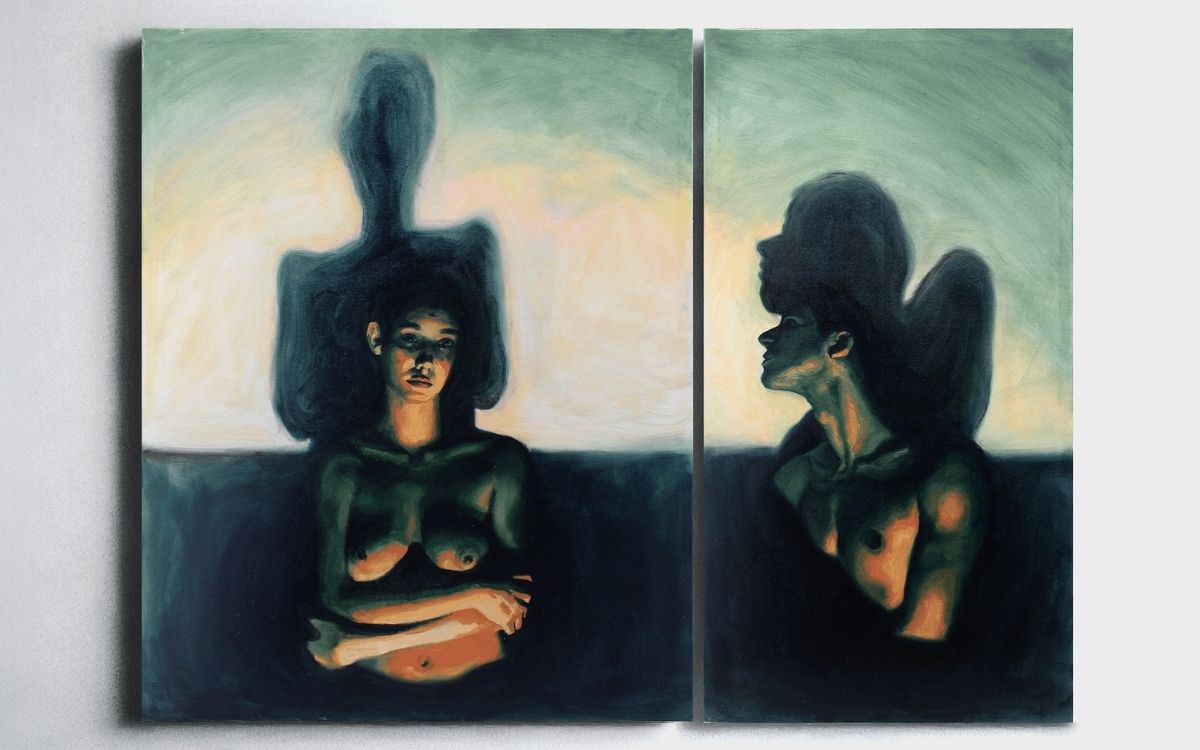
A work that holds a very strong emotional value for me is Rebis. It is a diptych I created last year, during a difficult period marked by health problems that my girlfriend and I had to go through. I was in a state of confusion, hyperactivity, and extreme anxiety. I withdrew from the world and began to look inward. The images emerged spontaneously and, at that moment, did not yet have a definable form.
All I knew was that obsession with shadows and their dual relationship with the body. Rebis is part of a series of works born from an unconscious exploration of my state of solitude: I depicted only the people closest to me, or myself, naked alongside my shadow, perhaps as a psychic projection of the way I perceived myself.
Among these works, Rebis is the most significant because it depicts Lisa and me, shrouded in shadow yet separated across two distinct canvases, where she occupies more space and takes on greater importance, while I gaze at her. The title refers to the Rebis of alchemical tradition, while also evoking the myth of the androgynous being described by Plato, split in two by Zeus in search of its other half.
Can art be truly therapeutic? Have you experienced its healing power personally, or seen it impact others?
Art has been therapeutic for me. When I was going through difficult times, painting was like delving into my own mind, immersing myself in my emotional state. Over time, it also became a tool for self-understanding. Looking back at my paintings after having gone through certain phases helped me fully comprehend them, because often what we depict and create reveals more about us than words ever could.
Can you pinpoint a single moment in your life when you realized art was not just a passion but your purpose?
There's no specific moment, but I remember this image of my mother with her hands in clay, modeling a face and then a hand, on a black canvas spread with written words. My mother is an artist, specifically a sculptor, and my father is a painter, so growing up in such a strong creative environment was extremely important to me.
As a child, I loved comics, especially superhero comics, and I spent hours copying the panels, reproducing them exactly, or inventing my own stories. I drew constantly. Some of my drawings were dark, and I find it interesting to think that they were a manifestation of a child's fears and genuine emotions. I wanted to be a comic book artist, but my artistic exploration eventually led me to painting.
How has your artistic style transformed over the years?
I am currently a student at the Brera Academy of Fine Arts in Milan, and am continually researching. In the early stages of my work, the shadow was configured as a psychic double, directly related to the body and with a strong introspective component. Subsequently, my gaze shifted outward, touching on pressing issues such as war, and today my work is situated in a tension between these two dimensions.
The shadow reappears in new forms: no longer just a projection of the body, but a trace, an imprint. With the airbrush, I capture objects and shapes, fixing their direct memory, then distorting their structures or imagining new ones, transforming, for example, the shadow of a tie into a figure.
I am also exploring indirect transfers, such as oil that passes through the canvas, imprinting the memory of the gesture on a second support. In my latest works, I've introduced wax, versatile for its ability to change shape with heat and mutate over time. This instability interests me because I am fascinated by the intermediate realm of opposites, the Platonic metaxy: a liminal space that generates tension and from which new forms and reflections emerge.
How does your art engage with or comment on pressing contemporary issues, social, political, or environmental?
My research also explores the threshold between introspection and pressing contemporary issues, focusing on the interstitial space that emerges between these two poles. Contemporary collective images sometimes enter my work, though not as direct representations: I’m interested in observing how they settle on a psychic level and transform into internal images.
The installation 0°;0° is an example of this: it creates a dialogue between a painting of a bombed-out neighborhood in Gaza and a grid of internal images, born from an unconscious reworking of material from television news broadcasts. Painting thus becomes a relational space, where elements from the outside and the inner world meet.
This aspect is still being developed in my research. I am interested in exploring it through the idea of an intermediate space between opposites, understood as a place of tension from which new meanings can emerge.
Michele Savona is an artist still deep in the process of formation. The airbrush capturing shadows and distorting them, the wax that changes shape with heat, the oil that passes through the canvas to leave its memory on a second support: these are not stylistic choices so much as philosophical ones, each material selected for its instability, its capacity to exist between states. The Platonic metaxy, that liminal space between opposites where tension generates new form, is not just a reference but a genuine description of where this practice lives. What comes next will continue to emerge from that in-between place, which is exactly where the most interesting work tends to happen.