
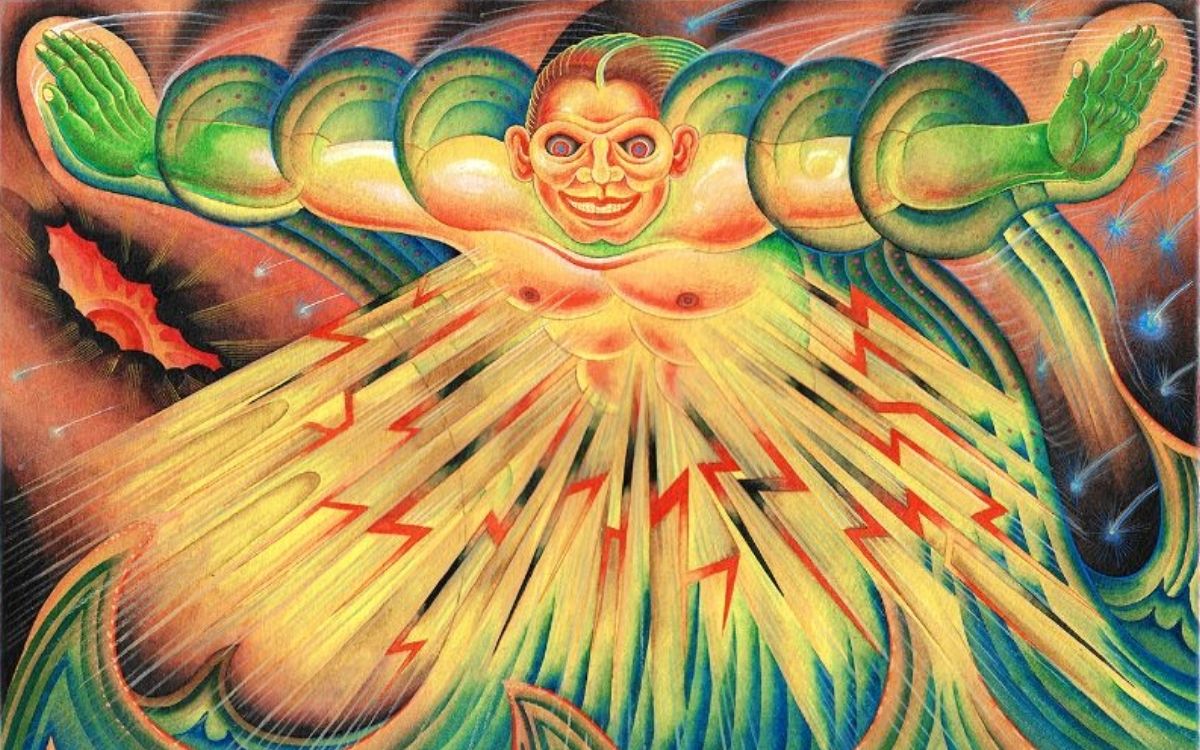
Matt Panuskal grew up in the vast stillness of the Permian Basin in west Texas, where desert landscapes, Catholic ritual, and Mexican folk art formed an early and lasting visual education. The Stations of the Cross, retablos, the sense of being drawn into another world through an image, these were not simply childhood impressions but foundational experiences that planted something which has never stopped growing. No longer religious, but still moved by that original feeling of spiritual connection to an illustrative image, Matt Panuskal now builds intimate, detailed, dream-like worlds at a drafting table, working small, working slowly, and finding in that concentrated stillness something genuinely cathartic.
How has your upbringing or cultural heritage shaped the themes and techniques you explore in your art today?
My cultural upbringing has profoundly influenced my visual language. I grew up in the Permian Basin of west Texas, near the Mexico border, and was surrounded by a landscape that continues to inspire me. The vast desert vistas, with their stillness, acted as a template for me to create imaginative worlds.
My upbringing was also deeply rooted in Catholicism. As an altar boy at Catholic school, I was captivated by the Stations of the Cross. The illustrative aspect of the paintings, coupled with the sense of being drawn into another world, were inspiring from an early age. Additionally, I was surrounded by Mexican religious folk art, which I found visually captivating. Retablos, in particular, held a profound and intimate significance for me.
I am no longer religious, but that initial feeling of a spiritual connection to an illustrative image remains a powerful motivator in my creative process. I believe that my early exposure to art and religious imagery planted the seed for my future as an illustrator and painter.
Does spirituality or a connection to something larger than yourself influence your creative process?
Painting and drawing are a meditative practice for me. Since I don’t have a religious structure or a spiritual practice beyond art making, creating my own worlds feels like an escape from my own context and material surroundings. I often work small, sometimes almost in miniature, focusing on one character or environment in an image. When I work at that scale at my drafting table, the stillness and focus allow me to crystallize a feeling into a new world, which is spiritually cathartic for me. It feels like a way of letting go of something by sharing it in imagery.
How do you reignite creativity during those inevitable periods of self-doubt or stagnation?
I feel lucky to have a wide range of artistic interests. When I’m feeling particularly stuck, I take on a small-scale project to explore a different craft. While I primarily create drawings and paintings, I also enjoy working with leather and wood. Some of these crafts become integral to my art practice, but even small or utilitarian projects can spark new ideas.
In the past, I had a routine where if I was working on a more intense project and feeling frustrated, I would take a break and make a wallet, incense holder, or similar item. These small projects served as a stress reliever for me. I could take a break and still get the dopamine rush of completing something. This approach has been instrumental in keeping me engaged in the creative process and exploring various mediums.
How important is it for viewers to understand the intended message of your work? Does ambiguity add value, or do you seek clarity in your expression?
I have a few different feelings about this idea. When I take on commercial illustration work, the prompts and what needs to be communicated are usually quite clear. The work needs to convey a story or provide a visual context that the viewer can easily understand. This is an enjoyable challenge in itself and an artistic exercise I find rewarding.
On the other hand, my personal work is infused with personal imagery and symbolism. When I start on a personal project, I construct a narrative and context within my mind and sketchbook. The imagery I choose to use often represents a part of a larger story. However, the stories in my work are often dream-like and ambiguous, even to myself. I admire the approach of surrealists and symbolists and don’t shy away from the ambiguity. In terms of its value to the viewer, the work that has always resonated with me the most has been mysterious and unclear. I hope the viewer can appreciate it in the same way.
Can you take us through the evolution of an artwork, from that first spark of inspiration to the finished piece?
The sketchbook is essential to me. I carry a small notepad in my back pocket to jot down intriguing ideas or phrases. This serves as a starting point and helps me build context for a story. If an idea gains momentum, I begin sketching it in my sketchbook, developing characters and environments. However, things can change significantly. I might have a well-developed idea ready to paint but revisit it and explore a different aspect that resonates better. I can go through several narratives before arriving at a final version.
When I paint or draw, I work small in scale, and heavily detailed. I predominantly use watercolor or dip-pens, and rely heavily on a detailed underdrawing. Painting is a slow process for me. I usually begin with a broad wash to establish a base tone. Subsequently, I render shadows to add depth. The most time-consuming part is creating glazes and washes with transparent hues. Finally, I add opaque colors to continue rendering and highlight the subject.
If you had the chance to sit down with any creative mind from history, who would it be and what would you ask?
William Blake and H.C. Westermann, two of my favorite artists, were both iconoclasts who created visionary worlds. Their work is captivating, and I try see it in person whenever possible. If I had the opportunity to sit with them, I would be eager to learn about their creative process, how they worked, and to explore their studios.
In particular, I would be interested in discussing Blake’s Prophetic Works. I admire his illustrative pieces based on the Bible and classic literature, his poetry, and everything else he created. However, I believe his Prophetic works are the most enigmatic and offer profound insights into his personal spiritual beliefs.
If you could step back into any artistic era, which would it be and why?
That’s a tough question! I often daydream about this, where I can travel back in time and visit some of my favorite artists. I get to live with them for a short while and experience their lives firsthand.
There are many great eras for illustrative art. Paris in the 1920s, during the rise of Surrealism, would be fascinating. Similarly, America in the 1960s was also a golden age for illustration. Being around in the late 19th century with the Symbolists would have been an incredible experience as well. On the other hand, I had a lot of fun in the mid-2000s, before social media became so dominant.
Matt Panuskal is an artist who trusts the sketchbook, the small notepad in the back pocket, the wallet made during a moment of frustration, and the slow accumulation of glazes on a watercolour that may take weeks to resolve. The work is unhurried by design, because the worlds being constructed, ambiguous, symbolic, quietly surreal, require time to become themselves. What holds it all together is that original feeling from childhood: the sense that an image can pull you into somewhere else entirely. Decades later, that remains both the method and the purpose.