
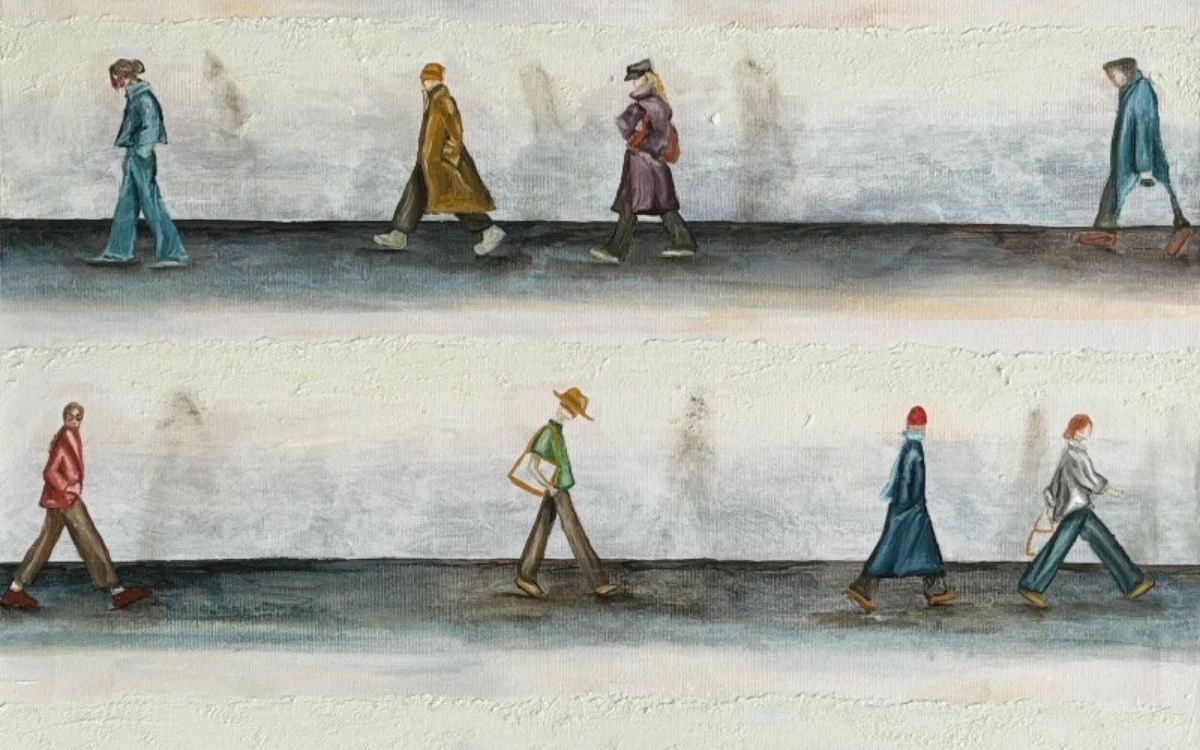
Emma Lisnell has been painting for as long as memory allows. The earliest creative education came through a grandfather who introduced exhibitions, books on the human figure, and a shared space for making, someone who marvelled at an imagination he said he wished he could step inside. That formative encouragement left a clear mark: people have remained at the centre of the work ever since. Self-taught and instinct-driven, Emma Lisnell builds paintings around human presence, figures that move, carry themselves, hint at something beneath the surface, finding in that space between what is visible and what is withheld an inexhaustible source of depth.
How has your upbringing or cultural heritage shaped the themes and techniquesyou explore in your art today?
My upbringing has definitely shaped my work, especially through the shared passion for art between me and my grandfather. I’ve always felt that my creativity comes deeply from within, I’ve been painting and creating for as long as I can remember. But my interest was really sharpened through the time we spent making art together. His encouragement meant a lot; he was always fascinated by my imagination and used to say he wished he could “step inside my mind” to understand where my ideas came from.
He also introduced me to exhibitions and a lot of books, particularly focused on the human figure, something that still clearly appears in my work today. I incorporate people in almost all my pieces in one way or another. For me, people are the most interesting subject that exists. Whether it’s a subtle movement or a more abstract figure, I believe the presence of a human element naturally adds depth and emotion to a painting.
What unusual or unexpected sources of inspiration have deeply influenced your work?
A big source of inspiration for me is people; how they move, dress, carry themselves and express something without saying anything at all. Fashion is also an important influence in my work. It adds another layer to how a person is perceived, but can also hint at something deeper about identity, mood, or character. That balance between surface and what lies beneath is something I find really interesting. Lately, I’ve been focusing a lot on groups of people. At first glance, a group can seem simple or almost anonymous, but every individual within it carries a whole life of their own. That contrast between what we see and what is hidden underneath is something I’m exploring more and more in my work.
How important is it for viewers to understand the intended message of your work? Does ambiguity add value, or do you seek clarity in your expression?
It’s not important to me that viewers interpret the work the way I intended. I actually find it more interesting when they don’t. I may have a certain character, feeling, or idea in mind when I paint, but once the work is out in the world, the interpretation no longer belongs only to me. Someone else might see something completely different in the same figure or scene, and I think that’s part of what makes art so powerful. Since I work a lot with people and human presence, there is always room for interpretation. A viewer might connect to a figure in a very personal way, based on their own memories, emotions, or experiences, and I really value that openness. For me, ambiguity adds depth.
How has your artistic style transformed over the years? Are there specific influences, experiments, or moments that marked a turning point?
Experimentation is at the core of my work. I constantly try new ideas and ways, just to see what happens. Since I’m self-taught, this has always been my approach, and I think it has given me a strong sense of artistic freedom. For me, there aren’t really right or wrong ways to create, it’s about trying, feeling, and exploring. I go with my intuition, and that mindset keeps the process exciting and allows my work to keep evolving.
At the same time, even though my work has developed and changed over time, I’ve always tried to stay true to my core. Looking back at my very early sketches, even from when I painted with my grandfather as a child, I genuinely feel that you can still see that it’s me. So for me, the transformation isn’t about becoming something different, but about building on something that has always been there. It’s important that every painting still carries something that feels like me.
Can art be truly therapeutic? Have you experienced its healing power personally, or seen it impact others?
For me, art really is therapy. There’s nothing that makes me feel as present, focused, and grounded as when I’m painting. It allows me to slow down and fully be in the moment. At the same time, art is also a reflection of my state of mind, but also a kind of anchor. When I feel inspired and at peace, I naturally create a lot and it becomes a way to express that energy. But during more difficult or uninspired periods, art becomes a way back. It can be harder to start, but once I do, I reconnect with that feeling again. It’s difficult to fully put into words, but it’s an essential part of my life, a tool I will always have with me, and something I’m very grateful for.
Can you take us through the evolution of an artwork, from that first spark of inspiration to the finished piece?
Inspiration can come from something very small, even something unexpected. From that moment, my mind starts building ideas from a single starting point. I often think in terms of colors and emotions first, what feeling I want to express, and then I begin. But the initial idea usually evolves into something more, or something different, during the process. Once I’m painting, I experiment, adjust, and follow my intuition until it feels right. For me, trusting that feeling is key - that’s when the work turns out best.
If you could live anywhere in the world to further inspire your creativity, where would it be?
If I could choose anywhere, it would be Paris. I lived there for a while, and looking back, I can really see how much it inspired me. There’s something about the city itself -the balance between elegance and playfulness, but especially the people. The way they live, dress, and carry themselves is incredibly inspiring to me. It’s a city where you constantly observe without even trying. I live in Copenhagen now, which in many ways has a similar feeling. There’s a lot of inspiration to absorb from this city. But with that said, nothing quite compares to Paris.
Can you imagine ever choosing to stop creating art? What might lead you to such a decision?
Never ever.
What comes through most clearly in this conversation is a practice held together by consistency of feeling rather than consistency of style. The early sketches made alongside a grandfather and the paintings being made now are, by Emma Lisnell's own account, recognisably the same person, the work has grown without losing its core. Art here is not a career strategy or a conceptual position. It is, plainly and essentially, a way of being present: an anchor during difficult periods, an expression of energy during good ones, and something that will never be set aside. Never ever, as the last answer puts it, and that brevity says everything.