
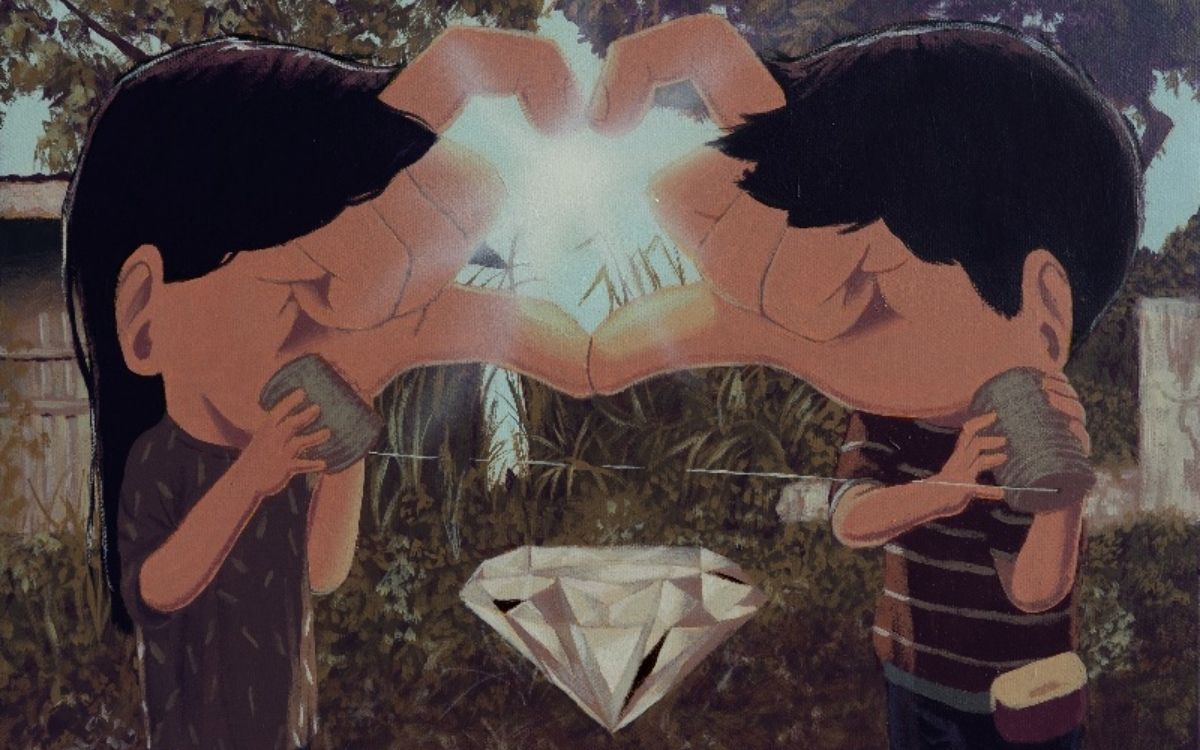
Blic Pinas arrived at painting by a route that was anything but direct, computer science, graphic design, UI/UX, street art, and then, gradually, the gallery. That circuitous path, rather than being a detour, turned out to be the education. Each phase added something: the logic of code, the boldness of graffiti, the technical ambition of pop surrealism, the compositional complexity of Bosch and Bruegel. What emerged from this accumulation is a practice rooted in resilience, not as a theme imposed from the outside, but as something lived and then translated, with increasing skill, onto the canvas.
Have you ever felt drawn toward a conventional career path? What made you take the "creative leap" despite the risk?
Before I got into street art and studio work, I was working as a creative in a corporate company. I got lucky because even though it was a corporate setup, it was still infused with creativity. I worked as a graphic artist and a UI/UX designer, even though I graduated with a degree in computer science. It’s actually pretty far from each other, my studies were very logic-heavy, but what I do for a living is creative. I think that contrast is also what pulled me toward becoming a full-time painter. The love for creating was always there, it just came out naturally.
How do you reignite creativity during those inevitable periods of self-doubt or stagnation?
When I was just starting out in street art, I was really goal-oriented. I think part of that came from being self-taught, I didn’t really have a clear reference point for my value as an artist. I didn’t know if I was actually good or just average. I was more focused on the artists I looked up to. I’d study their techniques, try them out, and think about why they approached things the way they did. I’ve kind of always been like that, just focused on the craft. Maybe because I came from street art, I got used to the idea that everything I make could eventually disappear. So I learned to just keep moving forward.
Over the years, I still get hit with self-doubt. I question whether I’m really a good painter or artist, especially because my work can be a bit peculiar. Sometimes I even think what I’m doing is nonsense or feels immature. But then there are moments I don’t expect people come up to me and thank me, saying my work inspired them. Sometimes they even see meaning or relevance in what I do. Those moments fuel me to keep going. Especially because they’re things I never really set out to hear.
If you could communicate just one core message through your entire body of work, what would it be?
Resilience, that’s really what inspires me. The way you overcome the hurdles you’ve been through. Especially these days, there are so many things that can make us want to give up, so being resilient is vital. It’s what proves your purpose. For me, you become an exceptional person when you truly overcome what you’ve gone through. And I mean overcome, not just endure. There’s a difference between just putting up with something and actually finding a way forward. It’s not about simply surviving, it’s about actively doing something to move ahead.
How has your artistic style transformed over the years? Are there specific influences, experiments, or moments that marked a turning point?
I was introduced to street art and its technical side early on. I think what pulled me in was how it felt like a hybrid, rooted in graffiti, very style-heavy, bold, and fun. I was a late bloomer, though. I only really got into art at around 25, and at that time I had no real understanding of technique, no idea about light, shadows, or anything like that. So my work back then was very graphically inclined.
Then I got introduced to the gallery scene, and that’s where I fell in love with pop surrealism. I was blown away by artists like Mark Ryden, Robert Williams, and Todd Schorr. At some point, I started noticing that my street art heroes, Aryz, Nychos, and Alex Face, were also thriving in the gallery scene. Their work was evolving, and that really inspired me. That’s when I went down the rabbit hole into contemporary art.
From studying artists like Hieronymus Bosch and Pieter Bruegel the Elder, I eventually found my way to artists like Ryan Heshka and Neo Rauch. That’s when I started to really understand a more contemporary approach to painting. Then discovering artists like Jansson Stegner and Louise Bonnet opened my eyes to this fusion of technical skill and raw expression. I feel like my growth as an artist has always been tied to my growth as a person. We kind of grow older together, and as I evolve, so does my taste in art.
Has there ever been a time when the creative process felt more like a burden than a joy? How did you navigate that?
I still feel how hard it is the pressure, the heaviness, even that sense of laziness that comes from knowing how much you have to go through in the process. But there’s also something that keeps me going, the reward of finishing something. That feeling is different. So for me, I always remind myself: it’s hard first before it feels good. It’s natural that anything meaningful or beautiful comes with difficulty. That’s what motivates me, the harder something is, the more I believe there’s something valuable waiting on the other side. That’s why when something feels too easy, I actually get bored. That’s when it starts to feel like a waste of time.
Can you share a moment when someone’s unexpected interpretation of your art gave you a new perspective?
When I was starting out, there were so many times people interpreted my work in ways I didn’t expect. Honestly, that helped me a lot in understanding my identity as an artist. It pushed me to go deeper to really try and understand those interpretations. And over time, I found myself thinking, “Yeah… that actually makes sense.” Through those moments, I was able to refine who I am now.
Has social media democratized art or diluted its value? How do you feel platforms like Instagram influence modern creativity?
Social media has really helped when it comes to exploring creativity and getting exposed to art, not just for aspiring artists, but even for established ones. It lets us see how art evolves, and it makes it more accessible to people, even those who aren’t really into art. The awareness has become global. But for me, as an artist, it can also dilute the creative process a bit. With so much exposure to different styles, perception starts to become the basis for making art. I think this is something aspiring artists might struggle with a lack of deeper wisdom when it comes to being an artist.
Do you think art that is created for commercial success loses its integrity, or can it still hold meaning?
I’m honestly biased toward having a solid foundation in painting and then making that solid transition into unlearning. Like, you slowly build your skills, then you also slowly break what you’ve learned. That’s where the meaning in my work really comes from. It’s the value of all the trial and error just to reach that sense of satisfaction.
For me, selling is just a bonus, same with anything becoming commercial. I see “commercial” as people buying into you because you’re part of the hype. I’d rather be in a place where there is hype, but at the same time, your process as an artist is truly solid. That’s probably the best position you can be in as an artist.
What are five steps you’re taking to ensure your continual growth as an artist.
My mantra has always been to start with my last piece, using it as a baseline to make something better. It’s always a reaction. I look at what needs to be fixed, improved, or pushed further.
After that, I start looking for new things to study based on that reaction. I think about what I can apply to the next piece, and what inspirations can help me achieve the direction I’m aiming for.
Next is conditioning myself. Just lately, I’ve really learned the importance of rest. I usually give myself two to three days to recharge, while still staying aware of my schedule.
Then comes the study phase. This is where I really break things down and filter everything through what I feel.
And lastly, I try to listen, whenever I get the chance to share my studies or finished work. Other people’s perspectives help me a lot. It gives me a way to gauge whether I actually achieved what I was aiming for.
This is how I’ve been surviving so far, and hopefully, it’s led to real growth on my end.
If you had the chance to sit down with any creative mind from history, who would it be and what would you ask?
I’d want to sit down with Hieronymus Bosch. I’d ask him how he builds his compositions from the smallest details all the way to the full picture. I’m really amazed by that kind of style, where you have this wide, almost panoramic landscape, and every single detail carries its own narrative. It’s incredibly technical, and honestly, that level of complexity is just mind-blowing.
Blic Pinas is an artist who thinks in reactions, each new piece a response to the last, each phase of growth tied to a preceding moment of difficulty or doubt. The process is described honestly: it is hard first before it feels good, and when something comes too easily, it starts to feel like a waste of time. That particular relationship with difficulty, the belief that something valuable waits on the other side of resistance, runs through everything said in this conversation and, by all evidence, through everything made in the studio. The work ahead, wherever it goes, will be built the same way, carefully, incrementally, and with full awareness of how much further there is to go.