
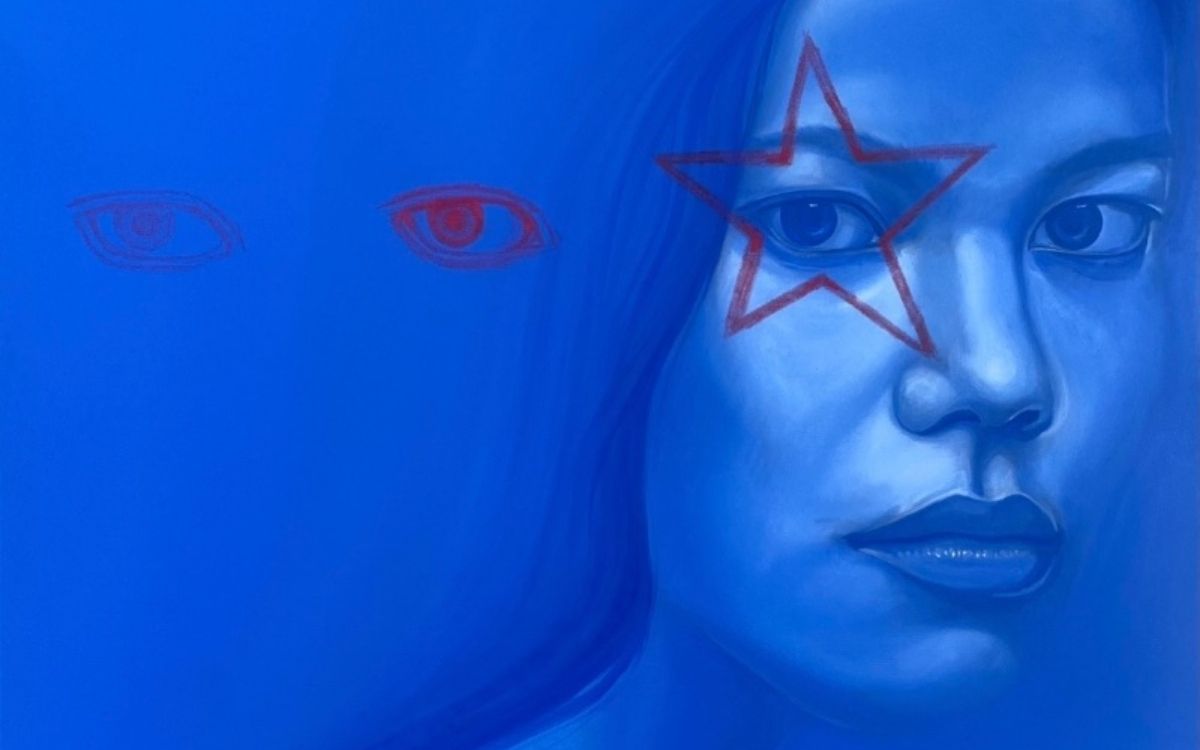
Sveva Ambrosoli grew up watching a mother paint with oils, quiet, intense sessions that left a deep imprint long before art became a conscious pursuit. That early visual education, combined with years spent reproducing faces from fashion magazines and a formal passage through the Brera Academy of Fine Arts, produced an artist whose practice now moves with equal confidence between inheritance and conscious choice. At the centre of the work is the female face: not as a fixed identity but as a suspended, symbolic presence, a surface through which duality, the coexistence of opposing forces, is explored with growing clarity and structural precision.
How has your upbringing or cultural heritage shaped the themes and techniques?
Although my academic training, particularly my studies at the Brera Academy of Fine Arts, where I graduated in Visual Arts, played an important role in shaping my artistic practice, I believe that the most profound influence on my work comes from my family background. In many ways, the decision to pursue an artistic career was not a sudden choice, but something that grew naturally out of the environment in which I was raised.
My mother, who is also a painter and the daughter of a painter, has been my earliest and most significant reference point. On her side of the family, there seems to be an almost inexplicable creative inclination, as if it were embedded in our DNA. Growing up while watching her paint with oils left a deep impression on me. Those moments, quiet yet intense, shaped my visual sensitivity and contributed to the development of my artistic identity from a very young age. This early exposure is closely connected to my fascination, almost an obsession, with female portraiture. Initially, this interest emerged as a personal technical challenge. I would spend hours attempting to reproduce faces taken from fashion magazines, focusing on accuracy, proportion, and detail. Without fully realizing it at the time, I was training my eye to understand the structure and composition of the human figure. This practice became foundational, not only in terms of technique but also in defining the central themes of my work.
The human face, and particularly the female face, gradually became a space of exploration, a way to investigate identity, emotion, and perception. What began as an exercise in representation evolved into a deeper inquiry into presence and subjectivity. My academic experience, on the other hand, provided me with a very different kind of education. At the academy, I was encouraged to experiment, to question my assumptions, and to explore a wide range of techniques and artistic languages. I worked with different materials and approaches, moving beyond the familiarity of oil painting and confronting new possibilities. This phase was essential in expanding my perspective and helping me understand my practice within a broader contemporary context.
However, it was precisely through this process of experimentation that I eventually returned to oil painting, this time with a new awareness. It was no longer simply a medium I was comfortable with, but a conscious and deliberate choice. I came to recognize oil painting as the most authentic way for me to express my ideas, a medium that had always been part of my artistic language, even before I fully understood it. In this sense, my work exists at the intersection of two fundamental influences: on one side, a deeply personal and almost instinctive artistic heritage; on the other, a structured and critical academic formation. These two dimensions do not conflict, but rather inform and strengthen each other.
Ultimately, both my cultural background and my education have shaped not only the themes I explore, such as portraiture and identity, but also the techniques I employ. My practice is the result of an ongoing dialogue between intuition and reflection, between what I have inherited and what I have consciously chosen to develop.
How important is it for viewers to understand the intended message of your work? Does ambiguity add value, or do you seek clarity in your expression?
My work focuses on the duality of the human condition: opposing forces that, despite their contrast, are in fact two sides of the same coin and must inevitably coexist. In my research, I explore the relationship between body and mind, between rationality and spirituality, between good and evil, and between spirit and matter. These themes are fairly explicit in my art, yet at the same time I am interested in leaving space for the viewer’s personal interpretation, allowing new meanings to emerge freely. Ultimately, my work originates from a deeply personal need: creating is a way for me to investigate and express a theme that I have come to realize has always been rooted within me, like a thread running through my past, connecting experiences, thoughts, and sensibilities. I believe this sense of duality is a universal condition, something that belongs to all of us.
For this reason, the female figures I paint are never fixed or clearly defined identities; rather, they become symbolic, suspended presences, capable of representing both everyone and no one at the same time, leaving the viewer free to recognize themselves, lose themselves, or find themselves within them. Although the meaning of my painting is relatively explicit, conveyed through the use of complementary, opposing colors and through the recurring motif of the eye, a central element in my work that acts as a bridge between two coexisting realities, I deliberately choose to keep certain meanings and symbolisms to myself. I am not entirely direct, and this openness allows the viewer to enter the work more freely and discover their own interpretation.
Maintaining blurred boundaries of meaning not only gives me greater freedom to experiment and evolve in my practice, but also invites the viewer into a more active and personal engagement with the piece. Rather than being confined within the artist’s predefined concepts, the observer is encouraged to explore, interpret, and move beyond fixed narratives, finding their own space within the work.
How has your artistic style transformed over the years? Are there specific influences, experiments, or moments that marked a turning point?
For an artist, the search for a personal style is a true journey: a layered and evolving path made of experimentation, detours, returns, and deep introspection. It is a process that requires courage, as it means constantly questioning oneself, letting go of certainties, and embracing the unexpected. In my case, after exploring different directions and visual languages, I felt the need to return to my roots, oil painting and portraiture. However, this return was not a repetition of the past, but rather a transformation of it.
Today, my approach has profoundly changed. Color, which once emerged more instinctively, has become a conscious and meaningful element: I control it, study it, and use it as both symbol and emotional vehicle. Likewise, the composition of my subjects is never accidental, but carefully constructed, often enriched by references to surrealist photography, particularly the work of Dora Maar, whose imagery evokes a dimension suspended between reality and the unconscious. Over time, my art has become the result of an increasingly deep inner research. It is no longer just about creating images, but about giving form to a dialogue, a dialogue that speaks not only to the viewer, but also back to myself. It is an ongoing conversation, a constant return to themes that I feel are urgent and essential, allowing me to stay grounded in what matters most to me.
Among these themes, the one that accompanies me most closely is the duality of human nature. I have always been fascinated by opposites: light and shadow, rationality and instinct, body and spirit. I am interested in how these poles not only coexist, but interact, colliding, seeking one another, and sometimes reaching a fragile harmony. Over time, I began to recognize this tension in the books that have shaped me, as well as in my attraction to the spiritual dimension, which I perceive as deeply intertwined with this interplay of contrasts.
Encountering sociological thought helped me give structure and clarity to these intuitions. In particular, reflecting on the work of Émile Durkheim allowed me to better understand how duality is an intrinsic part of the human experience. This awareness brought order to my thoughts and, consequently, to my artistic practice. My work has thus become more conscious and coherent, a space in which to explore, embrace, and express the complexity of being human. It is precisely this complexity that I wish to share: not as a definitive answer, but as an invitation. An invitation to look inward, to acknowledge one’s own contradictions, and to explore them, because it is often within that tension that a deeper, more authentic truth can be found.
Do academic institutions still play a vital role in shaping artists today, or has self-taught creativity disrupted this tradition?
Speaking from a strictly personal point of view, and therefore inevitably shaped by my direct experience, I can say that my time at the academy had a very specific value: it gave me time. Time to search, to make mistakes, to experiment without the pressure of having to immediately define a clear direction. It was a kind of suspended space in which I was able to begin building, piece by piece, what I now recognize as my visual language. However, it is important to note that the real turning point, the full awareness of my style and the thinking behind my work, came later, about a year after I had already finished the academy.
This leads me to reflect on an essential aspect: that period of exploration, in the end, I could have taken it on my own as well. It was not necessarily tied to an institution. With the right discipline, curiosity, and dedication, I believe I would have still reached a similar level of awareness. Today, more than ever, we live in a time when access to information is vast and often free: tutorials, online courses, digital archives, lectures, books, everything is potentially within reach. That said, there is one element that I still consider fundamental and difficult to replace: a solid foundational training, especially from a classical perspective. I am referring in particular to the study of anatomy, spatial construction, perspective, and light. These are not merely technical skills, but rather a deep structure that allows an artist to move more consciously within their own language. Having these foundations means being able to make choices, rather than proceeding through unconscious trial and error.
Skipping this step, in my opinion, is a bit like trying to go straight from crawling to running without ever learning how to walk. You might still arrive at an interesting result, but there will always be a lack of deeper understanding of the process. Paradoxically, even in the most abstract or conceptual forms of art, there is often a strong underlying knowledge of form and structure, which is then intentionally surpassed or deconstructed. In this sense, I believe that today academic institutions are no longer a necessary step in order to become an artist. They no longer hold the exclusive or decisive role they once had in shaping and legitimizing an artistic identity. It is entirely possible to build an independent path, to develop an authentic practice, and to find one’s own voice outside of academic systems.
However, the academy can still offer something extremely valuable: encounters. The daily exchange with other artists, whether teachers or peers, can be a crucial source of stimulation. Conversations, critiques, and mutual influences naturally nourish the creative process. This kind of environment fosters growth that is not only technical, but also human and conceptual. At the same time, it is important to remember that these connections are not limited to academic settings. Today there are many alternatives: artist residencies, workshops, collectives, or simply the personal initiative to reach out to artists, visit studios, and attend exhibitions. A network of relationships can be built in many ways, even outside traditional institutions.
Finally, I believe that what truly contributes to “making” an artist goes beyond training and technical skills. It is a deeper process that has to do with self-awareness. Recognizing oneself as an artist is neither immediate nor obvious. In my case, it took years before I was able to fully say it. I remember a very specific moment: one day, a friend asked me whether I considered myself an artist. Until then, I had always avoided that definition. I used to call myself a painter, almost as a way of downplaying what I was doing, as if “artist” were a word too big, too distant, perhaps even pretentious. And yet, from that moment, something changed profoundly. It was as if that simple question triggered an internal shift, altering the way I perceived myself and my work.
Accepting to call myself an artist gave me a new strength, a kind of inner validation that I had been missing. It was an act of self-determination, almost a declaration. From that point on, my approach became more decisive, more conscious. Because, in the end, even before any external recognition, it is precisely this inner shift that truly marks the beginning of an authentic artistic path.
Do you think the boundaries of what can be called "art" are being stretched too far, or is this evolution necessary?
The question of what art is, or what can rightfully be called art, has been debated for a very long time and continues to provoke discussion today. There is no single, definitive answer: every era, every culture, and every individual contributes to redefining its boundaries. In my view, one of the most compelling interpretations is that works of art are, above all, meanings that take on a tangible form. Art, therefore, can be understood as a process of embodiment: an idea, an emotion, or an inner vision is transformed into an object, an image, a sound, or an action. From this perspective, it can be argued that any human creation endowed with meaning may be considered art. It is not technique, material, or adherence to specific aesthetic standards that determines whether something is art, but rather intentionality and the presence of expressive content. Even the most unexpected or seemingly incomprehensible forms can belong to this category, as long as there is a human being behind them who assigns meaning to what is created. In this sense, art is deeply connected to human experience: it is a way through which individuals interpret the world and communicate with others.
Evolution is an essential element of art. Art is never static; it continuously transforms alongside the society that produces it. In this sense, art is the child of its time: it reflects the values, tensions, innovations, and contradictions of a given historical moment. Change is therefore not only inevitable but necessary. Human nature itself is dynamic, shaped by cultural, technological, and social shifts, and art is a direct expression of these transformations. Every change in collective sensibility gives rise to new artistic forms, languages, and modes of representation. Historically, art has always served as a mirror of humanity. Through works of art, we can read the history of civilizations and understand their aspirations, fears, and worldviews. From prehistoric cave paintings to contemporary installations, every artistic expression bears witness to a specific moment in human experience. In this sense, art is not only an individual expression but also a collective document.
A particularly significant example that illustrates these ideas is the case of Bird in Space (1925) by Constantin Brâncuși. This sculpture, characterized by its extremely essential and stylized form, broke radically with figurative tradition. When the work was purchased by a collector and brought to the United States, it encountered an unexpected obstacle: New York customs refused to classify it as a work of art. According to American legislation at the time, a sculpture had to be “in imitation of natural models” in order to be recognized as such. Since Brâncuși’s work did not realistically represent a bird, it was instead considered an industrial object.
The issue was taken to court, giving rise to a landmark case in the history of both art and law. After examining the nature of the work and hearing expert testimony, the judge ruled that the traditional definition of sculpture was no longer adequate. Bird in Space was therefore recognized as a work of art, marking an important shift in how institutions interpreted artistic production. This episode clearly demonstrates how the criteria used to define art are not fixed, but evolve alongside artistic practices and cultural sensibilities. What emerges from this case is the typically human tendency to classify and define art, both in practical and conceptual terms. However, every attempt to rigidly confine art seems destined to fail, or at least to be surpassed over time. Art follows the human spirit, and the human spirit is, by its very nature, dynamic, free, and resistant to strict categorization.
In conclusion, art can be understood as a form of expression that arises from the human need to give meaning to the world. It is a constantly evolving language that resists rigid definitions and continuously renews itself. Rather than trying to establish precise boundaries, it may be more meaningful to embrace art in its plurality and in its ability to surprise, challenge, and inspire reflection.
Name five pivotal lessons you’ve learned that shaped your artistic journey.
Throughout my artistic journey, I have learned a number of fundamental lessons that have deeply shaped both the way I create and the way I live. These are not just rules related to art, but principles that intertwine with personal growth and, over time, have become true points of reference for me.
The first lesson is about failure. I have come to understand that failures are simply proof that we have tried. Every mistake, every closed door, every moment of doubt represents an opportunity for growth and change. They are necessary steps in becoming the best version of ourselves, both as artists and as individuals. In Italy, unfortunately, failure is often seen as a taboo, something to be ashamed of. I had to work hard to break free from this mindset. Learning to embrace failure as part of the process has been liberating, it means allowing yourself to grow without fear.
The second lesson is that beautiful things take time. We live in a society that pushes us to seek immediate results, making us believe that success can come quickly and effortlessly. However, I have learned that what comes fast often fades just as quickly. Immediate gratification can feel good, but it is rarely lasting. The process, on the other hand, is what gives real value to what we create. It is through time, consistency, and dedication that something authentic and meaningful is born—not only for ourselves but also for others.
Another important lesson is about control. Trying to control everything is impossible and often leads to a great deal of stress. For a long time, I believed that planning every detail was the key to avoiding mistakes or disappointment. As a matter of fact, I discovered that learning to let go of situations, expectations, and sometimes even parts of myself can open the door to unexpected and surprisingly positive outcomes. It is not easy, and often it feels counterintuitive, but those moments have brought some of the most beautiful experiences into my life.
The fourth lesson is that there is no universal “right time.” It is never too late or too early, neither in personal life nor in a career. Everyone has their own rhythm, their own path, and there is no fixed timeline to follow. Constantly comparing yourself to others can be frustrating and misleading. What truly matters is moving forward at your own pace and, in the end, trying to live with as few regrets as possible.
Finally, self-confidence is essential. There have been, and still are, moments when I have not felt good enough, when doubt has taken over. It is a common feeling, but we must not give it power. We cannot allow that voice to define who we are. It is important to remember that even the greatest artists have gone through the same insecurities, failures, and struggles we face. The difference lies in continuing, in believing in your own path despite everything.
These five lessons did not come all at once; they were built over time, through experiences, mistakes, and small victories. Today, they serve as a valuable guide that accompanies me every day, both in art and in life.
Are there any upcoming projects or dreams that you’re particularly excited about?
Even though oil painting has been my starting point, and continues to represent a solid and indispensable foundation of my artistic journey, I recently felt the need to go beyond the surface of the canvas and explore new expressive possibilities. This led me to my recent foray into sculpture: a completely new territory for me, one that I am discovering with curiosity, respect, and a fair amount of excitement. Transforming some of my paintings into three-dimensional forms has been an almost natural step, although initially not without hesitation. It is, in fact, the first time I have engaged so directly, physically, and tangibly with materials. Unlike painting, where the gesture is deposited on a flat surface, sculpture requires a continuous dialogue with volume, space, and the very resistance of the materials. It is a slower, at times more complex process, but precisely for that reason, it is extremely stimulating. Every mistake becomes part of the journey, every attempt contributes to building a new awareness.
I am still at the beginning of this path, and I am fully aware of it. I know that time will be necessary to gain confidence, technique, and mastery of the materials. However, I feel that this path has great potential and could become a constant presence in my artistic research. This is not just about experimenting with something new, but about expanding the language with which I express what is meaningful to me. I have always had the desire to approach sculpture, but only recently have I found the courage to truly do so. Perhaps today I feel more ready to embrace uncertainty and to challenge myself without rigid expectations. This new approach allows me to look at my work with different eyes, more open, more receptive to change.
One of the aspects that fascinates me the most is the possibility, in the future, of combining painting and sculpture into hybrid works, unique pieces in which the two practices dialogue and complement each other. The idea of bringing color into space, of allowing it to step out of the two-dimensional plane to become a tangible presence, feels deeply aligned with my artistic vision. The third dimension, in fact, seems to me a particularly effective medium for expressing the concept of “the double” that has long characterized my work. Through volume, duplication, shadows, and the relationship between solids and voids, I can make this theme even more evident and perceptible, turning it into an experience that is not only visual but spatial as well. In this sense, sculpture does not replace painting, but enriches it, offering new ways of reading and new narrative possibilities.
Looking further ahead, I would also like to explore the connection between art and design. The idea of applying these concepts to functional objects or projects, while maintaining a strong artistic identity, is something that deeply intrigues me. It may be too early to define the contours of this path, but I feel it could be a natural evolution of my practice. For now, I continue to experiment, to learn, and to allow myself to be surprised by this new language. I hope to soon share the first results of this journey, with the awareness that every step, even the smallest, is part of a larger and meaningful transformation.
What emerges from this conversation is an artist in a period of genuine expansion from canvas into sculpture, from the two-dimensional into volume and space, from a personal visual language into something increasingly architectural. Sveva Ambrosoli moves carefully and without rush, aware that beautiful things take time, that failure is evidence of having tried, and that the moment of truly claiming the word "artist" can arrive quietly and change everything. The work ahead, hybrid pieces, the dialogue between painting and sculpture, perhaps eventually art and design, feels like a natural continuation of a practice already deeply rooted in what it means to hold opposing things together.