
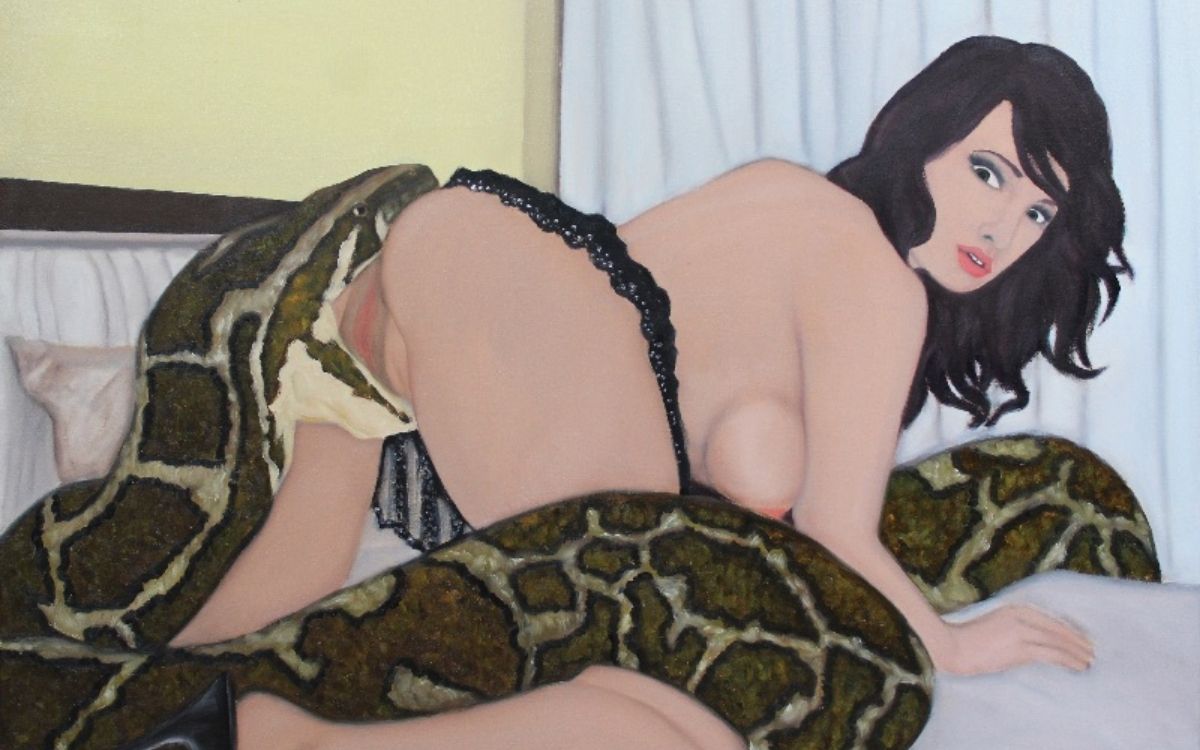
Anna Mária Beňová paints the things that are difficult to stop thinking about. Growing up in Slovakia, shaped by a Ukrainian mother's world of superstition and phraseological warnings, don't do this or you won't get married, don't do that or it will bring bad luck, a rich and peculiar visual language was absorbed long before it became artistic material. That inheritance, filtered through humor, anger, and a sharp eye for gender dynamics and power asymmetry, now drives a practice built on narrative fragments that exaggerate the unbearable until it tips into something tragicomic. The paintings do not explain. They confront.
How has your upbringing or cultural heritage shaped the themes and techniques you explore in your art today?
I am from Slovakia, a former communist bloc country in Central Europe, surrounded by 5 states with different geopolitical identities and cultural structures. My mother comes from Ukraine and my father has Hungarian roots, he actually learned Slovak language as his second language, when he was child in kindergarten. When it comes to cultural heritage, the first thing that comes to mind is my mother's origin, and for me it is associated with a certain way of thinking and especially with superstition. It is these phraseological elements in my upbringing that serve as starting points for the various images that I paint. Most sayings can be reduced to two groups of statements: don't do some things because it brings bad luck/illness, and don't do some things because you won't get married.
List five core themes or messages you aim to convey through your art.
As I outlined in the last sentence of the first question (superstition and "threats" that you won't get married: for example, if someone sweeps the floor under youwith a broom), the first 5 topics that come to mind are definitely:
gender stereotypes
sexualization
natural ideas about femininity/masculinity
power/partnership relationships
and, last but definitely not least is humor
I understand my paintings as narrative fragments, through which I want to reflect certain intrusive ideas that lead to their creation. In addition to externalizing thoughts that anger me, amuse me in a tragicomic way, or that I can't stop thinking about out of sheer absurdity, my driving force is to point out various problems that I present to the viewer in my paintings as an eyesore.
How do you reignite creativity during those inevitable periods of self-doubt or stagnation?
I am always reassured by the fact that all artists face the same emotional cycle of doubt and feeling of being stuck, and it is perfectly okay and part of the "package". During my student days, I was at the studios where we named these feelings and shared them together, which really helped me a few years later to experience and go through these feelings with a more kind approach to myself, instead of the accusatory model of being a personal failure. No one is creating 24/7. I am trying to use a model of looking at myself as someone else, as if looking at a third person. So instead of feeling terrible that I didn't go to the studio or wasted valuable time, I imagine that this regret is being expressed to me by a friend, and my first natural reaction is that it is okay to take a break when you need it.
Can you take us through the evolution of an artwork, from that first spark of inspiration to the finished piece?
In my case, the creative process is bound with free associations, random or intimate talks, books or even memes. Initially, the works are created as prototypes ironizingserious topics such as sexism, gender and power asymmetry/disparity. I find the themes for my paintings in various periodicals/books from the 90s (and before) or the internet and then collage them in Photoshop where I compose the initial outline.Most of my paintings represent thought processes that are so unbearable that I try to drive them away by even greater exaggeration on the canvas, where they slowly lose their original meaning and are turned “upside down”.
In what ways has viewer feedback surprised you or shifted your perspective on your own work?
Reactions to my work are always different, but in principle you could say that it is something between love and hate. Many times, I have encountered a reaction that male viewers who look at my paintings felt a sense of shame and only later some of them were able to look at it again with a slightly depersonalized view. The female viewers are a different story and the reactions I often get there make me honestly very happy. A large part of the dialogue takes place directly at the exhibitions. The questions always start at the image itself and later move from there to discuss personal experiences that the painting reminded them of. Most of the reactions to my paintings are a mirror and a catalyst of one’s confrontation with themselves and the feeling that arose from the canvas.
Do you think art should have a political or ideological agenda?
Art has a great power to leave imprints in people's minds, to tease and highlight important topics. It is perfect if there are artists who deal with political or ideological topics in their work and it is perfectly fine if there are those who do not explicitly depict them in their works. The essential thing is that works of art can draw attention, open dialogues, name and highlight certain issues. From my perspective, any work of art originates from and reflects on the surrounding world events, the conditions in which it finds itself, political tension, oppression or frustration. Would art even exist in a utopian world if it did not reflect the pitfalls of its time?
Can you imagine ever choosing to stop creating art? What might lead you to such a decision?
I can't imagine life without art at all. It's probably the only support in my random existence that keeps me relatively sane. I see art as a language through which I have the opportunity to interpret my innermost thoughts, ambivalences and grievances regarding various issues that touch me or that I care about. As with normal communication. It takes some time for people to get to know each other and be able to tell what is a joke and what is not – something like this also happens with art, I think. You have to get to know it, in order to communicate with it. And this communication with the viewer is what allows me to express myself through painting, along with the themes that I want to focus on. I really need this expression in my life, otherwise I would have gone crazy a long time ago.
What are your long-term aspirations as an artist, both personally and professionally?
My long-term artistic, personal and professional ambitions are that I very much hope that regardless of what happens, I will always have the opportunities and means to create freely. I do not plan anything for the future because whenever a person plans, fate laughs at him. I would like to devote even more time to my work in the studio, I would like to have the courage to open up to various new topics that may awaken uncomfortable feelings in the future. I would like to work more on my mental health, which has a direct impact on my artistic madness and further creation. Among other challenging and achievable dreams, I would like to have a 3-tier fountain with pickles at the opening of an exhibition in the future as part of the catering. Pickles are a basic human need.
What makes this conversation distinctive is the combination of intellectual seriousness and genuine wit that runs through it, the same combination that makes the paintings work. Anna Mária Beňová is an artist who thinks carefully about shame, about dialogue, about the slow process by which a viewer moves from discomfort to recognition. The long-term ambitions are stated with equal parts honesty and self-awareness: more studio time, more courage to open uncomfortable territory, better mental health, and, when the moment comes, a three-tier fountain filled with pickles at an exhibition opening. A basic human need, after all.