
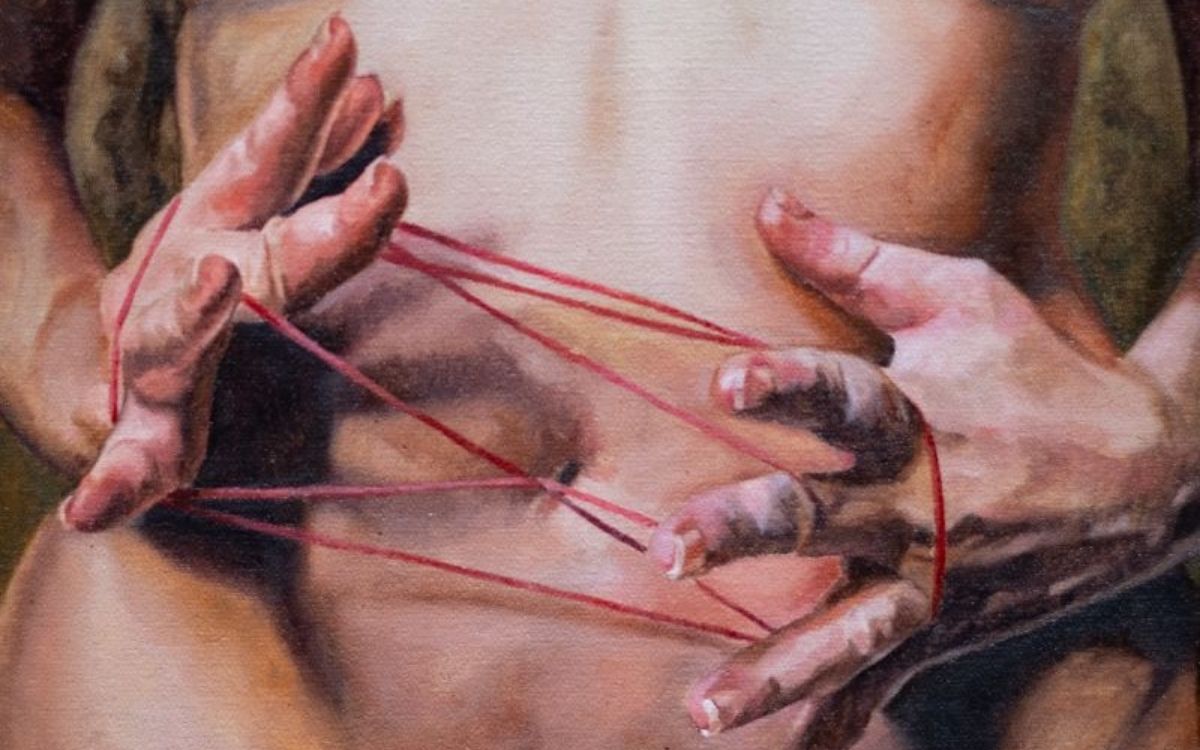
Nicole Debono paints from within. Raised in Malta, where domestic space, devotional imagery, and cultural expectation are inseparable from daily life, the work that has emerged from this background treats the interior the room, the object, the figure as a site of psychological weight rather than simple familiarity. Memory, in Nicole Debono's practice, is not a source of certainty but of productive instability. It edits, distorts, and reconstructs, and the paintings follow that same logic. What results are images that feel simultaneously intimate and withheld, grounded and unresolved.
How has your upbringing or cultural heritage shaped the themes and techniques you explore in your art today?
My upbringing has shaped my work very directly, especially in the way I think about domestic space, intimacy, memory, and symbolism. Growing up in Malta meant growing up in a place where personal history, religion, family life, and architecture are closely entangled. Interiors are rarely neutral. They carry ritual, expectation, inheritance, and a kind of emotional residue. That has stayed with me, and I think it is why I return so often to rooms, objects, and figures in enclosed or familiar settings.
I am interested in the home not simply as a place of comfort, but as a site where identity is formed and negotiated. It can be protective, but it can also be tense, theatrical, and psychologically charged. In my work, domestic scenes often become a stage on which something larger is taking place: a negotiation between memory and reality, between what is visible and what remains withheld. That probably comes from growing up with an awareness that private life is never entirely separate from cultural expectation. The personal is always shaped by broader values and narratives.
Cultural heritage has also influenced the atmosphere of my paintings. Malta is visually dense: there is ornament, devotional imagery, old stone, strong light, shadow, and a deep awareness of history coexisting with the present. I think that has affected my sensitivity to surface and to the emotional potential of light. Light in my paintings is rarely just descriptive. It often carries a symbolic or psychological role, helping to create a sense of ambiguity, revelation, or tension. Similarly, objects are rarely incidental. I tend to treat them almost as witnesses or carriers of meaning.
Technique-wise, I do not approach painting as a straightforward act of documentation. I usually work by gathering fragments: photographs, remembered spaces, symbolic references, historical echoes, and observed details. These are then edited, rearranged, and reconstructed into an image that feels emotionally true rather than strictly factual. That method is very much tied to how I understand memory itself. Memory is unstable, selective, and often shaped by desire, fear, or hindsight. Painting allows me to work within that instability rather than trying to resolve it.
In that sense, my background has influenced not only what I paint, but how I paint. I am less interested in capturing a scene objectively than in rebuilding it as a charged image. The figure, the room, and the surrounding objects all become part of a psychological structure. That comes, I think, from living in a culture where space, family, ritual, and image all hold strong emotional weight. My work grows out of that condition, even when it moves into more universal questions about intimacy, agency, and perception.
Does spirituality or a connection to something larger than yourself influence your creative process?
Yes, although not in a narrow or doctrinal sense. I am interested in spirituality more as a sensitivity to what exceeds the purely literal. In my work, that often takes the form of atmosphere, symbolism, intuition, memory, and the sense that an image can hold meanings that are not immediately transparent. Painting becomes a way of approaching something that I cannot always articulate directly in words. In that respect, the process does feel connected to something larger than myself.
I think there is a spiritual dimension in the act of sustained looking. Painting requires a particular type of attention: slow, repetitive, and deeply observant. That attentiveness can feel almost devotional. It asks you to remain with an image, an object, or an emotional tension long enough for it to reveal more than its surface. Sometimes that revelation is subtle. It may emerge through colour, light, gesture, or the relationship between figures and space. But I often feel that a painting begins to work when it opens onto something beyond description, when it starts carrying emotional or symbolic force that exceeds my initial intention.
I am also drawn to the ways certain symbols and visual motifs persist across time and culture. Flowers, mirrors, beds, thresholds, curtains, hair, windows, domestic objects: these things can operate as ordinary elements and as carriers of deeper meaning. I do not necessarily use them in a fixed allegorical way, but I am interested in how they accumulate associations. That accumulation can feel spiritual in the sense that it connects the personal to the collective, or the contemporary to something archetypal.
At the same time, spirituality in my practice is closely tied to uncertainty. I am not interested in certainty or fixed answers. I am more interested in ambiguity, in the unseen, in what haunts an image without resolving into a single message. That is partly why I am drawn to memory and reconstruction. A painting often begins with something concrete, but as I work, it moves into another register, where psychological truth becomes more important than factual exactitude. That shift is significant to me. It suggests that the image is participating in something beyond representation.
So yes, I would say spirituality influences my creative process, but in a broad and intuitive way. It is less about illustrating belief and more about remaining open to depth, to resonance, and to the possibility that an image can carry forms of knowledge that are emotional, symbolic, and not entirely rational. Painting, for me, is one way of accessing that field.
How does your art engage with or comment on pressing contemporary issues – social, political or environmental?
My work tends to engage with contemporary issues through intimacy rather than overt declaration. I am interested in how large structures are experienced on the scale of the body, the room, and the everyday. Social and political conditions do not exist somewhere abstract; they enter our lives through habits, expectations, relationships, spaces, and emotional patterns. That is often where my work begins.
A central concern in my practice is the domestic interior. The home is often imagined as a place of refuge, privacy, and stability, but it is also a place where power is negotiated, where care is performed, where gendered expectations are absorbed, and where tension can accumulate quietly. I am interested in that ambiguity. The domestic sphere is not separate from contemporary social issues; it is one of the primary places where they are lived and reproduced. By focusing on figures within intimate settings, I try to show how the personal and the political are deeply entangled.
Questions of female subjectivity are especially important to my work. I often paint women not as passive subjects to be looked at, but as figures who withhold, redirect, or complicate the gaze. Even when a figure is partially obscured or turned away, that withholding can itself be a form of agency. I am interested in the psychological and symbolic lives of women, and in the ways bodily presence, gesture, and surrounding objects can suggest tension between autonomy and expectation. In that sense, my work engages with contemporary conversations around identity, gender, self-fashioning, and visibility.
I also think my work speaks to the instability of memory and image in a contemporary condition saturated by representation. We live in a moment where images circulate constantly, often detached from context, and where personal narrative is continually edited and performed.
My paintings push back against speed and easy readability. They ask for slower looking and allow for contradiction. Rather than offering a direct statement, they create a space where ambiguity and layered meaning can remain intact. I see that as a contemporary gesture in itself.
In environmental terms, while my work is not explicitly ecological, I do think about materiality, built space, and our emotional relationship to the environments we inhabit. Rooms are never passive backdrops in my paintings. They hold memory, mood, and pressure. The way we shape space, and the way space shapes us in return, is an important thread in my practice. Overall, I do not try to illustrate issues in a didactic way. I am more interested in creating images where contemporary pressures can be felt rather than simply named. For me, painting can be a way of making those tensions visible through atmosphere, structure, and emotional charge.
What unusual or unexpected sources of inspiration have deeply influenced your work?
What influences my work most deeply is not always a single image or event, but the unstable way memory behaves. I am very interested in memory not as a reliable archive, but as something that edits as it returns. It drops parts, exaggerates others, merges times and places, and still manages to feel emotionally true. That distortion is a major source for me. I do not necessarily see it as a failure. Sometimes memory alters things protectively, sometimes strategically, and sometimes in ways that allow us to live with what has happened. That has deeply influenced both the imagery and the logic of my paintings.
I am also influenced by the domestic, though perhaps not in the expected sense. I do not treat the home as a neutral backdrop. I see it as a psychologically charged site where agency, restraint, intimacy, inheritance, and social expectation all meet. A room can carry emotion, but it can also carry ideology. It can tell you what you are allowed to see, how you are expected to behave, and what kinds of presence are welcome. That is especially important to me as a woman working through questions of permission, privacy, and self-fashioning. So the domestic interior is not only where my paintings are set; it is one of the main structures through which I think.
Another source of inspiration is the partial or the cropped. I am often more interested in hands, hair, legs, backs, shadows, thresholds, or gestures than in a fully disclosed figure. What is visible is never the whole, yet it still persuades. That tension matters to me because it resembles recollection itself: we rarely remember an entire scene in equal detail. Instead, one angle, one object, one shadow, one bodily gesture carries the weight of the whole. I rely a lot on that kind of fragment. Shadow play, too, has been unexpectedly important to me. Shadows can behave like memory: they suggest, distort, elongate, conceal. They create drama, but they also create uncertainty. A shadow can feel factual and impossible at the same time. I am drawn to that slippage. Similarly, I often think about child’s play, not in a sentimental sense, but in the way play allows for rearrangement, role-making, exaggeration, and alternate logic. That freedom to reconstruct a scene according to emotional truth rather than strict realism is very close to how I build images.
I am also deeply influenced by the idea that time is not linear. In my paintings, moments can shift between past, present, and future. A room may resemble one place while carrying the behaviour of another. A remembered scene might contain details from different periods of life. That temporal instability is not incidental; it is part of how I understand lived experience. We do not always inhabit time neatly, and painting allows me to make that visible. So I would say my most unusual influences are memory’s distortions, the psychological life of rooms, shadow, fragmentation, and the ways women learn to navigate agency and restraint within inherited structures. Those are not always named as artistic “sources” in the conventional sense, but they are the forces that most deeply shape the work.
How do you think art should be valued—emotionally, socially, or monetarily? Is there ever an objective measure?
I think art has to be valued across all of those registers: emotionally, socially, intellectually, and monetarily. None of them on its own is sufficient. Emotional value matters because art has the capacity to move us, disturb us, clarify something for us, or remain with us long after we encounter it. That kind of value is not minor; it is often the reason art matters so deeply in the first place. It can offer recognition, discomfort, release, or a new way of seeing. For instance, people including myself can become deeply emotional in front of prehistoric cave paintings of hands. Even though they are separated from us by thousands of years, those marks still register as intimate, human, and immediate. That response reminds us that art can exceed context and technique and speak to something very fundamental in us.
Socially, art also plays a vital role. It contributes to public culture, preserves and challenges collective memory, and creates spaces for dialogue, critique, and imagination. Even very private or intimate works can have a social dimension, because they shape how we understand experience and how we relate to one another. Art does not need to be didactic to be socially meaningful. Sometimes its contribution lies in making room for complexity, ambiguity, and reflection in a culture that often rewards speed and simplification.
Monetary value is equally important, though it is often treated with discomfort. Artists’ labour is real labour. Time, research, materials, training, risk, and emotional investment all form part of the work. So I do think art should be valued monetarily in a serious way. The tendency to romanticise artistic labour while resisting its economic worth reflects a broader problem in how creative work is perceived. A functioning cultural ecosystem depends on artists being able to sustain their practice materially, not just symbolically.
As for objectivity, I think there are criteria by which art can be critically discussed. One can speak about formal intelligence, conceptual coherence, technical rigour, sensitivity to material, historical awareness, originality, and depth of engagement. Those things matter, and they allow for informed judgment. But I do not think art can ever be reduced to a fully objective measure in the way one might evaluate a technical outcome. Context always matters. Reception changes over time. Different audiences bring different experiences and frameworks to a work. What feels marginal in one moment may later become central.
So I would say there are informed ways of assessing quality, but not an entirely neutral or universal metric. Art resists that, and rightly so. Its value often emerges relationally: between the work, its maker, its context, and the people who encounter it. That does not mean all judgments are equal, but it does mean that value is layered. For me, the most meaningful approach is to recognise that art can be emotionally affecting, socially necessary, and economically deserving all at once.
Do academic institutions still play a vital role in shaping artists today, or has self-taught creativity disrupted this tradition?
Academic institutions still play an important role in shaping artists, particularly by offering structure, critical feedback, technical training, historical grounding, and access to a community of peers. At their best, they create an environment where artists are pushed to interrogate their work more rigorously and to situate what they are doing within a broader discourse. That kind of framework can be incredibly valuable.
At the same time, I think the idea that institutions are the only serious route into artistic development has been meaningfully disrupted. Many artists today build substantial practices outside formal academic systems, and I think that has broadened the field in important ways. In my own case, I did not come to painting through a conventional art-school route, so a lot of my development has been self-directed. That has meant learning through reading, looking, sustained studio practice, experimentation, and, importantly, through peer-to-peer exchange.
I think peer-to-peer learning is one of the most valuable aspects of self-taught practice. Conversations with other artists, curators, and makers can offer a form of education that is dynamic, reciprocal, and rooted in lived practice. It allows for honest dialogue, exchange of references, mutual critique, and the sharing of practical and conceptual tools outside a rigid institutional framework. In many ways, that kind of learning can be incredibly formative because it emerges through active engagement rather than prescribed structure.
So while institutions absolutely still matter, I do not think they hold a monopoly over seriousness, depth, or artistic legitimacy. What matters more is whether an artist develops discipline, criticality, curiosity, and an openness to challenge. That can happen within an academic setting, but it can also happen through self-teaching when it is supported by strong peer networks and sustained commitment. For me, the most interesting reality today is not a competition between the two, but the fact that artists often learn through a combination of formal, informal, and collective modes of exchange.
How do you respond to debates about the accessibility of art—should it be exclusive, or is it for everyone?
I don’t think art should be exclusive in the sense of being reserved for a socially, economically, or intellectually initiated few. Art is for everyone in that everyone has the capacity to feel, interpret, question, and form a relationship with an image. You do not need specialist vocabulary or institutional validation to have a meaningful encounter with a work. In fact, some of the most powerful responses to art are the least rehearsed.
That said, accessibility should not mean oversimplification. I do not think a work has to explain itself entirely or become immediately legible in order to justify its existence. Difficulty, ambiguity, and slowness are also valid. A painting can be open without being fully transparent. It can invite people in without reducing itself to instant consumption. For me, accessibility is less about making art easy and more about not artificially restricting who gets to enter the conversation around it.
I am also conscious that debates around accessibility are not only aesthetic, but structural. Who gets access to education, time, space, money, cultural confidence, and institutional legitimacy? Who feels entitled to walk into a gallery and trust their own response? Those questions matter enormously. Historically, art worlds have often been shaped by exclusion, whether social, economic, or intellectual, and I think we have to name that honestly.
So my position is that art should remain open, but openness does not require flattening complexity. It means creating conditions where
people feel permitted to engage, even if they do not “decode” everything. I think a viewer should be allowed curiosity, uncertainty, even misunderstanding. In many ways, that is already part of how art works. Not every encounter has to be complete to be real.
For me, the most meaningful art often operates on several levels at once. Someone might respond first through atmosphere, emotion, colour,
or recognition, while another viewer might approach it through history, theory, or form. Neither response is inherently invalid. Ideally, art holds enough depth to accommodate both. So I would resist the idea that it must choose between exclusivity and universality. It should be available to everyone, while still allowing for layered, demanding, and evolving forms of engagement.
Nicole Debono is an artist who trusts the complexity of what cannot be fully named. The rooms, figures, shadows, and fragments that populate this work are never incidental — they are structures through which larger questions about identity, agency, and memory are quietly negotiated. There are no easy declarations here, no images that fully give themselves away. Instead, the work asks for the kind of slow, sustained attention that it was itself built through. That patience is not a demand placed on the viewer. It is an invitation to remain with what resists resolution, and to find meaning there.