
Emma Schwartz explores the tension between belief and desire, history and intimacy, devotion and individuality. Art becomes a lens through which personal experience intersects with broader social realities—where biblical iconography meets contemporary questions of sexuality, care, and community. Through figurative paintings and sculptural forms, the work challenges binaries, reimagines sacred narratives, and builds spaces where desire, vulnerability, and connection coexist. In this dialogue, the evolution of ideas, materials, and practices reveals the commitment to authenticity, reflection, and the cultivation of shared experience.
How has your upbringing or cultural heritage shaped the themes and techniques you explore in your art today?
I grew up going to an Evangelical Megachurch in the Midwest where patriarchal, heterosexual, and traditional family values were central to the teachings. As someone who no longer subscribes to Christianity, I utilize and reflect on lessons and overarching themes that I was taught at that time, and how I understand my position in relation to them now. I create dichotomies between sexual imagery and religious iconography. This tension led me to explore the way I grew up in relation to sexuality, women’s roles, and political leanings. It led me to find solitude and more of a connection to spirituality through an agnostic framework. In an Evangelical setting, there is a lot of performative spirituality and not a material application of Christian teachings.
When I finally left the church I met people who did not have - or no longer had - ties to religion exhibiting an ethics of care that Christianity is based in. I believe this inner and outer troubling creates a realm where lessons of care and compassion are isolated, while still referencing their Biblical contexts. Through this recontextualization I found new ways to build stronger relationships and communities outside of religion and represent them in my work.
How does your art engage with or comment on pressing contemporary issues —- social, political, or environmental?
My art engages with ways that personal experiences are inherently tied to politics, which affects broader communities and how we build and support them. I am looking at the ways that religious leaders often co-opt teachings and twist them to perpetuate sexism, in order to exclude people who are different from the status quo. I reimagine religious excerpts through a secular lens, focusing on the themes of care, love, and welcomeness towards everyone. I firmly believe that the making of art is inherently political because the majority of artists are creating to purely share their personal experiences or to act as a moment to bear witness to what is happening in the world today.
One way that I am able to materially mobilize the messages artists are telling within their work is to utilize curatorial projects as moments of intentional gathering. Through my curatorial practice I have the opportunity to engage with artists and their activism, and create new conversations around their work to bring people together. At the same time as this community building is occurring, I pair exhibitions with fundraising and educational opportunities by having people bear witness to the ways artists have been speaking out against human rights violations at home and abroad. I aim to work with artists whose work has been censored by institutions due to their activism and to highlight the importance of their messages. I have utilized my curatorial practice as a way to create a praxis of community building. I want my curatorial practice to be one that mobilizes artists and their activism to push back against institutional and societal constraints.
Can you take us through the evolution of an artwork, from the first spark of inspiration to a finished piece?
Often times the idea for a painting comes from the reading phase of my research process. I allow for open inquiry into writings with unknown purpose, direction, or influence that it will have on my work. Recently, I have been looking at the treatment of women within narratives in Biblical stories, specifically Mary Magdalene, sparked by the writings of Jane Schaberg, Philip C. Almond, and Phyllis Trible. I found parallels between Mary Magdalene’s position within the sinner/saint binary, and how femmes today are also shamed when they do not fall into either one of the binaries. After I gather a literary understanding of the work I want to make, I often look at historical paintings and Biblical tales surrounding my research and sketch out ideas.
Then I utilize reference images as not just a moment of gathering for artistic purposes, but also as a moment to spend time with friends - using this moment to fuel community and art. I take a plethora of images based of my sketches, print them out, sketch the final images, and then start on the underpainting. I don’t have a specific method or reasoning for why a composition gets chosen for a painting - it is more of a gut feeling than meeting any specific criteria.
How has your artistic style transformed over the years? Are there specific influences, experiments, or moments that marked a turning point?
I have always painted representational figurative work, but starting out I relied heavily on the reference image to color match exactly what colors were in the image. As I progressed in my practice, I started to think more about how color can be mobilized to emphasize themes and concepts in my work. Now, I use highly saturated colors to emphasize the immediacy of the desire for connection on sexual and platonic levels that I discuss in my work. Moving beyond what is just seen, putting my work in a more fantastical realm.
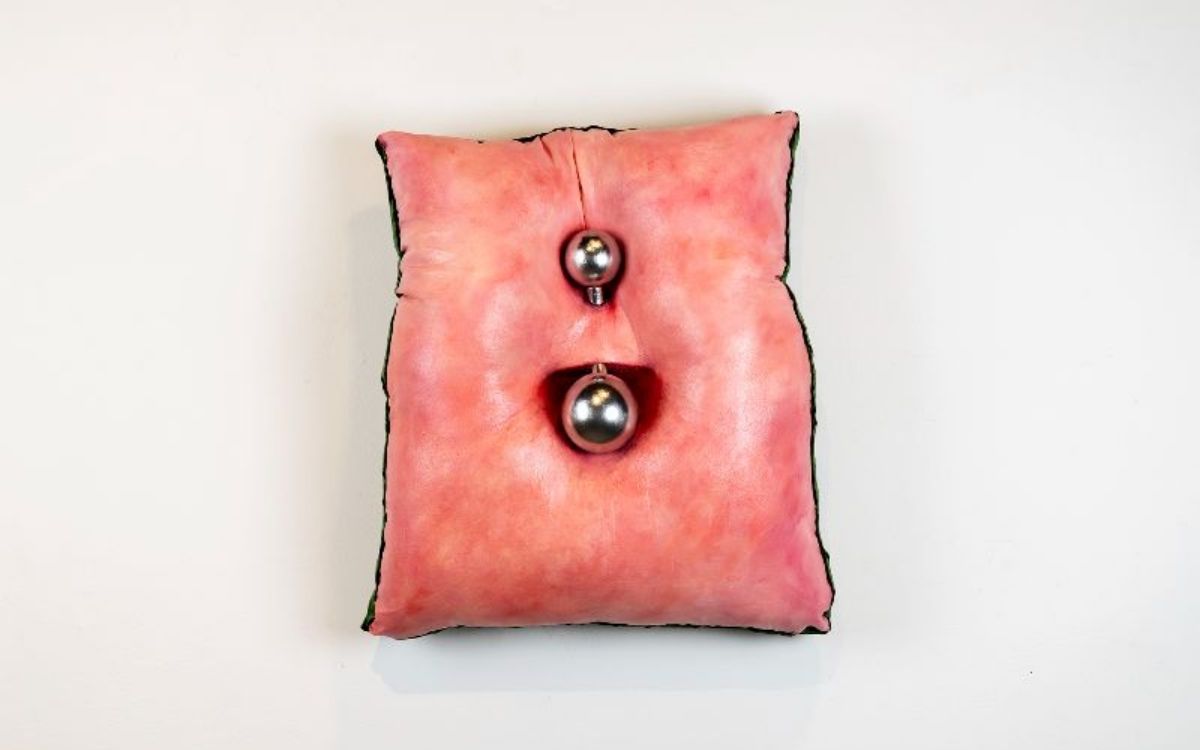
In addition to my two dimensional paintings, I pair them with bulbous wall sculptures that feature cropped figurative imagery. The soft sculptures’ imagery is usually derived from intimate images taken of myself for the private viewing of my partner. They signal to the devotive nature of Christian relics. The reference image acts as a relic of my desire. The pairing of these imageries modernizes and secularizes the ideas of faith, personal devotion, and spirituality. The 3D nature of the soft sculptures moves the desire featured in my work, through color and imagery, outside of the two dimensional nature of the paintings and into the room with the viewers.
What unusual or unexpected sources of inspiration have deeply influenced your work?
An unexpected source of inspiration came from watching Care Bears Movie II: A New Generation. I loved the simplicity of the lessons within this movie and see how in Care-a-lot they help each other learn lessons, but also show teach them to others who live on earth. Each Care Bear has a strength that adds to the community that they create and I think that is something that I have been focusing on when thinking about who I surround myself with in partnerships and friendships. To signal to the Care Bears, I also have my characters enveloped in clouds. In my cloud filled “Care-a-lot” I have created a safe space for exploration and self expression without external and internal shame surrounding identity, sexuality, and relationships.
In a world flooded with imagery, what responsibility do artists have to stand out and say something authentic?
There is an oversaturation of AI online, censorization, and a false sense of perfection seen on social media. I believe that artist are searching, exploring, and striving to represent the authentic parts of life despite these barriers. By staying true to our practices, mediums, and concepts we unravel obstacles and create new narratives outside of the mainstream images through our originality and honesty.
Do you believe that an artist’s passion is something destined or a conscious choice?
I believe that for most artists who are not coming from wealthy families the ‘artist’s passion’ is a conscious choice. Being an artist is another fulltime job that requires administrative, writing, and artistic skills that are used everyday on top of a day job. It is a constant choice everyday to choose to put time and effort into something that often doesn't reap monetary rewards. But, the act of creation and storytelling with other artists and art lovers is what makes all of the hard work worth it.
The practice of Emma Schwartz demonstrates that art is never separate from life. It is a conscious choice, a daily commitment to explore, to connect, and to bear witness. Each work is both a private reflection and a public gesture, bridging personal histories with collective concerns. The work resonates as a space for contemplation, community, and honest engagement, leaving a vision of art that is both intimate and unflinchingly present in the world.