
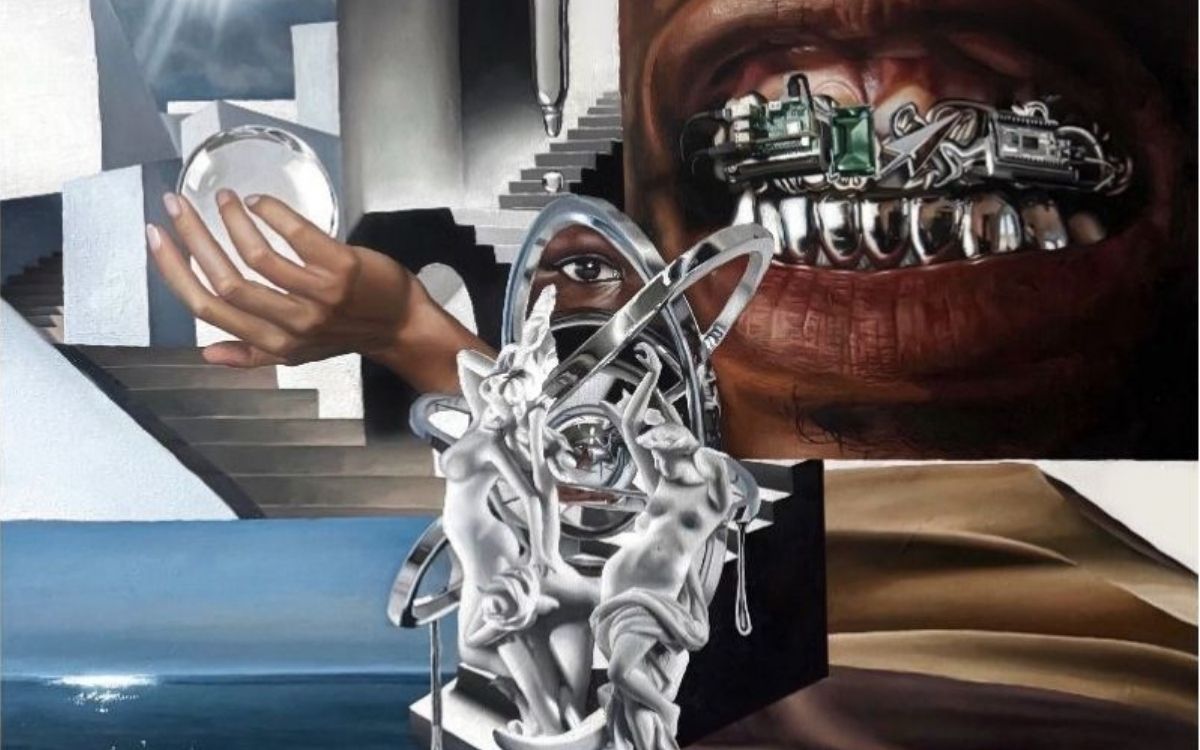
Helen Ifeagwu approaches painting as both investigation and world-building. Rooted in research, psychology, and visual symbolism, each work begins with a question rather than an image. Oil paint becomes a medium of slowness and precision, where discipline allows intuition to materialize and conceptual inquiry takes physical form. From early explorations in realism to expanding speculative universes shaped by science, perception, and identity, the practice has evolved into a language that balances structure with imagination. Painting functions here not as decoration, but as a method of thinking — a space where complexity can exist without immediate resolution.
Can you pinpoint a single moment in your life when you realized art was not just a passion but your purpose?
I don’t think there was a single defining moment. It felt more like a gradual accumulation and a series of small recognitions that kept pointing me in the same direction. Art was present from the very beginning of my life. One of my earliest memories is being around three years old and feeling excited to go to kindergarten because I knew I would get to draw and paint. At home, my mother encouraged that curiosity by surrounding me with art materials. She is so creative herself. She would be cooking while I sat nearby drawing for hours. Creating felt natural, almost instinctive. As I grew older, there were periods where I moved away from it, especially during school when attention shifted toward more conventional priorities. But art never disappeared. It consistently resurfaced, regardless of what else I was doing or how I was feeling. Looking back, that persistence was more significant than any single moment of realization. The turning point came later, around the pandemic, which was a time when many people were reassessing their lives and questioning assumptions about work and identity. I was studying something else during that time. Once it ended I began asking myself a very direct question: what is actually stopping me from pursuing art seriously? I quickly realised that the hesitation came from internalised beliefs about what was realistic, stable, or valid as a career. At the same time, the visibility of artists online was expanding, and new models of building a creative practice were emerging. The possibility started to feel less abstract.
In 2021, I made a conscious decision to try learning painting with intention. Once I began, the experience was deeply absorbing. Painting held my attention in a way that nothing else did, and it became clear to me I wanted to pursue taking it seriously, because why not! I see being an artist as a behavioural trait as much as a profession. Creativity doesn’t switch off. Even people who don’t pursue art professionally tend to express it somewhere, in how they build things, solve problems, cook, design spaces, or shape their lives or even at work. Creation is a fundamental human impulse. We are constantly bringing something into existence. For me, the distinction wasn’t discovering creativity, but deciding to centre it. Painting became the medium I wanted to commit to and the language I wanted to develop depth in. So rather than a single moment, it was a recognition that kept repeating: this is the thing I return to, the thing that sustains my curiosity, and the thing I am willing to dedicate time and uncertainty to. Choosing art professionally felt less like a dramatic decision and more like permission. It felt like an acceptance of something that had always been present. It marked the shift from instinct to intention, and set the foundation for everything that followed in my practice. However, it did take me a very long time to get there, the simple acceptance that I could call myself an artist. I felt like it came with a sense of guilt, accepting that work could truly be enjoyable. I felt like an impostor for a long time, and like I needed to prove myself somehow.
How do you reconcile the tension between raw, innate creativity and the discipline required to master your craft?
I don’t necessarily experience raw creativity and discipline as opposing forces. For me, they are interdependent, as they are different phases of the same process rather than a tension that needs to be resolved. Innate creativity is often where the work begins. It allows ideas to form, connections to emerge, and concepts to take shape before they are fully articulated. I’m particularly drawn to working conceptually and bringing together references from different fields. My background in journalism influenced this approach: researching, gathering information, and constructing narratives has always felt natural to me. In my practice, this often means drawing from disciplines such as science, psychology, or biology, which are areas that offer frameworks, theories, or visual metaphors I can translate into painting. I’m interested in how ideas can be visually embodied, and that early stage relies heavily on intuition. It involves curiosity, openness, and a willingness to explore unexpected connections. Discipline becomes more visible once the work moves into execution, especially because I work with oil paint. The medium itself demands patience, attention, and consistency. Detailed painting requires sustained focus, repetition, and an acceptance of time as part of the process. There is no meaningful way to rush oil painting, because layers need to dry, decisions accumulate slowly, and each brushstroke builds on the previous one.
In that sense, discipline is not separate from creativity; it is what allows an idea to fully materialise. Without it, concepts remain abstract. With it, they become tangible. There are also practical moments where discipline carries the work forward. Long studio days are not always driven by inspiration. Sometimes the process involves returning to the canvas even when motivation fluctuates, continuing to build layers, refine details, and resolve problems that arise during painting. That sustained commitment is essential to the kind of work I make, and desire to make in the future. At the same time, creativity continues to operate throughout the process. Even within highly controlled passages of painting, there is constant decision-making, like adjusting colour relationships, altering composition, or responding to what the painting suggests. The work remains a dialogue between structure and intuition. Stylistically, this relationship is also something I’m currently exploring. Much of my work has leaned toward realism, which naturally emphasises technical discipline.
However, I find myself in a transitional phase where I’m experimenting with integrating other modes of painting alongside realism,, or at least using realism as a vehicle to convey my messages. This period of experimentation requires both freedom and structure: the willingness to take risks, and the discipline to develop those risks into a coherent visual language. More broadly, I see creativity and discipline as reflecting different aspects of being an artist. Creativity generates direction, questions, and possibility. Discipline provides continuity, depth, and refinement. Both are necessary, and each strengthens the other over time. In my process, innate creativity often shapes the conceptual foundation, like the ideas, composition, and intention behind a painting. Discipline sustains the work through its physical realisation, particularly in the slower, more demanding stages where persistence matters most. Rather than reconciling a conflict, I experience the two as a rhythm. The work moves between openness and focus, exploration and commitment. That movement is what allows a painting to evolve from an initial impulse into something resolved and communicable.
Art is often chosen as a medium for its freedom. Why do you personally turn to art, rather than another form of expression?
Art has guided me throughout my life, and I’ve come to understand that this is largely because I think in images rather than sentences. While I love language - reading, writing, speaking - visual thinking feels more immediate and intuitive to me. Images allow ideas to exist simultaneously, without needing to be resolved into a linear explanation. Painting gives me a way to hold complexity, emotion, and ambiguity in one space. My interest in visual language is closely connected to my fascination with the subconscious mind. In neuroscience and psychology, the subconscious (or non-conscious processing) refers to mental activity that occurs outside of deliberate awareness, including pattern recognition, emotional associations, memory integration, and intuitive decision-making. Research consistently shows that much of human perception and meaning-making happens before we can verbalise it. Visual stimuli are processed rapidly by the brain, often triggering associations, emotions, and symbolic interpretations without conscious analysis. This is one reason images can feel powerful, as they operate across both conscious and non-conscious levels simultaneously. And this deeply fascinates me! I feel like more of a researcher in my painting process than a painter.
Symbolism has therefore always interested me: how images can carry layered meaning that cannot be fully reduced to words. More broadly, I’m fascinated by language itself: how humans developed systems to represent reality and communicate meaning. Historically, visual representation preceded written language. Early humans used imagery (like cave paintings, marks, symbols) as a way to record experience, transmit knowledge, and construct shared meaning. Over time, symbolic systems became more structured, eventually evolving into writing. In that sense, visual imagery is one of our earliest forms of thinking and communication. I often return to painting because it reconnects me to that fundamental mode of meaning-making. Visual language can communicate internally by helping me understand ideas, but it also communicates collectively, allowing multiple interpretations to coexist. A painting does not require a single conclusion. Instead, it creates space for dialogue between the work and the viewer. My background in journalism shaped my relationship to this distinction. Journalism seeks clarity, accuracy, and articulation. Painting allows ambiguity, speculation, and emotional truth. Both are valuable, but art gives me permission to explore questions without needing to resolve them. It is where uncertainty becomes productive. On a personal level, art also aligns with my temperament. I am naturally introspective, and painting offers a form of expression that does not rely on constant verbalisation. Even though I enjoy language deeply, visual art feels more direct, because it speaks before explanation. When I try to express certain ideas purely through words, something often feels incomplete. Painting allows those ideas to exist in a fuller, sensory form.
The physical act of painting is equally important. In a fast, technologically driven environment where attention is constantly fragmented, painting creates sustained focus. Oil painting, in particular, introduces slowness. Layers require time, decisions unfold gradually, and the process becomes a form of thinking. The material itself enforces patience. That rhythm is something I value deeply! It allows reflection that is difficult to access elsewhere. My practice often involves gathering ideas from disciplines such as science and psychology and translating abstract concepts into visual form. Painting becomes a bridge between theory and experience, because I read a lot and like to explore ideas further, as well as share them. It enables me to examine ideas not only intellectually but perceptually through colour, composition, texture, and symbolism. Although art is often described as a space of freedom, I’m drawn to the fact that it also contains structure. A painting may appear open, but it is shaped by decisions, constraints, and technical considerations. That combination of openness alongside discipline is central to why I choose this medium. Ultimately, I turn to art because it feels like the most natural language available to me. It allows me to think, question, and communicate in a way that is both personal and shared. Painting is where ambiguity is productive, where research becomes sensory, and where I feel most aligned with how I understand the world.
How do you reignite creativity during those inevitable periods of self-doubt or stagnation?
One of the most important things I’ve learned in my practice is that creativity is cyclical. There are phases of output and phases of input, and both are necessary. Earlier in my career, I didn’t fully understand this. When ideas didn’t come easily or productivity slowed down, I interpreted it as failure rather than a natural part of the process. That misunderstanding often created frustration, which in turn deepened feelings of stagnation. Over time, I’ve come to recognise that creative work moves in rhythms. Some days ideas appear quickly and feel effortless; other times they take days, weeks, or longer to form. Accepting that variability changed my relationship to self-doubt. Instead of seeing it as a sign that something is wrong, I now see it as information and an indication that something is shifting, developing, or asking for attention. Self-doubt is something I’ve consciously learned to manage. I tend to be reflective and can spend a lot of time thinking about the work, which can easily lead to overanalysis. Meditation has played an important role in helping me create distance from that internal noise. Rather than accepting every critical thought as truth, I’ve learned to observe those thoughts without attaching to them. That shift allows me to continue working without being paralysed by evaluation.
In many ways, I now consider self-doubt constructive. It often signals exposure to something new, whether it be work that inspires me, ideas that challenge my current approach, or a recognition that my practice is evolving. Instead of interpreting that feeling as inadequacy, I see it as direction. It points toward areas where growth is possible. The alternative, creative stagnation or plateau, feels far more concerning to me than uncertainty. When I experience creative stagnation specifically, I focus on returning to input. That might involve research, reading, observing, or exploring ideas without the pressure to immediately produce finished work. Because my practice draws from multiple disciplines, this phase is essential. Gathering references, revisiting concepts from science or psychology, or simply allowing curiosity to lead often reactivates the work organically. Stepping away is equally important. Spending extended time with a single painting can narrow perception, making it difficult to see the work clearly. Without distance, the internal critical voice tends to intensify. Creating space, sometimes by pausing a piece entirely, allows me to return with a fresh perspective. That distance often resolves problems that felt immovable while I was immersed in them.
I’ve also learned that stepping away does not mean disengaging from creativity altogether. It can mean shifting forms: experiencing something new, changing routines, visiting exhibitions, or engaging with life outside the studio. Input expands visual and conceptual vocabulary, and inspiration often emerges indirectly rather than through force. Another shift has been moving away from perfection-driven persistence. Earlier, I would remain with a work longer than was productive, trying to resolve every uncertainty immediately. Now I recognise that some questions need time rather than effort. Allowing work to remain unresolved can be generative. iÍdeas continue developing in the background even when I am not actively painting. Ultimately, reigniting creativity is less about forcing ideas and more about maintaining conditions where ideas can return. That includes discipline, but also patience, curiosity, and self-trust. The practice becomes sustainable when both output and input are valued equally. Self-doubt and stagnation are therefore not interruptions to creativity; they are embedded within it. They mark moments of transition, recalibration, and expansion. By reframing them as part of the process rather than obstacles to it, I’m able to move through those periods with less resistance, and often with clearer direction once the work resumes.
What do you think is the most meaningful role an artist plays in society today?
I believe one of the most meaningful roles an artist plays today is that of a translator and a sense-maker. Someone who helps transform complexity into experience. Artists have often existed slightly at the fringes of society, which allows them to observe from a different vantage point and use forms of language that other disciplines cannot always access. Through imagery, symbolism, and material process, art can communicate not only intellectually but also through the subconscious, engaging viewers on a fundamental perceptual and emotional level. While many fields generate information, I think art helps people make sense of that information, or at least that’s how I personally feel about my work. It provides a framework for processing thoughts, emotions, and shared experiences. In that way, art functions as a meaning-making practice. It allows individuals and societies to pause, reflect, and interpret what is happening around them rather than simply reacting to it, especially in a world that moves so quickly. It gives me that slowness I crave deeply. Art offers an antithesis to this by slowing down, from ideation to fruition; for both the creator and the audience. It helps us adjust our perception. This role becomes particularly visible during periods of social or political upheaval. Historically, major art movements have often emerged in response to moments of rupture or transformation.
For example, the movement of Dada arose during and after the First World War as a reaction to the violence and perceived irrationality of modern society, challenging traditional aesthetics and logic. Surrealism followed, drawing on psychoanalysis and the subconscious to explore inner reality in response to collective trauma. Later, Abstract Expressionism developed in the post-Second World War period, reflecting questions of identity, freedom, and existential uncertainty. I think art helps societies process disruption and changes. When reality becomes difficult to articulate directly, artists create symbolic languages that allow people to engage with experience indirectly through metaphor, atmosphere, and image. In that sense I think art mediates on events and surroundings emotionally and psychologically. I also see artists as observers of the human condition. Art makes internal experiences visible, through subconscious associations, tensions, and questions that are not easily expressed. Because visual language can hold multiple meanings simultaneously, it creates space for dialogue rather than conclusion. This openness is one of art’s most meaningful contributions, in my opinion. In a contemporary context defined by rapid technological change, information overload, and fragmented attention, this role becomes increasingly important. Art reintroduces slowness and sustained perception. Encountering a work, particularly a physical painting, invites viewers to spend time, interpret, and form personal connections. It creates a counterbalance to acceleration. The world is moving so fast these days and it feels like the speed of things is only increasing. Artists also function as connectors across disciplines. Many contemporary practices move between science, psychology, philosophy, and lived experience, translating abstract concepts into sensory form. This translational capacity enables audiences to engage with ideas beyond purely intellectual understanding.
For me, this sense-making role feels central. My work often begins with research and conceptual exploration, and painting becomes a way to examine those ideas through image and symbolism. Art allows complex theories or observations to be experienced rather than simply explained, it allows me to explore and the viewers to be inspired. I also believe art plays an important emotional and cultural role in difficult times. The presence of artistic expression can sustain morale, create shared understanding, and introduce moments of lightness or reflection even within uncertainty. The act of making and witnessing art reminds us that interpretation, imagination, and expression remain possible regardless of external conditions. Ultimately, the most meaningful role of the artist in my opinion is to expand how we understand the world and ourselves. Artists create languages for experiences that are otherwise difficult to articulate. They help societies process change, hold ambiguity, and find meaning within complexity. In periods of stability this role is valuable and in periods of uncertainty, it becomes essential!
Can you take us through the evolution of an artwork, from that first spark of inspiration to the finished piece? / What unusual or unexpected sources of inspiration have deeply influenced your work?
Usually, my ideas exist long before a painting does. There’s often a significant delay between the first spark and the finished piece, partly because of the nature of my process and partly because I tend to think in series now. In the past, ideas felt more fragmented, like individual things I wanted to explore, but recently I’ve been working in bodies of work where concepts evolve over time and speak to each other. Most paintings begin with a question rather than an image. It might be a concept I’m researching, a word that stays with me, or something I encounter that creates a feeling I can’t fully explain yet. I’ve always been curious, and my background in journalism shaped that instinct. Research feels natural to me. I read widely, often across psychology and science, and I’m interested in theories that explore perception, identity, and how we construct reality. Ideas I return to include things like cognitive bias (how our minds filter reality) and neuroplasticity, the idea that the brain is constantly reshaping itself through experience. I’m also interested in psychological concepts around the subconscious and symbolic processing, particularly how images can hold meaning before we can verbalise it. For example, predictive processing, which is a theory in cognitive science suggesting that the brain is continuously generating models of reality and updating them based on sensory input. It resonates strongly with how I think about painting. A painting can operate in a similar way: it proposes a visual hypothesis that the viewer interprets, adjusts, and completes internally. I’m also drawn to concepts from biology such as interconnected systems and emergence, which is the idea that complex patterns arise from simple interactions, mainly because these frameworks already contain visual potential.
Sometimes inspiration appears in quieter ways. Meditation has been important for me, and images occasionally surface during that space. I also keep a dream journal, which has become an unexpected source of material. Dreams operate symbolically, and even when they seem illogical, they often carry emotional coherence. I relate that to painting, as it is the process of translating something intuitive into something visible that can later be interpreted. When a spark appears, I write it down immediately. in my journal, my phone, whatever is most handy and quickest as I prioritise speed. From there, I move into a collection phase. I gather references, notes, fragments of research, and begin cross-referencing ideas. I start thinking in associations: this could represent that, this connects to this theory, this image could hold that feeling. It’s almost like assembling a symbolic language where different elements begin to form a structure. Sketching is usually the point where the work becomes visual. I develop compositions, consider symbolism, and decide how the idea might exist spatially. This stage holds a lot of creative freedom because once I begin painting, the process becomes more focused. The sketch gives me direction, even though I always allow space for change. During the painting phase, the work shifts into dialogue. Because I work with oil paint, the process is slower and layered, which naturally creates time for reflection.
Paintings rarely end exactly as they were imagined. Some things I expect to work don’t, and other elements surprise me. Being self-taught means much of this happens through trial, observation, and adjustment. I’m still learning why certain decisions succeed visually while others don’t. Unexpected influences often emerge here, like mistakes, material behaviour, or visual relationships that only become visible on the canvas. Research might initiate the work, but the painting itself reshapes the idea.That conversation is an important part of the evolution. Knowing when a piece is finished is less technical and more intuitive. I’m looking for a sense of resolution, I can't really describe, but it's just an inner feeling conceptual clarity and emotional completion. It feels like loops have closed. If I continue adding beyond that point, something starts to feel unnecessary. Occasionally I step away and return with fresh eyes, but more often there is a moment where the painting feels settled and able to exist on its own and thats where I stop. When I allow my perfectionism to take over, I really don't know when to end. So it’s a slippery slope. Overall, an artwork doesn’t move in a straight line from inspiration to execution. It evolves through cycles of questioning, research, translation, and response. Unexpected sources like dreams, scientific ideas, symbolic associations, even errors often shape the final work as much as the original spark. That evolution is what keeps the process alive and what allows each painting to reveal something I didn’t fully know at the beginning.
How has your artistic style transformed over the years? Are there specific influences, experiments, or moments that marked a turning point?
I began painting around the pandemic, and in the beginning my focus was simply learning. Painting was something I had always been drawn to but also intimidated by, especially technical aspects like skin tones. Before that, I spent years drawing and illustrating, and at one point I thought illustration or graphic design might become my professional path. But when I started painting in 2021, something felt different. There was a stronger connection to the material and to the process itself. Early work was largely about understanding the medium. I was focused on colour theory, anatomy, technique, and how images are constructed. I was often depicting subjects that already existed, particularly portraits, because realism provided structure. It gave me a framework to learn within. In that phase, style was less about expression and more about developing visual literacy.
At the same time, my work was inevitably shaped by social context. The period following 2020, including the global impact of the Black Lives Matter movement, influenced how I was thinking about identity, representation, and perception. One of my early paintings, Royalty, explored these questions through a portrait of a royal figure with altered skin colour, imagining alternate realities and asking how meaning shifts when visual markers change. Royalty was also the first painting I exhibited publicly in a group exhibition as an artist. I initially saw it as an exploratory portrait, but the response was much stronger than I expected. The work generated significant interest, and many people still tell me it remains their favourite painting. The collector who acquired it connected with it deeply, which made me realise that a painting can carry meaning beyond my original intention. That experience became an important turning point because it showed me that the questions I was exploring visually could resonate with others in a real and lasting way. Growing up in Vienna shaped my relationship to art through constant exposure to its history. While I became familiar with artists such as Gustav Klimt and Egon Schiele and movements like the Vienna Secession, the artist who influenced me most directly was Ernst Fuchs. Fuchs was a key figure of the Vienna School of Fantastic Realism, a movement known for highly detailed technique combined with mythological, symbolic, and visionary imagery. His work demonstrated how technical precision could coexist with imagination and world-building. What impacted me deeply was not only his paintings but the way his artistic universe extended across multiple mediums, including architecture, design, and spatial environments, most notably his transformation of the Ernst Fuchs Villa. I have always been drawn to artists who create entire worlds rather than individual works, and that idea stayed with me. When I was in high school, I completed a large research project on his work and was given access to archival material, including early pieces. Visiting his villa and seeing how his visual language existed beyond the canvas was a formative experience. It showed me that an artist’s practice can become an environment, a system, a world that viewers step into. That encounter influenced how I think about scale, continuity, and the possibility of expanding across mediums in the future.
As my technical confidence grew, the work shifted intellectually. I realised I was less interested in depicting what already exists and more interested in building worlds. My long-standing interest in science fiction, mythology, and speculative thinking began to move into the centre of my practice. Discovering Afrofuturism was particularly influential because it explores alternate histories and futures through imagination, technology, and cultural narrative. Artists and thinkers such as Sun Ra, Octavia E. Butler, and Wangechi Mutu demonstrated how visual world-building can question reality while proposing new possibilities. This marked a clear turning point. Realism became a tool rather than the destination for me. I began using familiar elements such as faces and the human body as symbolic carriers within imagined contexts. Symbolism, which had always interested me, became more intentional. Paintings started operating more like visual essays, exploring questions about perception, identity, psychology, and alternate realities. Another shift was structural. Moving from individual works to thinking in series changed how I approached style. Instead of isolated ideas, I began developing thematic continuity and clearer conceptual through-lines. This reflects a more professional stage of practice, where coherence across a body of work becomes part of the artistic language, especially in exhibition contexts.
Currently, I see my style as being in transition. Realism still informs my work, but I am increasingly interested in integrating other modes of painting and allowing experimentation, abstraction, and material exploration to coexist with representational elements. This phase feels less about arriving at a fixed style and more about expanding visual vocabulary. Intellectually, the transformation has been as significant as the visual one. My background in journalism continues to shape how I work. Curiosity leads the process, research informs imagery, and painting becomes a way of asking questions rather than illustrating answers. I often think of my practice as investigative, but using symbolism instead of text. Ultimately, the evolution of my style reflects growing confidence technically, conceptually, and professionally. What began as learning how to paint gradually became learning what I want painting to do. The shift from depiction to world-building, from individual works to series, and from certainty to experimentation marks the most important turning points so far. Rather than moving toward a fixed style, I see the trajectory as expanding language. Painting allows me not only to represent reality but to question it, reinterpret it, and imagine alternatives, and in the future I hope to extend that language across multiple mediums in the same way artists who build complete worlds have done!
Name five pivotal lessons you’ve learned that shaped your artistic journey.
This is a very loaded question because the process of learning as an artist never really ends. Every piece teaches me something, and even the days where I’m not physically painting still shape me. The act of living is creative. And I’ve realised recently that the act of creating also creates you. Each work changes the person who made it. If I had to narrow it down, these are five lessons that have shaped me the most so far.
Creativity is cyclical, not constant.
One of the hardest lessons early on was accepting that I cannot produce at the same level every day. There are days where ideas come effortlessly and inspiration feels abundant. Other days feel quiet, and I used to interpret that silence as failure. Now I understand it as part of a natural rhythm. Everything in life operates in cycles. The day you plant the seed is not the day you harvest the fruit. Sometimes an idea appears, then there is a period of stillness, and later something builds on top of it. Frustration often comes from resisting that natural cycle because you want results immediately. Once I began working with the rhythm instead of against it, the process became more peaceful.
Creating is not optional for me.
I’ve realised that every human being is a creator. Whether someone calls themselves an artist or not, we are always creating something. It begins in the mind, moves through action, and eventually something is born. That is simply how life evolves. But as artists, I think we are especially sensitive to this energy. If I ignore my creative impulse, it becomes destructive. I feel restless and unhappy. So I’ve learned that I have to listen to it. Creating is not just a profession for me. It is how I stay aligned with myself.
Technical skill is freedom, not limitation.
In the beginning, I was afraid of painting. I doubted whether I could even manage skin tones. I had to teach myself everything, from colour theory to anatomy. Some people feel that realism limits creativity, but historically many artists who later pushed visual language mastered representation first. Artists like Salvador Dalí and René Magritte had strong academic foundations before moving into surrealism. Ernst Fuchs and the Vienna School of Fantastic Realism are also examples of how technical mastery can coexist with visionary imagination. Developing skill gave me freedom. Once I understood structure, I could move beyond simple depiction and begin building worlds.
Self-doubt is a signal, not an enemy.
Self-doubt used to destabilise me. I would overthink and criticise my work constantly. Over time, I learned to see doubt differently. Through meditation and self-reflection, I realised that not every thought deserves to be believed. Self-doubt often appears when I am stretching or when I have encountered something that inspires me to improve. Instead of rejecting it, I now treat it as information. I would rather feel uncomfortable and evolving than plateau and remain unchanged.
Voice develops through seriousness and play.
When I began taking art seriously, everything shifted. I started thinking in series, considering thematic continuity, and asking what I truly wanted to communicate. I understood that distinguishing yourself as an artist requires clarity, not only stylistically but conceptually. At the same time, I learned that play is essential. Creativity has to come from calm. It cannot be forced from anxiety. When I allow myself to experiment without obsessing over outcomes, the work feels alive. Seriousness gives direction, but play gives freedom. Ultimately, I’ve also learned that art is a language, not decoration. It has a function. It allows me to question reality, explore symbolism, and build alternative worlds. And once a painting is finished, it no longer belongs only to me. The audience completes it. Meaning expands beyond my original intention. If there is one overarching lesson, it is this: you have to let go. Let go of control, of rigid expectations, of the need for immediate results. Creativity thrives in openness. And through that process you create both the work and yourself.
Have you considered teaching your artistic skills to others? What excites or challenges you about that?
Yes, absolutely. I’ve always been the kind of person who, when I discover something that brings me joy, immediately wants everyone around me to experience it too. Art has done that for me. It’s not just something I do, it’s something that genuinely improves my life. So of course I’ve thought about teaching. At the same time, it’s a bit of a tricky one. I do have a strong technical foundation now, especially in realism and oil painting, but I taught myself in a very unstructured way. During the pandemic, I basically immersed myself in it. It was chaotic at times. I researched, experimented, failed, tried again. It worked for me because I was obsessed and willing to push through confusion. But I wouldn’t necessarily want to teach someone in that same chaotic way. That’s probably where I get stuck. I want to teach, but I want to do it properly. I think I would love to create something structured, maybe a course or a curriculum, something that I wish I had when I was starting.
For a long time, I let the belief that I wasn’t “good enough” stop me. Teaching can feel intimidating, especially with oil painting because there’s just so much to it. But I do think I have the teacher gene in me. I enjoy explaining things. I enjoy seeing people understand something for the first time. And I’ve already had small experiences that confirmed that. I’ve done little paint sessions with my family, and I also led a larger paint-and-sip event in Vienna where we painted a magazine cover together. That was such a beautiful experience, watching people surprise themselves. What excites me most is not just teaching technique, but teaching how to think as an artist. For me being an artist is way of perceiving the world. You go through something, you interpret it, and then you bring that interpretation into form. That mindset can be nurtured. I would love to help people work with their creative cycles, detach from self-doubt, and trust their own vision. I truly believe every human is a creator. Whether you call yourself an artist or not, you are constantly creating. Art is just a more conscious version of that process. And I think having a regular creative practice is almost like exercise. It’s important for your mental health, your self-awareness, your emotional release. You don’t have to create the perfect piece. You can create just for the sake of creating. That’s something I’m still learning myself, letting go of perfectionism. I would never want to impose my style on anyone.
The goal wouldn’t be to produce mini versions of my work. It would be to help someone unlock their own voice. Art is very vulnerable. It’s a process of discovering who you are. And that process never ends. You evolve, your art evolves, and the art is also creating you while you create it. There are challenges, of course. Art can be intuitive and hard to verbalise. Translating something that feels natural into clear guidance takes effort. And I would need to balance teaching with protecting my own creative energy. But honestly, I see that as part of growth. So yes, I definitely see teaching in my future. Workshops, cross-disciplinary classes, maybe combining technique and mindset. I don’t know exactly how yet, but I know the desire is there. And usually when something keeps returning like that, it’s worth listening to.
Across evolving series and layered compositions, Helen Ifeagwu constructs visual hypotheses about reality, perception, and possibility. Technical rigor supports experimentation, while curiosity sustains momentum through cycles of doubt and renewal. Realism becomes a tool rather than a limit, enabling the creation of symbolic worlds that invite interpretation and reflection. Each finished work marks both an ending and a beginning — a closed loop that opens into the next question. In this practice, art remains an active force of translation, expansion, and self-formation, shaping meaning while continuously reshaping the one who creates it.