
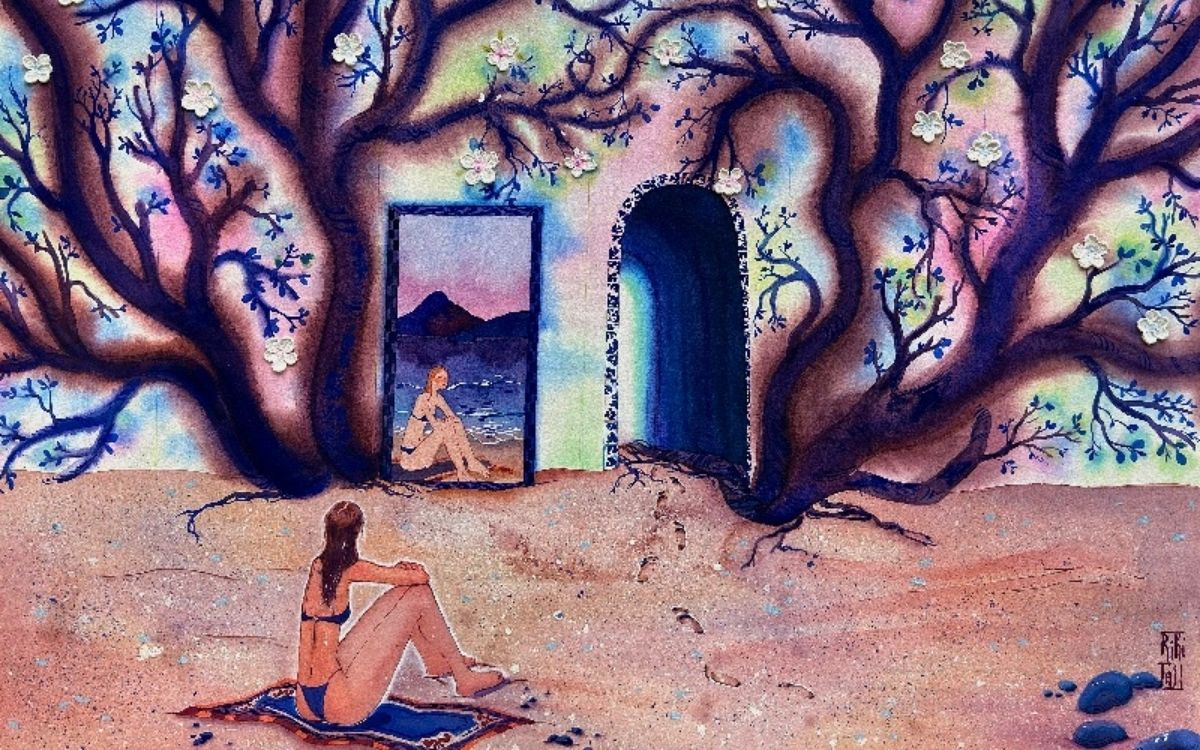
Valeriia’s practice was born quietly, in sketchbooks filled during school lessons and on early internet platforms where delicate watercolor portraits gathered admiration. For years, illustration was instinctive, almost effortless, shaped by audience response and the rhythm of social media. Then history intervened. The rupture of 2022 dismantled stability, identity, and livelihood in a single stroke, collapsing career and certainty at once. Out of isolation, grief, and impossible love emerged a decisive shift. A single painting, The Chaos Maze, marked the moment when decoration gave way to necessity. Since then, watercolor has become both confession and architecture: chaotic floods of pigment forming dreamlike interiors where solitude, longing, memory, and resilience take shape. This conversation traces a journey from viral visibility to inward truth, from algorithmic validation to emotional resonance.
Can you pinpoint a single moment in your life when you realized art was not just a passion but your purpose?
Yes. For most of my life drawing had simply been around me, something i did as naturally as walking or sleeping, a hobby of a little child. I had been sketching since i could hold a pencil, just like many other artists, it was just what i did while life unfolded around me. And since i was 14 i started my first social — DeviantArt, then slowly moved to local platforms in my country, then to Instagram… It wasn’t hard to post regularly as i was studying in school, then in university. I always used lessons as a space for drawing so i had a lot of pictures to post.
During 2019-2020 when the Pandemic started that quiet habit had somehow snowballed into a career. Cute stylish illustrations and portraits began attracting followers on Instagram, first slowly but then in waves. Commissions followed, brand collaborations, foreign customers, it seemed like a fairy tale. The audience grew large enough that i could leave my day job as a school art teacher and support myself entirely through art. It felt less like a triumph and more like an accident, something that happened to me rather than something i have chosen. I was grateful but i still saw myself as someone who made pretty pictures people enjoyed, a fast content… Art remained a passion, not a purpose. Everything changed in 2022. A conflict between Russia and Ukraine upended the world, and it upended mine with particular brutality. I will never forget that day, waking up and seeing a message from my best friend: “Please i wish you won’t wake up. We started a war with Ukraine.” I felt immediately that me would be the first one who will suffer from it and i wasn’t wrong, clients canceled all contracts, brands stopped collabs we had already began, on social media each day i started to face more and more hatred, blaming me for things far beyond my control simply because of the passport i carried. All income vanished just in one moment, projects evaporated, i was bullied, isolated and reduced.
At the same time my marriage was unraveling. The constant news, images of destruction, stories of loss kept me in a state of helpless grief for people i had never met but felt deeply connected to. I stopped eating and lost a dangerous amount of weight. Depression settled over me like a second skin, so much heavy, i never felt such a thing. For months i moved through days in a fog, unable to imagine a future in which i would create and have a job again. Then i met him. It was ordinary on the surface — a chance encounter that could have been nothing. But the connection was immediate and overwhelming. I fell in love with an intensity i had never experienced, a feeling so large it felt both miraculous and unbearable. And almost from the start i knew it could never become a shared life, no matter how i wanted it. Circumstances made it impossible. The joy of loving him and the pain of knowing we could not be together existed side by side, i was paradoxically the happiest and most devastated I had ever been. Those feelings were too vast to contain silently, they demanded release and the only language i had ever truly trusted was visual. One evening i began a painting unlike anything i had made before. It was not cute, not designed to please an audience. It was unfiltered emotion poured into piece of paper. I worked on it obsessively and that helped me calming all of my emotions down, instead of crying and feeling pain i was spreading a story with a meaning with my brushes and watercolors.
For the first time in months i could breath again. I understood: this painting was not just a self-expression, it was a way for communication. Through this piece i had spoken love, separation, a grief of hard choice and in doing so i had lightened the burden I carried. I realized that art could be a bridge between inner world and the outer one. After some time, when i felt i was ready, i sold it for the biggest price i had at that moment (and still i haven’t sold any painting more expensive than that). That single painting, “The chaos maze” as i named it, became a gateway to everything i create now. It marked the moment art stopped being something i did for fun, and became something i needed to do, not only for my own survival, but hopefully for the solace of anyone who sees echoes of their own story in my work. Love and solitude remain the twin pillars of my practice, every piece since then has carried some trace of that impossible, transformative love and the quiet strength required to carry on without it. Four years later i can say without hesitation that the darkest period of my life gave me the clearest understanding of why i create and what artist i wish to be.
How does your art engage with or comment on pressing contemporary issues-social, political, or environmental?
My art has never been overtly political in the sense of direct commentary or protest. For many years, I created primarily for beauty — delicate watercolor illustrations, stylish portraits, pieces designed to bring pleasure and lightness. They were sincere, but they were not trying to say anything beyond the surface. It took time, and a great deal of personal upheaval for me to understand that art could be a space to process something deeper, something that resonates with the complexities of the world we live in. The shift began with my first personal exhibition series “Rooms.” I knew I needed to move beyond the perception that my work was “unserious”, small watercolor sketches on paper pieces that could feel fragile or decorative.
To give the work more presence, I began working in larger formats and developed a technique of stretching heavy watercolor paper over wooden panels, creating a more substantial, almost architectural surface. But the deeper challenge was conceptual: I wanted to introduce myself not just as an illustrator, but as an artist with something to say. “Rooms” became an exploration of inner space, psychological interiors where emotions live, collide, and transform. Each piece depicted a metaphorical room inhabited by solitary figures or fragments of figures, reflecting states of longing, isolation, memory, and quiet resilience. It was my way of turning inward first, to discover what I actually wanted to speak about before addressing anything external.
Today, my practice engages most directly with social and emotional realities, the intricate, often contradictory feelings that define contemporary life. Love and solitude remain central, but they are no longer purely personal. In a world of constant connection yet profound loneliness, of polarized identities and fragile relationships, these themes feel urgently relevant. My works do not illustrate specific events or take explicit positions; instead, they create a visual language for experiences that resist easy description. The paintings emerge from a process that begins with chaos: I throw watercolor onto the paper in spontaneous splashes and pours, letting pigment pool, bleed, and layer unpredictably. This first layer establishes mood, texture, and composition through color and accident. Only then do I begin to “sculpt” the image, refining forms, carving details, revealing figures or symbols that seem to emerge from the mist of the initial flood. The result is dreamlike and open-ended, akin to Tarot cards or fragments of night visions. Viewers bring their own histories to the work, one person might see grief, another unrequited love, another the ache of displacement. In this way, the paintings become mirrors for collective emotional undercurrents — alienation in digital culture, the weight of unspoken longing, the quiet strength required to carry on amid uncertainty.
More recently, I have begun a new series that reaches toward collective memory and cultural identity. As someone whose life and career were profoundly disrupted by the geopolitical rupture of 2022, I have felt the need to explore where I come from, not to justify or defend, but to understand and reclaim. These works draw on motifs from Soviet era imagery, and fragments of shared cultural history, filtered through the same watercolor process. The figures are often suspended between past and present, memory and forgetting, belonging and estrangement. This series allows me to speak about nationhood and heritage in a way that feels authentic to my experience: not through slogans or polemics, but through the emotional residue of lived history. It is my quiet response to having been reduced, for a time, to a nationality rather than a person. Environmental concerns have not yet found a direct place in my work, though I am increasingly aware of how fragility of paper, pigment, human connection echoes larger ecological vulnerabilities. That may come in time. My portfolio is still evolving. I am far from having a perfectly resolved conceptual body of work, and I continue to experiment, refine, and push the boundaries of what watercolor can carry. What drives me now is the belief that art can hold space for the unsayable, the emotions and experiences that politics and news cycles often oversimplify or ignore. By inviting viewers to feel rather than decode, to interpret through their own lenses, I hope the work contributes, in its small way, to a more nuanced understanding of what it means to be human in this moment.
How do you measure the impact of your work-by its reception, its personal meaning, or something else?
For a long time, the impact of my work felt quantifiable in the most immediate, digital way: likes, comments, shares, follower counts. When my Instagram audience was at its peak, built on those early cute illustrations and stylish portraits, success arrived in real time. A post would go up, notifications would flood in, and strangers’ words would pour out: compliments on color choices, requests for commissions, simple hearts and emojis that added up to validation, finally purchases of original arts. It was intoxicating, and it allowed me to leave teaching for a full-time artistic life. In those years, reception was the primary metric. If people responded enthusiastically, the work mattered. Then i started to create absolutely different things and also i stopped being so active on social media and everything collapsed. Comments turned hostile or simply stopped. The numbers that once climbed so effortlessly now shrank dramatically. For a while, I measured impact by absence: the silence was noise. It was devastating to watch something I had built evaporate, and it forced me to confront how fragile that kind of measurement is. Likes are not a reflection of skill or depth; they are influenced by algorithms, timing, global events, and moods far beyond my control. Learning to detach from them was one of the hardest transitions of my career. It took months, perhaps years of deliberate effort to stop refreshing pages, to stop associating a quiet feed with failure. Instead, I began to look inward, to evaluate my work by what it gave me: a way to process unbearable emotions, a language for experiences that words couldn’t hold. Personal meaning became a new compass.
Today, I measure impact through connection — genuine, human resonance that transcends metrics. The feedback that moves me most comes from viewers who truly feel the work. They write to me about what they see in a painting: a memory of lost love, a moment of isolation that mirrors their own, a dreamlike figure that evokes something deeply private. Often, their interpretations differ wildly from mine, one person might read hope where I painted grief, or tenderness where I intended ache. Those messages are treasures. They remind me that the dreamlike, open-ended quality of my watercolors born from those initial chaotic splashes and layered refinements, it invites personal projection. When someone tells me a piece helped them articulate a feeling they couldn’t name, or simply made them pause and breathe differently, I feel the work has done what it is meant to do. That emotional echo is worth more than any viral post ever was. My first solo exhibition “Rooms” crystallized this shift. Seeing people linger in front of the paintings, reading the descriptions with quiet attention, was profoundly affirming. Many spent long minutes with my sketchbook pages filled with raw diary entries alongside preliminary drawings. I had hesitated before including it, exposing that level of vulnerability felt risky. Yet visitors responded with reverence. One person, toward the end of the opening night, said something I will never forget: “I would never share my personal diary in public. It’s so brave.”
In that moment, I understood the weight of what I had created. It wasn’t about sales (though there were some) or reviews (though they were kind). It was about courage recognized, intimacy shared, and the quiet acknowledgment that art had opened a door between strangers inner worlds. That evening taught me that impact can be measured in presence, in the way a room full of people stood, absorbing and reflecting. Of course, I still dream of broader institutional recognition: collaborations with galleries, thoughtful curatorial projects, the thrill of a second solo show. Those milestones would feel like external validation of the path I’ve chosen. Right now, opportunities in Russia are slow to materialize. Galleries and curators are cautious, and building those relationships demands patience and persistence. I understand it takes time, especially for an artist whose work carries the emotional and cultural complexities mine does.
How has your artistic style transformed over the years? Are there specific influences, experiments, or moments that marked a turning point?
My artistic style has undergone a profound evolution, shifting from precise, decorative illustrations to a more fluid, intuitive, and emotionally charged approach. My earlier pieces were technically accomplished, often beginning with careful pencil outlines before layers of controlled color. They were pleasing, marketable, and reflective of a younger self who drew instinctively but without deeper conceptual intent. Over the past four years, however, my style has transformed into something rawer and more collaborative with the medium itself.
One of the most unexpected turning points came during the darkest period of my life in 2022. Amid severe depression I could barely bring myself to create traditional illustrations. Instead, I found solace in an unlikely experiment: tie-dyeing t-shirts. It began as a way to fill the void of empty days. Without a job, my routine felt aimless; sleeping excessively couldn’t occupy all my time. Coloring clothes gave structure, preparing pigments and fabrics in the morning, applying them, then resting or listening to music while the dyes worked their magic and dried. The process was meditative and unpredictable: colors bled, blended, and transformed over hours, creating abstract patterns through chance and chemistry. This simple act became a revelation. Those random splashes and gradual evolutions directly inspired my current technique. Now, instead of fabric, I work on watercolor paper. I begin by wetting the surface thoroughly, then pour and splash pigments in a wet-on-wet approach, allowing gravity, absorption, and drying time to shape textures, blends, and unexpected forms. I sometimes incorporate dry pigments reminiscent of the tie-dye process. Only after this foundational chaos do I intervene, sculpting figures and details that emerge almost organically. The result is a style that feels alive with movement and ambiguity—less controlled, more collaborative with the watercolor’s inherent unpredictability. It mirrors the emotional turbulence I was processing: beauty arising from disorder.
Another pivotal moment came shortly after, when I was invited to the opening of a large coffee shop in Phuket, Thailand. Desperate for income, I agreed to paint quick portraits of strangers live, 10 to 15 minutes each, despite being an introvert and having no experience with such public performance. Fear nearly overwhelmed me, but necessity pushed me forward. What happened was magical: as soon as I began, I entered a deep working trance. People queued endlessly; I drew nonstop for six hours, fueled by their enthusiasm. Satisfied sitters brought friends, who brought more, until the owner finally intervened, saying, “It’s enough! You worked so well.” That evening unlocked a new freedom in my process. Painting directly with brush and color, without preliminary pencil sketches, infused the portraits with vitality and spontaneity they had previously lacked. The slight imperfections and bold gestures made them feel more human, more stylish in an effortless way. Since then, I’ve minimized or eliminated pencil underdrawings entirely. My watercolors now embody a true partnership with the medium: I set the stage with those initial splashes, then respond to what the paint reveals, allowing accidents to guide the final image.
These experiences, tie-dye as therapy and live portraiture as breakthrough, marked the decisive shift from illustration to expressive painting. My style today is more textured, and deeply tied to emotional authenticity. It invites viewers to project their own interpretations onto layered, ethereal compositions. While I continue to refine this approach, these turning points taught me that transformation often emerges from constraint, necessity, and surrender to the unexpected.
Can you take us through the evolution of an artwork, from that first spark of inspiration to the finished piece?
In future I also hope to open the doors to Batik, another form of liquid art. An idea comes first, it can be a feeling, a memory or some little detail of environment that inspires my mind to create an image in my head. Usually i carry a small notebook and a pencil so i can easily put my idea as a small rough sketch on a run. As I mentioned my sketches don’t contain much details, i prefer the paper to stay as much clear as possible to avoid dirt coming into my paints. This method allows me to create saturated, bright and pure color pieces. Color for me is not a decorative element, it’s an instrument for mood. The only hated part of my work is putting this clear sketch on a paper, no hard pressure so i could erase it easily without destroying a paper’s texture. Watercolor paper is very sensitive and erasers can do bad things to it. I can spend more time on a sketch than on coloring a few layers. After a sketch is done i try to separate my work into few pieces. It’s very hard to create something beautiful when the whole paper is wet as you need to pay attention to different parts of a painting, but watercolor dries and doesn’t excuse any mistake, so i came up to a solution of separating it. One day i work with left angle, second day i work with right angle and so on.
How do you feel social media is shaping the way art is created, consumed, and valued today?
Social media has profoundly reshaped the landscape of art, how it is created, consumed, and valued, often in ways that feel both liberating and precarious. As an artist who built a career almost entirely through platforms like Instagram, I have experienced its dual nature: a tool of unprecedented opportunity and a system that can exact a heavy toll. The most transformative gift of social media is democratization. It has allowed artists from anywhere to reach global audiences without gatekeepers: no need for gallery representation, elite networks, or institutional approval. In my own journey, growing up immersed in American pop culture while living in Russia, social media became a bridge to markets I could only dream of accessing otherwise. My early illustrations found enthusiastic buyers in the United States, and I sold original works abroad long before I had any local successes. There was a particular thrill in preparing packages with a “From Russia” sticker, imagining someone across the ocean unwrapping a piece of my world. That direct connection of artist to collector, without intermediaries felt revolutionary. It gave me independence, financial stability, and a sense of belonging to a broader creative community. Today, countless emerging artists owe their visibility and livelihoods to this same accessibility.
Yet the platform’s capitalist underpinnings reveal a darker side. Social media operates on relentless production: algorithms reward consistency, virality, and trend-alignment, extracting content until an artist burns out or steps away. When engagement drops, as it did for me, the silence feels punitive. The system doesn’t pause for rest, reflection, or personal crises; it simply shifts attention elsewhere. This fosters widespread comparison and mental health struggles. I’ve met artists who assume a large following equals wealth and stability, leading to transactional “friendships” built on requests for shout-outs or financial help. Refusing such demands can brand you as ungrateful or elitist, and that negative energy can cause a real damage. Many aspiring creators hesitate to share work at all, paralyzed by the polished feeds of more established artists. I often encourage friends and strangers: post anyway. Overcoming fear and self-doubt matters more than achieving immediate perfection. The real barrier isn’t skill — it’s the courage to exist publicly. More troubling still is how social media amplifies division. Algorithms curate feeds that reinforce existing views, creating echo chambers that deepen polarization. Content designed to provoke, whether relationship stereotypes (“why wives/husbands always…”) or political outrage, can seep into real lives, manufacturing conflict where none need exist. Two people sharing a home might consume opposing narratives about each other, eroding communication before it begins.
On a larger scale, this fragmentation affects how art itself is valued: nuance is sacrificed for hot takes, and artists risk cancellation or boycott for perceived affiliations rather than the substance of their work. Trends pose another quiet threat. I’ve been swept up in them myself: chasing styles or subjects that performed well, only to feel my voice diluting. Virality often prioritizes aesthetic sameness over originality, and artists without resources for professional teams (photographers, editors, strategists) struggle to compete for attention. A painter with modest reach might abandon the practice altogether, convinced their work isn’t “good enough” because it doesn’t garner thousands of likes. Ultimately, social media is a powerful instrument, capable of education, connection, and empowerment, but its impact depends on mindful use. It has expanded who gets to participate in the art world and how art circulates, often valuing immediacy, relatability, and emotional resonance over traditional metrics like provenance or critical consensus. For those aware of its mechanisms, it remains an extraordinary tool. For others, it can become a source of exhaustion and disillusionment. My hope is that artists continue to claim space on these platforms not just to survive the algorithm, but to shape it toward something more human.
Artificial Intelligence is increasingly infiltrating creative fields. Do you see artificial intelligence as a threat, a tool, or a collaborator in the art world?
We have already crossed the threshold into an era profoundly shaped by artificial intelligence, and there is no opting out, in my opinion. Denying its presence or wishing it away is futile; AI is weaving itself into every corner of human activity, including the creative fields I hold dearest. When it first emerged as a force in visual art, generating illustrations, concept designs, and advertising visuals I felt very very sad. I had always imagined art as the final sanctuary, the one domain machines could never truly inhabit because it demands soul, intuition, and lived experience. Yet AI struck creatives first and hardest, revealing an uncomfortable truth: much of what we considered skilled labor in commercial art and design could be approximated, and quickly. AI made certain kinds of art cheaper and faster. Stock images, logos, book covers, and social media graphics that once required hours of human labor could now be conjured in seconds from a prompt. Designers found their workflows accelerated but their roles now vanished, less need for deep technical mastery, lower pay. It democratized access in one sense, but it also devalued the craft. Small businesses, previously priced out of professional design, could now allocate budgets toward higher quality products instead of visuals.
Meanwhile, I notice that major brands and luxury markets reject AI-generated work, insisting on the authenticity of human hands. A new equilibrium is emerging like machine-made aesthetics for the masses, human-made for those who can afford the premium. Over time, I suspect anything unmistakably touched by a person — imperfect, idiosyncratic, emotionally resonant, will command much more higher value precisely because of its scarcity. Still, I carry real anxieties about the long-term consequences. Traditional artistic training will lose it’s purpose and need. Why enroll in art school, wrestle with anatomy or color theory, when a well-crafted prompt yields instant results? Future generations may choose convenience over discipline, and I fear that could erode something essential in us like patience, curiosity, the tolerance for failure that breeds originality. On a broader scale, AI’s dominance in search and information retrieval worries me deeply. If personalized algorithms replace broad and deep exploration, and access to diverse perspectives becomes paywalled or curated by corporations and governments, we risk greater intellectual conformity. Control over what we see and think tightens, and humanity grows more predictable, less inventive.
Yet I cannot ignore the doors AI opens. It lowers barriers that once seemed impossible to fight. I can now animate static watercolors, bringing subtle movement to my paintings without dedicating years to learning animation software. A blind person can describe a vision and see it rendered, sharing inner worlds previously trapped in words. Late bloomers who believed “it’s too late to start drawing” can experiment freely, discovering creativity they thought was out of reach. These are genuine expansions of human expression. For me, the healthiest stance is to regard AI not as a threat but as a collaborator and, more fundamentally, as an inevitable marker of a new era. I have already used it practically: when I was only starting to shape my concepts and written descriptions for my series, I turned to AI to refine my thoughts, making complex emotions more articulate without compromising the core idea. I look forward to future exhibitions where physical watercolor paintings hang alongside gentle AI-driven animations of the same works, layers of stillness and motion coexisting, enhancing rather than replacing each other. AI will reshape art, but it cannot replicate the singular perspective born from personal struggle, love, loss, or wonder.
What are five things you do to overcome creative blocks or feelings of discouragement?
Work.
Having a bunch of rough sketches in my pocket notebook I can come back anytime when I feel a lack of inspiration and ideas.
Having a long walk in a forest with my dogs.
Join any of the State Galleries to receive energy from older masters. One of my favourite museums to visit is the Tretyakov State Gallery dedicated to 20th century art in my country.
Cry because I have chosen to be an artist. Works very well and refreshes my mind.
What are five steps you're taking to ensure your continual growth as an artist?
Continue two of my current series: “Through the prism of blue eyes” and that one with Soviet heritage. Make them a strong body, strong concept that will represent me as an artist for gallery and collector.
Creating larger paintings, scaling it until possible.
Continue talking about my art with strangers so i won’t mess up on it when talking to art related person.
Having a personal show and taking part for the first time in an artist residency.
Expanding the amount and kinds of materials I can use in my art.
Across this dialogue, Valeriia returns to art as survival and bridge. Watercolor is no longer surface beauty but process: splash, accident, refinement, emergence. Personal upheaval, cultural fracture, and shifting identity dissolve into layered compositions that invite viewers to project private stories into shared space. Metrics fade beside human presence; virality yields to connection. Even in reflections on social media and artificial intelligence, the central belief remains steady: authenticity carries weight that no system can replicate. The work continues to evolve through larger scale, deeper research, and new materials, yet the core remains unchanged — art as a language for what cannot be spoken plainly, and as proof that even in chaos, form can emerge.