
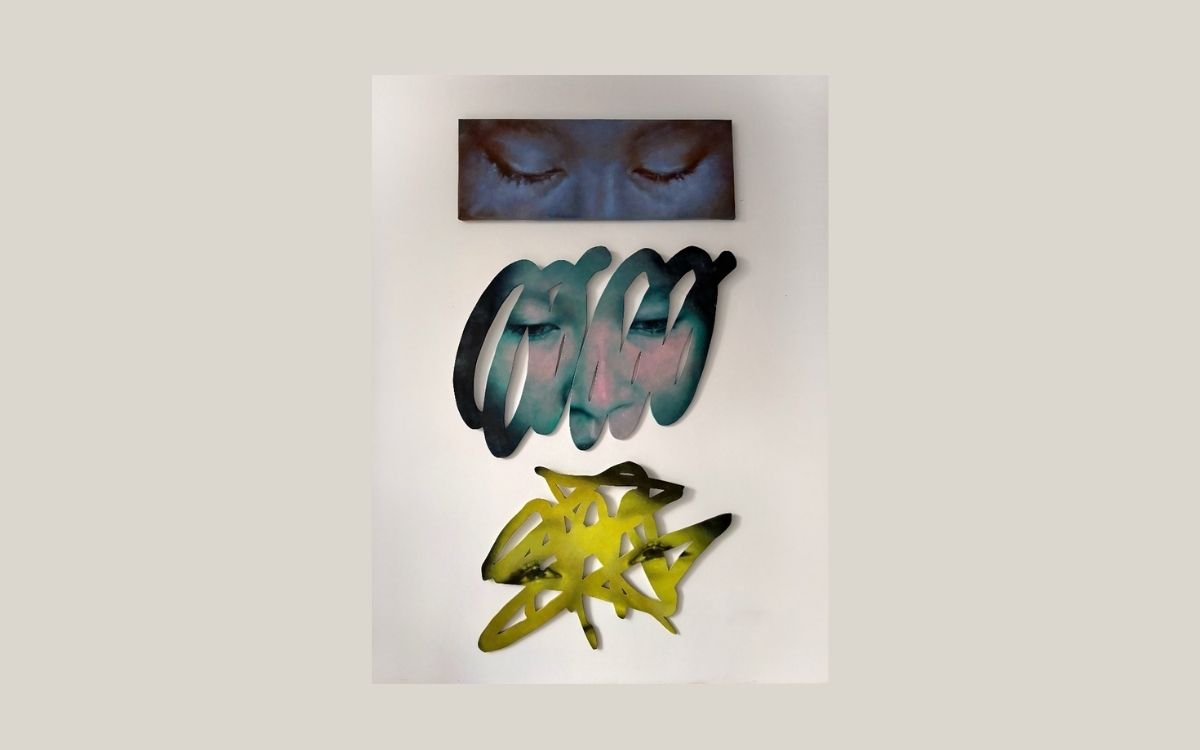
Vera Tepliakova’s practice emerges from resistance rather than tradition. Shaped by lived experience, displacement, and a refusal to conform to prescribed artistic paths, the work navigates vulnerability, feminism, political reality, and personal memory. Wood, color, and custom-cut forms become tools for reclaiming freedom—both formal and internal—allowing art to surface as an act of self-definition rather than compliance. This interview traces a practice built through opposition, risk, and an insistence on sincerity.
How has your upbringing or cultural heritage shaped the themes and techniques you explore in your art today?
My upbringing in Russia did not shape my artistic practice in a conventional or affirmative way; rather, my work developed in opposition to the circumstances, expectations, and cultural frameworks in which I grew up. That resistance itself is a decisive influence. I work with themes that disturb me personally, about my inner states, emotional vulnerability, and the social conditions I found myself in largely because of my origin and the cultural norms I was raised within. Working with wood, for example, was not considered appropriate for women: at school, practical subjects were divided into “male” and “female,” and I deliberately transferred to the woodworking class because it interested me more. In my experience, there is a very rigid model of what it means to become an artist in Russia: early enrollment in an art school, initiated by parents; formal academic training at a specialized university; and only then a professional career. I started drawing relatively late, during my teenage years, in the middle of my first depressive episode. By that point, enrolling in an art school was already considered too late, as this type of education is part of the primary school system and often begins as early as first grade. So for a long time I assumed art would remain nothing more than a private hobby. By the time I finished school, I wasn't interested in anything other than art, and I was the only one in my university course without any experience of studying at an art school. I felt very uncomfortable, and imposter syndrome was eating me up every day. After I was detained for participating in an anti-war rally, the university found out about my anti-war stance, they called my parents, forced me to write an explanatory letter, and after that I realized that I would not be able to get an education in peace, the teachers had the opposite position and would treat my work with prejudice. I dropped out and left the country. In emigration, I felt that I had absolutely nothing to lose, and this gave me the strength to try my hand at art and exhibit my work on the internet. The feeling of inner freedom allowed my creative style and inspiration to manifest themselves.
I do not like the expectation that artists should address their national identity in their work if there is no internal need to do so. My works are often too bright, too naïve, and insufficiently serious, at least, that is how I imagine any professor from my university would have described them. Yet I carry within me everything I have experienced by being born in Russia, in that specific city, in that specific family. What shaped me as a person is precisely what I am now trying to express through my art.
Have you ever felt drawn toward a conventional career path? What made you take the "creative leap" despite the risks?
I never thought I would have the opportunity to become an artist. As a teenager, I realized that I didn't want to do anything other than art, but I never allowed myself to think that it could become my profession. This made me angry, I was deeply unhappy, I considered artists to be useless people, and contemporary art to be empty and a sphere for money laundering. I became interested in art and became a more tolerable person when I allowed myself to create and enroll in an art university, while simultaneously working a "normal" job as an administrator at a children's language center near my home. I only started to consider art my job after emigrating, when I realized that I had nothing to lose, because I had dropped out of college, quit my job, and basically had absolutely nothing to fall back on, so why not give it a try? Now I live in Georgia and my income from my creative work satisfies my needs here, but I plan to emigrate further, which means I won't be able to afford the same standard of living in another country. I think that in the next few years I will need to find a "normal" job, and I hope that I will have time for creative work. I think I will find a way to be creative in any case.
How does your art engage with or comment on pressing contemporary issues-social, political, or environmental?
My work is a reflection of me, my inner world, and my views. I am an anti-war emigrant, a feminist, and my life is built on and directly dependent on social and political factors. I paint based on my life experiences, on what I want to share, and naturally, social issues and politics have a huge influence on this. Even if I create a work that at first glance does not appear to be sharply social, it is still a statement. When we study the biography of any artist, we take into account the circumstances of their life, the era, and the events of that era in order to understand the context of the work created. Without context, a work might lose its value. We can feel it on an emotional level, but to truly understand it, we need to delve into the author's "statement," which is sometimes immediately clear and sometimes requires further exploration. I often make works with an overtly feminist context. I have had two anti-war works, one about my experience of serving an administrative arrest in a detention center for participating in an anti-war rally. But even if my work does not "shout" about politics or social issues, it still implies them, because as an artist I hold certain views that shape my life, which I paint about.
What do you think is the most meaningful role an artist plays in society today?
As I said earlier, when I didn't allow myself to create, I was angry at artists who had the audacity to live the life of an artist. I considered these people useless, ridiculed them, and simply envied their freedom, while remaining within the confines of my own fear of self-expression. Now, the more I learn about art, the more I believe that it is a reflection and driving force of society's development. There is artificial intelligence, rockets are being launched into space, yet on the same planet there are women without access to education; the practice of female genital mutilation still exists, as do child marriages, wars, racism, violence, and slavery. Art, whether music or visual art, gives us a certain advantage to reflect, to sharpen our attention on something important, and to call upon feeling, which is what distinguishes a rational being from an irrational one. Perhaps this is a vicious circle, because access to art is still only available to a privileged group of people, and by that I mean access to both creation and contemplation of art. So perhaps the artist’s primary role is to reflect the full horror of our humanity, because I am not sure that any other kind of change can truly be achieved, except to point out its flaws and to give privileged people an opportunity to think, or simply to rest after a hard working day… To be honest, I thought long and hard about how to answer this question. Sometimes, looking at artists who painted hundreds of years ago, I catch myself thinking that there has been no development at all, that artists are talking about the same things centuries later, but I hope that this is a misconception and that I have simply given free rein to my characteristic maximalism and pessimism. In general, artists probably set or reflect on all stages of the development of the human personality and society in their work, if such development occurs. Responding to your question about the purpose of the artist, the only thing I can say with certainty in the end is that they always pursue their own goals and, through creativity, satisfy their own needs, whether it is the attainment of social approval, the desire to process their doubts and thoughts through art, or simply doing what they cannot help but do. Does this have any meaning or importance? I do not know. Probably not, like everything created by humans. Or it does, like everything created by humans. That is not for me to decide.
Can you take us through the evolution of an artwork, from that first spark of inspiration to the finished piece?
My work begins with an idea, a feeling, a theme, or a memory that I want to reflect in an artistic form. Then I look for a form that would be ideal for reflecting what I have in mind, and I make many sketches. A color comes to mind, and I decide whose image I would like to use to convey the idea of the painting. I draw the final draft of the painting, then cut the shape out of wood with an electric jigsaw, sand it, fill it, and sand it again. Then I cover the shape with several layers of glue and primer, sand it, and attach the fasteners. Only after that do I start the painting part of the work, which is the easiest and most enjoyable for me. The process of creating the form is long and complicated, but the physical work and preparation of the form helps my mind to rest from the artistic process and think through the idea again. It is this method of creating paintings that allows me to convey my ideas in exactly the way I want, combining form and image and studying their interaction.
How has your artistic style transformed over the years? Are there specific influences, experiments, or moments that marked a turning point?
My artistic style began to develop rapidly when I found the courage to paint what I wanted to paint, without relying on external approval or seeking inspiration from outside sources. When I first tried cutting a shape out of a wooden panel as a base for a painting, I realized that this was exactly what had always interested me. When I was studying art, composition was my weak point. I constantly shifted away from the center, couldn't fit something into the canvas, and couldn't understand why I had to limit myself to a rectangular or square shape. Who decided that art had to fit into these frames, when practically everything else in our world is unique and doesn't have 90-degree angles? Now I am experimenting in this niche, constantly exploring the possibilities offered by custom shapes and two modes of artistic expression: form and image.
How do you feel social media is shaping the way art is created, consumed, and valued today?
With the advent of social media, art has become more accessible, both in terms of production and consumption. In my opinion, the focus has shifted to the process of creating art, rather than just the result, as was the case before, when the process of creating art was something secret and intimate. Art has become more personal, and people like to follow the artist's story, not just their work. I don't really like the trend that if you want to be a visible artist in the modern world, you have to have social media accounts and be productive online. But on the other hand, it provides many opportunities for people like me who don't have the opportunity to build a conventional professional path of growth in the form of art school, professional connections, and gallery representation. When this path is not possible, social media becomes the only way to get your art seen without intermediaries, which is very important for many artists from different backgrounds. This makes the art world more inclusive and accessible.
Under what circumstances do you think art risks becoming pretentious?
I often think about this because some people might consider my art pretentious. I think this is possible if the author has not experienced what he writes about in his works, if the subject does not "touch" him, if the author artificially extracts a theme from himself and tries to talk about something that does not deeply concern him. In my opinion, this is not so scary in reality; what scares me much more is the root cause of this phenomenon—the fear of appearing stupid and simple, the fear of being a "flat" artist. I myself have encountered this fear. For some reason, I used to believe that every painting should have some kind of world-changing message, that every painting should be a breakthrough in the world of art and carry a hundred thousand different hidden meanings and subtexts, because only then would art have meaning and be considered correct. But this is not true. Art risks being false and pretentious if you do not consider your inner voice important and try to conform to society's expectations of you as an artist. You can paint a painting from a feeling, an emotion, a memory, some lost sensation, a reflection, or anything else. And it will be considered important, true, and sincere.
How do you approach criticism, whether from peers, critics, or audiences?
To be honest, I am unable to adequately perceive even constructive criticism from anyone due to my inner insecurity about myself and my work. No matter how much I talk about how an artist must believe in their process and consider their vision important, I still haven't come to this conclusion on my own. I am extremely sensitive to comments about my art, as I am never completely satisfied with it internally, and sometimes I think about turning off comments on social media because even if the ratio of positive to negative reviews of my work is 1000:1, I will still be hurt by negative comments. I don't think this should affect my state of mind, but it does, apparently due to the inexperience and vulnerability of my psyche. I am afraid of appearing clumsy and inexperienced, afraid of being "exposed" for my lack of talent, even though I understand intellectually that these fears are groundless. It seems to me that in this case, no matter how skilled I am, deep down I still won't be able to treat criticism with the necessary distance until I go through psychological work on myself and my self-esteem.