

What if colour holds what words cannot reach?
The early Expressionists understood something fundamental: colour is never neutral. It carries weight, history, emotion; a chromatic language that speaks directly to the body before the mind can translate it into words. From Kandinsky's belief in colour's spiritual resonance to the Fauves' wild, unnatural hues that prioritised feeling over representation, these artists positioned colour as a primary form of expression, a direct channel to psychological and emotional truth.
More than a century later, six contemporary artists continue this investigation, but with a crucial difference: they approach colour not just as expression, but as archive. In color//archives, we encounter hues that hold cultural memory, personal history, and the accumulated meanings that attach to colour across time and context. These works reveal that every shade carries associations we feel before we name—the pink of gendered conditioning, the red of desire and danger, the blue of melancholy and depth, the warm nostalgia of film grain, the muted browns and greens of natural time.
Pink as Political Archive
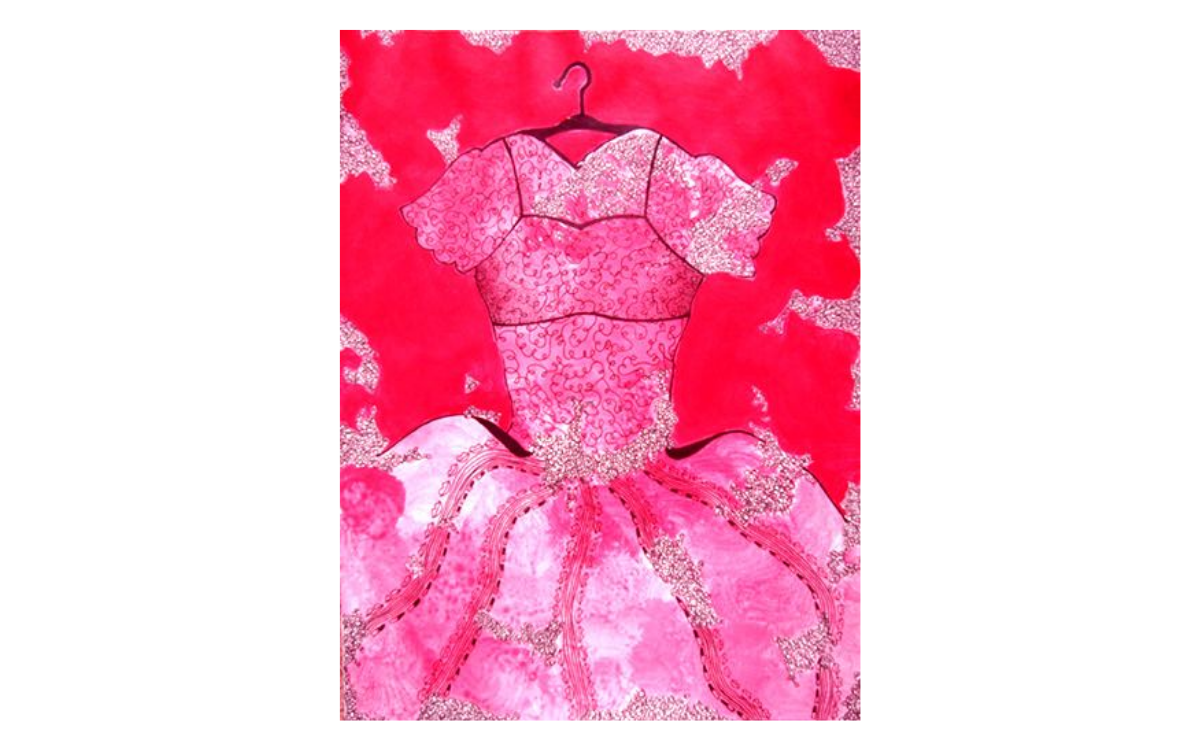
Puja Sarkar's Pink Series-5 immediately establishes colour as contested territory. The work presents a glittering pink dress suspended against an intense red background—a garment that is simultaneously beautiful and unsettling, seductive and mechanical. For Sarkar, "pink is not merely a colour—it is an emotional and cultural archive, a sensory memory, a political statement, and a site of resistance."
The series emerges from what the artist calls "a visceral meditation on femininity, intimacy, and the fragile choreography between desire and pain." Through fragmented bodies, suspended garments, and dislocated forms, Sarkar reconstructs "the inner landscape of womanhood: its tenderness, its violence, its longing, and its silent endurance." Pink becomes "a vessel of stored emotion—echoes of affection, shame, longing, and unspoken wounds."
The monochromatic intensity functions as insistence: "The colour is layered, scraped, stamped, and splashed—each gesture registering a different emotional frequency, revealing how women internalise and remember touch, desire, and violation." Historically associated with softness and innocence, pink becomes in Sarkar's hands both seductive and confrontational. The dress, "poised like an abandoned relic, reflects cultural conditioning, where femininity is crafted, displayed, and sometimes weaponised."
This is colour as archive at its most political: pink holding the accumulated weight of gendered expectations, the contradictions of intimacy, and what Sarkar calls "the emotional labour of inhabiting a female body in a world that alternates between fetishising and erasing it."
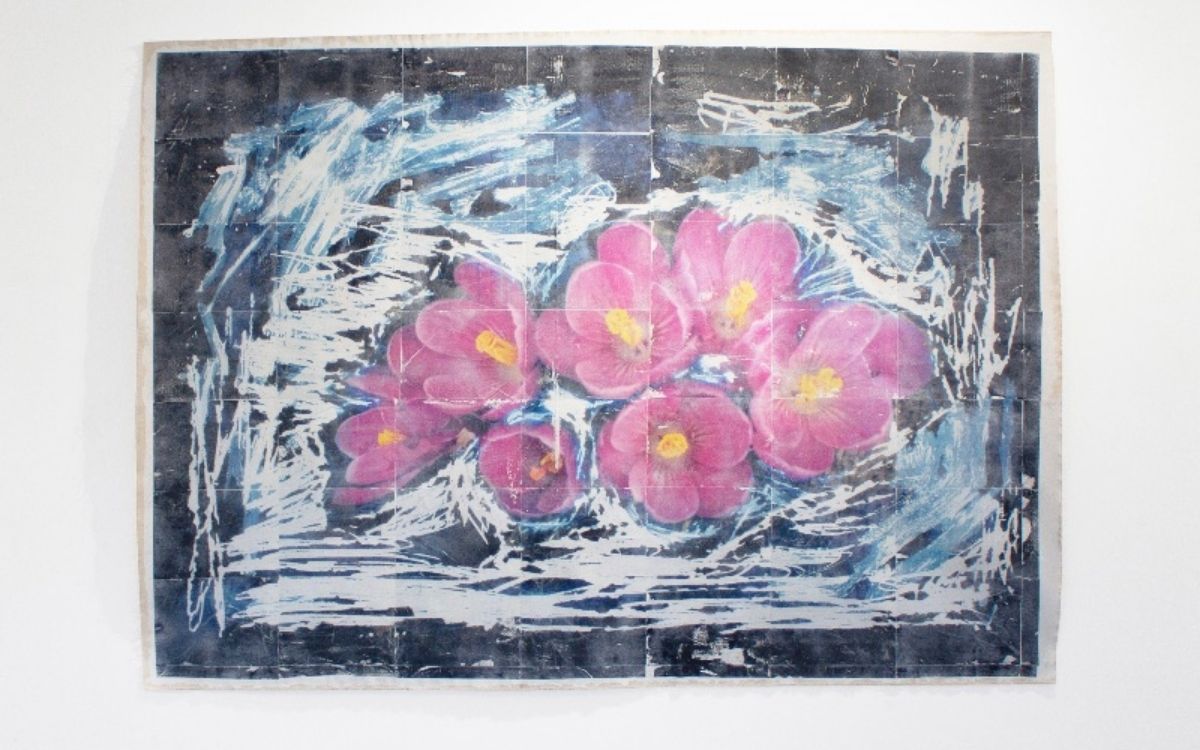
Sid White-Jones's Crocus Vernus offers a complementary approach to pink—the painting's delicate flowers emerging from a turbulent background of whites and blues. Without an artist statement, the work speaks through its material handling: pink as a natural phenomenon, as a seasonal return, as the colour that signals renewal and vulnerability simultaneously. Against Sarkar's constructed femininity, White-Jones presents pink as it appears in nature—fragile, temporary, beautiful without performing beauty.
Orange as Reverie
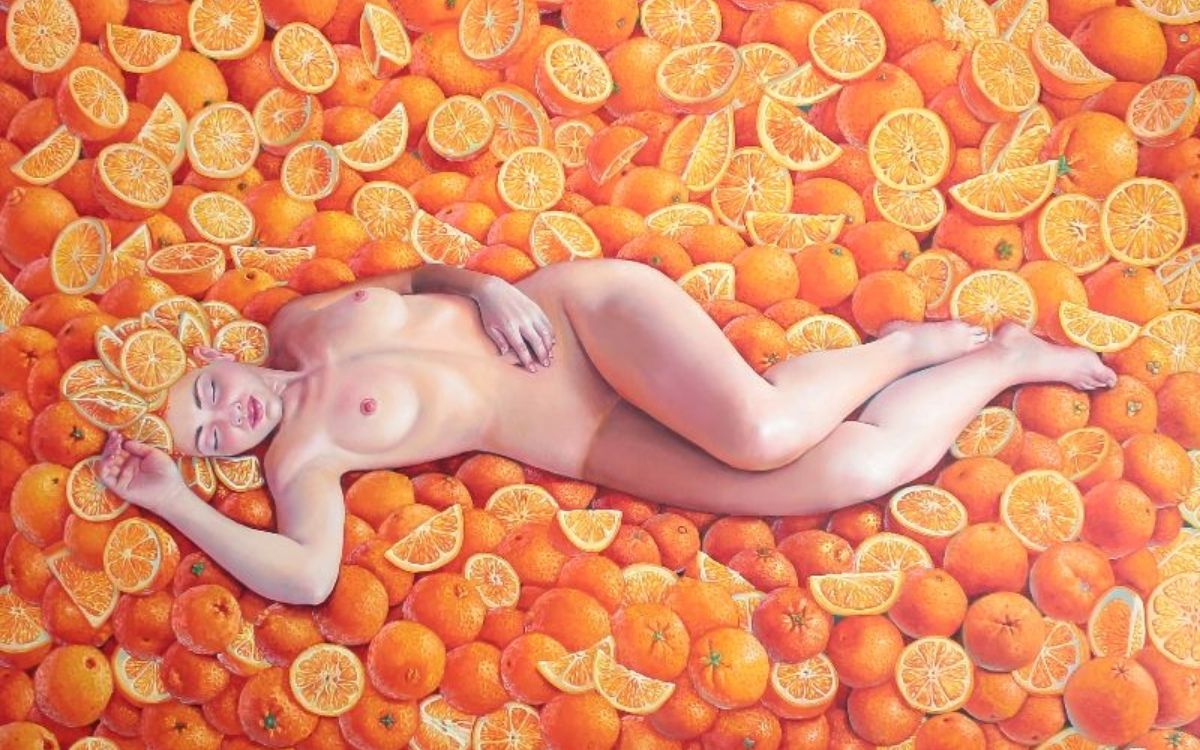
Tetiana Bogdanova's painting Orange Dream demonstrates colour's capacity to construct entire worlds of feeling. A pale figure reclines in a sea of oranges—whole and sliced, scattered and stacked—creating what the artist describes as a vision where "the whole world was made of oranges and there was no sorrow or anxiety in that world, only the sweet aroma of ripe oranges."
Part of the artist's "Dessert Girls" series, the work stages a chromatic immersion where a single hue dominates so completely it becomes environment, atmosphere, and dream logic simultaneously. Orange here operates as temperature, scent, taste, and mood—a synesthetic archive of summer heat, Mediterranean landscapes, childhood abundance. The monochrome intensity (broken only by the figure's pale skin) creates what the artist frames as escape: a girl who "tired from the heat, fell asleep sweetly" and entered a world defined entirely by one colour's associations.
This is orange as portal—the way a single hue, repeated and accumulated, can transform reality into fantasy. Bogdanova reveals how colour operates not just as a descriptor but as a world-builder, how chromatic saturation can archive longing, pleasure, and the desire for a simplified reality where complexity gives way to sensory abundance.
Blue as Accumulation
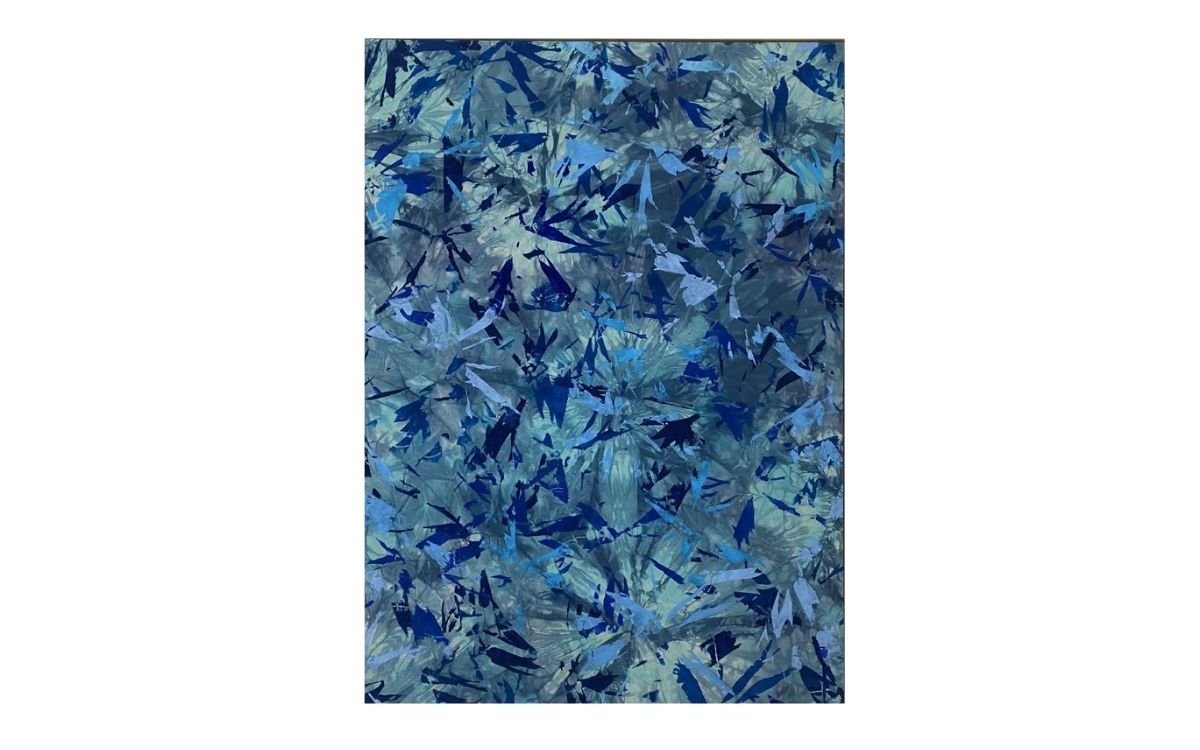
Avraam Hirodontis's Untitled #15 approaches colour through process rather than image. Working with fabric dye and acrylic on raw canvas, the artist creates what appears as a dense field of overlapping blue marks—each stroke, drip, and stain preserving its own moment of application. The artist describes colour here as "both event and residue—the trace of a process rather than an imposed form."
The work operates through what Hirodontis calls "the material behaviour of pigment—how it seeps, gathers, and resists." Colour becomes temporal: "The stains and veils of dye reveal a quiet record of material transformation, where memory is held not in depiction but in the physical act of absorption and change." This is blue as accumulation, as the sum of gestures, as what remains when representation is stripped away.
The surface reads as "sediment or skin, where each tone carries the memory of its own making." Hirodontis positions "colour as a living archive—mutable, porous, and temporal," engaging the viewer "not through image but through the material behaviour of pigment." In this process-based approach, we see echoes of Expressionism's interest in the artist's hand, but refocused: it's not the emotion of the artist that matters, but the autonomy of the material itself, colour as agent rather than medium.
Colour as Place Memory
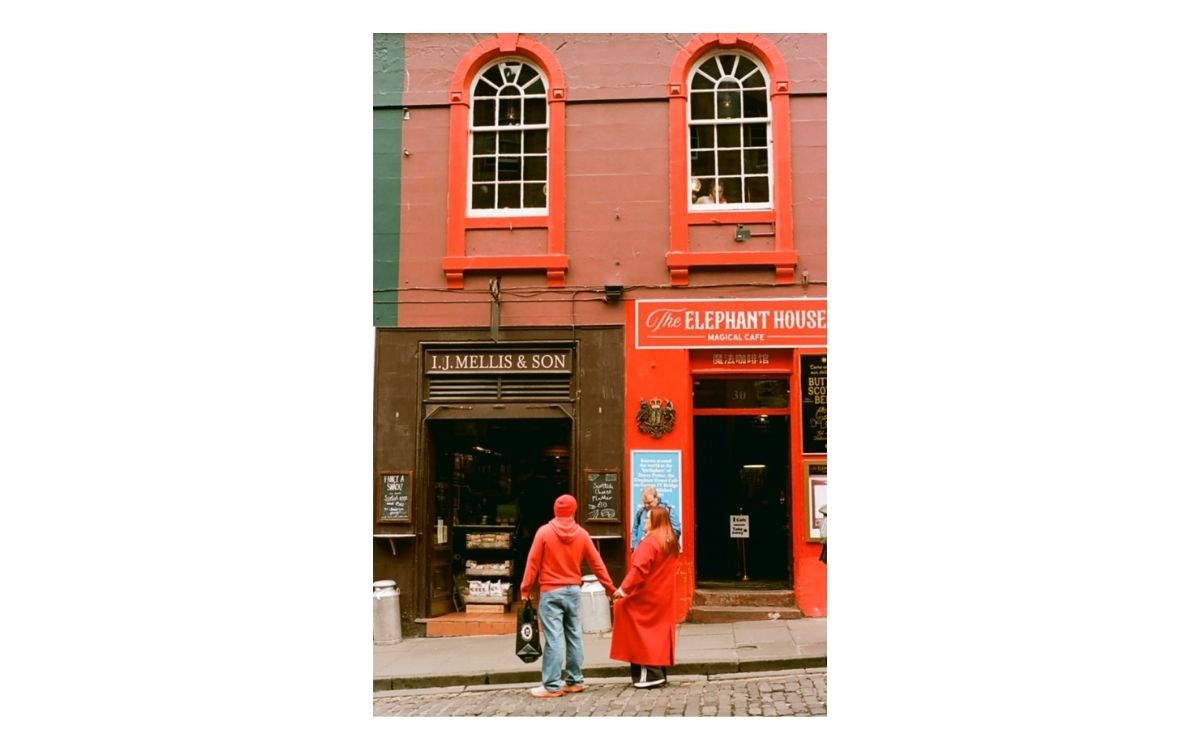
Anastasia Rak's film photography series Edinburgh, demonstrates how colour archives place and belonging. Shot on Minolta film, the images capture Victoria Street with what the artist describes as "a distinctive, warm texture, and a feeling of cosiness and nostalgia." The saturated reds and oranges of the building facades, the warm tones of the street scene, carry what Rak calls "the same sense of warmth and belonging that I carry from my time there."
This is colour as emotional cartography—the way specific hues become inseparable from place memory. The film medium itself contributes to this archival function: the slight grain, the particular colour rendering of analogue photography, creates what feels like memory rather than documentation. The warm palette doesn't just show Victoria Street—it archives a feeling, a quality of light, a chromatic atmosphere that digital precision might document but cannot evoke in the same way.
Rak's work reveals how colour functions as a place-marker, how we remember locations through their chromatic signatures. The reds and oranges of Edinburgh's architecture become part of personal history, colour operating as the sensory anchor for biographical memory.
The Chromatics of Natural Time
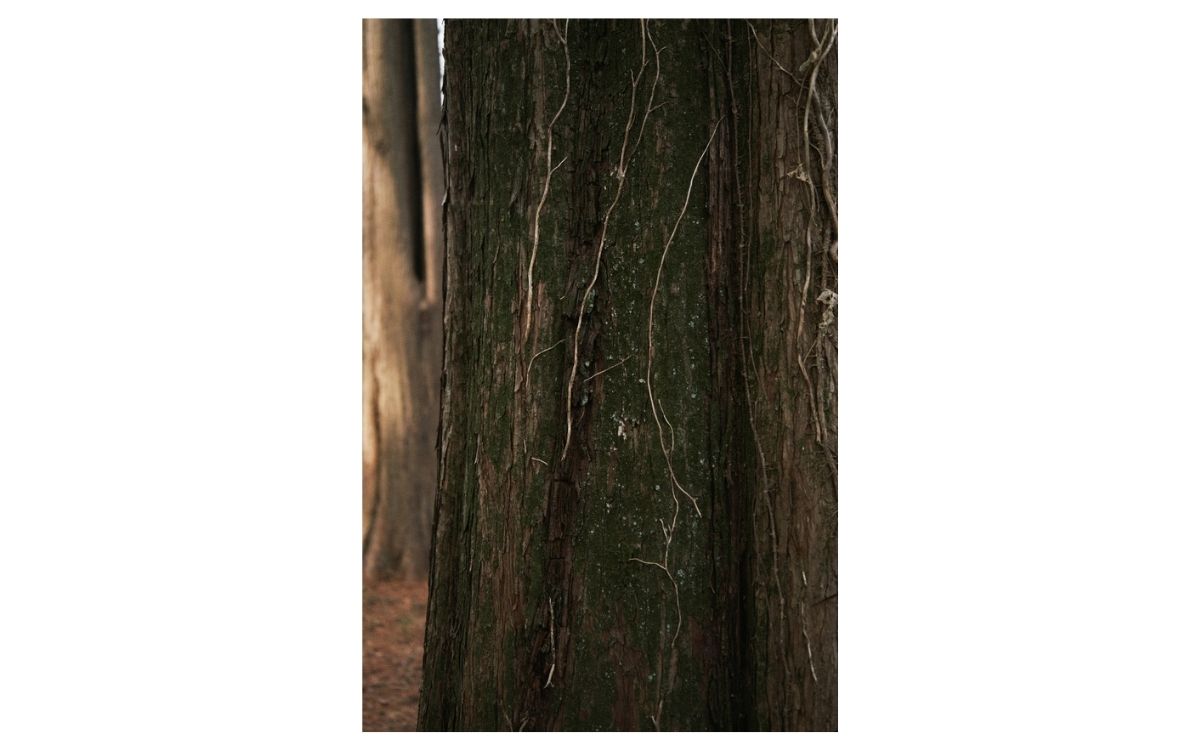
Lola Mirmuminova's photograph Trunk and Vines takes us to colour at its most subtle—the muted greens and browns of bark, the delicate tracery of vines against wood. The artist describes the image as reflecting "an unstable equilibrium—a moment between erosion and rebirth, where colour holds the memory of touch."
Here, colour operates at the threshold of visibility, in the range of hues we might not consciously notice but which fundamentally structure our relationship to the natural world. These are the colours of slow time: "The surface of bark carries the slow pulse of time. Vines trace delicate scars over layers of muted green and brown." This chromatic restraint—after the saturated pinks and reds of earlier works—reminds us that color archives operate across the full spectrum, from the loudest declarations to the quietest murmurs.
Mirmuminova's photograph suggests that even barely-there colour carries meaning, that the subtle variations in bark tones archive seasons, growth, decay. This is colour as a geological record, as the visible trace of organic processes operating beyond human timescales.
Beyond Expression
What distinguishes these contemporary artists from their Expressionist predecessors is this archival consciousness. Where the Expressionists used color to express inner emotional states—to make visible what was felt—these artists recognise that colour itself already carries accumulated meanings, cultural associations, and stored experiences that precede any individual expression.
Sarkar's pink arrives laden with the history of how femininity has been constructed and policed. Bogdanova's red carries centuries of associations with vitality, danger, and passion. Hirodontis's blue accumulates meaning through the physical process of its application. Rak's warm tones hold the feeling of a specific place at a specific time. Mirmuminova's muted palette archives natural processes. White-Jones's spring pink remembers all the springs before it.
This is colour as living archive—not the dead storage of static information, but the active holding of meanings that shift and accumulate as they're encountered across different contexts, different bodies, different times. These artists understand what the open call proposed: that colour holds what language cannot, that we feel chromatic associations before we can articulate them, that our memories are often colour-memories, that hues carry cultural codes we've internalised so deeply we mistake them for natural.
What Colour Remembers
In bringing these six works together, colour//archives proposes that every chromatic choice is also an archival act—a decision about which associations to activate, which histories to invoke, which emotional registers to open. The collection reveals colour operating across multiple scales simultaneously: as personal memory (Rak's Edinburgh, Mirmuminova's touch), as cultural construct (Sarkar's gendered pink), as material process (Hirodontis's accumulating marks), as natural phenomenon (White-Jones's flowers), as vital presence (Bogdanova's red).
These artists continue the Expressionist project of taking colour seriously as a primary form of meaning-making, but they do so with an awareness that colour is never innocent, never merely aesthetic. Every hue we encounter has been shaped by cultural use, personal experience, and the accumulated weight of all the times that colour has appeared before. We don't just see colours—we remember them, and they remember us.
Colour holds what language cannot. But perhaps more importantly, colour remembers what we've forgotten—and what we've never been allowed to forget.
Featured artists: Puja Sarkar, Sid White-Jones, Tetiana Bogdanova, Avraam Hirodontis, Anastasia Rak, Lola Mirmuminova