
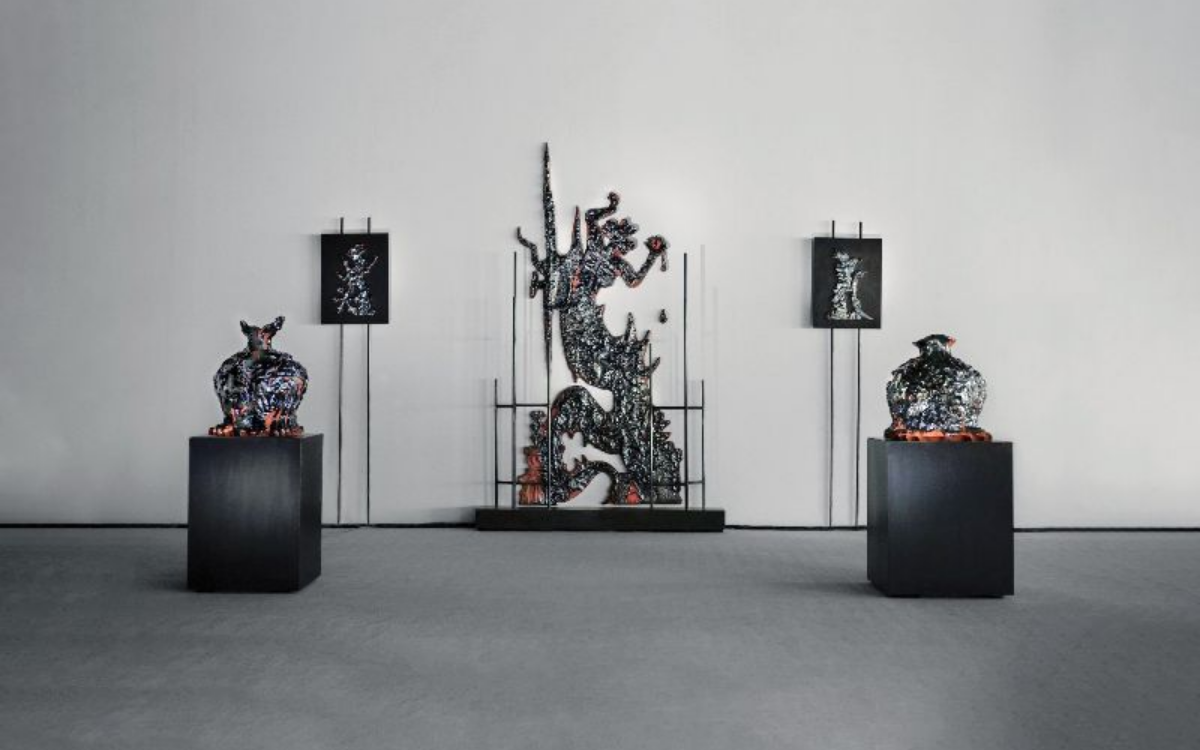
Rooted in the landscapes, myths, and tensions of rural Greece, the work of Niki Danai Chania unfolds between lived experience and inherited narrative. Sculptures, monsters, and hybrid forms emerge from encounters with crisis, migration, precarity, and the raw materiality of everyday life. Ancient stories blend with contemporary struggles, not as fixed symbols, but as evolving mirrors of social pressure, environmental instability, and the fragile boundary between the human and the mythic. Through text, collage, clay, metal, and sound, the practice constructs worlds where the abject, the marginal, and the monstrous reclaim presence and agency. The studio becomes a site where memory and myth collide, where materials misbehave, and where personal history is transformed into shared space for reflection and connection.
How has your upbringing or cultural heritage shaped the themes and techniques you explore in your art today?
I grew up in a working-class family in rural Greece, in a place where ancient myths, folk stories, and everyday struggles existed together. My environment was shaped by economic pressure, limited choices, and a very direct relationship with social and political instability, especially during the Greek financial crisis. These early experiences formed the core of my practice. They shaped how I see bodies, systems, and structures, and they later became part of the monsters, symbols, and narratives that appear in my work.
Being surrounded by Greek mythology from childhood also became a foundation. These stories were not distant or monumental to me. They were simply present, and over the years they blended with real events, memories, and things I lived through. When I saw people around me dealing with precarity, addiction, mental health issues, or discrimination, I started drawing parallels with figures in myth who were punished or transformed by forces larger than themselves. This connection slowly turned into the recurring theme of monstrosity in my work. This focus on the ‘monstrous’ shape also the way I use materiality. I often pick materials that can “misbehave”: rust, corrosion, dark silver glazes, scratches on metal surfaces. They let the abject take over in ways I cannot fully control.
So I could say I use a loose auto-ethnographical or maybe better auto-fictional process where my cultural background and personal history enter the work in two ways: through the stories I use and through the experiences I lived. Myth is not a nostalgic reference for me. It is a tool to connect past and present struggles, and sometimes I use it seriously and other times I subvert it completely. In the end, the relationship between ancient and modern Greece appears naturally, not as a national project, but as a way to understand how narratives and pressures repeat themselves across time and, most importantly, how people can break these patterns and imagine a different fate.
Have you ever felt drawn toward a conventional career path? What made you take the creative leap despite the risks?
When I was younger, choosing an artistic career was not considered realistic. In my family and in the environment where I grew up, the expectation was to follow the safer and more practical path. Because of that I studied mechanical engineering first, even though I never connected with it. It felt far from who I was, but I still followed it because there were limited options and the financial crisis made everything more restrictive.
With time, however, engineering pushed me in the opposite direction. I realized how little I wanted that life, and this became a very strong motivation to move toward design and eventually sculpture. The transition was slow. I worked as a design engineer during the day and spent my evenings in the studio working on my own projects. After years of doing both, I decided to take the risk and focus fully on my artistic practice, even though it came with some precarities like financial insecurity.
My engineering background shaped me, but more as a counterforce. At the same time it also gave me skills I still use. I can design and produce my own structures and understand materials and machines in a practical way. Many of my sculptures would not exist if I didn’t have that knowledge. But the main push toward art came from a deeper need. It felt like a calling, something I always knew internally even before I had the courage to act on it.
Taking the leap was not easy, and the uncertainty is still present. But the shift gave me the freedom to think and work outside narrow categories. Especially in the Netherlands, my mixed background was seen as an asset, and that encouraged me to develop my practice further. In a way, I did not choose art because it was safe. I chose it because the alternative was impossible for me to live with.
How does your art engage with or comment on pressing contemporary issues—social, political, or environmental?
My work is rooted in personal and collective experiences that are connected to larger sociopolitical issues. The first major influence was the Greek financial crisis. It shaped my generation’s everyday life and left deep emotional and material traces. I saw poverty, precarity, addiction, and mental health struggles close up. These experiences became the starting point of my work, because they were not abstract ideas but things I lived and observed around me.
In my practice I often connect these experiences with ancient Greek myths. Not because of nostalgia, but because myths often describe people trapped between forces larger than them, which is similar to how social and economic structures function today. By merging myth with present-day struggles, monsters appear as figures that carry these pressures. They become metaphors for people caught in systems they cannot escape.
Another ongoing focus is the environmental crisis, especially as it appears in the place where I grew up. The last few months, I have been focusing on water cotamination/pollution which started again from a personal experience in my childhood village, where polluted drinking water and local myths about spirits and nymphs coexist. This overlap between real infrastructure and mythic storytelling has become important in my current research. I am looking at water both materially and symbolically, trying to understand how these layers interact.
I don’t think art provides direct solutions to political or environmental problems. But it can transmit experiences in a way that opens space for reflection and for imagining different possibilities. It can bring visibility to stories that are often overlooked. It can create small cracks in dominant narratives. For me, this is already important. Art becomes a way to connect struggles across time, geography, and generations.
Can you take us through the evolution of an artwork, from the first spark of inspiration to the finished piece?
My work is primarily auto-fiction and auto-ethnographical, bridging the everyday with the mythic, and the ancient with the current. I start from personal experiences, memories, encounters, or dreams, and explore how these connect with broader social and political realities. From this foundation, I link my material to myths, folklore, literature, and contemporary cultural imaginaries, including internet culture. I work at the point where mythical narratives collide with bodies or the other way around, giving birth to monsters. For me, the mythical realm includes both ancient poetry and present-day socio-economic or technological forces. Just as the old gods could curse or elevate humans, contemporary secular myths shape our bodies and experiences.
Most of my works begin with research into the monstrous in personal histories, liminal spaces, or specific sites. I look at how the abject or excluded manifests there and trace connections in myth, literature, and folklore. From these grounds, I start developing the narrative, often using textual collage and techniques like the cut up. I experiment with fragments, repetitions, and unexpected juxtapositions to bring out the monstrous or uncanny qualities of my material. Writing allows me to test and combine stories, myths, and personal histories before they become visual or sculptural forms.
After text, I move into two-dimensional work such as drawing and collage. Here, the narratives take on visual form. I create a symbolic alphabet of shapes, icons, images, and textures, drawn from diverse sources. Collage becomes a way to recombine these elements into new forms and structures, testing how bodies, objects, and myths might interact. This stage bridges story and material, helping me imagine what will become physical in the sculpture.
The final stage is three-dimensional work. I use materials that can behave unpredictably, allowing the monstrous to assert itself. Terracotta might be covered in dark silver glazes that spread and transform the surface. Metal may corrode or rust into jagged, consuming forms. Gold surfaces may be scratched to reveal figures or inscriptions. The materials carry traces of both accident and intention, so the final work feels alive and partially beyond control.
Sound often complements the sculptures, as in collaborations with the composer Ioannis Xato Nafpliotis. The sound emerges from the narrative and the work itself, giving the monsters a voice and adding intensity to the experience.
Projects like MMXV Bestiary or Allilovorá illustrate this process. They started from personal experiences, research, and myths and evolved into terracotta monsters, inscriptions on gold, and layered narratives. The process is not linear; it moves back and forth between research, text, collage, and material experimentation. The final work often feels as if it existed before I started, waiting for the right combination of stories, materials, and forms to appear.
Describe a piece you’ve created that has held the most emotional weight for you. What makes it significant?
MMXV Bestiary is one of the works that carries the most emotional weight for me. Created for my graduation show at the Design Academy Eindhoven in 2024, it consisted of a large central ceramic wall piece and two oversized ceramic sound vessels. The project is deeply autoethnographical, rooted in the years following Greece’s financial crisis. It began from semi-fictional stories based on my own experiences and those of my friends during that period, when many around me were dealing with mental health struggles, addiction, precarity, and a general sense of being pushed into unstable and monstrous liminal states. These personal and collective experiences became the foundation of the monsters in the Bestiary.
The terracotta figures combine mythic elements like claws, wings, tails with modern symbols such as pills, phones, and snowflakes. In this way, the figures are shaped both by ancient myths and contemporary realities. The dark silver glaze that spreads across their surfaces carries emotional significance: it represents forces beyond one’s control, like a condition overtaking the body, a possession, or an uncontrollable social pressure. The materiality of the glaze allowed me to convey the overwhelming nature of these experiences visually and physically.
Sound was another key emotional layer. The collaboration with the composer Ioannis ‘Xato’ Nafpliotis brought the monsters to life with a noisy, raw, and vulnerable soundscape. Hearing the work fully realized with sound intensified the emotional impact, giving voice to the monsters’ stories and allowing them to exist as expressive, almost living entities.
MMXV Bestiary was the first project where I felt that personal experience, mythology, and social reality came together cohesively. It marked a turning point in my practice, showing that I could work across text, drawing, sculpture, and sound without losing a unified voice. The work functions as a kind of temple of monsters, a space where these beings, historically depicted as cursed or excluded, claim presence, agency, and recognition. They embody recurring human experiences: oppression, despair, love, and anger, bridging past and present, myth and reality.
The emotional weight of the project comes from its intimacy with a formative period of my life, and the way it allowed me to articulate experiences that were otherwise difficult to express. It remains a reference point for how I approach myth, monstrosity, and social commentary in my current work, and it continues to influence both the themes I explore and the way I structure multi-dimensional projects.
Can art be truly therapeutic? Have you experienced its healing power personally, or seen it impact others?
For me, art can be therapeutic because it allows experiences that are difficult, painful, or complex to take shape. It creates a space where emotions, memories, and personal or collective trauma can be explored and expressed without needing to be fully explained or justified. By transforming these experiences into material, sound, text, or form, art allows both the maker and the viewer to engage with them in a way that feels safe but also real. It opens a space for reflection, recognition, and understanding, where feelings that were once overwhelming can be shared and acknowledged.
As I mentioned in relation to MMXV Bestiary, the work became a way to process the difficult realities of the Greek financial crisis for myself and those around me. Fiction, myth, and material experimentation allowed me to imagine alternative outcomes, reclaim agency, and transform the precarity and suffering of people I knew into forms that could communicate and resonate. The work offered a means to confront trauma, create awareness, and share experiences that might otherwise remain invisible. This also applies in my work ‘Post European Rage Room’, people reacted strongly and sometimes very personally, even if the works came from my own experiences. The monsters, the ruins, or the structures opened a space where viewers could project their own frustrations, memories, or stories. In that sense, the works became therapeutic not because they “healed” something, but because they allowed recognition.
However, I don’t approach art with the intention of healing, like with the clinical or life coaching sense. I don’t think that should be its main goal. But I do think art becomes therapeutic when it gives shape to feelings or experiences that don’t easily fit into everyday language. It can also be therapeutic simply by making a person feel less alone in what they went through.
In this way, art becomes both a mirror and a bridge, connecting individual struggles with collective understanding. Could function as a connector, a language through which people can come together in our shared quest to reimagine new realities. It is not just about individual processing but about creating spaces where collective imagination and empathy can emerge, opening possibilities for understanding, solidarity, and new ways of being together.
How do you challenge yourself to continually grow as an artist while remaining true to your voice?
I challenge myself to grow as an artist by staying open to new materials, environments, and ways of researching while keeping the core of my practice grounded in personal and collective experiences. My work already draws from multiple points of entry: engineering, design, folklore, mythology, and sociopolitical realities. I try not to isolate these influences but to let them interact, similar to the collage techniques I use across text, images, and sculpture. I often work with cut-up methods and autofiction inspired by writers like Paul Preciado, which allows me to continuously remix and question my own narratives and processes.
Moving between countries has been a significant way to challenge myself. Living and working in Greece, the Netherlands, and now France exposes me to different artistic ecosystems and expectations, forcing me to rethink habits while remaining true to my voice. For example, my research on water began in childhood in Greece, resurfaced in the Netherlands as I became aware of the country’s complex relationship with water management, dikes, and flooding, and now continues in Paris with investigations into the Seine, city reservoirs, and purification systems. In each context, water embodies both awe and fear, from invisible pollutants to microbial life, from historical myths to technological infrastructure. These experiences push me to consider my subjects from multiple perspectives and enrich the work by linking local realities with universal concerns.
Collaboration is another way I keep evolving. My participation to projects like ESTO Association, an artistic/design collective in Athens with the visual artists Konstantinos Doumpenidis and Markella Bgialla or Unprocessed Realities, an artistic collaboration with the sculptor Dimitris Tampakis, exposed me to different disciplines and collective practices. This helps me stay engaged while not becoming isolated in my own bubble. Being around people with different skills and viewpoints changes how I understand my own work.
At the same time, I try to stay grounded by focusing on recurring themes that matter most to me: monstrosity, social pressures, myth, and the traces of crises on bodies and environments. These themes act as a consistent thread, allowing me to explore new techniques, materials, and contexts without losing coherence. I don’t try to reinvent myself all the time, but I do allow the work to move into new spaces when the context or material calls for it.
Across research, sculpture, sound, and auto-fictional storytelling, the work of Niki Danai Chania continues to evolve through new contexts, new materials, and shifting geographies. Whether exploring water contamination, economic precarity, or inherited mythologies, the practice remains anchored in a commitment to complexity, honesty, and transformation. Each project becomes a living organism, shaped by accident as much as intention, and carried by an ongoing search for meaning in the spaces where histories overlap and futures remain uncertain. Moving forward, the work holds open a space for collective imagination—an invitation to rethink how bodies, stories, and environments carry the traces of crisis, and how new forms of belonging can still be shaped from what survives.