
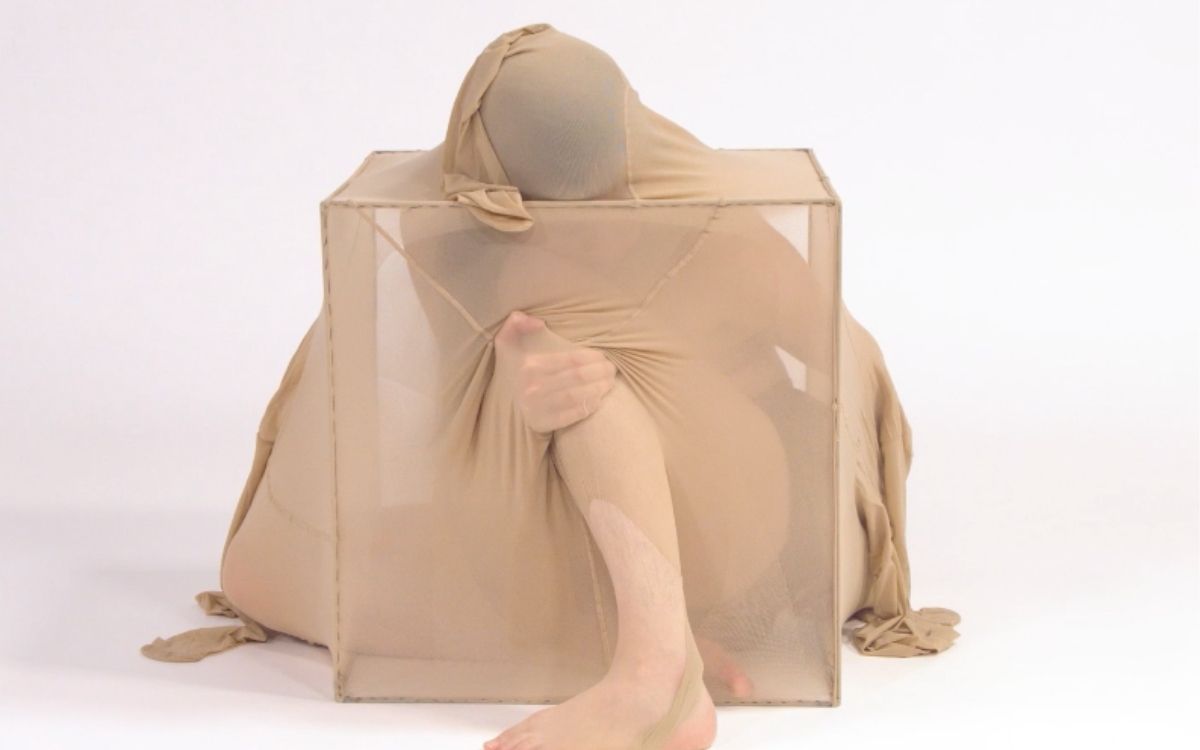
The work of Oriana Catton unfolds at the meeting point of body and metal, where raw physicality, disciplined craft, and lived experience converge. Each piece emerges from an intimate dialogue between structure and softness, resistance and release, instinct and precision. Through performance, sculpture, and wearable forms, a practice takes shape that is both deeply embodied and sharply aware of the social and political forces that define contemporary existence. Trauma, migration, queerness, and the fragility of belonging form the emotional terrain, while slow craft, movement language, and material experimentation provide the tools for navigating it. What results is an artistic vocabulary that embraces tension as a site of knowledge — a space where borders stretch, bodies speak, and new forms of resilience become visible.
How do you reconcile the tension between raw, innate creativity and the discipline required to master your craft?
My primary materials are metal and my own body. Both of these are raw materials; both require strong discipline to master. Fine metalwork notably requires an immense level of concentration and technical mastery, and the movement language I have developed in my performance practice comes from decades of highly intensive dance training. Because my methodology engages with slow craft and experimentation simultaneously, I think it has a way of not only reconciling that psychological tension, but really celebrating it. I find ways to explore the tensions between instinct and control in my process, moving between improvisation and detailed accuracy. Performance lends itself well to experimentation, while my physical making process is often more intentional and carefully planned out. I oscillate between the two, building work this way. I find discipline and restriction quite creatively helpful, and use it to push up against, sink into, or pull out of.
Those tensions found in the materials, shapes, and creative processes are also mirrored in the conceptual contexts of my work: fleshy, evolving body; rigid, metal structure. Queer, mixed, migrant, borderless; square, uniform, constrictive, bordered. I deliberately try to center these dualities—the metal’s resistance or flexibility, the body’s fragility or resilience, each shaping and responding to the other in one holistic, human-object collaboration. Body or bodily objects flattened and forced into unnatural frames; seemingly fixed borders being stretched into new shapes, reclaimed and redefined. That point of tension, bubbling at the margins, is precisely where my art seeks to live.
How do you reignite creativity during those inevitable periods of self-doubt or stagnation?
I turn to other forms of creativity. Often, creating music allows my mind to both wander freely and gather itself in all its scattered parts. I like to write lyrics, reflections, poetry, mess around with weird chord progressions on the piano, and experiment with vocal harmonies. These bits of musical experimentation and writing often have a way of feeding back into my art practice later: either directly as soundscores, or simply as an inspirational springboard, providing a new lens through which to recontextualise my thoughts and research.
As a neurodivergent person who sometimes struggles with debilitating anxiety, there are also times when stagnation (ironically) arises as a result of too much creativity, materialising as creative overwhelm, racing thoughts and decision paralysis. In those situations, when both visual and auditory experimentation seem to only intensify the spiral instead of successfully channeling them into something cathartic and digestible, I turn to actions that help me ground. Dance has long been a big one for me. I come from a classically trained dance background, so I find the structured medium of technique-based classes like ballet or modern/contemporary dance very familiar and grounding. Whilst freeform experimental movement opens the space for creating new things, noticing somatic sensations, or being guided by the subconscious, there is something very centering about following a movement structure that is understood intuitively through muscle memory. It gives me the chance to expel creative and physical energy, as well as make artistic choices with my body whilst pushing it through challenging and specific technical demands, all without triggering mental or emotional overwhelm. Traditional silversmithing and jewellery work is another area I turn to for balance—similarly, the structure and precision that’s needed helps pull me out of my head and into the present. They both give me the mental space to return to my creative practice with stronger clarity and stability.
How does your art engage with or comment on pressing contemporary issues—social, political, or environmental?
My art always emerges from the personal and the political. I draw heavily on my own experiences of trauma, migration, disability, and queer, mixed-race identity—the lived knowledge of being in my body, which is inherently politicised. I use my body or bodily abstractions to talk about marginalisation; defiance against social constructs and systems of inequality; the desire to belong; and existence as resistance, all through a queer-feminist, decolonial lens. I use borders as a visual and conceptual framework against which I position myself.
I’m particularly interested in the concept of wearability as a function of sociological passing and the preservation of self and personal histories. The notion of “fitting in”—culturally, socially—can be metaphorically explored in the way we “fit into” the things we wear. The language of jewellery fascinates me in performance, acting almost as physical frames that the body passes through. I explore this in my work “Stretched,” wherein a handcrafted gold vulva is permanently stretched open and worn over the head, positioning the vaginal orifice as an intimate border crossed by external bodies in sexual pleasure, violence, and birth. In other works, I have engaged with aspects of Hong Kong diasporic identity and political rupture, examining how boundaries are dismissed or violated, queer visibility and belonging, and the subversion of cis-male-dominated power through eroticism.
Can you take us through the evolution of an artwork, from that first spark of inspiration to the finished piece?
I have so many artwork ideas floating around on lists in my phone or in notebooks, some just sparks of potential, others fully formed and waiting for the right time and resources to bring them to life. These ideas usually come from a mix of lived experience and external inspiration: if the idea begins in something personal, I try to anchor it in theory and text; if it's sparked by something I've read or seen, I consider how my own body and experiences can give it emotional resonance.
When I get to working on an artwork, I use an embodied and reflexive process, moving through an iterative cycle of performative play, self-interrogation through writing, and object making. Performative play basically involves researching through the body—experimenting with free movement, or performing tasks I’ve set for myself—as a way to explore new territory and think. For example, I’ll create a task for myself to stand in a corner for a period of time, during which I’m forced to reckon with emotions of boredom, embarrassment, shame, or curiosity, whilst allowing my body to physically explore the space and become intimately acquainted with the walls and floor. I then turn to writing, reflecting on the performance research and recording sensations, thoughts, and observations. I usually do this a few times, allowing the writing to inform the next performative iteration. Object making is where I ground everything in something tangible, often through metalwork or a combination of metal and other materials. Recently I’ve been working materially with nylon stocking fabric and silicone, alongside silver, brass, and bronze.
This cycle repeats, often evolving multiple works at once. Sometimes writing finds its way back into performance through soundscores for performance or film; sometimes performance and object merge together, forming wearable sculptures or installations that act as performance sites. Occasionally, parts will branch off in new directions and become their own finished pieces—a standalone performance, a wall hanging work, or even a piece of jewellery.
How has your artistic style transformed over the years?
When I was younger, my performance work in particular was a lot more hard-hitting and in-your-face, and dealt with traumatic or violent themes from a place of pain, anger, darkness, and intensity. At times, I put myself in situations that were unsafe, almost to provoke the art, to create proof of the misogynistic violence I experienced as a young, queer person in a body socialised as female. My sculptural work, on the contrary, was often playful, abstract, or minimalist, and I didn’t have a clear way of harmonising them into one voice. Doing performance art often requires putting yourself in quite susceptible positions, and I’ve learned to do so in a way that protects my safety and health, whilst still communicating the issues that feel potent to me. I think my current work delves into a lot of the same themes of trauma and the effects of marginalisation that I previously explored, but has developed into a softer, gentler, and more abstracted representation—one that balances my own vulnerability with a greater sense of agency and empowerment. There is a quiet stillness to my practice now, which conveys the discomfort and intimacy of being on display to an audience, without giving that audience power over my exposed state. I feel 100% in control of myself, my body, my work. I definitely believe there is power in softness, and I really try to channel that sensitively.
Did that transition happen naturally with time, or are there specific influences or moments that marked a turning point in your approach to performance?
I actually spent some years away from doing performance art or movement of any kind; during that time I focused on metal and jewellery work. Performance had become a little bit self-destructive for me, and I was reeling from a lot of toxicity from the dance world, as well as chronic pain in my body that I needed to come to terms with and accept. I think giving myself some space and time away from it proved very constructive and healing in the long run; it has allowed me to return to the medium with greater care and a better sense of self.
The energy spent honing my silversmithing skills also played a significant role in transforming my art today. The techniques used in small-scale metalwork need precision and a calm approach—if you’re not calm, you’ll quickly find that things won’t work, something won’t solder, you’ll get increasingly frustrated and, before you know it, you’ve accidentally melted the whole thing. It’s awfully finicky. But this creates a structured working process that has refined and distilled my practice, even within my choreographic language. I am very careful and meticulous when making things with my hands, which helps to balance and ground the emotional intensity of my performative expressions.
In an increasingly globalised world, how can artists preserve authenticity and cultural integrity in their work?
Ultimately, by knowing themselves, and saying what they feel the need to say through their work. I feel like the focus on representation of underrepresented artists has been, somewhat narrowly, pushed towards culturally-specific experiences of struggle or triumph, rather than the need for underrepresented identities to be seen in their wholeness, with experiences and emotions that are also universal. Whilst the former is certainly urgent and important, providing platforms only to minority artists who make work specifically about cultural identity—in the pursuit of some ideal truth or authenticity—is ultimately restrictive and reduces them solely to their “otherness”. There needs to be space for marginalised voices to make work about simple joy, beauty, or the banality of daily commutes and meal deal sandwiches, just as keenly as we need those who discuss heavier socio-political topics of displacement, state violence, genocide and resistance. To make something modern is not to disown tradition; rather, tradition, generational history, and cultural knowledges innately live within the body, so to live in a body in the modern world is to be authentic. So long as the artist is coming from a place of knowing oneself and creating what matters to them, the work is inherently honest. On the other hand, I fear that forcing a narrative of integrity in the name of cultural preservation can easily lead to work that is merely performative or, worse, that neatly satiates the colonial gaze.
How do you envision the evolution of your work in the coming years?
I feel passionately about the direction my practice is moving in right now—an amalgamation of performance, installation, wearable object, and sculpture—and I see it growing along that trajectory. I’m intrigued about delving deeper into photography and video as mediums to stage performative work. I’ve made a few video pieces in the past couple of years, but I do wonder if that’s an area I could push further. I think I’ll always prefer performing live, because it has this irreplaceable intimacy and relational urgency that I find very uniquely affecting. That being said, I’d like to learn more techniques in video editing, as it opens the door to layering and distortion that aren’t physically possible with the live body. A good proportion of my work touches on themes of bodily autonomy and agency, so I’m also interested in playing with the camera lens as a mechanism to control, direct, or shift the outsider’s gaze and consumption of my body. I also envision creating more wall-based pieces—not so much as painting, but more like textural, visual moments that come together to integrate the body with the room it occupies, while setting both stage and tone for live performance.
Site-specific performance and installation is another area I see my work evolving in. I did a performance in September titled “Memory Palace Halls,” and it’s an ongoing work where the same site-specific choreography is staged within new site-specific contexts. The performance traces domestic paths, shapes, or gestures, such as hallways and spaces around furniture, mentally mapping the topography of the home though the body as a means of archiving memory. It originated in 2020 in my then-apartment in Hong Kong, and has since been transposed to an outdoor sports ground, the digital space of animation (in collaboration with my friend and visual designer Yichan Wang), and most recently, an apartment show in London. Each site displaces the way the movement sits in space, at times converging and at other times at odds. I’m curious about where the next iteration of this piece will unfold, and I can definitely see myself engaging in future site-responsive projects exploring how the body remembers, stores, and transfers spatial memory.
Across performance, metalwork, and site-responsive installations, Oriana Catton builds a practice grounded in vulnerability, clarity, and a strong sense of agency. The work leans into contradiction — bodily and structural, intimate and confrontational, personal and political — while refusing to collapse complexity into a single narrative. In each process and piece, there is a quiet assertion that softness can be powerful, that discipline can coexist with improvisation, and that the body carries histories no archive can contain. Moving forward, the practice continues to open new pathways in movement, material language, and spatial memory, inviting audiences into spaces where tension is not something to resolve but something to understand. Through this ongoing evolution, new possibilities for connection, visibility, and self-defined expression take root, shaping a body of work that stands firmly at the edges — where transformation begins.