
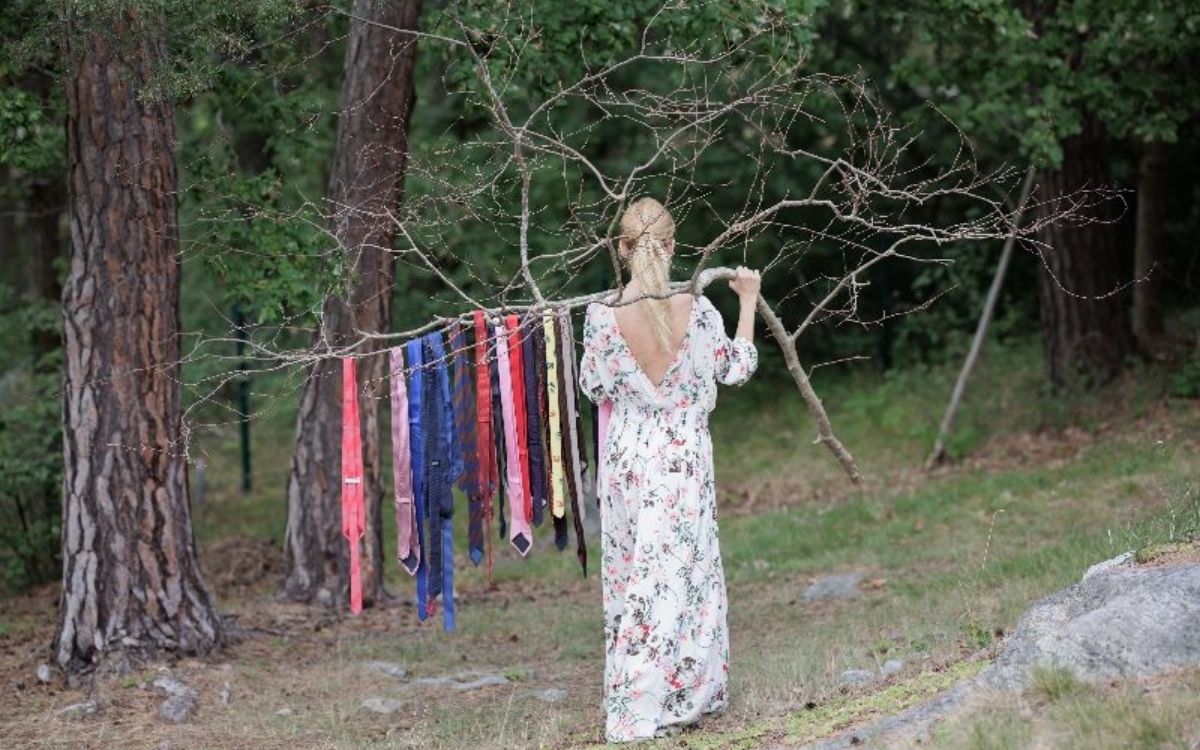
Ludmila Christeseva transforms loss into connection and memory into art. Rooted in the traditions of Belarus and shaped by life in exile, the practice weaves together threads of belonging, care, and resistance. Every gesture—whether weaving with refugees, folding neckties into roses, or baking from inherited recipes—becomes an act of remembrance and renewal. Through collective creation, art becomes not an object but an experience: a shared ritual of healing that bridges cultures and restores human closeness in times of fracture.
Today, when about 123.2 million people around the world have been forcibly displaced - people who, like me, were uprooted by dictatorship, war, persecution, or fear - I often think about what it means to belong. One in every sixty-seven people on Earth now lives in exile, far from home. I am one of them. And through my art, I remember. I found myself in feminist Sweden, carrying with me the cultural heritage of a Belarusian woman raised with a dowry and taught by my mother how to cook, sew, and care for others. These traditions, once considered domestic, have become the foundation of my artistic language. They shape my research on femininity across cultures and generations, where crafts become a form of resistance, remembrance, and renewal.
In 2022, when the war in Ukraine began, my daughters asked me, “What is our future if our father is Russian and our stepmother is Ukrainian?” At that moment, I realized my purpose to give them a sense of safety and belonging. I stopped painting and began learning weaving from Ukrainian refugees who had arrived in Sweden. I transformed my studio, Artten, into a refuge for displaced mothers and children. Through weaving, sewing, and crafting together, I discovered that pain, loss, and trauma have no cultural borders. Over time, our shared sorrow and resilience took form as Roses of Ties. Today, Roses of Ties have become a symbol of connection, remembrance, and hope - an artwork to wear close to the heart, a small gesture of holding on for all of us, from different cultures, who are still longing for home.
Yes, I am thinking about this now. Through art, I have planted many seeds, and today I watch how people weave nets and fold ties - continuing my way of creating patterns that reach toward a brighter future. Art has led me on unexpected paths. In 2023, I received the Impact of the Year Award from IHM Business School, which included a scholarship for a Business degree. I am completing the program now, and I find myself looking toward a more conventional career path - one where I can redirect my creativity toward socially impactful market strategies, bridging art, empathy, and communication. The creative leap never truly ends - it simply takes new forms.
All of my projects create spaces for dialogue on displacement, war, and ecological awareness. Whether weaving with Ukrainian refugee women, folding neckties into roses, or baking apple pies from rescued Swedish apples using recipes from Belarusian political prisoners - and serving them at human rights conferences - each act transforms everyday gestures into rituals of reconciliation and care. Through these participatory practices, I explore how art can restore trust, rebuild belonging, and reimagine solidarity in a fractured world. The process itself - collective, tactile, and intimate - becomes a form of social healing. In my work, creativity is not decoration but an act of repair: stitching together people, memories, and places that conflict has torn apart.
I believe the most meaningful role of an artist today is to bring people together - to provide materials for weaving, folding, and creating collectively. Art is no longer a solitary pursuit; it has become a shared heartbeat. In a world that needs healing more than perfection, there is no room for the lone painter or isolated sculptor. Together is the future.
Love is the core of my work, expressed today through the Roses of Ties project. I let people wear my art close to the heart, carrying love with them every day. The project blooms in countless colors and forms, each one a testament to unending beauty. Yet at its heart lies the original idea: collecting ties from men in war and men we have lost. On the back side of the project, there is absence - an empty place at the table. And in that silence, I sometimes feel powerless, as if no beauty can fill the void. It asks us quietly yet urgently: how many flowers do we need? How many children grow up without fathers today?
The impact of my work cannot be measured by one metric alone. It is reflected in both the personal and collective experiences it creates. For example, the documentary Weaving: Stockholm Through the Eyes of Ukrainian Refugees, directed by Taiwan-born, NYC-based filmmaker Hsuan Yu Pan, follows a series of weaving and performance events we presented during the war years. It captures the intimate, personal meaning of weaving for participants who have faced loss and displacement. At the same time, projects like Gul & Blå: Hela Sverige flätar demonstrate a broad social impact: more than 8,000 people participated, and the project’s significance was documented in a master’s dissertation at Uppsala University. These examples show that impact is both felt personally and recognized collectively, through participation, reflection, and scholarly acknowledgment.
I have often reflected on how the Covid pandemic and the Russo-Ukrainian war unexpectedly changed people’s lives - just as they changed mine as an artist. These events reshaped daily existence, bringing turbulence, loss, and an urgent need for connection. For me, they could not help but reshape my art. I stopped painting alone and turned toward collective art production, creating spaces where people could share, heal, and support each other through life’s crises. In these moments, we reach out and hold hands, metaphorically, through collective weaving and Roses of Ties, bridging distance, grief, and uncertainty with care and creativity.
One of the most emotionally significant pieces I’ve worked on is the animated documentary My Apple Tree Behind Bars, illustrated by Belarusian artist Liliya Busarava. The animation powerfully expresses the experiences of Belarusians living in exile and draws attention to the injustices of the Lukashenko regime. Through this work, we aim to support political prisoners, amplify silenced voices, and foster solidarity, turning personal stories into a call for awareness, rights, and freedom.
Growth comes from listening, observing, and responding to the world, allowing my practice to evolve without losing its core voice. I follow life’s currents, letting my art go where it is needed most. In a world fractured by war and conflict, my work becomes a vessel for connection, healing, and bearing witness - an attempt to turn turbulence into shared resilience.
Ludmila Christeseva continues to build spaces where art and humanity meet—spaces defined by tenderness, strength, and solidarity. Each project grows from the conviction that creativity can repair what conflict divides, offering beauty as a quiet form of resilience. The work stands as a living archive of belonging, proof that even in displacement, roots can be rewoven, and hope can take shape through the hands that create together.