
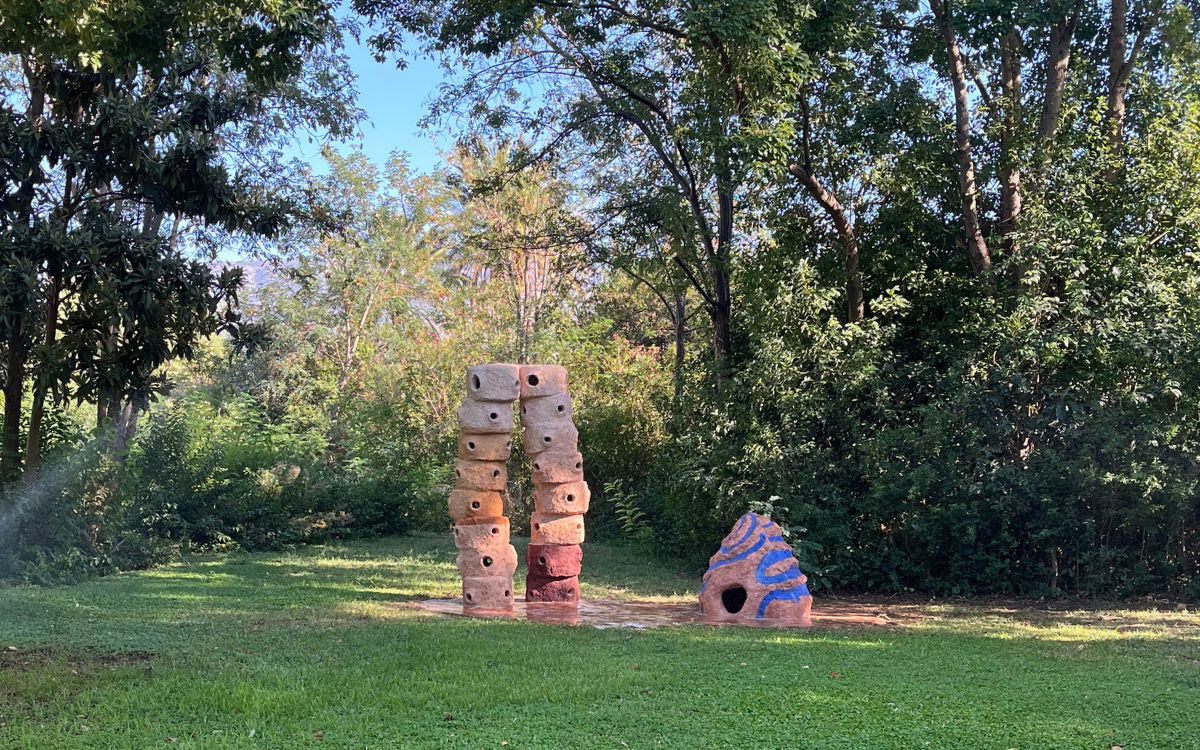
It was an evening after our office day at Artit when we walked through central Athens toward the Athens Concert Hall. We were looking specifically for the garden—that's where Jenny Marketou's invitation had directed us a few days earlier. After just a few steps from the main entrance, there it was: Folly for Songs for Funk Kinships standing in a beautiful, sunny corner, its earthy forms catching the late light.
Our first reaction was pure curiosity. Is this a nest? A sculpture? Both? The biomorphic structures—one dome and two elaborate totems—seemed to grow from the garden itself, their latticed chambers and openings suggesting shelter, threshold, invitation.
An Artist Who Builds for Others
Jenny welcomed us with warmth and immediately began unfolding the conceptual and material world behind this eco-restorative sculpture. Commissioned by annex M under the direction of Anna Kafetsi and curated by Panos Giannikopoulos for the Athens Concert Hall garden, the work extends from September 2025 through May 2026—deliberately spanning seasons to allow the piece to transform with weather, vegetation, and the species it's designed to host.
What struck us immediately was the materials themselves. Built entirely from colorful soils, adobe bricks, cob, lime, and sand, the folly doesn't just sit in the garden—it becomes part of it. The striking blue derived from loulaki, a natural pigment, creates moments of intense colour that both contrast with and emerge from the earthen palette. Jenny explained how these natural materials will eventually return to the earth without environmental harm, sometimes even enriching the local ecosystem. After years of working with polluting materials, she's committed to this slower, geological cycle of creation and dissolution.
Making the Unmakeable
The complexity of realising this vision became clear as Jenny described the construction process. She could only find one collective in Greece familiar with these traditional building techniques and natural materials: COB, a social cooperative from Larissa specialising in natural building and bioclimatic design. This detail reveals something crucial about the work—it required not just artistic vision but the recovery of nearly-lost knowledge systems, the kind of embodied expertise that exists outside institutional art production.
The chambers and lattices aren't aesthetic choices—they're deliberately designed to host birds, insects, turtles, cats, and other organisms living in the urban garden. Every opening, every curve serves a purpose beyond the visual, creating microclimates and shelter spaces that acknowledge different species' needs and behaviours.
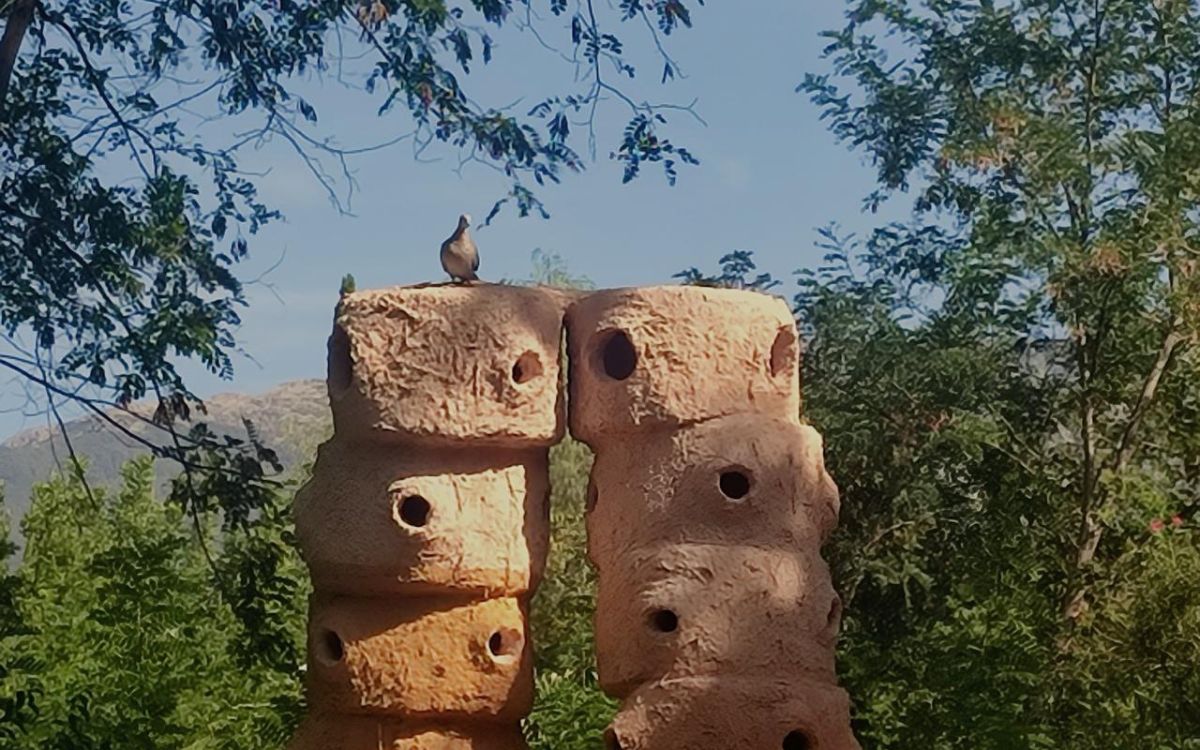
Photo Credits: Jenny Marketou
Kinship Beyond the Human
Jenny's practice draws on philosopher Donna Haraway's thinking about multispecies entanglement, Finnish architect Juhani Pallasmaa's research on animal architecture, and direct observation of biogenic structures like bird nests and termite mounds. But this isn't academic theorizing translated into art form—it's something more radical.
As Jenny writes about her approach, "I am less concerned with aesthetics or utility than with creating the conditions for life to unfold." This shifts the entire premise of what sculpture can be. The artist's role becomes one of creating frameworks for observation, staging encounters between species, making space for agencies beyond her control.
The work acknowledges that its ultimate form will be determined by the natural ecosystem—by which birds choose to nest there, how plants grow around it, and how weather shapes its surfaces. Jenny isn't creating a finished object but initiating a process of ecological becoming.
From New York to Athens: A Practice of Care
Born in Athens and based between New York City and Athens, Jenny's interdisciplinary practice spans public art, sculpture, video, and installation. Her work has been presented at Documenta 14, Manifesta, the Biennial of São Paulo, and major institutions worldwide. But increasingly, her focus has shifted toward collaboration with non-human agents—oysters, corals, turtles, mussels, birds, plants, soils, clay.
Recent projects like Wet Gatherings and Futuring Waters bring together artists, scientists, and communities around aquatic ecosystems and practices of care. Her book Futuring Waters: A Manifesto for the Rights of Water (2023) extends this thinking into urgent questions about how we might reimagine our relationships with natural systems.
Folly for Songs for Funk Kinships continues this trajectory but grounds it literally in earth, in the specific ecology of an urban Athenian garden. It's simultaneously local—built with Greek materials by a Greek collective for Athens species—and part of a global conversation about interspecies kinship and ecological repair.
What Encounters Mean Here
Standing in the garden as evening light shifted across the folly's surfaces, we understood something about why this work matters now. It doesn't ask us to contemplate nature from a distance or feel guilty about environmental crisis. Instead, it creates actual conditions for multispecies cohabitation in an urban context.
The work is patient. It will be there through winter rains and spring growth, slowly weathering, gradually hosting more life. Success isn't measured in gallery visits or critical reception but in whether birds nest, whether the materials enrich the soil as they erode, whether the garden's ecology shifts in response.
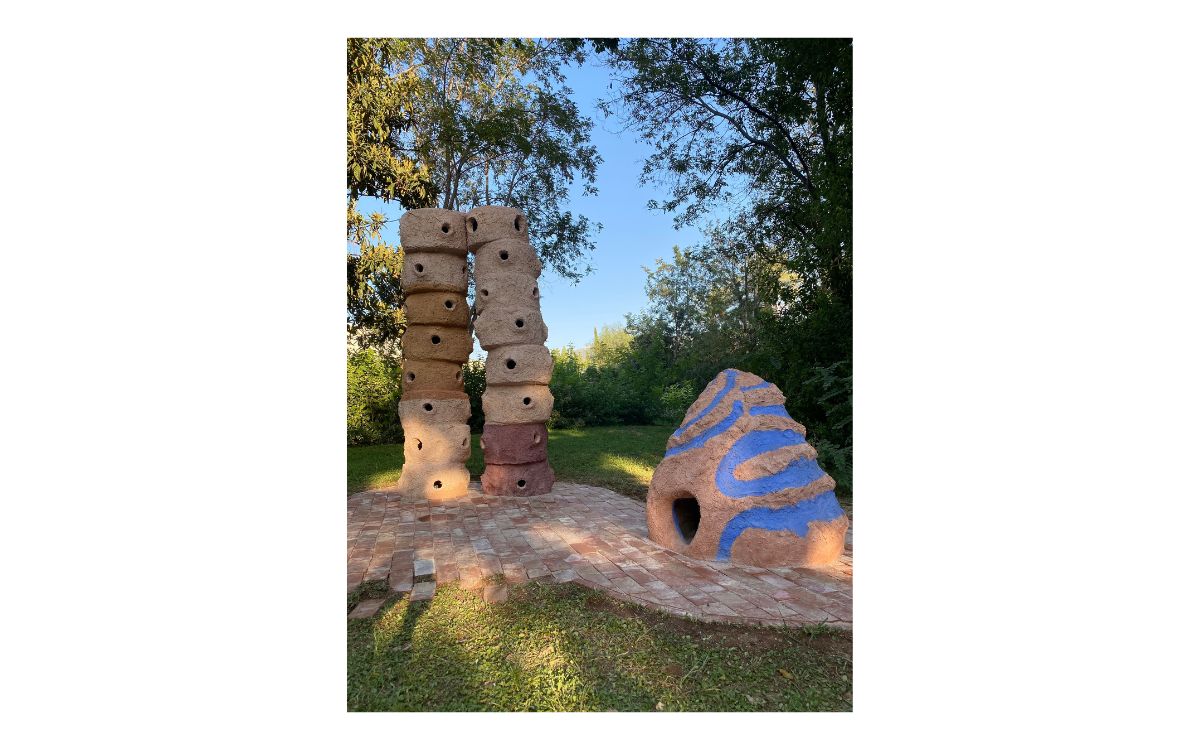
Photo Credits: Jenny Marketou
This encounter reminded us that contemporary art can operate on timescales beyond exhibition cycles, can prioritise non-human flourishing, and can use materials that heal rather than extract. Jenny's eco-restorative sculpture offers a model for what art might become when it stops trying to represent the world and instead works to repair it.
Visit
Folly for Songs for Funk Kinships remains open to the public daily from 10 am to 9 pm through May 2026 in the garden of the Athens Concert Hall. The work includes a public program featuring sound work by Esther Lemi, poetry by Marios Chatziprokopiou, workshops, and discussions.
We recommend visiting at different times, in different weather, across seasons. This isn't a work that reveals itself in a single encounter—it asks for the kind of sustained attention it offers to the species it shelters.
Encounters is Artit's series examining art that creates conditions for meaningful dialogue—between people, ideas, and in this case, between species.