
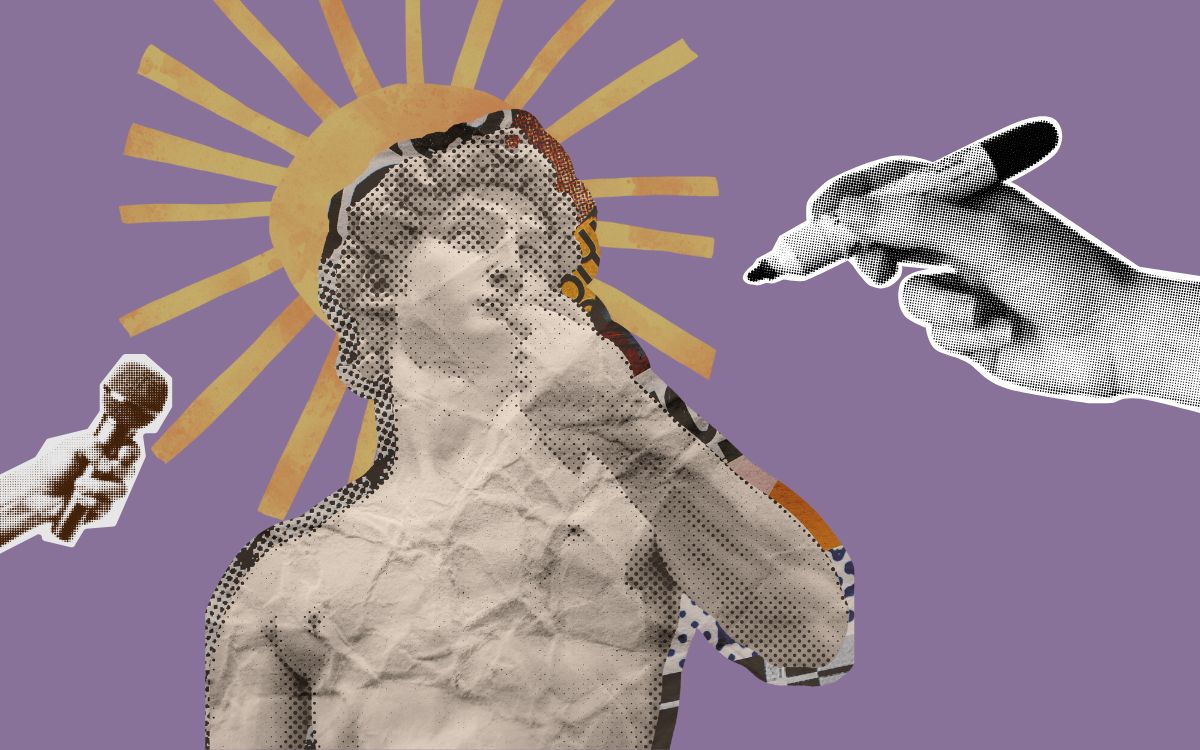
What happens when a teenager stops reciting a constitutional article and starts painting what it feels like to lose it?
Picture this: Sixteen-year-old Elena from a rough neighborhood in Athens holds up a canvas that looks like it's bleeding. Bold strokes of red crash into jagged blacks. The room falls silent; educators, local officials, other teenagers all lean forward. "This is Article 21," she says, her voice steady. "Freedom of expression. But see how the red bleeds into the black? That's what happens when your voice gets silenced before you even know you have one."
Six months ago, Elena couldn't tell you the difference between a constitutional right and a grocery list. Today, she's debating fundamental freedoms with passion. This transformation didn't happen in a dusty classroom with a legal textbook. It happened because we figured out something that's been staring educators in the face for decades: when young people create art about constitutional law, magic happens.
The Brutal Truth About Civic Education
Let's cut through the educational jargon for a moment. Constitutional education in Europe is failing spectacularly. Hand any teenager a copy of their country's constitution and watch their eyes glaze over faster than you can say "fundamental rights." Ask them to explain what democracy means to their daily life, and you'll get responses that sound like they were copied from Wikipedia, if you're lucky.
Here's what nobody wants to admit: young people aren't apathetic about justice, equality, or freedom. They care deeply. What they reject is being lectured about abstract legal principles that feel completely disconnected from their lived reality. Traditional civic education treats constitutional rights like museum pieces, important, historical, and untouchable.
We watched this pattern play out across three countries. Teenagers in disadvantaged communities especially felt like constitutional rights were promises made to other people. "Freedom of expression? Sure," one 17-year-old in Umbria told us during our research. "But try expressing yourself when you're from my neighborhood. See how far that gets you."
The breakthrough happened when we stopped trying to teach them about rights and started letting them explore what those rights actually mean through art.
What We Discovered Changes Everything
Here's what we learned after working with young people across Greece, Italy, Portugal and beyond: when teenagers paint their understanding of constitutional principles, when they write songs about democratic participation, when they create theater about fundamental freedoms something extraordinary happens. They don't just memorize rights. They claim them.
Maria, a quiet 15-year-old from a working-class family in Athens, created a sculpture about the right to education using broken pencils and torn textbooks. As she explained her piece to other students, her voice grew stronger. "Education isn't just about sitting in classrooms," she said. "It's about having the tools to build the life you want. But what happens when those tools are broken before you even get them?"
That's constitutional education working. Not because she memorized Article 16 of the Greek Constitution, but because she internalized what educational rights mean when they're not equally accessible to everyone.
This pattern showed up everywhere. Each time, the same transformation: from passive recipients of civic information to active interpreters of constitutional meaning.
Grounded in an Old Idea, Applied to a New Problem
None of this was improvised. The structure draws on Ana Mae Barbosa's Triangular Approach, a pedagogy built on the idea that making art, understanding where it comes from, and critically reading what a work says are three inseparable parts of learning, not three separate lessons.
Applied to constitutional rights, that meant a young person didn't just paint a right; they first had to find out what it actually meant in their own community, make something in response, and then stand in front of peers and defend the choices behind it. Each group moved through six phases this way, from first naming a constitutional concept to producing a finished, original piece of work, with the framework below running through the middle of that process.
The Framework That Works
Our research revealed that effective constitutional education requires four essential elements, which we call in ARTIT the VOICe framework:
Visceral Connection:
Constitutional rights must be connected to young people's lived experiences, not presented as abstract legal concepts.
Ownership Through Creation:
When young people create art about rights, they develop personal relationships with constitutional principles.
Intercultural Dialogue:
European constitutional consciousness emerges through collaborative exploration across cultural contexts.
Civic Agency:
The goal isn't just understanding rights, but developing confidence to use constitutional frameworks for social change.
The Implementation Reality Nobody Talks About
Let's be honest about the challenges. This approach requires educators who are comfortable with ambiguity, school systems that can handle noise and creativity, and institutional support for non-traditional learning methods. Not every educational environment can accommodate teenagers painting their interpretations of fundamental rights or writing protest songs about democratic participation.
We encountered resistance from educators who worried that artistic interpretation would lead to constitutional misunderstanding. "What if they get the law wrong?" one teacher asked. Our response: "What if they understand the law's human impact correctly?" The programs that work best have three characteristics: educators who view themselves as facilitators rather than lecturers, institutional support for experimental learning methods, and recognition that constitutional literacy isn't just about legal accuracy, it's about democratic engagement.
Starting small works. One art project exploring a single constitutional right. One collaborative workshop between classrooms in different countries. One creative presentation that lets young people explain constitutional concepts to their peers. These modest beginnings consistently grow into more comprehensive approaches.
That's urgent work. That's necessary work. And increasingly, that's work that's actually happening.
This research was developed through the Using Art to Do my Part (SmArt) Project, funded by the Erasmus+ programme, which represents collaborative innovation in constitutional education across southern Europe, developed to address shared challenges in civic engagement through artistic methodologies that work across different educational contexts and democratic traditions.