

What does it actually look like when a young person with a disability is handed a paintbrush, a script, or a microphone, and trusted to run with it?
Not a policy line or a funding category. An actual room, an actual rehearsal, an actual Tuesday afternoon.
That question sent a recent piece of cross-national research looking for what's already happening on the ground, rather than what's written down as intention. Researchers went through theatres, classrooms, festivals and digital studios across six countries, cataloguing real practices rather than policy promises, and the pattern that came back says a lot about where energy in this field actually goes.
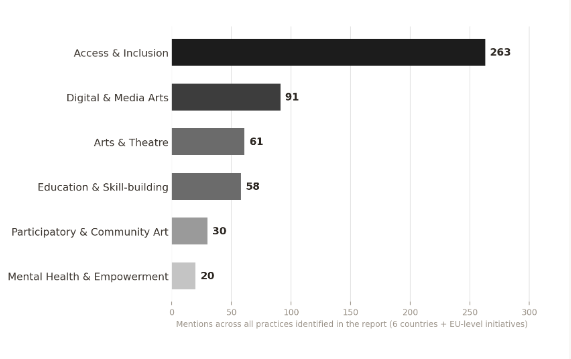
Access and inclusion dominate everything else combined. Mental health barely registers. Worth going through each one on its own terms.
Access & Inclusion
This is where the bulk of the work sits, and it shows up as unglamorous, structural stuff more than grand gestures: accessibility models built for whole networks of public institutions, staff trained to actually welcome a wider range of visitors, guides rewritten in plainer language. One regional programme retrained staff and rewrote accessibility guidelines across more than twenty cultural institutions in a single push.
None of it reads as dramatic on paper. That's rather the point: accessibility mostly wins through repetition, not spectacle.
Arts & Theatre
Live performance keeps turning up as one of the most effective ways to build confidence and start conversations that wouldn't otherwise happen. Some of the strongest examples are companies made up largely of disabled performers, producing their own original work rather than simply appearing in someone else's. One European collaboration brought together more than a hundred artists from thirteen countries for a single shared programme of dance, theatre, music and poetry, disabled and non-disabled performers sharing one stage instead of two separate ones.
The throughline is the same each time: stop treating disabled artists as the subject of the work and start treating them as the ones making it.
Digital & Media Arts
Some countries lean on this hard, building tools like 3D printing, assistive apps and adaptive platforms directly into how programmes are designed, not bolted on afterward. One striking example is a streaming platform that makes over a hundred films accessible through sign language, subtitles and audio description, aimed at deaf, blind and low-vision audiences alike. Elsewhere, despite strong practice almost everywhere else, digital accessibility barely gets touched at all, a gap the report calls out directly.
A film platform sounds like a small thing until you notice how many of the strongest projects in this research are built around exactly that kind of specific, unglamorous fix.
Participatory & Community Art
A handful of projects treat participation itself as the goal, using art and culture specifically to prevent social isolation and loneliness rather than simply to entertain. Others bring transnational street art and digital tools together to build social cohesion across communities that wouldn't otherwise cross paths. What these share is a habit of pulling the audience into the process rather than seating them in front of it.
Education & Skill-building
The strongest examples here look past the workshop and toward an actual career: occupational training and professional platforms aimed at getting disabled artists into paid cultural work, not just onto a stage for one night. Others focus on residencies and high-profile showcases built to raise visibility over the long term, or on non-formal education that builds inclusive learning structures into the arts from the ground up.
Mental Health & Empowerment
This is the shortest bar on the chart, and by some distance. One country's research turned up exactly one initiative built around it. A couple of places do noticeably better, including a festival built entirely around exhibitions, workshops and performances that challenge the stigma around mental health, and a cross-border initiative working specifically to improve mental health care in the wake of the pandemic by sharing practice between countries.
Outside those examples, mental health mostly shows up as a side effect of other work rather than something anyone set out to design for.
None of this is a finished picture, and it isn't meant to be one. What it adds up to is a working map: where genuinely strong practice already exists, and where the room to build something new is still wide open, particularly in the two shortest bars on that chart. Access has become second nature. Mental health, mostly, hasn't yet.
Art doesn't fix a broken system on its own. But a theatre company run by its own disabled performers, or a festival built to talk about stigma out loud, does something a policy document can't: it shows what's already possible, right now, without waiting for permission.
This research happened under the Artistic Minds project, a European initiative working across Belgium, Cyprus, Greece, Italy, Poland, Spain and beyond, co-funded by the European Union under the Creative Europe programme, to build a more accessible and equitable cultural sector for young people with intellectual disabilities.
If you're running something similar in your own community, get in touch; the best practices tend to spread by word of mouth long before they make it into a report.