
What happens when a teenager with an intellectual disability wants to join the school theatre club, and the building has no ramp, the workshop isn't explained in plain language, and nobody thought to ask what they'd actually need?
Multiply that scene across six countries and you start to see the shape of the problem this piece is about.
Culture gets talked about as something that belongs to everyone. In practice, whether that's true still depends heavily on where someone lives, what their mind or body needs, and whether any policy ever bothered to ask them what would help.
That gap is what a recent cross-national research effort set out to map: seven policy landscapes in total, the EU level plus six countries, checked against five areas that keep coming up wherever this conversation happens. Laid out side by side, the pattern is hard to miss.
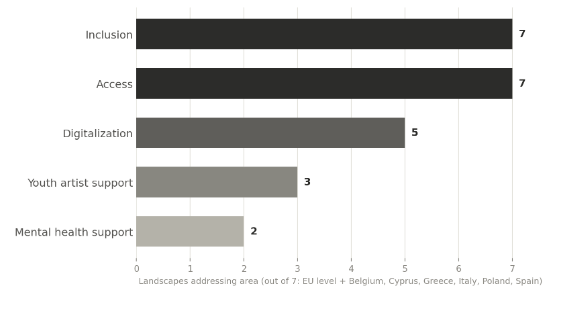
Two areas are covered almost everywhere. One is covered by barely a handful. That gap between the tall bars and the short ones is really the whole story, and it's worth sitting with each one to see why.
Whose Culture Counts
Inclusion is the one area every single landscape addresses, EU level included. Look closer, though, and "addressing" it means very different things from one country to the next. Belgium ties public funding for cultural programmes to inclusion standards, so a youth arts centre in Brussels that wants government money has to prove it's actually reaching people, not just claiming to. Spain reserves education places and offers tax measures that make it easier for organisations to hire and support disabled artists. Greece leans on storytelling projects and small creative hubs that pair artists with mentors and give their work somewhere to be seen.
Seven out of seven sounds like consensus. It's closer to seven different definitions of the same word.
Getting Through the Door
Access ties with inclusion at the top of the chart, and for good reason; it's the easiest priority for a policy to state and the hardest one to actually deliver. Ramps, sensory-friendly hours, information in plain language, formats that don't assume everyone reads the same way. Every landscape in the review claims it.
A building can be legally accessible and still feel like it wasn't built with a particular visitor in mind. That's less a data point than a pattern the researchers kept running into, across almost every country they looked at, which is presumably why the claim is universal and the lived experience often isn't.
Barriers Behind Screens
Digitalization drops to five out of seven. The EU-level framework itself is one of the two gaps, alongside Cyprus; everyone else, Belgium, Greece, Italy, Poland and Spain, has built some form of digital strategy into their cultural policy, from training programmes to virtual access platforms aimed at people who can't easily reach a museum or workshop in person.
The catch is that a website passing an accessibility checklist and a website actually being usable by someone with an intellectual disability are two different standards, and few of the policies reviewed treat them as such. A page can tick every box and still be too dense, too fast, or too confusing for the person it was supposedly built for.
Making Room, Not Waiting
Support for young disadvantaged artists falls to three out of seven, and it shows in how the idea gets framed. It's no longer just about offering a seat at the table. Belgium, Greece and Spain go further, funding young disadvantaged artists to build their own platforms and shape decisions, rather than simply attend meetings about them.
A small grant that lets a nineteen-year-old stage their first exhibition does more than pay for the show. It tells them their work belongs in the room before anyone else gets around to confirming it. The other four landscapes in the review, though, still treat this as an afterthought rather than a target.
Culture as Care
Mental health support is the shortest bar on the chart by a wide margin, addressed directly in only two of the seven landscapes reviewed: the EU-level framework and Greece. Everywhere else it's folded into general youth welfare language rather than named as its own priority.
Picture a young person who has spent years being talked about in clinical terms, finally handed a script or a paintbrush and asked what they think instead of how they feel. That's not therapy in the formal sense, but the research suggests it does something therapy alone often can't: it hands back a bit of authorship over their own story.
Inclusion, in the end, isn't one reform or a box to tick. It's closer to a habit, something a system either keeps practising or quietly lets slip.
This policy mapping happened under the Artistic Minds project, a European initiative working across Belgium, Cyprus, Greece, Italy, Poland, Spain and beyond, co-funded by the European Union under the Creative Europe programme, to build a more accessible and equitable cultural sector for young people with intellectual disabilities.
If you're doing similar mapping in your own country, get in touch; comparing notes usually beats starting from scratch.