
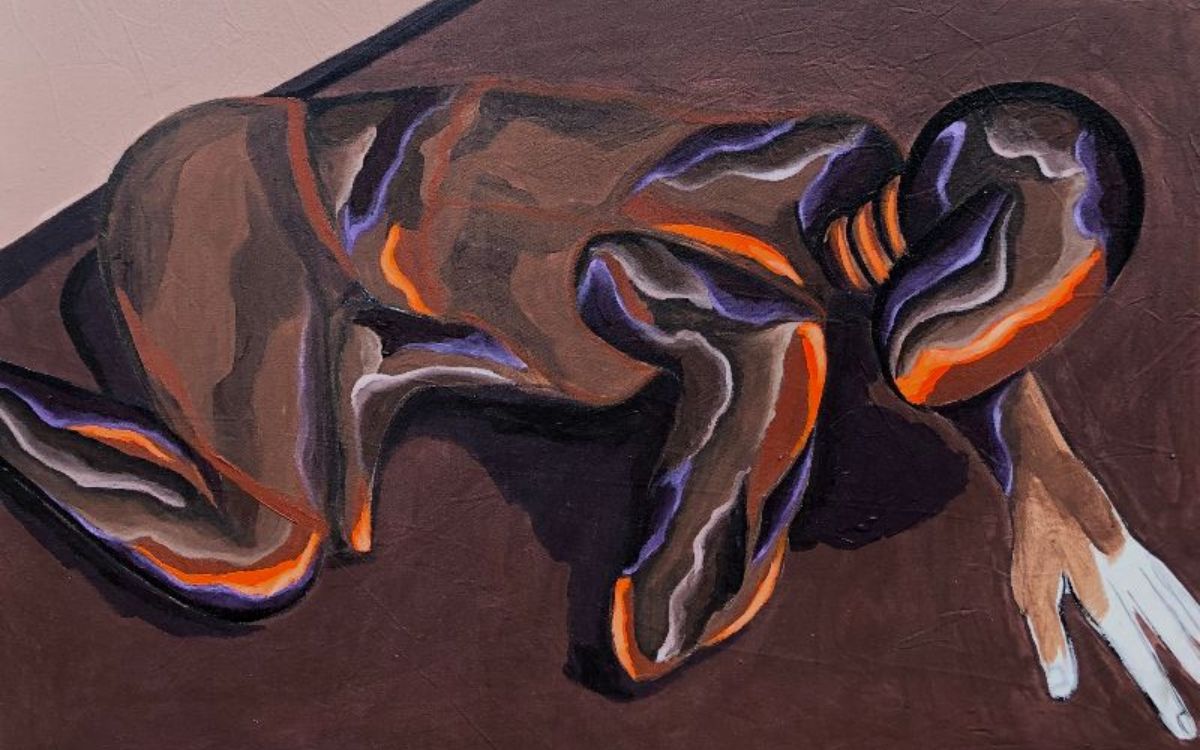
Janet Adenike Adebayo’s practice unfolds at the intersection of ritual, memory, and emotional depth. Drawing from confessional modes and cultural inquiry, the work resists easy categorisation, leaning into tension, ambiguity, and layered symbolism. Through painting, storytelling, and conceptual exploration, the practice engages with discomfort as a generative space — one that invites viewers to reconsider clarity, perception, and presence.
In a world flooded with imagery, what responsibility do artists have to stand out and say something authentic?
The art is not in the image, it’s in my temperament. It lives in the decisions I make. Each piece I create is a burial ceremony of information. It is both a closing and an unlocking of knowledge, memory, and sometimes a new version of self. We are surrounded by images that seek attention but say nothing and one of my pieces, titled “Alot not enough”, perfectly addresses this. I think the responsibility of an artist is not just to stand out visually, but to stand inwardly. To return to what is felt, what is uncomfortable, what is true. That’s the difference between content and art: content is fast, reactive, impulsive, easily consumed; art is slow, layered, and rooted in intent. So, for me, it’s not about standing out, it’s about standing in. Being inwardly aligned, to be honest in my process, and open to transformation. If the work feels real, it will eventually find its place, no matter how crowded the room is.
How important is it for viewers to understand the intended message of your work? Does ambiguity add value, or do you seek clarity in your expression?
For me, as a confessional artist, ambiguity is the ideology. I work in a way that intentionally leaves room for tension, controversy, contradiction, and discomfort. I’m not interested in making work that tells people what to think. I want to invite people into the unfamiliar, into unfamiliar stories, styles, textures, and rituals. Because most of the systems we live in teach us to think in absolute or binaries, to crave clarity, forced into a belief system and to fear difference. But the world is not binary. We live in times that demand clarity, but art, real art, should leave enough space for people to bring their own histories, and hopefully, leave them changed.
If you could become one of your creations for a day, which would it be and why?
It would be one from a series I created, a piece titled "More Than Enough." In it, I painted myself raising a peacock above my shoulder. That image has stayed with me like a mirror. At the time, I was battling deep insecurity and self-doubt. I had forgotten how strong I was (some would call me a tigress, a horse and 10-in-one), I had forgotten how much I had already survived, how many rooms I had entered even while shaking. That piece reminds me of my strength, of the softness and sternness I’m allowed to reclaim without apology. The peacock is a presence, it doesn’t apologize for its colors or space. In that work, I wasn’t just lifting it; I was lifting a new version of myself. One that doesn’t flinch at her power, damn I’ve got thick skin! If I could become any of my creations, I’d become that one indeed. Not because it’s perfect, but because it holds a version of me that had to fight her way back into light. That version is no longer scared. That version is the best of me.
Do you think the boundaries of what can be called "art" are being stretched too far, or is this evolution necessary?
It’s not too far. It’s necessary. If I had been born in an era where natural plant pigments were the only way to paint, I would have adapted. But we live in a time where color is mass-produced, more durable, and easier to access. That’s evolution, and I’m indeed grateful. Why are we afraid of growth? Why do we resist change, especially in art? Is it fear that we’ll be forgotten? That we’ll lose relevance? I think that fear is rooted in ego, not integrity. Every generation inherits tools and leaves new ones behind. That’s how art breathes. That’s how culture survives. If the boundaries weren’t stretching, we’d still be locked in one definition, one style, one medium. I say let it stretch, let it scare us and let it surprise us.
If you were appointed as President for a day, what initiative would you launch to support arts and culture?
If I were President for a day, I would launch a national campaign to shift the sentiment around Artificial Intelligence and its relationship to creativity. Oftentimes, I see artists panicking as if AI will replace us. But we weren’t creating in the first place to stop innovation. That mindset is rooted in fear and gatekeeping. AI is not a threat, it’s a challenge. And challenges keep the mind alive. It compels us to refine our voice, deepen our originality, and most importantly, defend our humanity. Look, right now, I’m answering this interview as a person with pain, context, contradiction, and memory. AI doesn’t get to do that. It can’t. Let us stop viewing it as a competitor and start seeing it the way businesses view competition: a force that sharpens strategy and raises standards. If we resent AI innovation, it will feel like creative gatekeeping, like the governments when they cling to power by limiting growth for others. AI threatens that comfort zone. Not because it lacks value, but because it makes creation more accessible, and accessibility terrifies people who are just used to dominance. We don’t want to be that way.
If you had the chance to sit down with any creative mind from history, who would it be and what would you ask?
It would be Michael Jackson. Without hesitation. Not just because of his genius, but because of what he endured and still gave the world. I’d ask him how he survived the cruelty that came not only from strangers, but from the people closest to him. I’d ask how he made art when he was breaking. How he found rhythm when he was being pulled apart by expectation, illness, and misunderstanding. I’d ask him what it felt like to live inside a body that the world constantly wanted to reshape. I’d also ask: “Michael, If you had a supernatural power, what would you want to perfect?” And I think he’d say: “The mind of the community.” Because even with vitiligo, with all the scrutiny and pain, he was already perfect. His humanity was complete. It was the world that needed healing.
Do you believe an artist's passion is something destined or a conscious choice?
I believe it’s both. There’s a part of me that has always been drawn to making things, to listening to people and their stories, to color, to memory. Even as a child, I was bold and inquisitive. But curiosity alone doesn’t sustain the fire. Passion needs effort, and destiny needs decision. Life has pushed me around. I’ve been broken by grief, by confusion, by failure. I’ve walked away from art before, but somehow, it always calls me back. I studied science and technology. I’ve dabbled in other things. I know what it means to take the “sensible” path. But art is where my language lives. To stay in art is a choice I make every day. I stay because it gives me a way to breathe when the world feels heavy. So yes, some part of this is written as my fate. But it’s my hands that keep turning the page.
Situated between personal archive and collective reflection, Janet Adenike Adebayo’s work challenges the pace of contemporary image-making. Each piece opens a space for contradiction, transformation, and rooted intent. At a time when so much visual language is shaped by immediacy, this is a practice grounded in slowness, density, and deliberate return.