
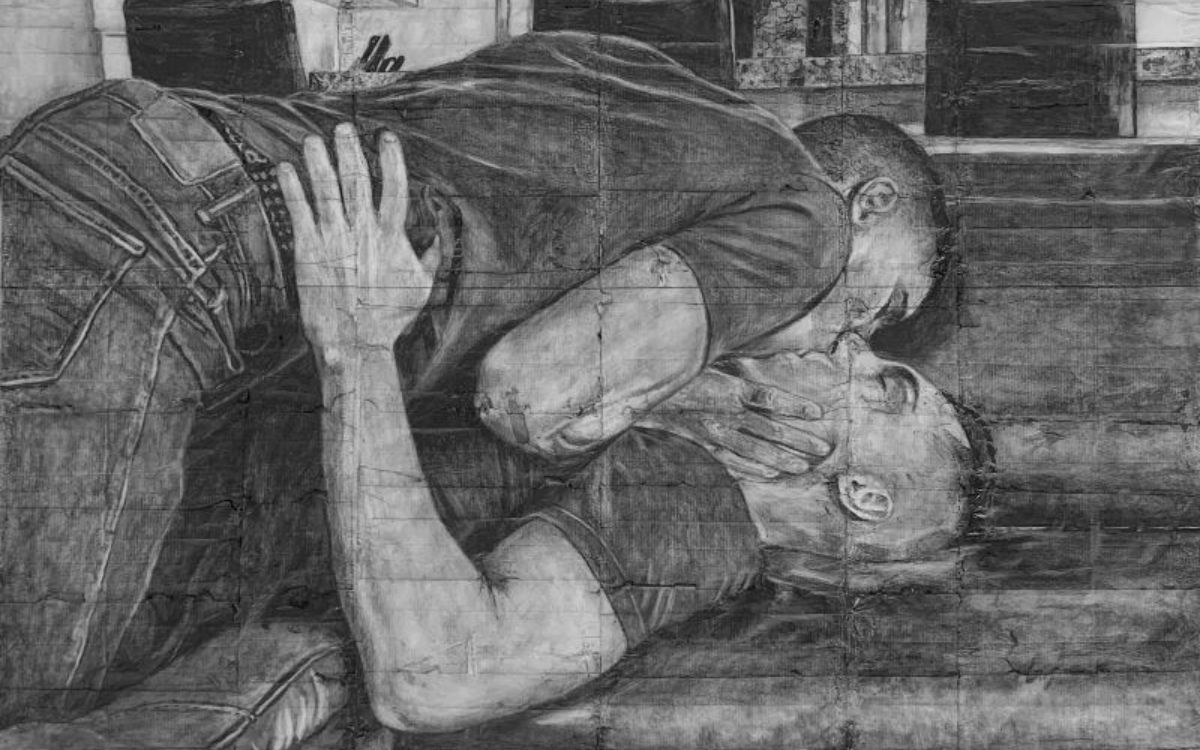
With a practice rooted in introspection, identity, and resilience, James Robert Morisson explores deeply personal narratives shaped by lived experience, class, and queerness. His journey reflects not only a powerful return to art after a long hiatus but also a critical lens on visibility, representation, and the challenges many artists face outside institutional privilege. Drawing from memory, cultural shifts, and the everyday, his work blends technical precision with emotional nuance, offering space for reflection and quiet resistance.
Have you ever felt drawn toward a conventional career path? What made you take the "creative leap" despite the risks?
After graduating from Central Saint Martins in 2002, I worked full-time in the cultural sector for 17 years before returning to an active art practice. This decision was not because I felt drawn toward a conventional career path; I knew from a young age that I wanted to be an artist, and up until that point, this was the career path I was following. This decision was driven by my working-class background and the need for a stable income to repay student debts accumulated during my five years of studying fine art after secondary school. To give this some context, in 2023 less than one in ten visual artists in the UK came from working-class backgrounds. This means that the vast majority of visual artists in the UK come from middle and upper-class backgrounds.
It was always my intention to go back to my art practice as soon as my student debts were paid off, but sometimes life gets in the way, and you have to be realistic and adjust your plans accordingly. My end goal remained the same; it was just going to take longer to achieve it. A few years later, my circumstances had changed and I had the confidence and reassurance I needed to take the “creative leap”. In 2017, I started a new full-time role working for the UK Government Art Collection. One of my key responsibilities was providing Secretariat for the Collection’s Advisory Committee, which approved the acquisition and commission of artworks and advised on policy and stewardship. This role allowed me to view a variety of contemporary artworks and hear the opinions of Committee members, including Directors from institutions like the National Gallery, the National Portrait Gallery, and Tate. This experience increased my confidence as it kept me up-to-date on current and contemporary art practices, taught me to look at and appreciate art in new ways, and enabled me to understand what National Collections, Museums, and Galleries seek in artworks they acquire. After almost two years in this role, I was confident that if I was going to return to my art practice, this was the time to do it. However, this decision would also affect my partner, with whom I had lived since 2014 and entered into a Civil Partnership in 2016, so I needed to discuss it with him first. Thankfully, he loved the idea and really encouraged me to go ahead with it, providing me with the reassurance I needed. So in January 2019, my hours working for the Government Art Collection were reduced to part-time, and I was able to establish a dedicated studio and working pattern to support new development of my creative practice. Although, I should point out that I have always had to work part-time or full-time compressed hours alongside my art practice in order to survive financially. To give this some context, in 2024 research indicated that in the UK only 48% of artists work full-time in their artistic practice, and 52% of artists have to supplement their income from being a practising artist with other work.
What unusual or unexpected sources of inspiration have deeply influenced your work?
In the final year of my fine art degree at Gray’s School of Art (from 2000-2001), I started creating work that reflected on the experience of discovering my sexuality and the journey to understanding and accepting it. Using this intimate and deeply personal experience as subject matter was definitely an unexpected source of inspiration for me as I am quite a private person, and I had only come out as a gay man the previous year. After I came out, it felt like a massive weight had been lifted, which gave me a sense of empowerment and led me to have a stronger sense of self. I was also incredibly fortunate to have family and close friends who were supportive, and I believe that finally being comfortable enough to share my true self with them really strengthened our existing relationships. Looking back at this now, I think after all those years of hiding and suppressing my true self, once I had come out, I had this feeling of wanting to shout about it that stemmed from a desire to be seen, accepted, and celebrated for who I really was, and I believe this explains my motivation to create work that reflected on this personal experience.
After completing my degree at Gray’s School of Art, I moved to London to study for an MA in Fine Art at Central Saint Martins and continued to create work about my sexuality. Fast forward to 2019 when I returned to my art practice, and once again I continued to create work exploring the same subject matter, however I approached it from a different perspective. Coming out as a gay man is a significant step, but it’s a process and not an endpoint. It doesn’t automatically remove the internalised feelings of shame and guilt and it can also be accompanied by new challenges related to acceptance, relationships and societal expectations. During the 17 years I wasn’t creating work, I was building a fulfilling life as a gay man while navigating various challenges and opportunities for growth and self-discovery. The work I have been creating since 2019 no longer shouts about being gay; it now has a touching and nostalgic narrative, aims to normalises non-heteronormative identities, and, importantly, begins to address the lack of positive representation and visibility that I, and many other members of the gay community, did not encounter during our formative years.
How has your artistic style transformed over the years? Are there specific influences, experiments, or moments that marked a turning point?
Both art schools I studied at influenced my artistic style. Gray's School of Art was more of a traditional art school where I developed fundamental skills in drawing and painting. Central Saint Martins had a greater emphasis on self-directed study, which tested and challenged my practice, bringing it into a contemporary critical context. As a result, the style of work I was producing combined traditional drawing and painting with a contemporary critical perspective. Around a year after I had returned to my practice, I found myself thinking about the work I had created while studying for my undergraduate and postgraduate degrees. I came to the conclusion that most of it didn’t demonstrate the best of my abilities or fully express my artistic vision, and more often than not, I didn’t enjoy the process of making it. Working to strict deadlines, receiving negative feedback from tutors, or not meeting their expectations became a source of pressure and anxiety. I also felt that in order to get a good grade, I should follow the advice of my tutors without question and focus on fulfilling the degree requirements. After working independently in the studio for the first time, I realised that most of the joy I found in creating art had been missing during my time studying art. This was a moment that marked a turning point for me as a few weeks later I started the series ‘There is never more than a fag paper between them’, which was a significant departure from my previous work. I hadn’t drawn in such a focused and detailed way since I was around 12 years old drawing animals from my dad's Encyclopaedia Britannica and my favourite pop stars from Smash Hits magazines. Creating this series brought me back to a happy place, where I was drawing simply because I loved to draw, not to impress a tutor or to earn a degree.
Do academic institutions still play a vital role in shaping artists today, or has self-taught creativity disrupted this tradition?
In my opinion, academic institutions still play a vital role in shaping artists today, and self-taught creativity has not necessarily disrupted this tradition but has impacted and influenced it. Ultimately, they both offer paths to artistic development, but they differ significantly in structure, resources, and learning environment.
Academic institutions provide:
structured learning by guiding students through various techniques, art history, and critical thinking and analysis.
expert guidance from lecturers through feedback, mentorship, and opportunities for critique, helping students refine their skills and develop their artistic voice.
a community of artists, opportunities for collaboration, exhibition, and professional connections.
access to studios, equipment, materials, and specialised facilities.
Self-taught creativity provides:
an opportunity to learn at your own pace, focus on specific interests, and develop a unique style without external pressures.
a strong self-discipline, problem-solving skills, and independent learning habits.
a significantly more affordable option compared to the costs of studying at an academic institution.
I think it is important to remember that there is no guaranteed formula for being a successful artist, and just being able to create really great art is definitely not enough; those who are successful have a combination of talent, dedication, business acumen, a wide and varied network, and the ability to adapt to the changing art world.
Is art created for the artist, the audience, or somewhere in between?
Art is created for a variety of reasons. Whether it is for the artist, the audience, or somewhere in-between really depends on the individual artist. Some artists create purely for self-expression, while others create with the intention of engaging or impacting an audience. Many artists find themselves somewhere in the middle, balancing their own creative impulses with the desire to connect with others through their work. Personally, I am definitely an artist who falls into this middle ground, creating work that is both personally meaningful to me and intended for an audience.
How do you respond to debates about the accessibility of art—should it be exclusive, or is it for everyone?
Art can be both exclusive and inclusive, depending on the context and presentation. It is accessible to the public through museums and galleries but remains exclusive to those who can afford it and appreciate it. Contemporary art is often complex, layered, cerebral, open-ended, and subtle compared to traditional art. It is also diverse in terms of medium, subject matter, and form, unlike traditional art which can be categorised into specific styles, movements, and techniques.
More effort could be made to make contemporary art more appealing and relatable to the public, and responsibility for this lies with curators. Some curators focus too much on academic interpretations and historical contexts, which can create a disconnect between art and the audience. On the other hand, there are curators who successfully make art more accessible and understandable to the public. The key to success for a curator lies in finding a balance between academic rigor and accessibility, and in connecting with the audience on both emotional and intellectual levels. As for the public, it may require a shift in mindset for them to become more receptive to contemporary art. Many prefer to invest in luxury items like gadgets, clothes, or cars rather than artwork, perpetuating the perception of contemporary art as elitist.
The digital age has revolutionised the accessibility of contemporary art through the internet and social media. Artists can now easily share their work online, reaching a wider audience beyond traditional galleries and museums. Social media platforms facilitate connections between artists, art enthusiasts, curators, and collectors, fostering a vibrant online art community. Additionally, purchasing art has become more convenient with online galleries and platforms like Instagram offering a diverse selection of artworks for sale. While efforts have been made to make art more inclusive, it's important to recognise that art inherently carries an element of exclusivity. Not everyone is interested in art, and that's okay, as respecting individual preferences and values is crucial in fostering a diverse and inclusive art world.
Have you considered teaching your artistic skills to others? What excites or challenges you about that?
In March this year, I led my first drawing workshop at Cartwright Hall Art Gallery in Bradford, and I found the experience rewarding on many levels. Not only was I able to share my passion, techniques, knowledge, and unique perspective on drawing to inspire and motivate a group of aspiring artists, but it also provided me with an opportunity to gain experience as an art educator and develop my communication and public speaking skills. I would like to lead more drawing workshops, but I am concerned that there won't be enough interest without the support of a public gallery and access to their audience.
I have applied for positions to teach art at higher education, further education and adult education levels. However, the only teaching experience I have is the drawing workshop mentioned above, and this seems to be an issue for potential employers. I don’t have a teaching qualification either, but this doesn’t seem to be as much of an issue as most employers are content for candidates to agree to obtain one within a specific timeframe if they are offered the role. I think my next steps should be to focus on getting more teaching experience and then try applying for any suitable teaching positions that come up.
Informed by years spent both inside and outside the studio, Morisson’s practice carries the weight of stories long untold — drawn not only from his own history but also from collective absences in cultural memory. Through honest observation, skilled draughtsmanship, and a commitment to representation beyond the mainstream, his work invites the viewer to consider what is seen, what is hidden, and what it means to truly be visible.