
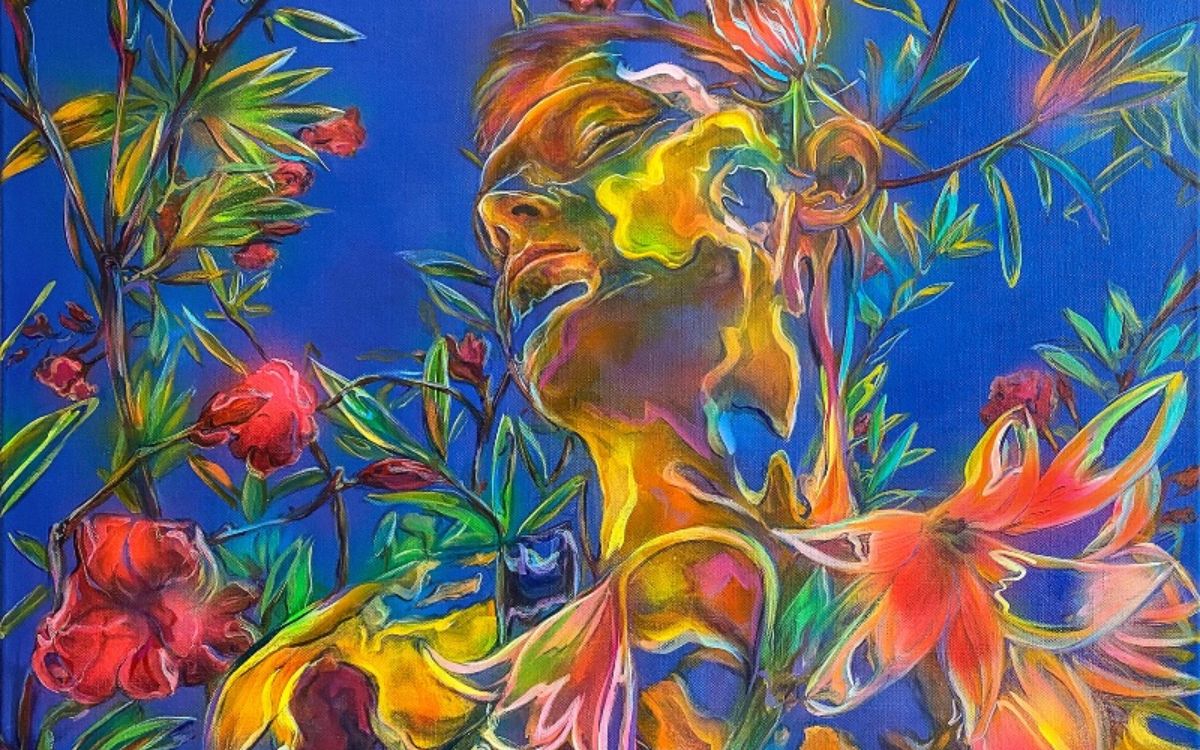
Armin Scheid’s painting practice moves between figuration and abstraction, driven by a deep commitment to experimentation and personal truth. From early experiences of alienation to his later embrace of visual complexity, Scheid’s work reflects a powerful intersection of identity, vulnerability, and energy. Grounded in the belief that “we are all made of stardust,” his paintings speak to a shared cosmic origin while celebrating contrast, transformation, and diversity. For Scheid, painting is not only a visual language but a vital force — one that channels color, tension, and light into works that resonate with both personal and universal meaning.
Can you pinpoint a single moment in your life when you realised art was not just a passion but your purpose?
Art started for me to be a tool of surviving in my early teenage years: Though I was raised in a loving environment I had some severe difficulties to fit in as I was a very atypical boy/ young man who didn’t alligned very much with the requirements on masculinity - neither concerning my abilities nor concerning my willingness to do so. In fact, I was a queer boy in a heteronormative world, without noticing this for a long time. To me, masculinity wasn´t something desirable; it seemed almost stupid or wrong to me, and I preferred the company of girls and women. Besides reading, it was drawing and painting that were my most intense passions, and they turned out to be something like home, like belonging to something broader than my little world in which I grew up, giving my life a meaning where it seemed to be useless.
Though I was always very much aware that art is something I couldn’t cut out of my life, even if I wanted to, it seemed not to be a pro option at first sight: My first studies were art education and I was convinced: When it will be my destiny to be an artist then it will evolve anyways! This decision was a stroke of luck as I had the chance to study with one of the best artists in Germany who also turned out to be a wonderful coach: J.P. Kastner did a great job to recognize and to develop the different strenghts of his students and he - a sculptor, art historian and habilitated art philosopher - also was aware of my painting skills and later introduced me to famous painter-sculptor Norbert Tadeusz who then asked me to be his assistant in the field of sculpture but also provided me with a lot of coaching and impetus towards my own painting journey. Finally, I turned from sculpture to painting while still benefiting from the skills I’ve learned concerning volume and space.
Do you believe an artist’s passion is something destined or a conscious choice?
In fact, though I for sure was talented being an educator, a journalist, a gastronome or for many other things - I had no other choice than being an artist: It´s my destiny! I can’t be anything else in the long run, and I was lucky enough to recognize and accept it at some point in my life when it still wasn’t too late.
If you could communicate just one core message through your entire body of work, what would it be?
We are all made of stardust!
We are all made of the same few basic elementary particles built in a Big Bang billions of years ago. This matrix provides us with endless combinations and it’s the base of our twinkling diverse existence - its an endless process going on and on, if you want it or not. The universe itself is a rector of diversity: Accept it, celebrate it, cope with it and stop demanding for uniformity!
In my paintings I take up this universal energetic tension because I believe it’s inherent anyways in every form of art. I use these very own means of painting to transform it into a firework of contrasting effects. With all this fragmentation respectively particularization going on in my process of creating figuration, in all this opening towards the light, all he transparency, the pushing of the background to the foreground and the other way round, there resonates an existential struggle but also something very serene.
Do you think art should have a political or an ideological agenda?
There is no way to see art not also in a political way, but art and politics are not the same! I am convinced art is closer to philosophy or even to religion than to politics. I think painting is most powerful and touches us most deeply when it draws entirely on its own fundamental means: The exploration of the power of colors and different contrast effects — their luminosity, the magic of sophisticated lighting, the interplay of color values and weightings — all of this belongs to these fundamental means. My work is to bring this forward in my own unique way and to make sure people never get tired of engaging playfully with this visual experience again and again. But why is this a way to touch us so deeply and sometimes cut to the core? My conviction is that there is an analogy between art and the conditions of the possibility for human existence. A composition always captivates us when it builds tension; tension generates energy, and this energy remains stored in the work of art, is almost physically tangible and can be accessed through vision.
How has your artistic style transformed over the years? Are there specific influences, experiments, or moments that marked a turning point?
Over the years, I’ve developed pretty diverse bodies of work and a relatively wide range of switching between figuration and abstraction. I know, for many artists, it works perfectly well to focus on one specific modular way of creating and to conjugate it in any possible way. My approach is another: I need a wide field of experimentation concerning motives, materials and techniques. Yes, I love to reinvent and to surprise! Sometimes, even technical accidents lead to a rich new way of creating.
My current approach is to digitally edit selected works - for example, to mirror and to extend them kaleidoscopically, to print them on jackets, beanbags (aka soft sculptures because they function both as movable/shape changing sculptures in space as well as lounge furniture) and also on giant fabrics. In this way, I already brought my painting „Cosmic Dance“ into space and movement, combined it with giant projections, sounds and professional dancers in an installation-like and performative way.
Do you feel a personal connection to your subject matter is essential? How has this connection shaped your work?
Though I am working in a spectrum between very figurative and very abstract, my motifs always remain figurative! From blooming nature, to beach and pool scenes, to fragile masculinity, it's always deeply connected to my personal history, experiences, connections, joys, fears, questions and wishes. Having a closer look at my „Oleander Darling“-series, we see male beauty surrender to blooming nature, almost dissolving. Most of my models I know personally: They are friends or became friends, or if we haven’t met personally so far, I feel a special connection via social media. All these wonderful individuals have something in common that is a „sweet soul“ aura, and I love them for this. It’s something that shows that there has to be more than just fight and flight mode and that caring, empathy, being kind and showing a certain tenderness, grace, and fluidity are not unmanly or signs of weakness but thriving skills for social development.
How do you envision the evolution of your work in the coming years?
In my more recent installation and performance works, painting will detach itself even further from the wall and be transferred into space. The combination of wall and floor prints with large- and small-format canvases, as well as colored objects, sounds, projections, and dance-based actions, will conquer the space and create an immersive spatial effect like a color landscape or a walkable painting.
Scheid’s practice continues to evolve toward immersive installation, with painting stepping beyond the canvas into space, performance, and sensory encounter. Whether through digitally expanded forms, soundscapes, or embodied movement, his vision remains consistent: to awaken energy, defy singularity, and create visual experiences that honor complexity, joy, and fluid connection. Through each body of work, Scheid invites viewers to engage — not with fixed meanings, but with an ongoing celebration of what it means to be fully, vibrantly human.