
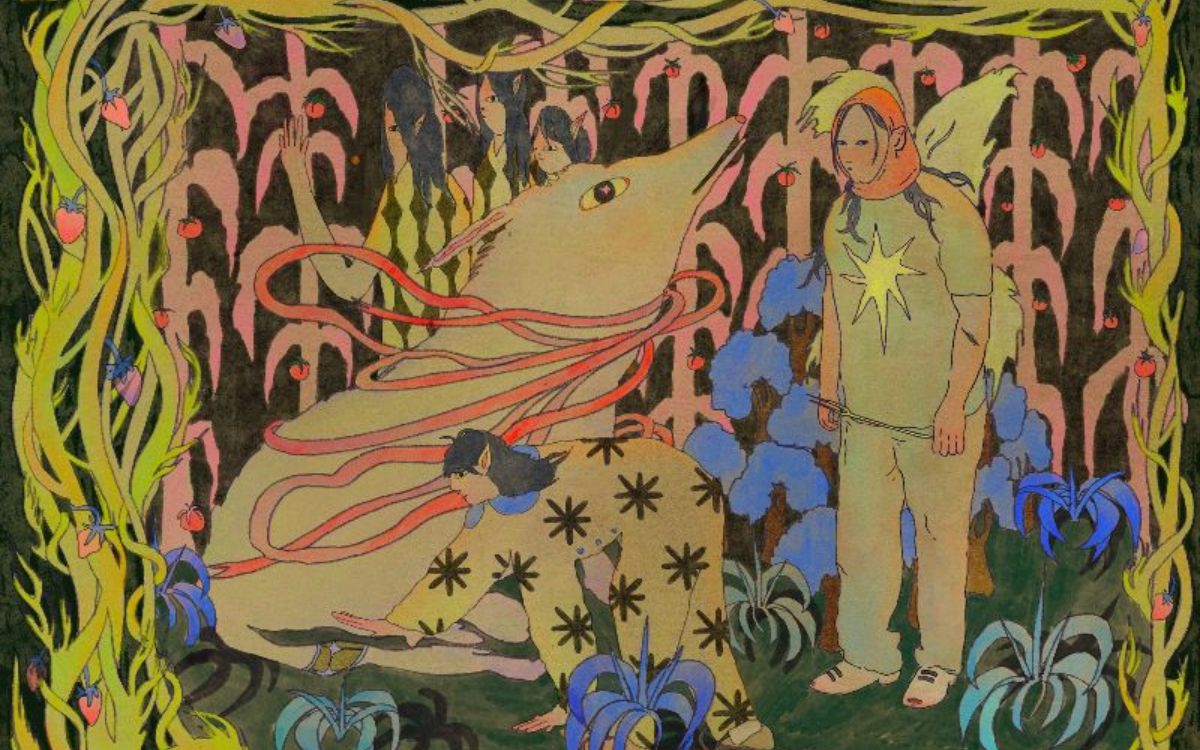
Liv Garber’s world is shaped by a quiet clarity—one drawn from nature, grounded process, and the rhythms of ordinary life. Informed by a deep respect for craftsmanship and a clear-eyed critique of romanticized artistic struggle, the work foregrounds small moments, emotional texture, and environmental awareness. Through line, space, and a deliberate invitation to pause, each image becomes a portal into reflection—hopeful, soft, and deeply considered.
Does spirituality or a connection to something larger than yourself influence your creative process?
Nature is the main thing that makes me feel connected to something bigger, though it’s also a reminder that I’ll never make anything as intricate or perfect as what's already out there. Still, it keeps me making. As I get older, I spend more and more time outside, and nature is this huge amazing source with endless material to pull from, and I’m mostly just trying to keep up with it.
If you could communicate just one core message through your entire body of work, what would it be?
My work tends to orbit around images that feel quietly optimistic and hopeful. I pull a lot from the natural world and the joy of just being alive, even when it’s hard to square that with everything else going on. I’m interested in using drawing to create a kind of open mental space that mimics the strange clarity you get when something mundane suddenly feels significant for no real reason.
How has your artistic style transformed over the years? Are there specific influences, experiments, or moments that marked a turning point?
There were a few key turning points in my practice. The first was right after I graduated. This is when I started to really find my style and my work started to flatten out and move away from any attempt at realism. I used to do a lot of academic-y oil paintings and realized those were not the images I wanted to create anymore. Then in 2023, I became really focused on line quality. I used to gravitate toward very rigid, tightly controlled images, and that structure is still there in some ways. But now, I’ll intentionally slightly shake my hand while drawing to introduce imperfections that make the image feel more lived in. That shift, along with experimenting with different color washes under the images, definitely changed how I approach making work, and it’s way more fun now.
Do you believe the ‘mad artist’ stereotype still holds weight, or is creativity more grounded than we think?
In my case, creativity only shows up when I feel good, am healthy, and have some structure in my life. I tried living the typical chaotic and often difficult ‘artist’s life’ when I was much younger, but the only outcomes were body pain and worse art. I find the ‘mad artist’ stereotype can be a bit dangerous to young artists. We are craftspeople, laborers. We can glamorize that all we want, but caring for ourselves, expecting living wages, and listening to our own intuition is utmost. Artists are made up of workers just like any other profession. Romanticizing unfair treatment and lifestyles born out of struggle can put us in precarious positions. There are so many sources of creativity, but I personally feel most inspired when things are balanced or even kind of boring. That said, everyone’s different. Some people do lean into the “mad artist” stereotype to their advantage as a kind of branding, and others really are a bit unhinged, and that’s great too. I think like any other group or profession, we’ve all got our own thing going on.
Artificial Intelligence is increasingly infiltrating creative fields. Do you see artificial intelligence as a threat, a tool, or a collaborator in the art world?
I’m answering this because I’m sitting through a heatwave right now, and it feels like something that needs to be said. AI sucks—but not because it’s a threat to artists as creators. It is definitely a threat to artists’ wages and artists as laborers, but not to the art itself. Human creativity always looks best. What worries me most, and what’s often overlooked in this debate, is the environmental cost of AI. We’re already starting to feel the effects. I think most all of us just want a stable climate and reliable access to water in the years to come, as well as job security and fair wages. Not using AI right now feels like a win-win; we all get better art, artists can get paid fairly, and we all survive on a better planet. It’s corny, but it’s true, there’s no art without earth!
Name five pivotal lessons you’ve learned that shaped your artistic journey.
take care of your body
be patient
do things before you feel ready
try new things
get bored
Have you considered teaching your artistic skills to others? What excites or challenges you about that?
Right now, I’m teaching an illustration course at Parsons School of Design. Teaching has been one of the most rewarding parts of my work, and it keeps me constantly inspired. There’s truly a magic to being in a room with a bunch of people all figuring things out together with the same interest. It helps me see things differently and is a great reminder that experimentation is kind of the key part of any artistic practice.
From advocating for creative labor to teaching future illustrators, Liv Garber continues to shape not only the content of contemporary visual language but also the values that sustain it. The practice stands as a quiet but firm assertion: the personal is planetary, the slow is radical, and art—at its most essential—is a way to pay attention.