
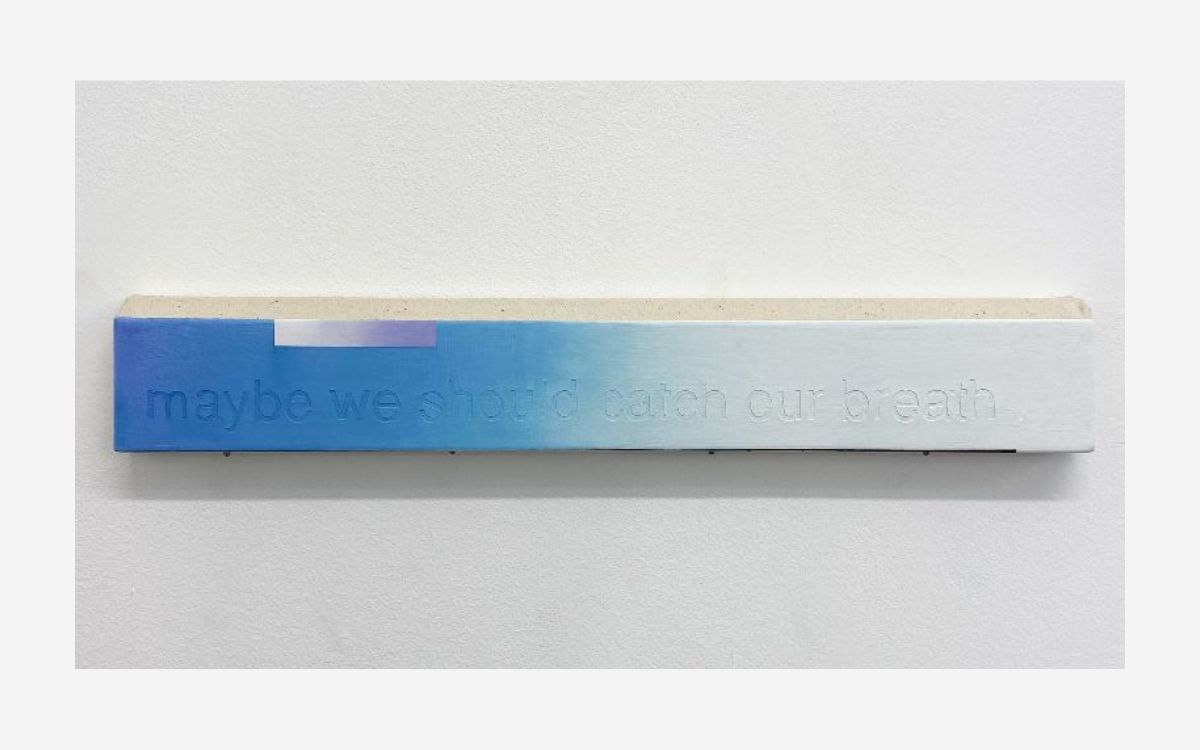
Mimi Lanfranchi’s practice embraces ambiguity, slowness, and the open-ended encounter between artwork and viewer. Rather than offering instant legibility, her paintings invite prolonged looking—unfolding gradually across time, distance, and perspective. Informed by ongoing conversations with fellow artists and a studio community that fuels both reflection and momentum, her work resists rigid interpretation and easy consumption. Lanfranchi makes space for uncertainty, encouraging the viewer to move, question, and discover at their own pace.
How do you reignite creativity during those inevitable periods of self-doubt or stagnation?
I try to keep a few things on the go at once. That way, if I find myself in a rut with one work, it makes it easier to sidestep into something else. Another, and probably the most fruitful, way to lift myself out of these moments is through conversations with fellow artists, both in and outside of the studio. Sometimes all the work needs is an additional perspective.
How important is it for viewers to understand the intended message of your work? Does ambiguity add value, or do you seek clarity in your expression?
We encounter so much visual content in our day-to-day lives, which so often reveals itself all at once. The rise of short-form content has caused a measurable reduction in global attention spans, whilst simultaneously shaping habits, trends and cultural tastes at an incomprehensible rate. I’m not interested in replicating this speed and easy consumability. I am far more concerned with slowing the viewer down, allowing people to move between the surface and form of a work, viewing it up close and from a distance. I want to extend the interaction between the work and the viewer for as long as I can. Ambiguity is such a key player in this. It allows the work to be opened up to multiple interpretations. It’s the space between two things. I’m not keen on rigidity and prefer work which offers itself up as a guide or a set of contradictory signposts. Something open-ended that nudges you toward forming your own route through the work, a tool towards uncovering.
Has there ever been a time when the creative process felt more like a burden than a joy? How did you navigate that?
Often. My practice is slow and laborious. It doesn’t offer abundance. I find joy in my studio community. Discussing my own work, that of my peers and the work we see at shows. Joy enters my practice when I discover something unexpected, something which appears along the path, gathering momentum and picking up speed as it bounds through.
Is art created for the artist, the audience, or somewhere in between?
I’m not sure. I definitely think my own work can be self-indulgent at times and sometimes gets too wrapped up in research or process. However, I am consistently thinking about how the work will be encountered by others and how I might shift the expectations of that encounter. Making the audience move around the exhibition space in a way they might not normally, or behave differently with one painting than another. This means that the way I install my work becomes particularly important.
What if the painting is hidden in plain sight, above a skirting board or resting on top of a power outlet? Or is so small that is goes unnoticed or blends into its surroundings? Could it be installed so precariously that the audience feels worried or curious or wary? I love to play with the audience. I think it’s especially important when making paintings. There can be an expectation that a painting behaves in a certain way and in turn, directs the viewer in a particular way. I’m keen to shift that. The paintings are both performative to make and performative to be with, relying on the body of the visitor to (re)activate them.
Can you take us through the evolution of an artwork, from that first spark of inspiration to the finished piece?
Every work is different. My work can be slow to come to fruition, so I often have multiple things happening at once in the studio. I might be simultaneously working on finding the best mode of display for one work, whilst building research for another. It can be hard for me to let go of the work and accept when it's finished, or at least when it's finished with me. This means the work can end up hanging around the studio for months before I accept that it's ready to go out into the world. At any time, I might have two paintings on the go, a drawing on the desk and another two works resting. Sometimes I think it needs that time to settle. The energy of making an artwork can be quite intense, so sometimes that cooling-off period is really important.
How do you feel social media is shaping the way art is created, consumed, and valued today?
Art making doesn’t happen in a vacuum and therefore is influenced by the things which shape our daily lives. Social media is evidently a huge part of that. I’m interested in making paintings which resist digital documentation. This inevitably makes it hard to share the work online. When that feels like an important part of allowing other people to see the work, it can feel contradictory and frustrating. However, it is only a problem I’ve made for myself, and I love that the paintings reveal themselves when experienced in the flesh. All too often, I visit an exhibition and hardly spend any time with the work because I feel as if I have already encountered it online. This can really ruin the viewing experience for me, so I try to resist looking at the visuals of a show before I visit.
How do you approach criticism, whether from peers, critics, or audiences?
Criticism is one of the most important parts of making art. It means that people are engaging with your work and asking questions that they can’t immediately find the answers to. It serves as an opportunity to exchange, challenge, and refine perspectives and ideas. Everyone brings their own unique context, life experiences, and references to the work. For me, one of the most rewarding aspects of criticism lies in the unpredictability of its influence. I can’t control how any one person might experience the work, nor would I want to. Sometimes, the feedback I receive aligns with my thoughts and at other times it might take the work in a completely unexpected direction.
Mimi Lanfranchi’s work doesn’t demand attention—it invites it slowly, deliberately. Rooted in process and patient observation, her practice challenges the accelerated rhythms of digital culture by creating space for ambiguity, conversation, and physical presence. Whether lingering in the studio or installed with unexpected intimacy, her paintings resist fast consumption and ask viewers to look longer, return often, and remain open to what shifts. It is in this quiet, durational exchange that her work resonates most deeply—always in motion, never complete without the viewer’s part.