

In this candid and insightful interview, Lina Coy, a multidisciplinary artist with a background shaped by migration, takes us through the deeply personal journey that influences creative expression. Having lived in four different countries—Colombia, Chile, Spain, and the United States—art is profoundly influenced by the constant movement and adaptation inherent in the migratory experience. Coy describes how walking and deliberately getting lost—both literally and metaphorically—fuels inspiration and shapes the artistic process. Through the work, emotions and stories that resonate universally are captured, crafting a connection with the audience rooted in honesty and vulnerability. The journey is a testament to how observation, reflection, and a commitment to authenticity can shape a unique artistic voice.
Coy also opens up about the duality of creating art—balancing raw emotional expression with the disciplined application of technical knowledge. Art is viewed not as a singular act but as a multifaceted process, blending observation, experimentation, and introspection. Inspirations come from the world—stories found in everyday scenes, fleeting moments, and reflections uncovered in others. This interview offers a glimpse into how personal experiences, creative philosophies, and openness to evolution inform a multidisciplinary practice.
How has your upbringing and cultural background influenced your artistic journey and creative expression?
I’ve been considering myself an immigrant for the last 8 years. During these years, I’ve lived in four countries: Colombia, Chile, Spain and the United States. I’ve realized that to be an immigrant affects immediately my artistic process. Every time I settle in a new country, I observe. I become curious/amazed/dazzled with the new surroundings. I’m like a child trying to figure out life. That directly affects the way I perceive my art. The artworks that I make and the routines I create are a response to the environment I’m living in. Every time I move away, I’m aware of new things inside my particular creative expression. Like walking and getting lost.
My art begins in walking and getting lost. When I’m overwhelmed, I feel the need to get out my comfort zone and get lost. I get up from the couch and just walk outside. As an immigrant, you always have the curse of not being sure where you’re going to. You’re always expectant of what’s happening around you. I like to get lost (literally and metaphorically) because you always find a new something: a new way of getting there, a new destination, a new response to the survivor mode. While getting lost you can be constantly amazed and therefore inspired. This state of mind then develops into my art. I have the privilege of creating images out of reflections and emotions and as true as they are, they connect with others.
Discuss the importance of messaging in your art and the audience’s understanding of it. How crucial is it for your audience to grasp the message behind your artwork? Do you create with a specific message in mind, and how do you gauge its reception?
I don’t think I create my artwork with a specific message to be understood but I definitely create with the purpose of telling a story, and in terms of storytelling, there can only be some outcomes to the story I want to tell. It’s essential for me to tell my own vision of the story, even if I didn’t live it. The story has to go through me in order to be honest, therefore believable. Whatever I want to say, goes through my emotions and thoughts, I own it as much as I can, that’s how I make sure that the emotions that my artwork awake are pretty much closer to mine. Honesty is really important to me in terms of creative process. I know before hand that if I’m honest in the creation of my pieces with how/what/why I’m creating something, I’ll be able to reach more audience.
It also builds an identity in my images. I get attached to my artwork during its creation and I engage myself emotionally as much as I can. Because if I went through that situation, I’m aware that I can’t be the only one in the world going through such. And that similarity will eventually reach whoever it needs to reach. We build community through perception, empathy and compassion. My vulnerability inside my art is a space for someone to be vulnerable with me. I can’t control the reaction of my artworks, but I can display my emotions and hope for somebody else to feel at least remotely the same. I don’t aim for a precise message to be shared or understood, I aim for the reproduction of a feeling. The thing you can’t explain why you feel draw to a sound, picture or a face. We are human beings with multiple emotions, stories and contexts but human beings either way: we are sensible, irrational, instinctive, beings. Rather to impose what I want to say, I make very clear how I feel or felt. And art is the primary medium to do that in the most accurate way.
Elaborate on the creative process: is it an outpouring of the soul, a free flow of the mind, or a combination of both?
It’s a combination of both. We are beings with particular emotions. The humanity is a gift. But being able to analyze and be rational about our feelings is a treasure. For me, there’s a point in the creative process where you’re connecting with your most inner self. The moment of creation becomes a meditation, a therapy, a safe time and place to develop your raw emotions. But an artist knows how to handle both sources. An artist is not only leaded by a feeling, we search into our technique knowledge in order to find the most effective way to show it. You let yourself go, but at the same time you’re aware that there are expectations to fulfill. And that expectation doesn’t have to do with the spectator but with yourself. You know how the medium you’re using is supposed to look and react. And even so, you can’t inhibit your instinct to experiment and play with the medium just because it’s not reacting the way you already know it has to be. As an artist, it’s important to learn the balance between mind and soul to guide the emotion you’re experiencing into something more.
Share your sources of inspiration. What are your primary sources of inspiration? Do these come from personal experiences, observations, history, nature, or other artists? Can you give specific examples of how these inspirations have manifested in your work?
My primary source of inspiration are my surroundings. I let myself be constantly exposed to every wonder I can find. Wandering around I’m able to detail every little thing I observe. I believe that you can find a story everywhere: a bird flying through the sunrise, a loner sitting on a bench, clouds intertwining into forms. There are devices of lingering in every corner. But you must be open to find a story, immerse yourself in it and mold it through inner emotions. This can also be brought to other artists. An artist must remain humble and appreciate the point of view of others. I don’t know everything, which means, there is somebody out there who knows what I don’t. Every human being has their own particular process, you have to be open to learn from others; and that includes artists, nature, people, animals, or even objects.
My work is something very poetic for me. I like to observe under every circumstance. If I’m driving and I find something or somewhere to admire, I’ll just pull over and sit on a rock to watch. If I’m drawing and I’m thinking a very specific thought, I’ll stop and write it on the drawing. I’m thinking and analyzing all the time, and I’m not afraid to use it as part of my creative process. There’s a certain beauty in observation and to be able to build a story or an image from it, it’s poetry for me. I appreciate every little thing that’s around me. But I’ve also came to the realization that it is a result of being a wanderer. When you don’t have somewhere to call it home and you’re constantly walking or traveling around, you get attached to the most peculiar things. To be in constant movement represents inspiration for me: whatever moves the soul will move the body and mind.
List five key insights or lessons you wish you had known when you started your artistic journey.
Discipline: a human being can have an ease to paint/draw/sing/write/perform but it won’t become truly an artist until they desire to learn/explore/be curious about their technique or way of developing their sense for art.
Modesty: an artist has to be able to be humble about their pieces and processes in order to grow and explore. I’ll consider my self a dead artist in the moment I feel settle down with my processes.
Play: the key to improve as an artist is to remain playful in the process, enjoy the moment of creation and leave expectations behind. The ability to play while creating is harder than it seems.
Identity: rather to search for a specific style or technique to be categorized in, an artist should always be true to themselves, don’t please others, do what you actually want to do.
Honesty: a connection can be easily made with something honest to look at, the spectator can’t be fooled, they’re going to develop a feeling for a piece that was made out of a real emotion.
If you could become one of your creations or characters for a day, which would it be and why?
“I apologize for every scream you've got” was a piece I made based on a conversation I had with a really close friend. Until that moment I didn’t know that the only thing I needed was an apology. I wasn’t able to give it to myself and I never had an apology from anybody that ever hurt me. My friend granted me the apology I needed; despite she was never involved in my injuries. I started crying and felt seen/hugged/loved, I immediately felt the need to draw. This piece was made from little pieces of emotions, trying to rebuild myself again after being in such a vulnerable state. It’s one of my rawest pieces, it’s nostalgic but healing, tragic and beautiful. It’s a contradiction and the perfect display of the honesty I’m always demanding art wise. I’d like to habit in that image every time I’m feeling overwhelmed, anxious or simply struggling. It’s a reminder that I can hug myself through my art and that’s the primary emotion I’d like to portrait in my artwork. How I went through a blunt emotion and was able to detangle it with pencils, oils and the mediums I had at the moment, like the withered flowers. It’s a demonstration of how I’ve been pushed to restore myself several times with little pieces of everything.
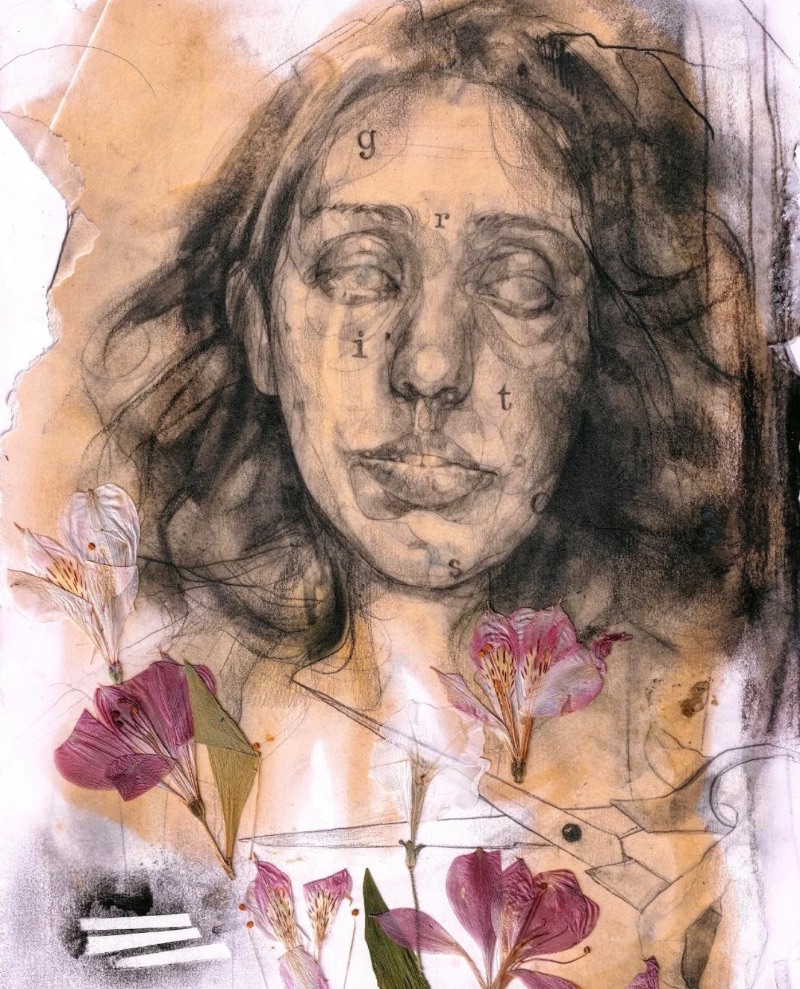
"I apologize for every scream you've got", 2023
Can you recall a specific instance where someone's unique interpretation of your artwork provided you with a new perspective or insight?
More than recalling a specific moment, I think it was an awakening for my process when someone told me that all of my portraits looked like me. It made me thought about the reflection of me in others. When I’m observing someone else, detailing every single scar and scratching every single story, I’m inevitably inserting me in them. To me, a portrait becomes a reflection of myself and how I end up perceiving myself while I’m seeing the other person. If I’m completely invested in pausing and contemplate the other, I begin a process of mindfulness where I can’t help but looking inside of me. It's a pure act of analysis, not only with them but with me. I wasn’t aware of how much that gazing affected in my process of being a portrayer until someone brought it up to me. It’s a double-edged tool. Because my purpose isn’t to invalidate the act of observing someone by imposing a likeness with the face I’m most familiar with (mine), but that reflection is a powerful method that I can’ just ignore. Hence, it’s nice to be aware of that thin limit that can be broken so easily.
How do you think social media platforms influence the way art is created and perceived today?
The art world is based on connections. With the spectators, the buyers, the galleries, fellow artists, etc. I don’t know how significant art would be without the otherness. Because what is really the purpose of art if is not to be shared? Not necessarily to be show around but just to put it out there. Art is just like talking communication wise. Is a word really said if it’s not heard, written or seen? Social media should be considered an efficient, fast, barrier-breaker communication tool. It does come with a lot of pressure. The likes, the audience, the views, the reaching. But it shouldn’t be different than a live show case. You shouldn’t be creating in submission of it. Of course, there’s the thought of ‘if I don’t keep up with certain rules then I won’t be seen, and if I’m not seen then what’s the point of sharing your art in social media?’. But it’s just part of creating an identity as a contemporary artist. Would you really stop creating art if it’s not showcased in a gallery? Social media for sure makes you think, doubt and hesitate, but it’s just an extra question inside the art process, it builds confidence and knowledge. If social media it’s purely perceived as a virtual tool of showcasing and connecting there shouldn’t be anything wrong to use it consciously.
Over the years, I’ve made incredible connections with fellow artists and viewers, which allowed me to grow as an artist. Social media gives me the privilege to also witness their struggles, studios and processes. It grants a sensation of humanity. When a particular artwork inspires you and blows your mind away, you’re mesmerized and think of it as a master piece. Which is great. But social media allows you to see the human being behind the artwork and it makes you realize that as artists we’re all going through similar battles. That sensation also translates to the viewers. That humanization of the artist grants the spectator the opportunity and confidence to reach out or to ask more personal questions, and that vulnerability eventually turns out into gaining more engagement to your artwork while enriching your path as an artist.
How do you envision the evolution of your art in the coming years?
My art has evolved into many shapes over the years. I studied music for at least 10 years before getting myself into the visual art world, so I’ve always had a tendency to explore different medias besides painting or drawing. My fascination with the different expressions of art got me into the multidisciplinary world. I’ve always believed that the categorization of the art is made to be broken. Why do I have to call myself a painter, a musician or a dancer? I’m aware that when you classify yourself into a discipline it allows you to investigate/grow/expertise in that specific something but I also think that it may inhibit you from exploring outside that medium. That need of colliding worlds and art expressions led me to develop a preference for the mix media in my artwork. I’m constantly defying myself. What happens if I write while I’m drawing? What happens if I paste salt on my paper? What happens if I draw with vegetable oil? On and on.
I envision my art for the upcoming years to remain playful and coherent with my emotions. I want to be constantly learning different ways of storytelling. I’d like to explore creative writing, performance, sound painting, figurative drawing. I want to try different mediums and combine them all inside my artistic process, so I can choose the proper one to say what I want to say.
Reflections on the balance between instinct and discipline, and the integration of diverse mediums, illustrate an artist constantly evolving. Dedication to connection—both with the self and the audience—underscores the transformative potential of art. As new forms of expression are explored, the work remains a testament to the idea that authenticity and openness are at the heart of meaningful creativity. This conversation invites reflection on the ways art can serve as a bridge between inner worlds and the shared human experience.